

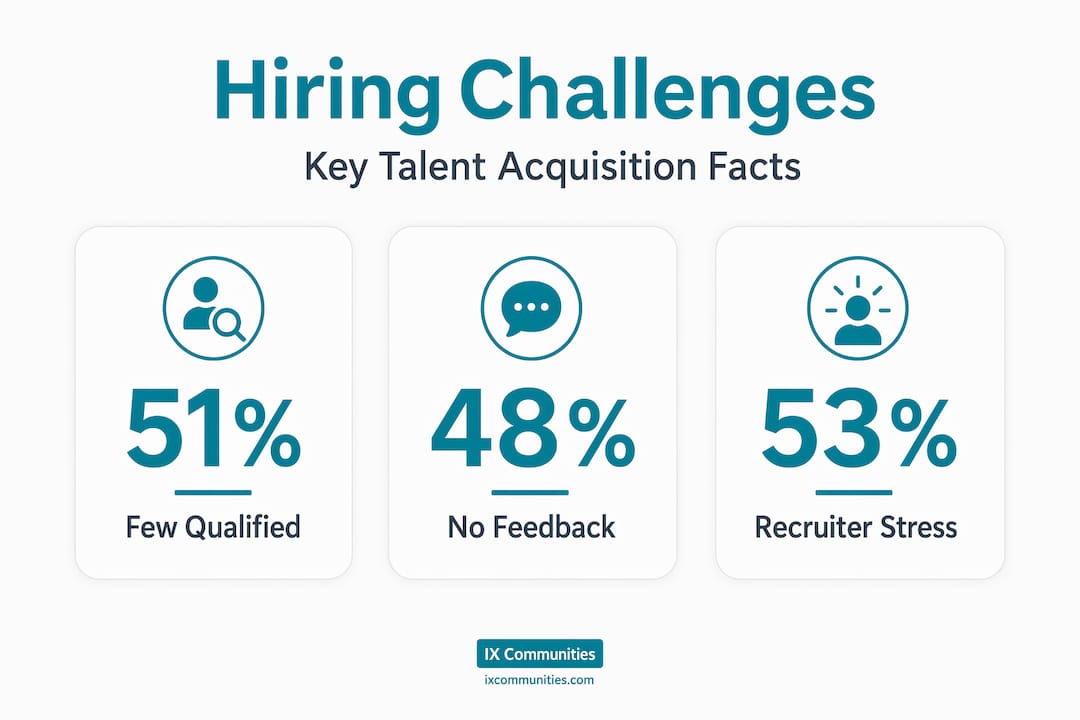
The biggest challenges talent acquisition teams face today are not what most hiring leaders expect. The assumption that more applicants solve the problem is widespread, but the real obstacles are quality, process speed, and competitive pressure. 51% of employers cite too few qualified applicants as their top recruiting challenge, not too few applicants overall. For TA professionals at mid to large organizations, understanding the actual barriers and what to do about them is the difference between consistently filling roles and losing top candidates to faster-moving competitors.
Table of Contents
- Key takeaways
- The talent shortage paradox
- Process inefficiencies and candidate ghosting
- Competitive pressures and shifting candidate expectations
- AI adoption and governance risks
- Practical strategies to overcome hiring obstacles
- My perspective on where TA focus needs to shift
- How Ixcommunities supports TA teams facing these challenges
- FAQ
Key takeaways
| Point | Details |
|---|---|
| Quality over quantity | Most hiring pipelines have volume but lack qualified, job-ready candidates due to skills gaps. |
| Speed is a competitive tool | Top candidates leave the market within 10 days; internal processes averaging 40+ days create serious risk. |
| Ghosting reflects process gaps | Candidate ghosting is largely a symptom of slow communication and impersonal hiring stages, not candidate behavior. |
| AI governance matters | AI improves sourcing efficiency but requires clear policies and human oversight to avoid compliance and quality errors. |
| Relationship recruiting wins | High-performing TA teams manage pipelines as ongoing relationships, not one-time transactions. |
The talent shortage paradox
Despite high application volumes in many sectors, qualified applicant pools remain shallow. The disconnect between raw applicant counts and actual hiring-ready talent is one of the most persistent talent acquisition hurdles facing corporate TA teams.
Several factors drive this:
- Skills mismatch. Technology and AI have changed role requirements faster than the talent market can adjust. A posting for a senior data analyst today often requires a combination of skills that didn't coexist in most candidates three years ago.
- Evolving job specifications. Roles are more complex. Hiring managers frequently update requirements mid-process, narrowing an already limited pool.
- Limited internal pipelines. Many large organizations still treat internal mobility as secondary to external hiring, leaving qualified internal candidates undiscovered.
- Low applicant-to-role ratios. With an average of 31 applicants per open role, there is very little margin for process inefficiency or poor screening practices.
The response from leading TA teams has been to invest in upskilling internal candidates and building proactive talent pipelines before roles open. Reactive sourcing, where you post and wait, consistently underperforms in this environment.
Pro Tip: Audit your last 20 filled roles and track how many hires came from proactive pipeline activity versus inbound applications. The ratio will tell you where your sourcing model is actually working.
Process inefficiencies and candidate ghosting
Speed is not a nice-to-have. It is a structural requirement. Top candidates exit the market within 10 days on average, while most enterprise hiring processes still take over 40 days from first contact to offer. That gap accounts for a significant share of lost hires that TA teams rarely diagnose correctly.
The current hiring difficulties around ghosting compound this problem. 41% of employers report candidate ghosting as a top concern. The instinct is to attribute ghosting to candidate behavior, but the data points elsewhere. Latent hiring process steps and poor recruiter responsiveness are the primary drivers. When candidates go silent, the process often failed them first.
Here is where the most common breakdowns occur:
- Delayed feedback loops. When recruiters take five or more business days to respond after an interview, candidates reasonably assume they are no longer in consideration and accept other offers.
- Generic communication. Templated status emails with no specificity signal low engagement. Candidates notice, and it affects their interest in the role.
- Unclear next steps. If a candidate does not know what happens after their interview or when they will hear back, anxiety increases and competing offers become more attractive.
- Handoff gaps between recruiters and hiring managers. Delays frequently happen not in sourcing or closing, but in the middle of the process where accountability is ambiguous.
48% of entry-level candidates report not hearing back after applying as their single biggest frustration. That is not just a candidate experience issue. It is a direct cost. Every unresponsive touchpoint reduces the probability that your preferred hire stays engaged through offer.
Process discipline and execution speed within TA workflows matter more than sourcing volume for successful hires. Fixing internal handoffs and communication timing is often the highest-return change a TA team can make. For a deeper look at reducing time-to-hire without sacrificing hire quality, the executive search benchmarks at Ixcommunities provide a useful reference point.

Competitive pressures and shifting candidate expectations
The obstacles for talent teams extend well beyond the internal hiring process. The external market adds its own complexity. 50% of employers identify competition from other employers as a primary challenge, and that competition has shifted from simply offering more money to offering a better total package.
Key pressure points include:
- Compensation gaps. Candidate salary expectations frequently exceed employer budget ranges, particularly for technical and strategic roles. The gap is widest in markets where demand for specialized skills outpaces supply.
- Return-to-office mandates. Organizations requiring full-time in-office attendance are competing against a smaller candidate pool. The candidates who do apply often expect a meaningful pay premium to offset the loss of flexibility.
- Meaningful work expectations. Particularly among candidates with in-demand skills, job purpose and career development weight heavily in acceptance decisions. Compensation alone does not close the gap.
- Speed of competing offers. When a competitor can move from first interview to offer in seven days, a 40-day process is not a fair competition.
Employers are now focusing hiring growth on strategic roles rather than broad headcount additions. This precision hiring approach puts even more pressure on TA teams to get high-priority roles right the first time.
AI adoption and governance risks
Artificial intelligence is changing how TA teams source, screen, and communicate with candidates. The efficiency gains in early-funnel work are real. However, the issues in talent acquisition tied to AI are equally real and often underestimated.
| Area | AI benefit | Governance risk |
|---|---|---|
| Sourcing | Faster candidate identification | Qualification errors from poor training data |
| Screening | Consistent criteria application | Bias in automated scoring models |
| Communication | 24/7 candidate touchpoints | Impersonal tone reducing engagement |
| Compliance | Audit trail creation | EU AI Act and local labor law complexity |
AI adoption in European TA teams is less about tools and more about building operating models that balance speed, governance, and compliance. The 12 to 18 month operating-model gaps that delay effective AI integration are not technical delays. They are governance and change management delays. Teams that skip the operating model work suffer the most visible failures. For context on how EU compliance affects hiring operations, the regulatory requirements add meaningful operational complexity that TA leaders cannot ignore.
Beyond compliance, candidate perception of AI matters. When candidates feel they are interacting with a fully automated process, engagement drops. AI introduces a second layer of risk where governance frameworks with human oversight are vital to maintain hiring quality. The solution is not to avoid AI but to position it correctly within a human-led process.
Pro Tip: Before deploying any AI screening tool, document what decisions it makes autonomously versus what it recommends for human review. That boundary is your governance framework, and it should be written down before the tool goes live.
For a more detailed analysis of where AI falls short in recruiting contexts, the Ixcommunities post on AI in executive recruiting covers the practical gaps that most vendor materials do not mention.
Practical strategies to overcome hiring obstacles
Knowing the challenges is step one. Applying specific changes to your recruitment strategies is where real improvement happens. Here is a prioritized set of changes that high-performing TA teams are using in 2026:
- Audit recruiter response times. Pull data on average response time after each hiring stage. If the number exceeds 48 hours at any stage, you have a fixable bottleneck that is costing you candidates.
- Qualify earlier and faster. Move structured qualification conversations to the first 72 hours after application. Accelerating qualification and reducing delays between stages yields the highest return when volume is not the bottleneck.
- Formalize hiring manager handoffs. Set a defined service level agreement between recruiting and hiring managers. When a candidate is submitted, the hiring manager has 48 hours to respond. Unenforceable expectations create the largest delays.
- Rebuild compensation benchmarks quarterly. Annual compensation reviews are too slow for current market conditions. Quarterly adjustments tied to live market data reduce offer rejection rates.
- Shift sourcing toward relationship management. Top TA organizations treat recruiting as continuous relationship management, not transaction-based sourcing. Maintaining warm pipelines of qualified candidates before roles open cuts time-to-fill significantly.
- Apply AI with documented human oversight. Use AI for sourcing and initial screening, but require human review before any candidate is advanced or rejected.
53% of recruiters report increased stress affecting candidate experience and responsiveness. Addressing workload and process clarity is not just an HR issue. It directly impacts whether your candidates stay engaged or drop out.
My perspective on where TA focus needs to shift
I've spent considerable time working with corporate talent acquisition leaders across large organizations, and the pattern I keep seeing is that teams optimize for what they can measure most easily, which is volume. Resumes reviewed, calls made, offers extended. These numbers feel like progress.
What I've learned is that the teams consistently filling critical roles faster than their peers are not the ones with the most sourcing capacity. They are the ones with the tightest process discipline. They know their average response time by stage. They have a defined handoff protocol between recruiters and hiring managers. They do not wait for roles to open to build relationships with high-value candidates.
My concern about AI is not that it is being used. It is that many teams are deploying it to paper over process problems rather than to extend a healthy process. AI on top of a broken workflow produces faster broken results.
The shift I'd encourage is from measuring recruiter activity to measuring process velocity and candidate conversion at each stage. That data will tell you exactly where candidates are dropping out and why. When you fix those stages, the results follow.
— Simon
How Ixcommunities supports TA teams facing these challenges
Recognizing the specific pressures TA leaders face is exactly where Ixcommunities operates. ESIX, TLIX, and IXCommunities provide a secure, peer-driven environment where corporate talent and recruiting leaders share benchmarks, compare strategies, and access expert-led training.
If your team is working through the challenges outlined in this article, the ESIX Recruiter Peer Mentorship Programs offer structured mentorship specifically designed to build recruiter capability in areas like process optimization, candidate communication, and AI governance. The benchmark surveys provide data-driven context so you can compare your team's performance against peers at similar organizations. For broader access to events, tools, and expert resources, IXCommunities membership connects you with the talent leadership community solving these exact problems.
FAQ
What is the top challenge for talent acquisition teams right now?
The most common challenge is finding qualified applicants, with 51% of employers citing too few qualified candidates as their primary obstacle, not overall applicant volume.
Why are candidates ghosting employers during the hiring process?
Candidate ghosting is most often linked to slow response times and impersonal communication from recruiters, not candidate disengagement. Fixing internal process delays addresses most ghosting issues.
How does AI affect talent acquisition risks?
AI improves sourcing speed but introduces governance and compliance risks, particularly in markets with tightening regulations. Teams need documented human oversight policies before deploying AI screening tools to maintain hiring quality.
How can TA teams compete when salary expectations are too high?
Updating compensation benchmarks quarterly using live market data reduces offer rejection rates. Flexibility, career development, and clear role purpose also carry significant weight for candidates with in-demand skills.
What is the most effective way to reduce time-to-hire?
Accelerating early-stage qualification within the first 72 hours and formalizing recruiter-to-hiring manager handoffs consistently reduces time-to-hire without lowering hire quality.