

Collaboration of talent acquisition and executive search in organizations is defined as the strategic integration of internal recruiting teams with external executive search partners to produce better leadership hiring outcomes. When this integration works, organizations move from reactive, role-by-role searches to a continuous model where talent intelligence, candidate pipelines, and hiring decisions are shared assets. Tools like LinkedIn Recruiter, hireEZ, and Gem support this model by giving both internal and external teams access to the same market data. The most effective organizations treat this not as a vendor relationship but as a structured partnership with defined roles, governance rhythms, and shared accountability.
What are the key collaboration models between talent acquisition and executive search?
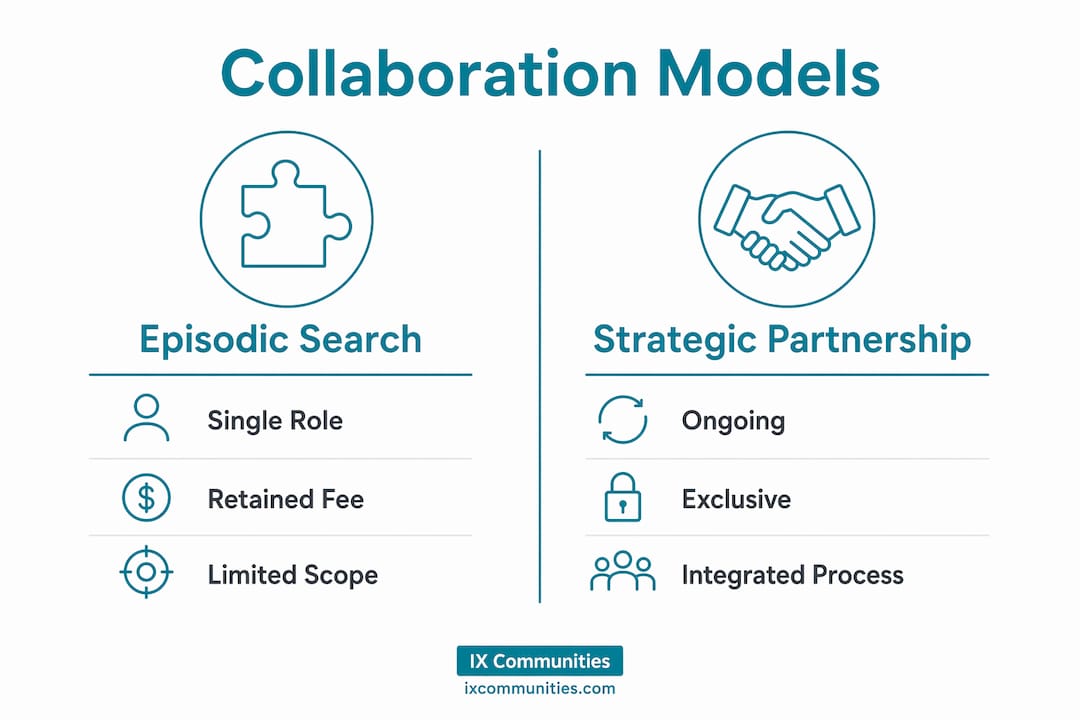
The two primary operating models are episodic retained search and ongoing strategic partnerships. Each has a distinct structure, fee logic, and collaboration depth.
In the episodic retained model, an organization engages an executive search firm for a single mandate. Retained search fees are typically split into three installments: roughly 33% at engagement launch, 33% at shortlist delivery, and 33% upon offer acceptance, regardless of whether a placement occurs. The standard fee is approximately 33% of the placed executive's first-year total compensation. This structure creates shared financial commitment but limits collaboration to the duration of one search.
The strategic partnership model operates differently. According to the partnership operating model, effective executive search partnerships are built on seven pillars, including continuous talent intelligence, quarterly business reviews, and post-placement integration. These pillars convert episodic mandates into long-term advisory relationships with recurring value on both sides. The hiring organization gains a partner who understands its culture, priorities, and leadership gaps. The search firm gains the context needed to deliver faster, more accurate results.

| Dimension | Transactional model | Partnership model |
|---|---|---|
| Engagement scope | Single role, defined timeline | Ongoing, multi-role, advisory |
| Fee structure | Per-placement retained fee | Retainer plus milestone fees |
| Talent intelligence | Role-specific only | Continuous market mapping |
| Governance | Ad hoc check-ins | Quarterly business reviews |
| Post-placement support | Minimal or none | 100 to 120 day onboarding support |
Pro Tip: Before selecting a search partner, ask specifically how they structure quarterly business reviews and what post-placement support looks like. Firms that cannot answer in detail are operating transactionally, regardless of what they call themselves.
The partnership model requires exclusivity from the hiring organization during active searches. That exclusivity is not a constraint. It is the mechanism that allows the search firm to invest deeply in market mapping and candidate engagement rather than hedging across multiple clients.
How to operationalize effective collaboration: processes and role definition
Effective collaboration requires crystal-clear role definitions and communication protocols that integrate internal TA and external search partners without creating accountability gaps or process friction. Without this clarity, candidates receive inconsistent messaging, internal teams duplicate outreach, and hiring managers lose confidence in both parties.
The following role boundaries work in practice for most organizations:
- Internal TA team: Owns employer brand, candidate experience standards, offer logistics, ATS management, and compliance. Acts as the primary interface with hiring managers for role definition and approval workflows.
- Executive search partner: Owns market mapping, passive candidate identification, outreach strategy, and candidate assessment. Provides competitive intelligence and compensation benchmarking as part of the engagement.
- Hiring manager: Defines success criteria, participates in structured briefings at engagement launch, and provides timely feedback after each candidate interaction.
- HR business partner: Coordinates succession context, internal candidate consideration, and post-placement onboarding planning.
Embedding search recruiters within the client's ecosystem, rather than keeping them at arm's length, produces a unified candidate experience and eliminates the handoff friction that derails most searches. Practically, this means shared access to relevant ATS records, joint candidate debriefs, and a single point of contact for candidates throughout the process.
Technology platforms matter here. Shared CRM access, whether through Greenhouse, Workday, or a dedicated executive search platform, gives both internal and external teams visibility into candidate status, feedback, and timeline. This is not about surveillance. It is about removing the information delays that slow decisions.
Pro Tip: Document your collaboration model in a one-page operating agreement before the first search begins. Define who communicates with candidates at each stage, who owns the offer conversation, and how conflicts are escalated. This document prevents 80% of the friction that derails search partnerships.
Retained search timelines typically run 60 to 120 days from engagement to placement. That timeline requires coordinated decision gates between internal TA, hiring managers, and the search partner. Delays at any gate compound quickly. A two-week lag in interview scheduling can push a search past a critical business window.
Leveraging ongoing talent intelligence for smarter executive search collaboration
Talent intelligence is the practice of continuously mapping the external market for leadership candidates, compensation data, and competitive movement. It is not a one-time activity conducted at the start of a search. The most effective talent intelligence cadence includes quarterly market mapping, competitive benchmarking, and compensation data gathering that informs both search prioritization and offer strategy.
Tools like Gem, hireEZ, and LinkedIn Recruiter make this continuous model operationally feasible. They allow search partners and internal TA teams to maintain living candidate pipelines across target functions and geographies, updated as market conditions shift. This means that when a leadership vacancy opens, the organization is not starting from zero. It is activating a pipeline that has been cultivated over months.
Strategic Research Retainers formalize this approach. These are rolling six-month engagements renewed iteratively, delivering talent intelligence and candidate engagement across multiple roles and geographies simultaneously. Unlike sequential retained mandates, they allow organizations to build actionable talent cohorts rapidly, without waiting for a vacancy to trigger a search. This model is particularly effective for organizations with predictable leadership turnover or aggressive growth plans.
| Intelligence activity | Frequency | Output |
|---|---|---|
| Market mapping | Quarterly | Candidate universe by function and geography |
| Compensation benchmarking | Semi-annual | Offer range calibration by role level |
| Competitive movement tracking | Monthly | Alerts on target candidate transitions |
| Pipeline review | Monthly | Updated candidate status and engagement notes |
The connection between executive recruiting intelligence and hiring outcomes is direct. Organizations that maintain continuous pipelines fill leadership roles faster and with less disruption than those that initiate searches reactively. The intelligence gathered between searches also informs succession planning, compensation strategy, and organizational design decisions.
Pro Tip: Ask your executive search partner to deliver a quarterly talent landscape briefing even when no active search is underway. This keeps the relationship productive and gives your leadership team current data on competitor moves and compensation trends.
Best practices for post-placement integration and sustaining partnership value
Post-placement integration is the phase most organizations underinvest in, and it is where the difference between a transactional search and a true partnership becomes visible. Post-placement onboarding spans roughly 100 to 120 days and includes coaching the placed executive, facilitating stakeholder introductions, reviewing prioritization, and conducting regular check-ins. For CEO placements, board engagement typically begins in week one.
A structured post-placement plan covers the following phases:
- Days 1 to 30: The search partner facilitates introductions to key internal and external stakeholders. The placed executive receives coaching on organizational culture, communication norms, and early priorities. The internal TA team coordinates onboarding logistics with HR.
- Days 31 to 60: The search partner conducts a structured check-in with the executive and the hiring manager separately. Any early friction points are identified and addressed before they become retention risks.
- Days 61 to 90: A formal mid-point review assesses alignment between the executive's early actions and the success criteria defined at search launch. Adjustments to priorities or support structures are made here.
- Days 91 to 120: A closing review with the hiring manager and HR confirms placement durability. Succession readiness for the role is documented. The partnership transitions into the next planning cycle.
Post-placement integration distinguishes elite executive search partnerships from transactional models and directly drives retention and client trust. Organizations that skip this phase report higher early-tenure attrition among placed executives and lower satisfaction with their search partners. The investment in this phase is modest relative to the cost of a failed placement.
Annual succession readiness reviews, conducted jointly by internal TA and the search partner, extend the value of each placement beyond the individual hire. They identify gaps in the leadership bench before they become urgent, giving the organization time to develop internal candidates or initiate proactive searches.
How to measure and govern the collaborative partnership for executive hiring success
Governance is what separates a functioning partnership from a well-intentioned one. Quarterly business reviews are the primary governance mechanism for executive search partnerships. A standard QBR runs approximately 90 minutes and covers five agenda items: the current talent landscape, active search progress, executive integration status, succession planning updates, and a partnership value review.
Effective governance also requires defined KPIs that connect hiring activity to business outcomes. The following metrics are standard in high-performing partnerships:
- Time to shortlist: Measures search partner responsiveness and market access. Target is typically 30 to 45 days from engagement launch.
- Offer acceptance rate: Reflects candidate quality and compensation alignment. Rates below 80% indicate a calibration problem.
- 90-day retention rate: Tracks whether placed executives are still in role and performing at 90 days. This is the most direct measure of placement quality.
- Hiring manager satisfaction score: Collected after each placement via structured survey. Identifies process friction and communication gaps.
- Pipeline diversity metrics: Tracks representation in candidate slates by gender, ethnicity, and background. Governance disciplines that embed diversity pipeline requirements produce more consistent outcomes than ad hoc commitments.
High-performing hiring managers treat executive search partners as strategic advisors, involving them early in role definition and sharing candid feedback throughout the process. This behavior is not incidental. It is a governance practice that should be modeled and reinforced by TA leadership. When hiring managers withhold feedback or delay decisions, search timelines extend and candidate quality declines.
Escalation paths are the final governance element most partnerships lack. Define in writing how disagreements about candidate quality, timeline, or fee interpretation are resolved. A clear escalation path prevents small misalignments from becoming relationship-ending disputes.
Key takeaways
Effective collaboration between talent acquisition and executive search requires defined roles, continuous talent intelligence, structured governance, and active post-placement support to produce durable leadership hiring outcomes.
| Point | Details |
|---|---|
| Choose the right model | Partnership models outperform transactional retained search by delivering continuous intelligence and advisory value. |
| Define roles in writing | Document who owns each stage of the candidate experience before the first search begins. |
| Invest in talent intelligence | Quarterly market mapping and compensation benchmarking reduce time-to-fill and improve offer acceptance rates. |
| Govern with QBRs | Quarterly business reviews covering active searches, integration status, and succession planning sustain partnership value. |
| Prioritize post-placement | A structured 100 to 120 day onboarding plan directly reduces early-tenure attrition for placed executives. |
Why the transactional mindset is the real barrier to better executive hiring
The most persistent obstacle to effective collaboration between talent acquisition and executive search is not process design or technology. It is the organizational habit of treating executive search as a procurement transaction rather than a strategic advisory relationship.
I have seen organizations with sophisticated TA functions and capable search partners produce mediocre outcomes because neither side invested in the relationship infrastructure. The search firm delivered resumes. The internal team managed logistics. No one owned the candidate experience end to end, and no one was accountable for what happened after the offer was signed.
The shift to a genuine partnership model requires TA leaders to extend trust and share context that feels proprietary, including succession plans, leadership gaps, and organizational politics. It requires search partners to invest in client knowledge that does not generate immediate revenue. Both sides resist this. Both sides benefit when they stop resisting.
The future of this collaboration is data-driven in a specific way. AI-augmented tools like hireEZ and Gem are making continuous talent intelligence operationally feasible for organizations that previously could not afford dedicated research functions. That capability shifts the conversation from "who can we find?" to "who should we be tracking?" That is a fundamentally different and more valuable question. The organizations that learn to ask it consistently, with their internal and external partners aligned, will build leadership pipelines that are genuinely predictive rather than reactive.
— Simon
How Ixcommunities supports talent acquisition and executive search professionals
Talent acquisition leaders and executive search professionals who want to move from transactional to partnership-based models need more than frameworks. They need peers who have solved the same problems in comparable organizations.
Ixcommunities provides exactly that through ESIX and TLIX, the preeminent peer networking and benchmarking groups for talent leadership professionals worldwide. The ESIX Recruiter Peer Mentorship Programs connect recruiting professionals for structured knowledge-sharing on collaboration models, governance design, and search partner management. The Talent Leaders Peer Mentoring Program supports senior TA leaders in building the strategic advisory skills that effective partnerships require. Ixcommunities Benchmark Surveys provide compensation and market data that directly supports the talent intelligence activities described in this article.
FAQ
What is the difference between retained search and a strategic partnership?
Retained search is a fee structure for a single engagement. A strategic partnership is an ongoing operating model that includes continuous talent intelligence, quarterly business reviews, and post-placement integration across multiple roles and time periods.
How should internal TA teams and executive search firms divide responsibilities?
Internal TA teams own employer brand, candidate experience standards, ATS management, and offer logistics. Executive search partners own market mapping, passive candidate outreach, and compensation benchmarking. Clear written role definitions prevent overlap and accountability gaps.
What KPIs best measure executive search collaboration effectiveness?
Time to shortlist, offer acceptance rate, 90-day retention rate, and hiring manager satisfaction scores are the four most direct indicators of collaboration quality. Diversity pipeline metrics should also be tracked as a governance discipline.
How long does post-placement integration typically last?
Post-placement onboarding spans 100 to 120 days and includes coaching, stakeholder introductions, mid-point reviews, and a closing assessment. For CEO placements, board engagement begins in week one.
What is a Strategic Research Retainer?
A Strategic Research Retainer is a rolling six-month engagement that delivers continuous talent intelligence and candidate engagement across multiple roles and geographies, rather than initiating a new retained search for each vacancy.