

The executive search tech stack used by leading teams is defined by an AI-native core platform that unifies matching, outreach, and reporting, with specialist tools added only where the core falls short. This is the architecture that separates high-performing talent acquisition teams from those drowning in disconnected point solutions. The executive search tech stack what leading teams actually use is not a product catalog. It is a deliberate system built around one central data model. Tools like Spott, Greenhouse, and Ashby anchor the core, while platforms like Metaview and SeekOut handle the edges. Poor tool integration is the primary bottleneck for over 28% of recruiters. That number reflects a structural problem, not a vendor problem.
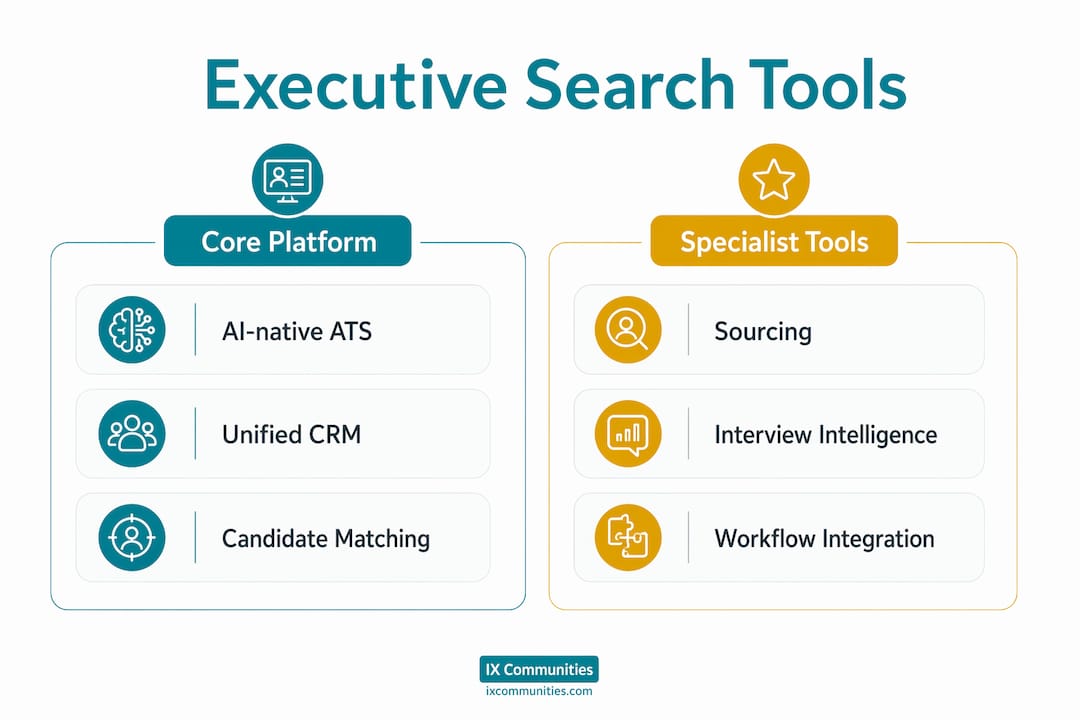
What does an AI-native core ATS/CRM bring to executive search teams?
An AI-native ATS/CRM is architecturally different from a legacy system with AI features bolted on. Legacy platforms store structured data in fixed fields. AI-native platforms index unstructured data too, including call notes, emails, and LinkedIn messages, and use that full dataset for matching, outreach, and reporting.
That distinction matters in executive search more than anywhere else. A candidate at this level leaves a trail of nuanced signals across conversations, not just a resume. Unstructured data like call notes and messages contain key candidate insights that structured field-based matching misses entirely. AI that indexes this data produces better fit scores and more relevant outreach.

The other defining feature of an AI-native core is the single data model. Matching, notes, enrichment, outreach, and reporting all run on the same dataset. AI-native platforms unify these functions on one connected architecture, which reduces the need for point tools and improves data reliability across the team.
Spott is one example of a platform built on this architecture. It consolidates candidate matching, CRM, outreach sequencing, and reporting without requiring separate tools for each function. A contact in the system can exist simultaneously as a candidate, a client, a referral source, and an advisor without creating duplicate records. Fluid contact roles like this are a core CRM requirement for executive search that most legacy systems cannot handle.
- AI-native platforms read unstructured data for richer candidate profiles
- Single data models eliminate sync errors between disconnected tools
- Fluid contact roles prevent duplicate records across candidate and client functions
- Automated matching runs on live data, not stale field entries
Pro Tip: Audit your current tech stack before adding any new tool. If your team spends more time managing integrations than managing candidates, the architecture is the problem, not the individual tools.
What specialist tools do leading teams integrate alongside their core platforms?
The best recruitment technology stack is not built on a single platform alone. Leading teams add specialist tools at the edges of their core, covering sourcing, interview intelligence, and market research. The key discipline is restraint. Each added tool must integrate natively with the core or it creates a data silo.
Sourcing tools
SeekOut, HireEZ, and LinkedIn Recruiter are the three most common sourcing tools in executive search stacks. SeekOut uses AI to surface passive candidates from public data sources and claims to deliver interview-ready candidates in 14 days, compared to traditional timelines that can span several weeks. HireEZ focuses on outbound sourcing with contact data enrichment. LinkedIn Corporate Recruiter provides direct access to the largest professional network, though at a significant cost.
Interview intelligence platforms
Metaview is the most recognized interview intelligence platform in executive search. It captures, transcribes, and structures partner-led candidate conversations, then pushes that data directly into the ATS/CRM profile. Interview intelligence automates the largest non-billable task in a search partner's day: converting raw call data into polished candidate reports.
| Tool | Function | Best use case |
|---|---|---|
| SeekOut | AI sourcing and passive candidate discovery | Teams with thin pipelines needing fast candidate volume |
| HireEZ | Outbound sourcing with contact enrichment | Teams running high-volume outreach campaigns |
| LinkedIn Recruiter | Direct network access and InMail outreach | Firms where relationship-based sourcing is primary |
| Metaview | Interview capture, transcription, and report generation | Reducing admin time on candidate write-ups |
| Spott | AI-native ATS/CRM core with integrated outreach | Teams consolidating multiple tools into one platform |
Native integrations determine whether specialist tools add value or add friction. A sourcing tool that does not push enriched profiles directly into the core CRM forces manual data entry. That manual step is exactly the kind of redundant task that fragments candidate data across the team.
Pro Tip: Before signing any specialist tool contract, confirm it has a documented native integration with your core ATS/CRM. A CSV export is not an integration.
How do integration and workflow design affect executive search effectiveness?
Over 28% of recruiters identify poor tool integration as their primary workflow bottleneck. That bottleneck produces two specific problems: fragmented candidate data spread across multiple systems, and redundant manual tasks that consume time without adding value.
The solution leading teams use is the "1 Core + Enablers" model. One AI-native ATS/CRM serves as the single source of truth. Specialist tools connect to it at the edges and push data back into the core rather than holding data independently. This modular philosophy prevents the data silos that form when teams try to replace core systems with a dozen point solutions.
Workflow design inside that architecture follows conditional logic. If a candidate opens an outreach email but does not respond within five days, the system triggers a follow-up sequence automatically. If a candidate completes an interview, Metaview pushes the structured report into the CRM profile and flags the record for partner review. These if/then workflows eliminate the manual coordination that slows search timelines.
"The most common failure point in building a modern executive search stack is attempting to replace core systems with a dozen point solutions, which creates data silos." — Foundire, 2026
Consolidated outreach sequencing is another workflow advantage of a well-integrated stack. When outreach runs through the core platform rather than a separate email tool, all response data feeds back into the candidate record. Real-time alerts notify the recruiter the moment a high-priority candidate engages. That speed of response is a direct competitive advantage in executive search.
- Fragmented tools create duplicate data entry and inconsistent candidate records
- Conditional workflow automation removes manual coordination steps
- Consolidated outreach keeps all engagement data in one candidate profile
- Real-time alerts on candidate engagement reduce response lag
What are the typical investment levels for executive search technology?
Executive recruitment technologies carry significant costs that require deliberate prioritization. Enterprise-grade ATS platforms like Greenhouse and Ashby cost between $6,000 and $10,000 per recruiter annually. LinkedIn Corporate Recruiter licenses reach $10,000 to $13,000 per seat per year. A team of five recruiters using both can spend over $100,000 annually before adding any specialist tools.
| Platform category | Annual cost per user | Primary value delivered |
|---|---|---|
| Enterprise ATS (Greenhouse, Ashby) | $6,000–$10,000 | Structured hiring workflow and compliance |
| LinkedIn Corporate Recruiter | $10,000–$13,000 | Network access and direct outreach |
| AI-native ATS/CRM (e.g., Spott) | Varies by contract | Unified matching, outreach, and reporting |
| Interview intelligence (Metaview) | Varies by contract | Automated candidate report generation |
| AI sourcing (SeekOut, HireEZ) | Varies by contract | Passive candidate discovery and enrichment |
Budget allocation should follow the team's primary constraint. Firms struggling with client wins should prioritize business development platforms with integrated outreach. Firms with empty pipelines should prioritize sourcing-heavy platforms alongside ATS migration. Spending $13,000 per seat on LinkedIn Recruiter while the core CRM is a spreadsheet is a misallocation.
The financial case for consolidation is direct. Replacing three point tools with one AI-native platform that covers the same functions reduces per-user cost and eliminates integration maintenance. Fewer tools also mean fewer vendor contracts, fewer renewal cycles, and less time spent on tool administration.
- Prioritize spending based on whether the primary constraint is client development or candidate pipeline
- Consolidating functions into an AI-native core reduces total cost of ownership
- LinkedIn Recruiter seats are the largest single line item for most executive search teams
- ROI from AI platforms comes from time saved on admin, not just candidate volume
How does AI-powered interview intelligence transform executive search workflows?
Interview intelligence is the highest-leverage AI application in executive search. It is not generic sourcing automation. It targets the most time-consuming non-billable task in a search partner's day: turning a 60-minute candidate conversation into a structured, client-ready report.
Metaview captures the call, transcribes it, and structures the output against the search criteria defined in the brief. That structured output pushes directly into the candidate's CRM profile. The partner reviews and approves rather than writing from scratch. The time saving per search is measurable in hours, not minutes.
"The highest-leverage application of AI in executive search is not generic sourcing but rather interview intelligence: capturing, transcribing, and structuring partner-led candidate conversations." — Metaview, 2026
The downstream effects extend beyond time savings. When every candidate conversation is captured and structured, the CRM profile becomes a complete record of the search process. Partners can review prior conversations before follow-up calls. Clients receive consistent, well-formatted reports rather than outputs that vary by partner. Pipeline intelligence improves because the data exists in a searchable, structured form rather than in a partner's notes or memory.
- Interview intelligence captures and transcribes candidate calls automatically
- Structured outputs push directly into ATS/CRM candidate profiles
- Partners review and approve reports rather than writing them from scratch
- Consistent report quality across the team improves client perception
- Searchable call data creates a permanent, queryable record of each search
The shift from process to intelligence in executive recruiting is most visible in how interview intelligence changes the partner role. Less time on documentation means more time on candidate relationships and client advisory work.
Key takeaways
The most effective executive search tech stack is built on one AI-native core platform, with specialist tools added only where native integrations exist and a clear workflow purpose is defined.
| Point | Details |
|---|---|
| AI-native core is the foundation | Choose a platform like Spott that unifies matching, outreach, and reporting on one data model. |
| Specialist tools require native integrations | Only add tools like Metaview or SeekOut if they push data directly into your core CRM. |
| Integration failures cost real time | Over 28% of recruiters cite poor integration as their primary bottleneck, causing fragmented data and redundant tasks. |
| Costs require deliberate prioritization | ATS and LinkedIn Recruiter seats together can exceed $23,000 per user annually; allocate based on your primary constraint. |
| Interview intelligence delivers the highest ROI | Automating candidate report generation reduces non-billable admin more than any other AI application in executive search. |
The tools are only as good as the discipline behind them
The teams I see getting the most from their recruitment technology stack are not the ones with the most tools. They are the ones with the fewest tools that cover the most ground. That observation sounds obvious until you look at how most mid-size executive search firms actually operate: a legacy ATS, a separate CRM, a sourcing tool that does not talk to either, and an email platform running outreach in isolation.
The real limitations of AI in executive recruiting are not about what the technology can do. They are about what happens when technology is layered on top of a broken process. An AI-native platform does not fix a team that has not agreed on how to classify a contact or when to move a candidate to the next stage.
My recommendation is to start the audit before the purchase. Map every tool your team currently uses, identify where data leaves one system and has to be re-entered in another, and count how many hours per week that costs. That number is your baseline ROI case for consolidation. The path to becoming a strategic advisor rather than an IT manager runs directly through that audit.
— Simon
How Ixcommunities helps teams build better tech stacks
Ixcommunities operates ESIX, TLIX, and the broader IXCommunities network as the preeminent peer networking and benchmarking groups for talent leadership professionals worldwide. Members share technology adoption experiences, benchmark tool costs and outcomes, and access structured learning in a secure environment. If your team is evaluating a new ATS, debating whether LinkedIn Recruiter seats justify the cost, or trying to build a case for consolidation, the ESIX peer mentorship program connects you with leaders who have already made those decisions and can share what worked. Ixcommunities also offers membership options that give talent acquisition teams ongoing access to benchmarking data, peer forums, and technology working groups.
FAQ
What is an executive search tech stack?
An executive search tech stack is the set of software platforms a recruiting team uses to source, engage, evaluate, and place senior-level candidates. Leading stacks are built on an AI-native ATS/CRM core with specialist tools for sourcing and interview intelligence added at the edges.
What tools do leading executive search teams actually use?
Leading teams use AI-native ATS/CRM platforms like Spott or Greenhouse as their core, sourcing tools like SeekOut or HireEZ, and interview intelligence platforms like Metaview. LinkedIn Corporate Recruiter remains common despite its $10,000 to $13,000 annual per-seat cost.
Why is tool integration the biggest challenge in executive search technology?
Over 28% of recruiters identify poor integration as their primary workflow bottleneck. When tools do not share data natively, candidate records fragment across systems and teams spend hours on manual data entry instead of candidate engagement.
How much does executive search technology cost per recruiter?
Enterprise ATS platforms like Greenhouse and Ashby cost between $6,000 and $10,000 per recruiter annually. LinkedIn Corporate Recruiter adds another $10,000 to $13,000 per seat. Total annual spend per recruiter across a full stack commonly exceeds $20,000.
What is the "1 Core + Enablers" model in executive search?
The "1 Core + Enablers" model means selecting one AI-native ATS/CRM as the single source of truth and adding specialist tools only where native integrations exist. This approach prevents data silos and reduces the administrative overhead of managing multiple disconnected platforms.