

Weak recruiting leadership does not just slow down hiring. It creates compounding costs: misaligned talent pipelines, inflated time-to-fill, poor candidate experience, and ultimately, missed business targets. Yet most enterprises that invest in recruiting metrics focus almost entirely on output numbers. They track hires made, time-to-fill, and cost-per-hire, but rarely benchmark the operational effectiveness of the leaders running those processes. This guide lays out a practical, step-by-step framework for benchmarking recruiting leaders at mid-to-large enterprises, covering the right metrics, the right data discipline, and the structural approaches that produce lasting results.
Table of Contents
- Understanding benchmarks for recruiting leaders
- Preparing for benchmarking: Prerequisites and resources
- Step-by-step benchmarking process for recruiting leaders
- Troubleshooting common pitfalls and recalibrating benchmarks
- Beyond benchmarks: What most leaders overlook in recruitment effectiveness
- Take benchmarking further with peer networks and survey tools
- Frequently asked questions
Key Takeaways
| Point | Details |
|---|---|
| Benchmark at system level | Measure recruiting leaders by decomposed process metrics, not just outcomes. |
| Normalize by role and context | Calibrate benchmarks across recruiter types, departments, and hiring intensity to avoid mis-sizing. |
| Build true bench strength | Develop depth through structured exposure, not just succession planning. |
| Validate benchmarks with surveys | Use industry survey tools for reliable, actionable insights and cycle time data. |
| Leverage peer networks | Peer mentorship and benchmarking programs sustain performance improvement over time. |
Understanding benchmarks for recruiting leaders
Benchmarking recruiting leaders is not the same as measuring recruiting output. Standard KPIs like time-to-hire or offer acceptance rate tell you what happened. Leadership benchmarks tell you why it happened and where in the system things broke down.
According to Ashby's Recruiting Operations Benchmarks report, organizations should benchmark system performance metrics and decompose them into stage delays rather than relying only on top-line output KPIs. This shift in perspective is significant. It means looking at which stage in the funnel is creating bottlenecks, and assigning accountability at the leadership level for fixing those delays.
Similarly, Metaview's Recruiting Benchmarks data supports tracking funnel-stage conversions as the primary diagnostic tool. When you understand where candidates drop off at each stage, you can make specific, targeted improvements rather than guessing at solutions.
Standard KPIs vs. leadership and system benchmarks
| Metric type | Example metric | What it measures |
|---|---|---|
| Standard KPI | Time-to-fill | Total days to close a role |
| Standard KPI | Cost-per-hire | Total spend divided by hires |
| Standard KPI | Offer acceptance rate | Percentage of offers accepted |
| System benchmark | Stage conversion rate | Applicant to phone screen ratio |
| System benchmark | Interview-to-offer ratio | Efficiency of evaluation process |
| System benchmark | Sourcing channel yield | Quality per channel, per stage |
| Leadership benchmark | Feedback turnaround time | Speed of recruiter-to-hiring manager loop |
| Leadership benchmark | Data entry quality rate | Accuracy and completeness of ATS data |
This comparison illustrates a core principle. Standard KPIs summarize results. System and leadership benchmarks explain how those results were produced. Strong recruiting leaders are accountable for the system, not just the scoreboard.
Key system benchmarks for recruiting leaders
The following benchmarks provide a practical starting point for leadership-level accountability:
- Funnel-stage conversion rates by role type and department
- Recruiter-specific time-to-fill, segmented by role complexity
- Interview scheduling speed, from application to first screen
- Hiring manager satisfaction scores, tracked per recruiter portfolio
- Sourcing channel effectiveness, measured by quality-of-hire, not just volume
- ATS data quality scores, reflecting discipline in tracking and reporting
- Candidate experience ratings, segmented by recruiter assignment
"Recruiting benchmarks can be translated into actionable insights by tracking benchmarked funnel-stage conversions and not optimizing solely for top-line metrics, including diagnosing where candidates drop off." — Metaview Recruiting Benchmarks
These system-level benchmarks, when tracked consistently, give talent leaders clear visibility into which parts of the recruiting operation are performing well and which require leadership intervention. You can also explore recruiting best practices and access benchmark survey tools to start validating your own baselines.
Preparing for benchmarking: Prerequisites and resources

Once you know what benchmarks matter, gather your benchmarking resources and set up your data discipline. Effective benchmarking does not happen by accident. It requires structured inputs, reliable data sources, and clearly segmented teams.
APQC's Talent Acquisition Key Benchmarks are prepared using its Open Standards Benchmarking portal and include validated cycle time and cost metrics across source, recruit, and select process steps. Using validated sources like this provides a defensible baseline for comparing your recruiting operations against industry norms, rather than relying on anecdotal comparisons.
One common mistake large enterprises make is applying a single average benchmark across all recruiter roles. Ashby's Capacity Benchmarks data shows that using an average "hires per recruiter" number can lead to mis-sizing or mis-investment because recruiter scope and process maturity vary significantly. A technical recruiter filling senior engineering roles operates in a fundamentally different environment than a recruiter handling high-volume hourly hiring.
Data and tools for effective benchmarking
| Resource type | Examples | Purpose |
|---|---|---|
| ATS data exports | Stage timestamps, disposition reasons | Funnel conversion analysis |
| Survey platforms | Validated benchmarking portals | Baseline comparison |
| CRM and sourcing data | Channel tracking, pipeline activity | Sourcing effectiveness measurement |
| Hiring manager feedback | Structured survey tools | Recruiter performance input |
| External benchmarks | APQC, industry reports | Context for internal metrics |
Prerequisites for effective benchmarking
Before launching a formal benchmarking program, confirm the following:
- Consistent ATS data entry practices across all recruiters and coordinators
- Role segmentation definitions, clearly separating recruiter, sourcer, and coordinator functions
- Hiring intensity classification, distinguishing high-volume from specialized hiring
- Department-level baseline data, pulled from at least 12 months of historical records
- Stakeholder alignment, with hiring managers committed to providing structured feedback
- A designated owner, typically within recruiting operations or TA leadership
Pro Tip: Adjust benchmarks for context before setting any targets. A recruiter supporting a high-growth technology division with 150 open roles needs different benchmarks than one managing 20 specialist roles in a legacy business unit. Segment before you compare.
Reviewing industry benchmark sources and staying current on talent acquisition trends will also help you calibrate benchmarks that reflect current market conditions rather than pre-pandemic norms. For senior roles, look at executive recruiting metrics that are specific to leadership-level benchmarking.
Step-by-step benchmarking process for recruiting leaders
With your resources assembled, move into the execution phase. Here is a clear, research-backed benchmarking process that enterprise talent teams can implement systematically.
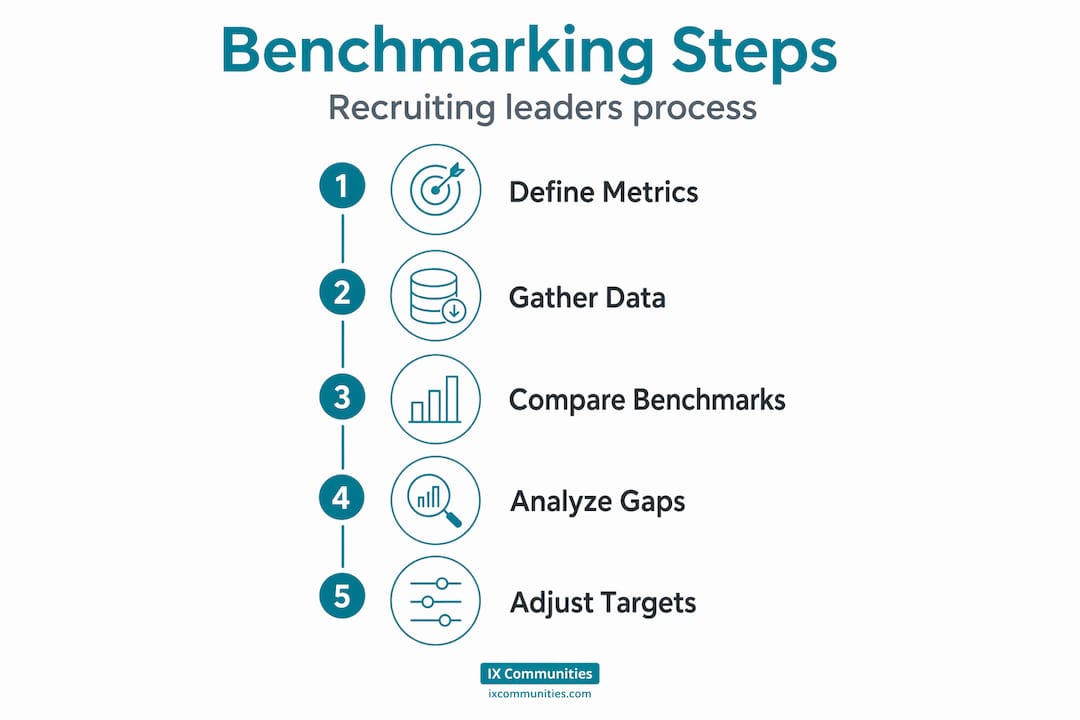
Ashby's Recruiting Operations Benchmarks outlines a practical methodology that translates well for mid-to-large enterprises. It involves five structured steps that address both operational and leadership dimensions of benchmarking.
The five-step benchmarking process
-
Forecast leadership-critical hiring horizons. Map the roles your recruiting leaders will need to fill in the next 6 to 18 months. This gives benchmarking a forward-looking purpose rather than a purely retrospective one. Align this with workforce planning data and business growth projections.
-
Segment roles to create pre-assessed internal and external benches. Divide your recruiting portfolio by role type, department, and complexity. Then identify internal talent who can step into senior recruiting roles, and build an external network of candidates and leaders who could be assessed if needed. This dual bench approach reduces dependency on reactive hiring.
-
Benchmark recruiting operations as a system. Use decomposed stage delay data, not just total time-to-fill. Map each delay to a specific stage owner and build in feedback loops and data quality checks. This is where most organizations have the largest gap: they have output data but lack the stage-level granularity to act on it.
-
Benchmark capacity with role and context normalization. Never apply a flat hires-per-recruiter target without accounting for role complexity, sourcing difficulty, and process maturity. Build context-specific benchmarks for each recruiter segment and update them quarterly as conditions change.
-
Build leadership bench strength through structured, repeatable development. According to the KKM Leadership Guide, bench strength is the deliberate depth and readiness of multiple leaders prepared to step up. This is built through stretch assignments, coaching, and rotational exposure, not simply naming successors on an org chart.
Pro Tip: The difference between naming a successor and building bench strength is the difference between reactive and proactive leadership development. Organizations that run structured rotational programs for recruiting leaders report stronger internal promotion rates and lower external hiring costs for senior TA roles.
Organizations that apply validated benchmarks to their recruiting operations and track stage-level delays can see meaningful cycle time improvements over 12 to 18 months. The key is consistency: benchmarks reviewed quarterly and acted on promptly outperform those reviewed annually. For a deeper foundation, see the guide on building an executive recruiting function and explore leadership hiring best practices as applied reference points.
Troubleshooting common pitfalls and recalibrating benchmarks
After following a step-by-step process, it is critical to watch for common benchmarking mistakes and recalibrate as your organization evolves. Even well-designed benchmarking programs drift over time if they are not actively maintained and adjusted for changing contexts.
"A convenient formula such as hires divided by recruiter capacity benchmark (e.g., 40 hires per recruiter annually) may obscure real differences across industries, departments, or individual recruiters. Benchmarking should be calibrated beyond a single average." — Toby Culshaw, LinkedIn
This caution applies broadly. The most common failures in recruiting leader benchmarking come from oversimplification and lack of ongoing recalibration.
Common pitfalls and how to fix them
- Using a single average for all recruiters. Fix: Segment by role type, department, and hiring intensity before applying any benchmark number.
- Ignoring stage-level data. Fix: Export ATS timestamp data by stage and build a stage conversion dashboard, reviewed weekly by recruiting operations.
- Benchmarking output only. Fix: Add process quality indicators such as data entry completeness, feedback speed, and scheduling efficiency.
- Setting benchmarks and never revisiting them. Fix: Build a quarterly recalibration cycle into your recruiting operations calendar. Market conditions and organizational priorities shift rapidly.
- Applying external benchmarks without internal context. Fix: Use external data as a directional guide, then layer in internal historical baselines to create context-aware targets.
- Excluding hiring managers from the benchmarking loop. Fix: Implement structured quarterly surveys that capture hiring manager satisfaction at the recruiter level, not just at the team level.
- Overlooking coordinator and sourcer capacity. Fix: Build separate capacity benchmarks for each role in the recruiting function. Treating all roles as equivalent distorts the picture significantly.
Recalibration is not an admission of failure. It is a sign of operational maturity. Connect this recalibration practice to your broader work on talent management and recruiting alignment, and consider how talent communities in recruiting can support pipeline continuity when benchmarks signal capacity strain.
Beyond benchmarks: What most leaders overlook in recruitment effectiveness
Process discipline and validated metrics are necessary. They are not, however, sufficient. This is where most enterprise talent teams stop, and where the most significant opportunities remain unrealized.
The most effective recruiting leaders we observe in peer communities do something that does not show up in any benchmarking report. They invest in relationship capital. Not just internal relationships with hiring managers and HR partners, but external networks of talent advisors, executive search practitioners, and peers at comparable organizations.
Market search recruiting practitioners make a critical observation: the best senior hires may never enter the open market. They are reached through relationship networks built over years, through discretion, and through repeatable search execution that goes far beyond scaling standard inbound processes. No ATS dashboard captures this. No capacity benchmark reflects it.
This has a direct implication for how you think about executive recruiting intelligence. Intelligence, in the truest sense, is the ability to access talent information that others cannot. That access comes from relationships, trust, and a reputation built through consistent, ethical practice.
The organizations that sustain genuine recruiting excellence over multi-year periods are the ones that treat their recruiting leaders as ambassadors in the talent market, not just operational managers. They invest in peer learning, cross-industry exposure, and external visibility for their TA leadership. This is not a soft practice. It produces measurable results in time-to-slate for senior roles, in quality-of-hire for critical positions, and in the ability to move quickly when urgent leadership needs emerge.
Pro Tip: Invest deliberately in building your recruiting leaders' external networks. Conference participation, peer mentoring programs, and structured roundtables with counterparts at other enterprises generate relationship capital that reduces sourcing friction on your hardest roles.
Benchmarking tells you how your system is running. Relationship capital determines whether your system can access the talent your business actually needs. Both are required. Neither substitutes for the other.
Take benchmarking further with peer networks and survey tools
Sustaining benchmarking excellence requires more than internal data discipline. Enterprise recruiting leaders benefit significantly from peer networks and validated survey programs that provide comparative data, shared insights, and structured development opportunities.
IXCommunities offers benchmark survey tools designed specifically for large corporate talent and recruiting departments. These tools provide reliable, validated data across the metrics that matter most for recruiting leader effectiveness, including cycle time, cost, and funnel conversion. For leadership development alongside benchmarking, the talent leader peer mentoring program connects TA executives with peers who are navigating similar operational challenges at comparable enterprises. Recruiters at all levels can also access the recruiter peer mentorship program to build skills and expand their professional networks in a secure, peer-driven environment.
Frequently asked questions
What is the best metric to benchmark recruiting leaders?
The most useful benchmarks are system-level metrics like time-to-hire, time-to-fill, and stage conversion rates, rather than only top-line KPIs. Decomposing these into stage delays reveals exactly where operational accountability lies.
How do I adjust capacity benchmarks for different teams?
Normalize benchmarks for recruiter, sourcer, and coordinator roles separately, and factor in hiring intensity and role complexity. Capacity numbers should be normalized by role scope rather than applied as a single enterprise-wide average.
What is leadership bench strength in recruiting?
Bench strength means having a depth of leaders ready to step up, developed through structured rotational assignments and coaching. Deliberate depth and readiness distinguishes genuine bench strength from simply naming successors on an organizational chart.
How do benchmark surveys improve recruiting leader effectiveness?
Validated surveys provide reliable median metrics and actionable cycle time, cost, and conversion data to compare your recruiting operations against industry peers. APQC's Talent Acquisition Key Benchmarks cover the full source-to-select process with validated data across enterprise organizations.