

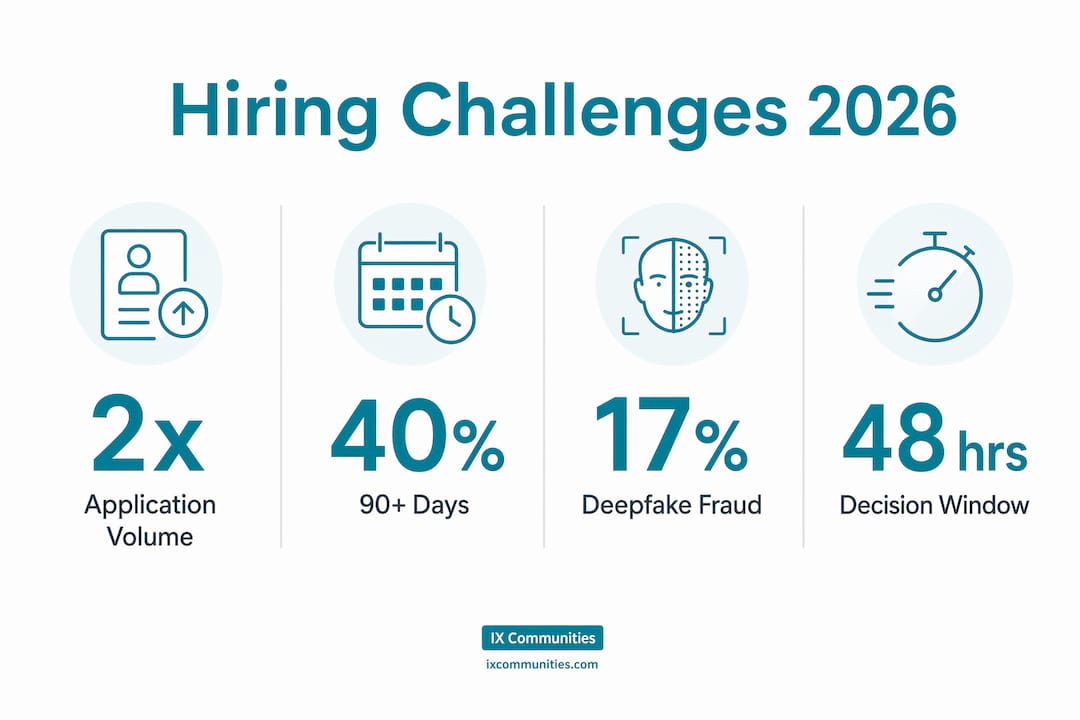
Hiring is harder today because AI-driven application surges, organizational hesitation, and shifting candidate expectations have created a compounding set of challenges that recruiters have not faced before. Why hiring feels harder than ever is not a perception problem. It is a structural one. Applications per role have doubled since 2022 due to AI-enabled one-click applying, while internal decision-making has slowed and candidate trust has eroded. The result is a market where volume is up, quality signals are down, and the average hire still takes 42 days. For HR professionals and talent acquisition leaders, understanding each layer of this problem is the first step toward fixing it.
Why hiring feels harder than ever: the AI application surge
AI tools have fundamentally changed how candidates apply for jobs. Platforms like LinkedIn, Indeed, and a growing category of AI resume tools allow candidates to submit dozens of applications per day with tailored resumes generated in minutes. The practical result is that recruiters now face signal collapse, a condition where every candidate appears equally qualified on paper and genuine differentiation becomes nearly impossible.
The downstream effects on talent acquisition are significant:
- Volume without quality. 84% of small business owners hiring report few or no qualified applicants despite receiving large application pools. High volume does not equal high signal.
- Longer screening cycles. Recruiters add more interview rounds and additional stakeholders to compensate for the inability to differentiate candidates at the resume stage. This extends time-to-hire and increases cost-per-hire.
- Recruiter overload. Screening hundreds of AI-polished resumes per role consumes time that should go toward closing strong candidates and building relationships.
- Authenticity gaps. AI-tailored resumes often misrepresent actual skill levels, creating a mismatch that only surfaces late in the process, after significant time investment.
The core problem is not that AI helps candidates apply. The problem is that it has removed the filtering function that resumes once served. Recruiters now need new tools and criteria to restore that function.
Pro Tip: Shift your screening criteria away from resume keywords and toward structured, skills-based assessments or work samples early in the funnel. This restores signal before you invest time in interviews.
What internal factors are slowing time-to-fill?
Application volume is only half the problem. Inside many organizations, the hiring process itself has become a source of delay. Economic uncertainty in 2026 has made hiring managers more cautious, and that caution translates directly into stalled requisitions and longer decision cycles.
Here are the most common internal bottlenecks talent leaders report:
- Requisition stalling. Hiring managers approve roles, then delay moving forward due to budget reviews, reorgs, or shifting priorities. Candidates in these pipelines disengage while waiting.
- Slow time-to-fill. Nearly 40% of senior-level roles take more than 90 days to fill. The average across all roles sits at approximately 42 days. Both figures represent significant windows for candidate dropout.
- Scheduling overload. Recruiters spend 38% of their time coordinating interview logistics. That is more than a third of their working hours consumed by calendar management rather than talent strategy.
- Zombie pipelines. Stalled requisitions create what practitioners now call zombie candidate pipelines. Recruiters manage pools of disengaged candidates who applied weeks ago and have since moved on mentally or accepted other offers.
The candidate disengagement that results from these delays is not passive. Candidates who wait more than two weeks without a clear update actively begin pursuing other opportunities. By the time a hiring manager is ready to move, the best candidates are often gone.
Pro Tip: Set a maximum decision window at each hiring stage and communicate it to hiring managers upfront. A 48-hour feedback rule after interviews alone can meaningfully reduce candidate dropout.
How have candidate expectations shifted in 2026?
Candidate behavior has changed in ways that make recruitment more difficult, and not all of those changes are the candidate's fault. Years of poor hiring experiences, including ghosting by employers, misleading job descriptions, and drawn-out processes, have produced a candidate population that is more skeptical, more selective, and more likely to disengage early.
Key shifts talent leaders are observing:
- Candidate ghosting is now widespread. Ghosting contributes to burnout and disengagement on both sides. Candidates ghost because they have multiple options and low trust in the process. Recruiters burn out managing pipelines where a significant share of candidates simply stop responding.
- Trust in job descriptions has declined. Candidates increasingly expect a gap between what a job posting says and what the role actually involves. That skepticism slows commitment and increases offer decline rates.
- AI amplifies competition. Because candidates use AI to apply broadly, many are not deeply invested in any single opportunity. Closing a candidate now requires more deliberate relationship-building than it did three years ago.
- Remote and flexibility expectations remain high. Candidates who built careers around flexible work arrangements treat rigid return-to-office requirements as a disqualifying factor, not a negotiating point.
Transparency and consistent communication are the most direct tools for rebuilding candidate trust. Organizations that set clear timelines, follow through on communication, and accurately represent roles in job descriptions report better offer acceptance rates and lower dropout.
How does the low-hire, low-fire economy affect recruitment?
The macroeconomic context of 2026 has produced a labor market that is simultaneously stable and stagnant. The low-hire, low-fire economy describes a condition where employers are not laying off workers at high rates, but they are also not hiring aggressively. Workers, in turn, are staying in their current roles rather than risking a move in an uncertain market.
| Labor Market Factor | Effect on Hiring |
|---|---|
| Low voluntary turnover | Fewer open roles from natural attrition |
| Employer hiring caution | Longer approval cycles and frozen requisitions |
| Candidate risk aversion | Fewer active job seekers despite openings |
| Wage growth stagnation | Reduced incentive for candidates to switch roles |
This dynamic creates a paradox. Job postings exist, but the candidates most qualified to fill them are not actively looking. The candidates who are actively applying are often doing so at high volume with AI tools, producing the signal collapse described earlier. Economic caution is causing a paradoxical labor market where career mobility has slowed sharply even as unemployment remains relatively low. For talent acquisition leaders, this means passive candidate outreach and internal mobility programs are more important than they have been in years.
What strategies actually work for recruiters right now?
The biggest challenge recruiters face in 2026 is not sourcing applicants. It is closing candidates quickly before process delays and competing offers take them out of the pipeline. Addressing that requires changes at both the operational and strategic level.
Shorten the process. Reduce interview rounds to the minimum necessary for a confident decision. Every additional round adds days to time-to-hire and increases dropout risk. A three-stage process with clear criteria outperforms a five-stage process with vague ones.

Build internal pipelines before you need them. Nurturing relationships with passive candidates means you have warm contacts when a role opens, rather than starting from zero. Tools like LinkedIn Talent Solutions and CRM platforms built for recruiting support this approach.
Invest in verification. 17% of hiring managers have encountered deepfake video fraud in interviews. AI adoption in executive recruiting adds complexity to authenticity verification, making multi-step verification protocols a practical necessity rather than an optional safeguard. Consider in-person or high-trust verification steps for senior roles.
Improve job description accuracy. Accurate descriptions reduce mismatched applications, lower dropout after offer, and rebuild candidate trust over time. This is a low-cost change with measurable impact on offer acceptance rates.
| Strategy | Primary Benefit |
|---|---|
| Reduce interview rounds | Faster time-to-hire, lower candidate dropout |
| Skills-based screening | Restores signal lost to AI resume polishing |
| Proactive candidate nurturing | Reduces time-to-fill for future openings |
| Deepfake verification protocols | Protects against AI-generated fraud |
| Transparent job descriptions | Improves offer acceptance and candidate trust |
Pro Tip: When reviewing AI-assisted applications, use a structured scorecard tied to role-specific competencies rather than general impressions. This reduces bias and restores the differentiation that AI resumes obscure.
Key takeaways
Hiring is harder in 2026 because AI-driven volume, internal process delays, and eroded candidate trust are compounding simultaneously, and each factor requires a distinct response.
| Point | Details |
|---|---|
| AI doubles application volume | Applications per role have doubled since 2022, creating signal collapse that extends screening time. |
| Internal delays cost top candidates | 40% of senior roles take 90+ days to fill; candidates disengage long before decisions are made. |
| Candidate trust is a real barrier | Ghosting and misleading job descriptions have made candidates more skeptical and harder to close. |
| The labor market is structurally stagnant | Low-hire, low-fire dynamics reduce active candidate pools and slow natural turnover. |
| Speed and transparency are the fix | Shorter processes and accurate communication directly improve offer acceptance and reduce dropout. |
What i have learned about hiring difficulty in 2026
After years of working alongside talent leaders at large corporate organizations, the pattern I keep seeing is this: most teams are solving the wrong problem. They invest in sourcing tools and job board spend while the real bottleneck sits inside their own process. Hiring managers who cannot commit to a decision timeline, interview loops that add rounds for political reasons rather than quality ones, and job descriptions written by committee that bear no resemblance to the actual role. These are the things that lose candidates.
The AI application surge is real, and it does create genuine screening challenges. But the gaps and real limitations of AI in recruiting are just as significant as its advantages. Recruiters who treat AI as a sourcing solution without addressing verification and authenticity are trading one problem for another.
The teams that are performing well right now share one trait: they make decisions faster than their competitors. They have reduced interview rounds, set internal SLAs for hiring manager feedback, and communicate with candidates on a defined schedule. None of that requires new technology. It requires organizational discipline. That is harder to build than a new tool stack, but it is also more durable.
— Simon
How Ixcommunities supports talent leaders facing these challenges
Ixcommunities operates ESIX, TLIX, and IXCommunities as peer networking and benchmarking groups specifically for talent leadership professionals at large corporate organizations. Members share hiring data, compare process metrics, and learn from peers who are navigating the same conditions.
For recruiters looking to build the skills and strategic judgment that today's hiring environment demands, the ESIX Recruiter Peer Mentorship Programs provide structured mentorship from experienced talent leaders. For those seeking broader access to benchmarking data, peer collaboration, and expert speakers, Ixcommunities membership connects you with a global network of talent acquisition professionals working through the same challenges. The Talent Leaders Peer Mentoring Program is designed specifically for leaders who need to move faster and smarter in a market that rewards neither hesitation nor volume.
FAQ
Why has hiring become so much harder since 2022?
Applications per role have doubled since 2022 due to AI-enabled one-click applying, while internal decision timelines have lengthened and candidate trust has declined. The combination of higher volume and lower signal quality is the core driver of current hiring difficulties.
What is signal collapse in recruiting?
Signal collapse occurs when AI-polished resumes make all candidates appear equally qualified, removing the filtering function that resumes traditionally served. Recruiters respond by adding interview rounds and stakeholders, which extends time-to-hire and increases candidate dropout.
How long does it take to fill a senior role in 2026?
Nearly 40% of senior-level roles take more than 90 days to fill, and the average time-to-hire across all roles is approximately 42 days. These timelines are long enough for most strong candidates to accept competing offers.
What is the low-hire, low-fire economy?
The low-hire, low-fire economy describes a labor market where employers are not laying off workers at high rates but are also not hiring aggressively. Workers stay in current roles due to risk aversion, reducing the active candidate pool available to recruiters.
How can recruiters rebuild candidate trust?
Transparent job descriptions, defined communication schedules, and shorter interview processes are the most direct methods for rebuilding trust. Consistent follow-through at each stage reduces ghosting and improves offer acceptance rates.