

The best hiring organizations define talent acquisition as a structured, measurable system, not a series of judgment calls. While most teams still rely on gut feel and volume sourcing, top performers use structured evaluation, stakeholder alignment, and deliberate technology adoption to achieve consistently better outcomes. The gap between high-performing and average recruiting teams is not a matter of budget or headcount. It is a matter of operational discipline. Understanding what separates these organizations is the first step toward closing that gap.
What the best hiring organizations know that others don't
Top-performing talent acquisition teams achieve 30–40% higher predictive accuracy by using structured evaluation metrics instead of unstructured, intuition-based methods. That gap is not marginal. It means fewer mis-hires, faster decisions, and stronger alignment between the person hired and the role they fill.
Structured hiring, the industry term for a standardized process using defined criteria, consistent questions, and anchored scoring, is the foundation of every high-performing talent acquisition function. The alternative, ad hoc interviewing driven by personal impressions, produces results that vary by interviewer, by day, and by mood. The best organizations eliminate that variance by design.

A 239% spike in AI-generated and one-click applications has made volume-based sourcing obsolete as a primary strategy. Top teams responded by shifting to intentional, skill-based hiring. They screen for demonstrated competency, not credential proximity. That shift alone separates organizations that fill roles from organizations that build teams.
How structured evaluation improves hiring accuracy
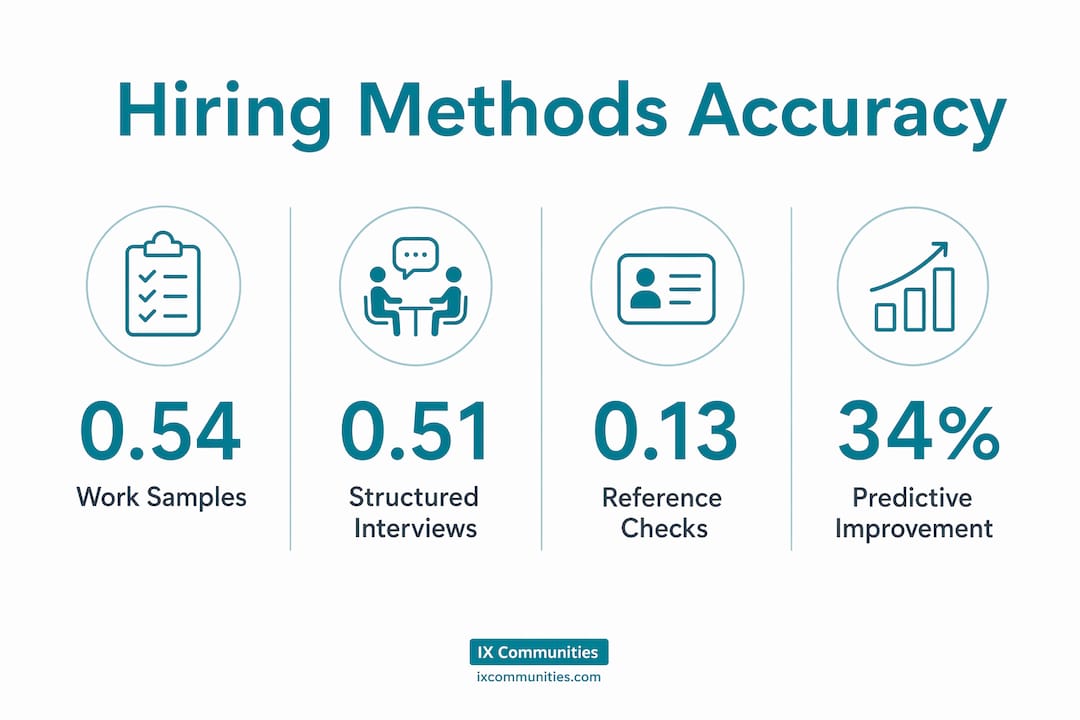
Structured interviews with anchored rating scales yield a 34% improvement in predictive power compared to unstructured formats. Predictive validity rises from r=0.38 in unstructured interviews to r=0.51 in structured ones. That difference translates directly into better hiring decisions at scale.
The table below shows how common hiring methods compare on predictive validity:
| Hiring Method | Predictive Validity (r) |
|---|---|
| Structured interviews | 0.51 |
| Work sample tests | 0.54 |
| Unstructured interviews | 0.38 |
| Reference checks | 0.13 |
Reference checks, widely used as a primary filter, carry a predictive validity of about r=0.13. That number shows they function best as a final risk screen, not as a core selection tool. Organizations that rely on them heavily are making decisions on weak evidence.
Competency-based assessments replace generic credential screening by testing what candidates can actually do. Work samples, structured scenario questions, and anchored rubrics give interviewers a shared language for evaluation. That shared language is what makes hiring decisions defensible and consistent across a panel.
Pro Tip: Audit your last ten hires and check whether every interviewer followed the structured interview plan without deviation. Drift from the plan is the most common reason structured interviews underperform their potential.
The executive recruiting metrics that matter most are those tied directly to predictive accuracy, not activity volume. Tracking the right signals from the start separates teams that measure performance from those that only measure effort.
Why stakeholder alignment before posting matters
The best hiring managers align all stakeholders on role success criteria before a job is posted. Specifically, they define what success looks like at 90 days and at 12 months. That definition becomes the filter for every decision that follows.
Defining success metrics and non-negotiables upfront decreases mis-hires and accelerates the selection process. The reason is straightforward. When everyone agrees on what the role requires before candidates are reviewed, evaluators stop arguing about preferences and start measuring against a shared standard.
High-performing teams also treat job descriptions as target profiles, not rigid checklists. A checklist approach eliminates high-potential candidates who lack one credential. A profile approach identifies candidates who meet the core requirements and show the capacity to grow into the rest. That distinction changes the quality of the finalist pool.
Key distinctions that stakeholder alignment sessions should resolve:
- Non-negotiables: Skills or experience the role cannot function without
- Wish-list criteria: Preferences that add value but are not disqualifying
- 90-day success markers: Specific, measurable outputs expected in the first quarter
- 12-month performance indicators: Longer-term outcomes that define role success
- Evaluation ownership: Who scores which competencies and how conflicts are resolved
High-performing organizations distinguish between policies and actual mechanisms. A policy says "we value candidate experience." A mechanism is a documented communication protocol with defined response times. Candidates experience the mechanism, not the policy.
Pro Tip: Run a facilitated stakeholder alignment session before every senior or hard-to-fill role. Sixty minutes of upfront agreement prevents weeks of downstream disagreement.
Technology and operational maturity as differentiators
Top-performing teams use AI for analytics and scheduling, not just automation. 43% of top teams use AI for analytics and 42% for interview scheduling, while underperforming teams respond to capacity problems by adding headcount. That contrast reveals a fundamental difference in how these organizations think about hiring infrastructure.
Operational complexity is the true enemy of hiring speed and quality. Top performers maintain or reduce headcount while investing in process modernization. They remove steps that add friction without adding value. The result is a faster, more consistent process that scales without proportional cost increases.
Teams combining structured hiring with AI exceed hiring goals far more often than teams doing either alone. The combination matters because AI without structure produces faster bad decisions, and structure without AI creates bottlenecks. Together, they produce speed and accuracy.
Capturing interview content through audio or transcripts is one of the most underused tools in talent acquisition. Without recording actual questions and answers, structured interview plans drift over time. Interviewers improvise. Consistency erodes. Legal defensibility weakens. Recording restores all three.
The practical guide on AI in talent acquisition separates what AI actually delivers in hiring from what vendors claim. That distinction matters when building a technology stack that supports structured processes rather than replacing them.
How values-centered hiring builds retention and brand strength
High-performing organizations use the exact language from their values statements in job postings, offer letters, and performance reviews. Alignment between hiring and performance evaluation language predicts employee retention and employer brand strength. When the words match across the entire employment lifecycle, employees experience consistency rather than contradiction.
Candidate experience functions as a direct signal of organizational culture. Timely communication, clear next steps, and honest feedback tell candidates what working at the organization actually feels like. Companies with top candidate experience see 2x more referrals and 34% higher offer acceptance. Those numbers compound over time into a measurable talent pipeline advantage.
The shift from "culture fit" to "culture add" reduces bias and improves diversity outcomes. Culture fit screens for similarity. Culture add screens for contribution. The difference is that culture add asks what a candidate brings that the team currently lacks, rather than whether they resemble the people already there.
Key practices that connect values-centered hiring to retention:
- Use verbatim values language in offer letters and onboarding documents
- Set communication response-time standards as formal protocols, not informal norms
- Evaluate candidates on portable skill development potential, not just current role fit
- Include values alignment questions in structured interview rubrics
- Review departure data to identify where values misalignment first appeared
Investing in portable skill development signals to candidates that the organization values their growth beyond the current role. That signal attracts candidates who plan to stay and build, not candidates who plan to leave at the first better offer.
Key Takeaways
Top hiring organizations outperform peers by combining structured evaluation, upfront stakeholder alignment, and deliberate technology use into a single, defensible system.
| Point | Details |
|---|---|
| Structured interviews outperform gut feel | Predictive validity rises from r=0.38 to r=0.51 with structured, anchored formats. |
| Stakeholder alignment reduces mis-hires | Defining 90-day and 12-month success criteria before posting prevents costly downstream disagreements. |
| AI works best alongside structure | Teams combining AI with structured processes exceed hiring goals more often than those using either alone. |
| Values language drives retention | Using exact values language across postings, offers, and reviews predicts employee retention. |
| Candidate experience is a mechanism, not a policy | Documented communication protocols produce the experience candidates actually perceive. |
Why discipline beats intuition in talent acquisition
The organizations I see struggle most with hiring share one trait. They treat each hire as a standalone event rather than an output of a system. They rely on the interviewer's read of the room, the hiring manager's gut, and a reference call that tells them almost nothing. Then they wonder why the same problems keep appearing six months after someone starts.
What changed my thinking on this was watching teams with identical budgets produce wildly different results. The difference was never the sourcing channel or the job board. It was always the process behind the process. The teams that built structured evaluation frameworks, ran stakeholder alignment sessions, and used technology to remove friction consistently outperformed those that did not. Every time.
The discomfort most organizations feel about structured hiring is real. It requires discipline. It requires hiring managers to follow a rubric instead of trusting their instincts. It requires recruiters to hold the line on process even when a hiring manager wants to shortcut it. That discipline is exactly what makes it work. The candidate assessment advantage belongs to teams willing to build and protect that discipline.
The other thing worth saying directly: structured hiring is fairer. When every candidate answers the same questions and gets scored on the same criteria, bias has fewer places to hide. That is not just a legal benefit. It is a quality benefit. The best candidate wins more often when the process is designed to find them.
— Simon
How Ixcommunities supports talent leaders in building better hiring systems
Talent acquisition leaders who want to move from intuition-based hiring to structured, measurable systems need more than frameworks. They need peers who have done it, benchmarks that show where they stand, and a community that holds the conversation at the right level.
Ixcommunities provides exactly that through the Talent Leaders Peer Mentoring Program, where senior talent professionals work through real hiring challenges with peers from large organizations. The benchmark surveys give teams the data they need to evaluate their own processes against what top-performing organizations actually do. Both resources are built for talent leaders who are serious about operational excellence, not just incremental improvement.
FAQ
What makes structured interviews more effective than unstructured ones?
Structured interviews use consistent questions and anchored rating scales, which raises predictive validity from r=0.38 to r=0.51. That consistency removes interviewer bias and makes hiring decisions easier to defend.
How do top hiring organizations use AI in recruitment?
Top teams apply AI to analytics and interview scheduling rather than using it as a replacement for structured evaluation. AI combined with structured processes produces better hiring goal attainment than either approach alone.
Why does stakeholder alignment matter before a job is posted?
Agreeing on 90-day and 12-month success criteria before recruiting starts gives every evaluator a shared standard. That shared standard reduces mis-hires and speeds up the selection process.
What is "culture add" and why do high-performing teams prefer it?
Culture add asks what a candidate contributes that the team currently lacks, rather than whether they resemble existing employees. This approach reduces similarity bias and produces more diverse, higher-performing teams.
How does candidate experience affect hiring outcomes?
Organizations with strong candidate experience see twice as many referrals and 34% higher offer acceptance rates. Structured communication protocols, not informal policies, are what produce that experience consistently.