

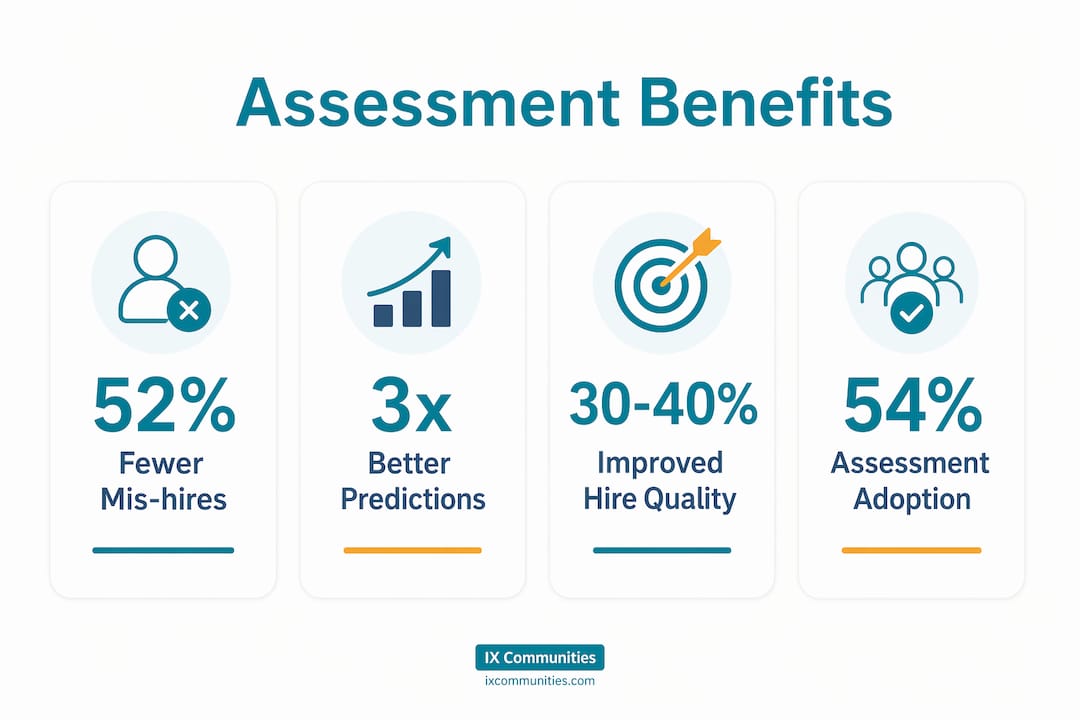
Candidate assessment is the strategic evaluation of job candidates through validated tools and structured frameworks that predict job performance and organizational fit. Lots of organizations can find candidates. Few can accurately evaluate them. That gap is where competitive advantage in hiring is built. Organizations using data-driven evaluation report 52% fewer mis-hires and fill critical roles 34% faster than those relying on ad-hoc approaches. A bad hire costs up to 200% of that role's annual salary. For talent acquisition leaders, systematic candidate evaluation is no longer a process improvement. It is a strategic priority.
Why candidate assessment is the new competitive advantage
The core argument is direct: organizations that assess candidates with validated, structured methods outperform those that do not, on every measurable hiring outcome. 78% of HR professionals report that structured assessment tools significantly improve quality of hire. Employees hired through skills testing are 65% more likely to stay beyond one year. Organizations with strong evaluation processes are 37% more likely to achieve their hiring goals. These numbers do not describe a marginal improvement. They describe a structural advantage.
Traditional hiring relies heavily on resumes and unstructured interviews. Both are poor predictors of actual job performance. Resumes signal credentials, not capability. Unstructured interviews introduce bias and produce inconsistent results. The shift to capability-based evaluation, using behavioral interviews, psychometric tests, and skills assessments, closes that gap. It replaces subjective impressions with measurable data.

The candidate assessment benefits extend beyond accuracy. Faster decisions, reduced bias, and a more consistent candidate experience all follow from structured evaluation. For large corporate talent departments competing for the same pools of qualified candidates, these advantages compound over time.
How does structured assessment improve quality of hire?
Structured interviews predict job performance three times better than unstructured ones. That single data point reframes the entire case for systematic evaluation. Unstructured conversations favor candidates who interview well, not candidates who perform well. Structured methods correct for that distortion.
The table below compares key assessment methods and their documented outcomes:
| Assessment Method | Primary Benefit | Documented Outcome |
|---|---|---|
| Structured behavioral interviews | Reduces interviewer bias | 3x better performance prediction |
| Psychometric testing | Measures cognitive and personality fit | Improved retention and role alignment |
| Skills-based testing | Validates technical capability directly | 65% higher one-year retention rate |
| Realistic job previews | Sets accurate candidate expectations | Reduced early attrition |
| Standardized competency scoring | Aligns stakeholder evaluation criteria | 30–40% hire quality improvement |
Each method addresses a different failure point in traditional hiring. Behavioral interviews surface how candidates have acted in real situations. Psychometric tools measure traits that predict long-term performance. Skills tests eliminate credential inflation. Realistic job previews reduce early attrition by aligning expectations before day one.
Assessments providing realistic job previews reduce early attrition more effectively than abstract potential measures. Six-month retention is a stronger indicator of assessment effectiveness than immediate job performance. That distinction matters for talent acquisition teams measuring the return on their evaluation investments.
What separates modern assessment from traditional hiring?
The defining shift in modern candidate evaluation is the move from proxy-based hiring to capability-based hiring. Proxy-based hiring uses credentials, pedigree, and interview impressions as stand-ins for actual ability. Capability-based hiring uses validated instruments for predictive validity, measuring what candidates can actually do in the role.
Artificial intelligence now plays a significant role in this shift. 74% of U.S. job seekers use AI in their applications. Recruiters integrating AI screening report a 30–40% improvement in hire quality within 90 days. AI handles high-volume triage efficiently, surfacing qualified candidates from large applicant pools faster than any manual process.
The limits of AI in assessment are equally important to understand. Key differentiators in modern assessment include:
- AI screening handles volume and consistency at the top of the funnel
- Structured scoring frameworks create defensible, auditable hiring decisions
- Bias reduction protocols improve diversity outcomes and candidate experience
- Human-led interviews assess cultural fit, motivation, and contextual judgment
- Transparent evaluation criteria build candidate trust and employer brand
AI cannot assess cultural fit, motivation, or catch red flags invisible on paper. Human interviews remain the essential second stage. The organizations gaining the most from modern assessment combine AI efficiency at the screening stage with structured human judgment at the evaluation stage.
Pro Tip: Balance AI automation with human assessment by using AI to rank and filter applicants, then applying structured behavioral interviews and competency scoring for every candidate who advances to the interview stage.
54% of organizations now use pre-employment assessments to screen skills and competencies objectively. That adoption rate reflects growing recognition that consistent, transparent evaluation frameworks reduce legal exposure and improve diversity outcomes simultaneously.
What are the most common candidate assessment mistakes?
Most organizations do not fail at candidate assessment because they lack tools. They fail because they misapply the tools they have or measure the wrong outcomes afterward.
-
Treating assessments as filters, not frameworks. Assessments designed only to eliminate candidates miss their strategic value. The goal is to identify the best fit, not simply reduce volume. Reframe every assessment as a data collection exercise that informs the full evaluation, not a pass-fail gate.
-
Falling into the AI doom loop. Increased AI applications prompt harsher filters, which escalate application volume without improving quality. When AI filters become too aggressive, qualified candidates are screened out before a human ever reviews them. The fix is to use AI for surfacing qualified candidates, followed by human review, not to automate rejection at scale.
-
Measuring success only at day one. Immediate job performance is an incomplete metric. Measuring assessment effectiveness post-hire must focus on retention and expectation alignment at six months. Organizations that track only early performance miss the long-term signal that assessment quality actually produces.
-
Skipping stakeholder alignment. Hiring managers and talent acquisition teams frequently disagree on what "good" looks like for a given role. Without shared competency definitions and scoring standards, even well-designed assessments produce inconsistent decisions.
Pro Tip: Start with one high-volume or high-impact role. Define three to five core competencies, build a structured scoring rubric, and run it for one quarter. The data you collect will inform every subsequent assessment framework you build.
Standardizing competency scoring across stakeholders can improve hire quality 30–40% within one quarter without significant technology investment. Clarity and consistency drive better outcomes faster than any new platform purchase.
How do you implement assessment strategies for competitive hiring?
Effective implementation follows a defined sequence. Talent acquisition teams that skip steps, particularly stakeholder alignment and competency definition, consistently underperform those that build the framework before selecting tools.
Define role competencies before selecting tools
Start with the role, not the technology. Identify three to five competencies that predict success in the specific position. These should be behavioral and measurable, not generic. "Communication skills" is not a competency. "Ability to present complex data to non-technical stakeholders" is.
Integrate AI thoughtfully at the screening stage
AI tools work best when they are given clear criteria and human oversight. Use platforms that allow you to configure screening parameters based on validated competencies, not just keyword matching. Recruiters who apply AI tools strategically alongside structured evaluation methods consistently report stronger candidate pipelines.
Align stakeholders on scoring standards
Every interviewer evaluating a candidate should use the same rubric. Transparent, consistent scoring frameworks make hiring decisions defensible and measurable. They also reduce the influence of individual interviewer bias on final decisions.
The table below outlines assessment types and their appropriate use cases:
| Assessment Type | Best Used For | Stage in Process |
|---|---|---|
| AI resume screening | High-volume roles, initial triage | Pre-screening |
| Skills-based testing | Technical and functional roles | Post-application |
| Behavioral interviews | All professional roles | Interview stage |
| Psychometric assessments | Leadership and senior roles | Final evaluation |
| Realistic job previews | High-attrition roles | Pre-offer |
Improve candidate experience through transparency
Candidates who understand how they are being evaluated report higher satisfaction, regardless of outcome. Communicate the assessment process clearly at each stage. Human recruiters freed by AI tools can focus on these high-value, human-centered interactions rather than administrative screening tasks.
Tracking candidate authenticity within AI-driven workflows is also a growing priority. As AI screening becomes standard, candidates who feel the process is fair and transparent are more likely to accept offers and refer others.
Key takeaways
Structured, capability-based candidate assessment is the most direct path to reducing mis-hires, improving retention, and building a defensible, consistent hiring process.
| Point | Details |
|---|---|
| Structured methods outperform gut instinct | Structured interviews predict job performance three times better than unstructured conversations. |
| AI works best at the screening stage | Use AI to surface qualified candidates, then apply human judgment for evaluation and fit. |
| Stakeholder alignment drives quality | Standardizing competency scoring improves hire quality 30–40% within one quarter. |
| Measure retention, not just performance | Six-month retention is a stronger indicator of assessment effectiveness than day-one performance. |
| Start small and iterate | Pilot one role with a defined rubric before scaling assessment frameworks across the organization. |
Assessment is a leadership decision, not just a process choice
From my perspective, the organizations that treat candidate assessment as a compliance exercise or a screening shortcut consistently underperform those that treat it as a strategic function. I have observed talent acquisition teams invest heavily in AI platforms while skipping the foundational work of defining what "qualified" actually means for their roles. The technology does not compensate for that gap.
The most durable competitive advantage in hiring does not come from the most sophisticated tool. It comes from the clearest definition of what success looks like in a role, combined with a consistent method for evaluating candidates against that definition. That combination is replicable, scalable, and defensible. It also builds employer brand. Candidates who experience a fair, transparent, and structured evaluation process carry that impression with them, whether they accept the offer or not.
Talent acquisition leaders have an opportunity to lead this change inside their organizations. The data supporting structured assessment is not ambiguous. The practical barriers, stakeholder alignment, competency definition, and measurement discipline, are manageable. The question is whether your team treats assessment as a strategic priority or an administrative step.
— Simon
How Ixcommunities supports assessment-driven hiring
Ixcommunities connects talent acquisition leaders with the peer networks, benchmarking data, and structured programs needed to build and refine candidate assessment strategies. For teams looking to move from ad-hoc evaluation to systematic, defensible hiring frameworks, the ESIX Recruiter Peer Mentorship Programs provide direct access to experienced practitioners who have implemented these methods at scale.
The Talent Leaders Peer Mentoring Program offers senior HR leaders a structured environment to benchmark assessment practices, share implementation challenges, and access proven frameworks from peer organizations. Ixcommunities members gain access to benchmark surveys, guest speakers, and a global network of talent professionals committed to raising the standard of candidate evaluation across corporate recruiting functions.
FAQ
What is candidate assessment in recruitment?
Candidate assessment is the structured evaluation of job applicants using validated tools and frameworks, including behavioral interviews, skills tests, and psychometric measures, to predict job performance and organizational fit.
How does structured assessment reduce mis-hires?
Organizations using data-driven evaluation methods report 52% fewer mis-hires compared to ad-hoc approaches. Structured methods replace subjective impressions with measurable, consistent data across all candidates.
What role does AI play in candidate evaluation?
AI handles high-volume screening efficiently, with recruiters reporting a 30–40% improvement in hire quality within 90 days of integration. AI cannot assess cultural fit or motivation, so human-led interviews remain a required second stage.
How do you measure whether your assessments are working?
Six-month retention is a stronger indicator of assessment effectiveness than immediate job performance. Track retention rates by hire cohort and compare against the assessment methods used during each hiring cycle.
What is the fastest way to improve hiring quality without new technology?
Standardizing competency scoring across all interviewers and hiring managers can improve hire quality 30–40% within one quarter. Alignment on evaluation criteria produces measurable results faster than any platform upgrade.