

AI in talent acquisition is defined as the use of machine learning, natural language processing, and automated screening tools to improve recruiter efficiency, candidate matching, and hiring speed. After their first year of AI adoption, TA leaders at mid to large corporations have learned that the technology delivers real gains, but only when organizations redesign workflows, manage change deliberately, and build ethical guardrails into every step. The lessons from year one are not about the tools. They are about the people, processes, and governance structures that determine whether AI delivers value or simply adds complexity. Tools like those benchmarked by HackerEarth and frameworks from Deloitte and Aptitude Research all point to the same conclusion: AI rewards preparation, not just installation.
What measurable benefits have TA leaders seen after one year of AI?
AI adoption in recruiting produces quantifiable efficiency gains with a recruitment efficiency beta coefficient of 0.61 (p < 0.001). That number means AI has a strong, statistically significant relationship with faster, more accurate hiring outcomes across multiple sectors.
The productivity impact is equally clear. Companies using AI in recruiting fill 64% more jobs per recruiter and submit 33% more candidates than non-adopters. That is not a marginal improvement. It represents a fundamental shift in what a single recruiter can accomplish in a given quarter.

Candidate experience also improves in measurable ways. AI tools reduce the time candidates spend waiting for screening feedback, which directly affects offer acceptance rates. Faster feedback loops signal organizational competence to candidates, particularly at the senior level.
Bias mitigation shows more modest results. AI adoption improves bias reduction with a beta coefficient of only 0.21 (p < 0.05). That figure confirms AI helps, but does not solve bias on its own. Deliberate explainability design and human review remain necessary.
| Metric | AI Adopter Outcome |
|---|---|
| Recruitment efficiency | Beta coefficient of 0.61 (p < 0.001) |
| Jobs filled per recruiter | 64% increase over non-adopters |
| Candidates submitted | 33% more than non-adopters |
| Bias mitigation effect | Beta coefficient of 0.21 (p < 0.05) |
| Candidate experience | Improved with faster feedback cycles |
The data shows AI delivers real value in volume, speed, and initial screening quality. The gap between adopters and non-adopters on jobs filled per recruiter alone justifies the investment for most large TA functions.
Pro Tip: Track your baseline time-to-hire and jobs-filled-per-recruiter before deploying any AI tool. Without a pre-adoption baseline, you cannot calculate your actual return or identify where the tool is underperforming.
What operational challenges did TA leaders encounter in year one?
The most common failure in year one is not a technology failure. Nearly half of organizations introduce AI without redesigning workflows or roles, capturing only a fraction of potential efficiency gains. Layering AI on top of a broken process produces a faster broken process.
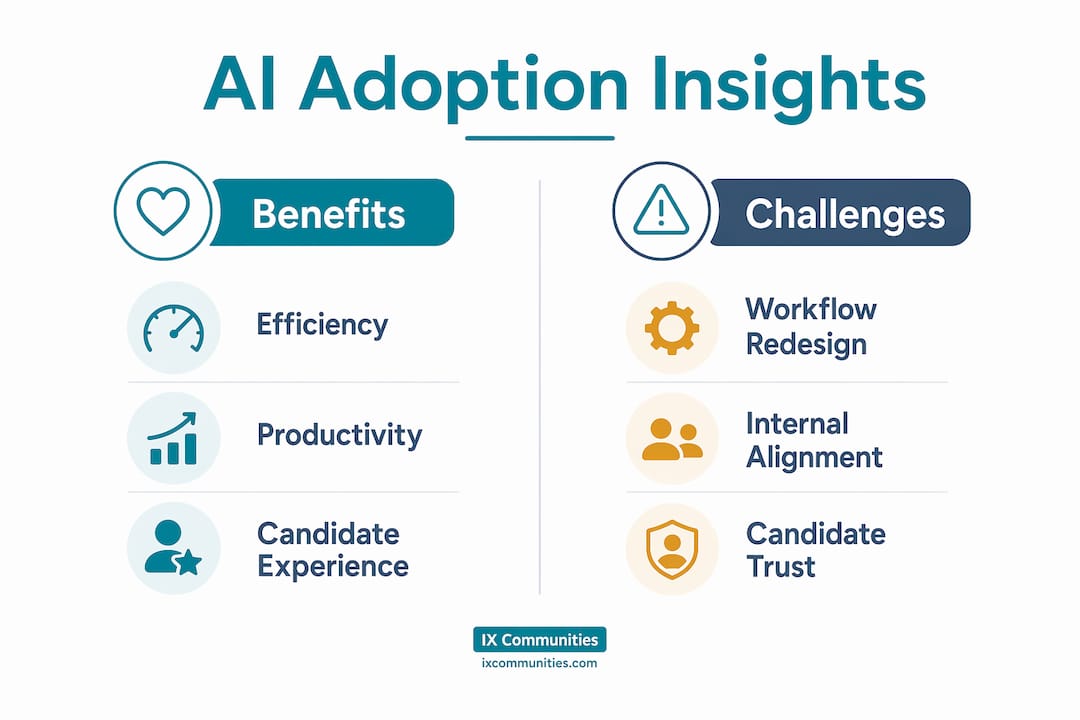
Internal alignment problems compound the issue. TA teams frequently deploy AI tools without defining what success looks like beyond login counts. Deloitte's 2026 enterprise AI data confirms that common adoption metrics like logins are poor proxies for actual impact. Without clear success criteria, teams cannot course-correct when results fall short.
Candidate trust is a serious and underappreciated risk. AI asynchronous interviews reduce continuation rates among top-tier candidates by over 50% due to perceived fairness concerns. That drop-off is concentrated in exactly the candidates most organizations want to attract. Algorithmic opacity, where candidates do not understand how they are being evaluated, drives this behavior.
Bias amplification is another hidden risk. AI tools trained on historical hiring data can encode and scale existing biases. The modest bias mitigation effect noted in the F1000Research study confirms that AI does not automatically produce fairer outcomes. Without transparent oversight in AI screening, bias risks increase rather than decrease.
Key operational pitfalls from year one include:
- Deploying AI without a workflow redesign plan
- Using login rates and activity counts as the primary success measure
- Failing to communicate AI assessment criteria to candidates
- Skipping governance frameworks and ethics reviews before launch
- Treating AI adoption as an IT project rather than a workforce transformation
Pro Tip: Before launching any AI screening tool, run a candidate communication audit. Confirm that every touchpoint explains what AI is assessing, why, and how a human will review the output. Candidates who understand the process are far less likely to drop off.
How can TA leaders balance AI automation with human decision-making?
The right framing for AI in TA is augmentation, not automation. AI-empowered approaches keep humans accountable and making final calls, with AI handling volume and pattern recognition. That distinction matters because it determines how you design workflows, train staff, and communicate with candidates.
Governance does not require a 40-page policy document. Simple, human-understandable AI guardrails maintain adoption momentum far better than complex policies that no one reads. A one-page set of rules that every recruiter can recall and apply is more effective than a detailed framework that lives in a shared drive.
Treating AI adoption as a workforce transformation rather than a software rollout changes everything about how you manage the process. Executive sponsorship and change management are critical success factors for sustainable AI adoption. Without visible leadership commitment, recruiters default to old habits and AI tools go underused.
A practical ramp-up sequence for hybrid human-AI workflows:
- Define the human decision points. Identify every stage where a human must review, override, or approve an AI output before it affects a candidate.
- Pilot with one role type. Run AI screening on a single, high-volume role category before expanding. Measure results against your pre-adoption baseline.
- Train for judgment, not just operation. Teach recruiters when to trust AI outputs and when to question them. Operational training alone is not enough.
- Communicate the model to candidates. Tell candidates which parts of the process use AI and what role human reviewers play. Transparency reduces drop-off.
- Review and adjust at 90 days. Set a formal checkpoint to assess whether the hybrid model is producing the outcomes you defined before launch.
For teams building or restructuring around AI, high-performing TA team structures provide a useful reference for role design in an AI-augmented environment.
What metrics and frameworks maximize return on AI investment?
Measuring AI impact by hours saved is the wrong approach. Capacity reallocation metrics track where AI-generated saved time is redeployed, and that measure is more accurate and more useful than simple efficiency counts. If recruiters save 10 hours per week through AI screening but spend those hours on low-value administrative tasks, the ROI is minimal.
The right metrics connect AI activity to business outcomes. Hiring manager satisfaction scores, candidate-to-offer ratios, 90-day retention rates, and quality-of-hire assessments all reflect whether AI is improving the actual hiring decision, not just the process speed.
| Metric Type | Weak Measure | Strong Measure |
|---|---|---|
| Efficiency | Hours saved per recruiter | Jobs filled per recruiter vs. baseline |
| Adoption | Login frequency | Workflow integration rate |
| Quality | Resumes screened | 90-day retention of AI-sourced hires |
| Capacity | Time freed | Value of redeployed recruiter activity |
| Candidate experience | Application completion rate | Top-tier candidate continuation rate |
Pilots are the most reliable path to a credible business case. Run AI on a defined role category, set a baseline, measure against it at 60 and 90 days, and present the results before scaling. That sequence builds internal credibility and surfaces integration problems before they affect the full function.
AI adoption gaps and real limitations are well-documented for executive roles, where AI screening accuracy drops and human judgment becomes more critical. Knowing where AI performs well and where it does not is itself a strategic advantage.
Key Takeaways
AI in talent acquisition delivers measurable efficiency gains, but sustainable results require workflow redesign, clear metrics, and deliberate human oversight at every decision point.
| Point | Details |
|---|---|
| Efficiency gains are real | AI adopters fill 64% more jobs per recruiter than non-adopters, a proven productivity shift. |
| Workflow redesign is required | Nearly half of organizations deploy AI without changing processes, capturing only a fraction of potential value. |
| Candidate trust is at risk | AI asynchronous interviews cut top-tier candidate continuation rates by over 50% without clear communication. |
| Guardrails should be simple | Short, memorable AI governance rules outperform complex policy documents in sustaining adoption. |
| Measure capacity reallocation | Track where saved time goes, not just how much time is saved, to calculate true AI return on investment. |
What I have learned leading AI adoption in TA
The technology is rarely the problem. After working with TA leaders across large corporate functions, the pattern is consistent: organizations that struggle with AI adoption in year one almost always skipped the internal alignment conversation before launch. They defined success as deployment, not outcomes.
The teams that get it right treat AI as a workforce transformation from day one. They invest in change management before they invest in configuration. They celebrate recruiters who find new ways to use AI tools, not just recruiters who hit volume numbers. That cultural shift is harder than any technical integration, and it takes longer than a single quarter to take hold.
Executive sponsorship is not optional. When a CHRO or VP of TA visibly champions the AI program, reviews the metrics, and holds the function accountable for outcomes, adoption rates and recruiter confidence both rise. When AI adoption is delegated entirely to an operations team, it stalls.
The most underrated lesson from year one is this: standardize your tools before you scale. Organizations that deploy five different AI screening tools across five business units create governance nightmares and make benchmarking impossible. Pick a core stack, build governance around it, and expand deliberately. Ixcommunities members who have gone through this process consistently report that simplification in year one creates the foundation for genuine scale in year two.
— Simon
How Ixcommunities supports TA leaders navigating AI adoption
TA leaders at large corporations do not need more vendor pitches. They need peers who have already solved the problems they are facing now.
Ixcommunities connects talent acquisition leaders through structured peer mentorship, benchmark surveys on AI adoption, and a technology stack reference tool built specifically for TA functions evaluating AI platforms. The ESIX Recruiter Peer Mentorship Program pairs practitioners with experienced leaders who have managed AI integration at scale. Members share real adoption data, governance frameworks, and lessons learned in a secure, confidential environment. For TA leaders moving from year one into year two of AI adoption, that peer context is the fastest path to better decisions.
FAQ
What is the biggest lesson TA leaders report after year one of AI?
The most consistent lesson is that AI adoption fails without workflow redesign. Nearly half of organizations deploy AI without changing existing processes, which limits results significantly.
How much does AI improve recruiter productivity in hiring?
AI adopters fill 64% more jobs per recruiter and submit 33% more candidates than non-adopters, based on 2026 industry data.
Does AI reduce bias in hiring?
AI modestly improves bias mitigation with a beta coefficient of 0.21, but it does not eliminate bias. Deliberate explainability design and human review are still required.
Why do top candidates drop off during AI-driven interviews?
AI asynchronous interviews reduce continuation rates among top-tier candidates by over 50% when candidates perceive the process as unfair or opaque. Clear communication about how AI is used reduces this drop-off.
What metrics should TA leaders use to measure AI success?
Track capacity reallocation, hiring manager satisfaction, and 90-day retention of AI-sourced hires. Metrics like login counts and hours saved do not reflect actual business impact from AI adoption.