

The new TA operating model what high-performing teams are doing differently represents a shift that many talent acquisition leaders have been slow to recognize. Adding recruiters to a broken process produces more of the same broken results. High-performing TA functions in large organizations are not outpacing their peers by working harder or growing headcount faster. They are redesigning how work gets structured, how technology integrates into daily workflows, and how success gets measured. This article examines the structural, operational, and strategic differences that separate the top tier from everyone else.
Table of Contents
- Key takeaways
- The new TA operating model: what high-performing teams do differently
- Automation and AI in the TA operating model
- Measurement priorities that separate top teams
- Common pitfalls in TA model transformation
- My perspective on redesigning the TA operating model
- Advance your TA operating model with Ixcommunities
- FAQ
Key takeaways
| Point | Details |
|---|---|
| Stability over constant restructuring | Top TA teams avoid layoffs and role confusion, creating conditions where performance can actually improve. |
| Automate core workflow steps first | AI applied to scheduling and analytics delivers measurable speed gains without requiring more staff. |
| Track quality, not just volume | High performers prioritize quality-of-hire and funnel conversion metrics over raw applicant counts. |
| Map decisions and handoffs explicitly | Governance gaps, not staffing shortfalls, are the primary cause of TA transformation failures. |
| AI needs human oversight to stay compliant | Ethical AI deployment requires audit logs, bias testing, and named ownership of AI configurations. |
The new TA operating model: what high-performing teams do differently
Most TA functions are structured around a model built for a different era. Roles are loosely defined, accountability is shared broadly and owned narrowly, and technology is layered onto existing processes rather than integrated into them. The result is a function that scales by adding bodies rather than redesigning the system.
Top-performing TA teams take a fundamentally different approach. They treat the operating model as a design problem. Structure, role clarity, and workflow architecture are not afterthoughts. They are the primary levers that drive consistent performance.
Organizational stability as a performance condition
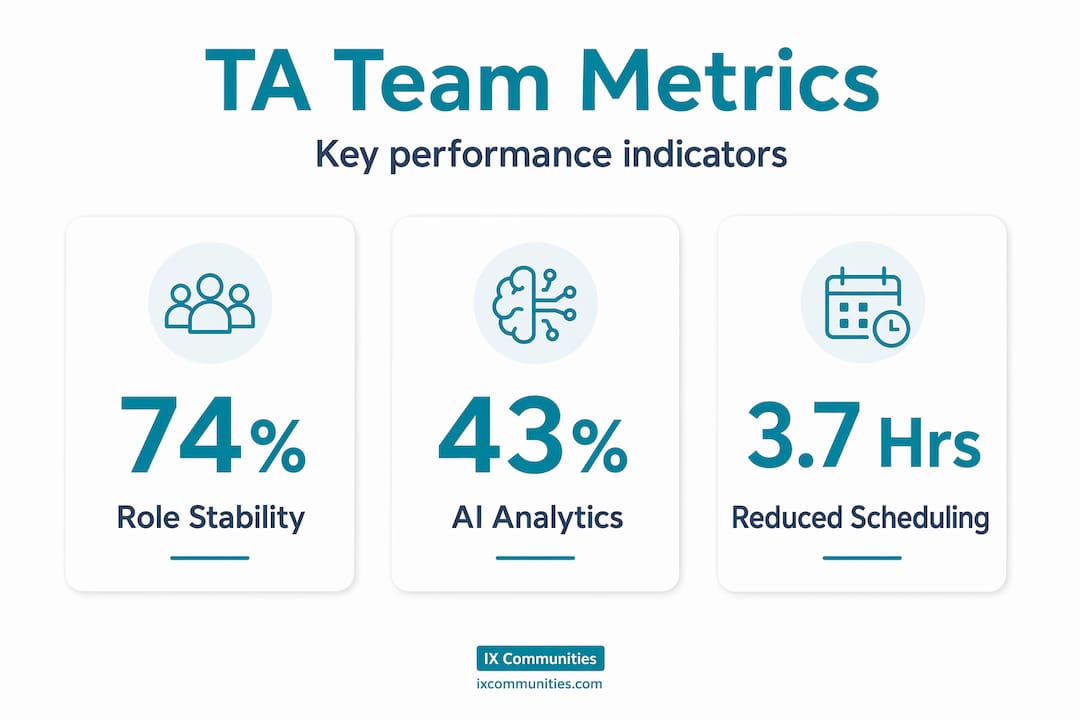
The data on this is direct. Top performers are almost twice as likely to report no layoffs and 74% more likely to reorganize roles without reducing headcount. That is not a coincidence. It reflects a deliberate philosophy: structural stability creates the conditions in which teams can actually improve.
When roles change every few quarters, recruiters spend cognitive energy adapting to new responsibilities rather than refining their execution. When layoffs cycle through a function, institutional knowledge disappears with each departure. High-performing teams protect against this by treating role design as an ongoing investment, not a reactive response to budget pressure.
Role clarity and hybrid work as operational infrastructure
High-performing TA functions are more likely to operate under hybrid and flexible working arrangements. This is not primarily a talent attraction benefit. It is an operational design choice. Teams that work with distributed structures have typically invested more deliberately in technology, documentation, and coordination protocols. That investment pays off in faster response times and higher adoption of new tools.
Clear ownership at the individual role level reduces the friction that comes from ambiguous accountability. When every step in a requisition workflow has a defined owner, bottlenecks surface faster and get resolved more quickly.
Pro Tip: Before adding headcount, audit your existing role definitions. If two people on your team could reasonably claim ownership of the same decision, that ambiguity is costing you more than a vacancy would.
Automation and AI in the TA operating model
Automation is not a future consideration for high-performing teams. It is already embedded in the core of their workflows. The teams pulling ahead are not using AI as an experimental tool on the margins. They are applying it where it has the highest operational impact.
The clearest example is interview scheduling. Automated scheduling reduces median coordination time from 5 hours to 3.7 hours, a 26% reduction. In a high-volume environment, that difference compounds across thousands of requisitions per year. It is one of the largest single efficiency gains available without increasing staff count.

Where top teams are actually deploying AI
Among high performers, 43% apply AI to analytics and reporting and 42% use it in interview scheduling. These are not peripheral functions. They sit at the center of how a TA team diagnoses performance and manages throughput. Applying AI here means faster insight, more consistent coordination, and less administrative burden on recruiters who should be focused on candidate relationships and hiring manager alignment.
Beyond scheduling and analytics, leading teams are deploying AI agents for structured screening and interview intelligence. These agents operate under recruiter instructions, with defined parameters, rather than as autonomous black boxes. AI Workers acting as digital teammates outperform traditional automation precisely because they execute with auditability and compliance built into the workflow.
The shift Deloitte's 2026 Global Technology Leadership Study identifies is relevant here: successful teams move from operators to orchestrators, managing AI-enabled outcomes rather than manually executing each process step. TA leaders who adopt this framing stop asking "what can AI do for us" and start asking "what outcomes do we need to orchestrate, and where does AI fit in that design."
Governance as a non-negotiable component
Deploying AI without governance is how organizations create compliance risk and bias exposure. Responsible deployment requires detailed logging, bias testing, and access controls built into the system from the start, not added as corrections after problems emerge.
High performers assign named owners to AI configuration, integration, monitoring, and continuous improvement. Without clear ownership, AI systems degrade silently, producing outputs that no one has been tasked with auditing. Governance frameworks aligned to standards like the NIST AI RMF provide practical artifacts including human oversight checkpoints and vendor monitoring responsibilities assigned to specific roles.
Pro Tip: When evaluating any AI tool for your TA stack, ask the vendor for their audit log architecture before discussing features. If they cannot produce a clear answer, that is a governance gap you will own.
Measurement priorities that separate top teams
The metrics a TA team tracks reveal what it actually values. High-performing teams track a different set of indicators than their average counterparts, and this shapes where they invest attention and effort.
The pattern is clear:
- Top performers are 22% more likely to track quality of hire and 42% more likely to select it as their top metric
- They are 23% more likely to track application completion rates
- They pay close attention to stage-by-stage conversion rates as indicators of funnel health
- Cost-per-hire receives less emphasis because it can reward false efficiency
| Metric | Why high performers prioritize it |
|---|---|
| Quality of hire | Connects recruiting output to business outcomes, not just filled seats |
| Application completion rate | Surfaces friction in the candidate experience before it becomes a drop-off problem |
| Stage conversion rates | Identifies where the funnel is losing qualified candidates unnecessarily |
| Time-to-fill by stage | Pinpoints delays that accumulate across steps rather than attributing lag to a single bottleneck |
The last point deserves attention. Hiring delays result from small process delays across stages, not a single large bottleneck. Teams that only look at total time-to-fill miss this. Teams that track stage-level metrics can intervene earlier and with more precision.
Deprioritizing cost-per-hire is a deliberate choice, not an oversight. When cost-per-hire dominates the scorecard, teams optimize for the cheapest path to a filled seat. That often means lower quality outcomes, higher turnover, and more cost downstream. Standardizing workflow stages and enforcing measurement at each step makes continuous improvement both visible and manageable.
Common pitfalls in TA model transformation
Most TA transformation efforts fail before they produce results. The reason is rarely a lack of resources or executive support. Most scaling failures trace back to governance gaps, not headcount shortages. Understanding where transformations break down is as instructive as knowing what top performers do right.
The most common failure patterns include:
- Fragmented accountability: Hybrid operating models where no one owns the full workflow from requisition to offer. Each team owns a piece, and the handoffs between pieces are where performance erodes.
- Linear headcount scaling: Treating every increase in hiring volume as a signal to add recruiters, rather than redesigning the workflow to absorb more volume with the same or fewer people.
- Black-box AI adoption: Deploying AI tools without logging, without bias testing, and without a named internal owner. When something goes wrong, there is no audit trail and no clear accountability.
- Measurement drift: Starting a transformation with strong KPI discipline, then allowing metrics to shift or be deprioritized as pressure mounts. This disconnects the transformation from its intended outcomes.
High performers avoid these traps by treating operating model design as an ongoing discipline, not a one-time project. Explicit mapping of decisions and handoffs is a structural practice, not a documentation exercise. When every decision point in the workflow has a named owner and a defined input/output, accountability becomes visible and enforceable.
Teams that succeed also invest in mapping recruitment and talent management as connected systems rather than separate functions. When both sides understand how their decisions affect each other, handoffs improve and candidate outcomes become more predictable.
Pro Tip: Run a decision audit on your last five requisitions that missed target time-to-fill. Map every decision point and identify who owned it. The gaps in that map are your transformation priorities.
My perspective on redesigning the TA operating model
I've worked with enough TA functions to see a clear pattern. The teams that struggle most are not the ones with the fewest recruiters. They are the ones that have never stopped to examine how their operating model is actually designed.
In my experience, the hardest part of this shift is not the technology. It is convincing leadership that adding headcount is a symptom response, not a fix. Every time a team under-performs and the answer is another recruiter, the structural problem gets one layer deeper. The new recruit absorbs the same broken workflows and produces the same results.
What I've learned is that the teams who make lasting improvements do three things consistently. They design stability into their structure, so that constant reorganization does not consume the capacity needed for actual improvement. They treat AI as an integrated part of their workflow, with clear governance and named ownership, not as a side tool that runs independently. And they track metrics that connect TA activity to business outcomes, not metrics that make the function look efficient in isolation.
The uncomfortable truth is that most TA functions could achieve significantly more with their current headcount if the operating model were redesigned thoughtfully. That is not a comfortable message for teams that have spent years asking for more resources. But it is the message the data supports, and it is where I consistently see the largest performance gains.
Embracing this perspective requires discipline. It means resisting the urge to solve workflow problems with people rather than design. It means investing in governance before problems surface rather than after. And it means being willing to measure outcomes that expose where the current model is falling short.
— Simon
Advance your TA operating model with Ixcommunities
Ixcommunities provides talent acquisition leaders and recruiting professionals in large organizations with the peer networks, benchmarking data, and expert resources needed to move from outdated operating models to high-performing ones. Through the Talent Leaders Peer Mentoring Program, TA leaders connect with peers who are navigating the same structural, technology, and governance challenges described in this article. The ESIX Recruiter Peer Mentorship Programs extend this support to recruiting teams focused on developing operating model capabilities. Ixcommunities also provides access to industry benchmark surveys that give TA functions the data reference points needed to assess where their current model stands relative to high performers. For teams ready to move beyond theory and into practical operating model improvement, Ixcommunities is where that work gets supported.
FAQ
What is the new TA operating model?
The new TA operating model shifts focus from headcount growth to structural design, workflow automation, and outcome-based measurement. High-performing teams redesign how decisions get made and how AI integrates into daily recruiting operations.
How do top TA teams use AI without creating compliance risk?
Top teams deploy AI with governance frameworks that include detailed audit logs, bias testing, and named internal owners responsible for configuration and monitoring. Governance frameworks aligned to standards like the NIST AI RMF provide the structure that keeps AI use compliant and auditable.
Why do most TA transformation efforts fail?
Most failures trace back to governance gaps rather than resource shortfalls. Fragmented accountability, undefined handoffs between workflow stages, and unmonitored AI tools are the primary causes of transformation breakdowns in large organizations.
What metrics do high-performing TA teams prioritize?
High performers focus on quality of hire, application completion rates, and stage-level conversion rates. They deprioritize cost-per-hire because it can drive short-term efficiency decisions that reduce hiring quality and increase downstream costs.
How much faster is automated interview scheduling?
Automated scheduling reduces median coordination time from 5 hours to 3.7 hours, a reduction of approximately 26%. Across high-volume recruiting functions, this difference produces significant throughput gains without requiring additional staff.