

Leaner talent acquisition teams are closing more roles than ever before, and the numbers back it up. Doing more with less is no longer a budget constraint workaround. It has become a defining competency for high-performing TA functions in mid to large corporations. The teams pulling this off are not working harder. They are removing the friction that quietly taxes recruiter capacity every single day. This article breaks down where that friction lives, what technology actually delivers versus what it promises, and how to measure whether your efficiency initiatives are working.
Table of Contents
- Key takeaways
- Where TA workflows lose the most time
- AI and automation as efficiency multipliers
- Structural redesign beyond automation
- Measuring efficiency gains accurately
- A note on balancing technology with judgment
- How Ixcommunities supports TA efficiency initiatives
- FAQ
Key takeaways
| Point | Details |
|---|---|
| Bottlenecks compound fast | Small scheduling and coordination delays add up to weeks of lost hiring time across the funnel. |
| Automation targets the right work | AI screening and automated scheduling return measurable recruiter hours without reducing hiring quality. |
| Process redesign matters equally | Reducing decision points and handoffs delivers efficiency gains that technology alone cannot achieve. |
| Metrics must go beyond cost | Funnel health, time to first interview, and quality of hire are more reliable efficiency indicators than cost per hire alone. |
| Calibration protects quality | AI tools require a validation phase before full deployment to maintain consistent, fair outcomes. |
Where TA workflows lose the most time
Talent acquisition efficiency rarely fails at a single, obvious point. It erodes through accumulation. A two-day delay waiting on a hiring manager to review resumes. Three back-and-forth emails to schedule a phone screen. A recruiter spending 40 minutes reconciling notes from two different systems before writing a debrief. None of these feel catastrophic in isolation. Together, they define the difference between a 16-day and a 35-day time to hire.
The biggest culprits fall into three categories:
- Scheduling and coordination drag. Manual scheduling is the single most persistent bottleneck in corporate recruiting operations. Automated scheduling reduces coordination time by 26% compared to manual methods, with automated processes completing scheduling in a median of 3.7 hours versus 5 hours manually. For teams managing dozens of open roles, that delta compounds quickly.
- Disconnected systems and data reconciliation. When recruiters juggle an ATS, a CRM, a scheduling tool, and a shared inbox that do not talk to each other, they spend significant time manually reconciling data. Disconnected systems create hidden handoffs and reconciliation work that taxes recruiter throughput without appearing on any efficiency report.
- Administrative screening load. Initial resume review and manual screening routinely consume 40 to 60 percent of a recruiter's working week at high-volume organizations. This is time that could be redirected toward relationship-building, offer negotiation, and strategic workforce planning.
The cognitive dimension of these inefficiencies is underappreciated. Every time a recruiter switches between systems or re-reads context to make a decision, they incur what researchers call cognitive load. Adding tools without reducing decision points increases that load rather than lowering it. This is why purely adding software to an already fragmented workflow often makes things worse before it makes them better.
Candidate experience suffers proportionally. Delays at the top of the funnel signal disorganization and reduce offer acceptance rates. The downstream cost of losing a qualified candidate late in the process because early scheduling friction created disengagement is rarely calculated but consistently real.
AI and automation as efficiency multipliers
The clearest wins in optimizing recruitment processes today come from two specific applications of automation: scheduling and initial screening. Both deliver measurable returns, and both have been validated at scale.
On the scheduling side, systems that automate calendar holds, manage reschedules without recruiter involvement, and balance interviewer load remove the coordination work that scheduling automation collapses into a self-serve workflow. Recruiters stop being calendar administrators. Hiring managers get requests that fit their actual availability. Candidates reschedule on their own when conflicts arise.

AI-powered screening delivers even more dramatic capacity returns. AI interviewing reduces time-to-first-interview by up to 90%, moving initial stages from three to four weeks down to days. This matters most for high-volume roles where recruiter bandwidth limits how many candidates can move through the funnel in a given week.
The Zapier pilot offers a concrete benchmark. After deploying asynchronous AI-led screens, time from initial review to completed recruiter screen dropped from 8 days to 2.75 days, returning 84 recruiter hours over the pilot period. Candidates rated the experience 4.5 out of 5. The efficiency gain did not come at the expense of candidate satisfaction. It improved both simultaneously.
| Approach | Time to first interview | Recruiter hours per role | Candidate satisfaction |
|---|---|---|---|
| Manual screening and scheduling | 3 to 4 weeks | High (est. 6 to 10 hours) | Varies |
| AI screening plus automated scheduling | 2 to 5 days | Low (est. 1 to 3 hours) | High (4.5/5 in pilot data) |
Technology functions as an efficiency multiplier, not a headcount replacement. Recruiters freed from administrative screening do not disappear. They redirect capacity toward candidate relationship management, internal stakeholder alignment, and strategic recruiter skills that directly affect hiring outcomes.
Pro Tip: Run a 30-day AI screening pilot on a single high-volume role type before scaling. Validate AI decisions against recruiter assessments during that window to confirm quality alignment before removing human review from the default workflow.
Sourcing strategy also affects funnel efficiency in ways that are easy to overlook. Referred candidates pass initial screens at a 52% rate compared to 35% overall. Prioritizing referral pipelines does not just improve quality. It reduces the volume of screening work required to fill each role.
Structural redesign beyond automation
Automation handles task-level inefficiency. Structural redesign handles the coordination and decision friction that automation cannot reach alone. This is where TA leaders have the most control and where process discipline pays off consistently.
- Consolidate your sources of truth. If recruiters maintain candidate status in three places, pick one and enforce it. A single system of record for pipeline status, interview feedback, and hiring manager notes eliminates reconciliation time and reduces the risk of decisions made on incomplete information.
- Reduce decision points in the funnel. Every approval gate, secondary review, or optional screening step that does not demonstrably improve hiring quality adds time and cognitive overhead. Audit your process for decisions that exist by habit rather than by design. Remove them or automate the handoff.
- Design for clear ownership. Ambiguity about who moves a candidate forward is one of the most common sources of pipeline stall. Assign explicit ownership at each stage. When a candidate completes an AI screen, one named person is responsible for the next action within a defined timeframe.
- Expand and certify your interviewer pool. Scheduling flexibility is directly proportional to how many trained interviewers are available at any given time. A limited interviewer pool creates bottlenecks regardless of how good your scheduling software is. Training more interviewers and documenting their availability reduces coordination drag at the interview stage.
- Align process changes with quality metrics. Top-performing TA teams measure efficiency by funnel health and quality of hire, not by cost reduction alone. Any structural change that speeds up the process but degrades hiring quality has failed its actual objective.
Pro Tip: Map your current hiring workflow end to end and count every handoff. Each handoff is a potential stall point. If a role has more than seven distinct handoffs from application to offer, you have structural room to improve throughput without adding technology.
For teams managing executive hiring alongside high-volume roles, the structural considerations differ but the principle holds. Reducing coordination friction in executive recruiting processes follows the same logic: fewer handoffs, clearer ownership, and faster decision cycles.
Measuring efficiency gains accurately
Boosting TA team output without a measurement framework produces activity, not progress. The metrics that matter most are not always the ones most readily available in standard ATS reporting.
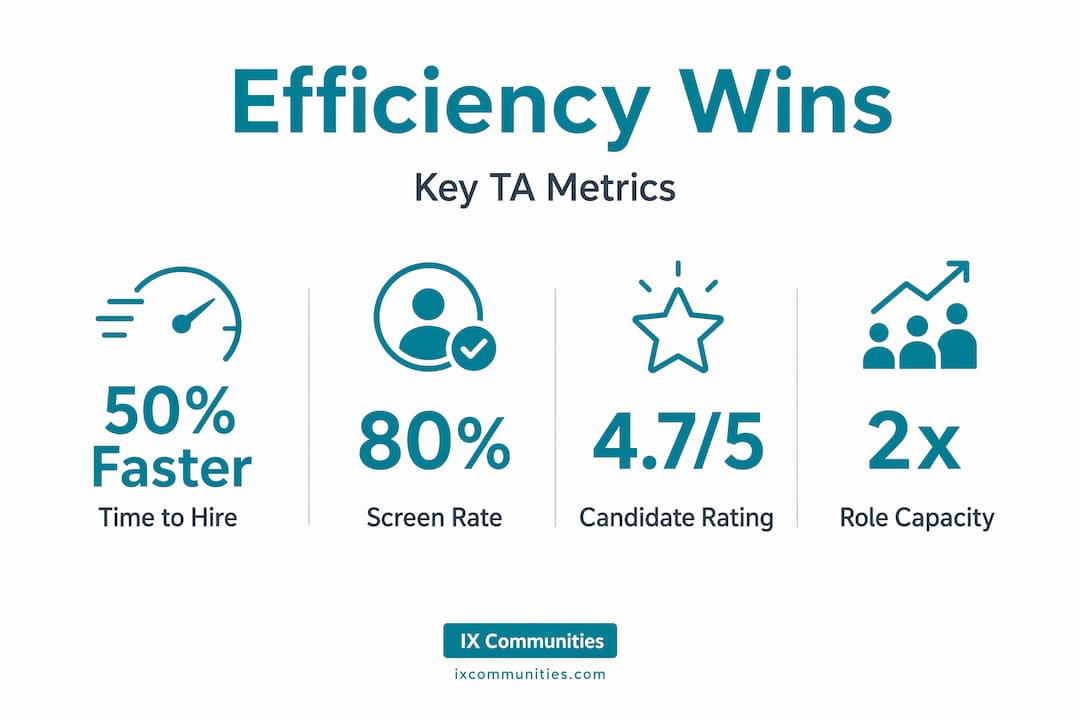
Current 2026 benchmarks give you a realistic baseline. Median time to hire sits at 16 to 23 days, time to fill at 44 to 45 days, cost per hire at $1,340, and offer acceptance rate at 75%. If your team is operating outside these ranges, you have a measurable starting point for improvement.
The metrics worth tracking as you implement efficiency changes include:
- Time to first interview. This early-stage metric captures operational speed better than aggregate time to fill, particularly for high-volume roles where candidate engagement peaks in the first two weeks.
- Funnel conversion rates by stage. After implementing automation, new bottlenecks often appear downstream. A candidate who moves quickly from application to phone screen may then stall at the hiring manager review stage. Funnel analytics surface these shifts.
- Offer acceptance rate. A faster process that produces lower acceptance rates signals a quality problem or a candidate experience problem. Track this alongside speed metrics.
- Recruiter capacity utilization. Hours returned through automation should translate into measurable changes in what recruiters spend time on. If automated screening saves 84 hours and none of that time goes to higher-value activities, the efficiency gain is not reaching its full potential.
Recruiting efficiency software that targets 40 to 50% reductions in hiring time works best when the underlying process has been audited and simplified first. Technology applied to a broken process produces faster broken outcomes.
A note on balancing technology with judgment
I have worked with enough TA teams to know that the most common failure mode in efficiency initiatives is not choosing the wrong tool. It is deploying the right tool into an unchanged workflow and expecting transformation.
The teams I have seen succeed consistently do two things differently. They treat process redesign as a prerequisite, not an afterthought. And they maintain human oversight during the transition period rather than assuming automation is immediately reliable at full scale.
AI screening requires calibration and human validation before full deployment. The teams that rush past this step often see early efficiency gains followed by quality deterioration that erodes stakeholder trust and sets back the broader initiative. A 30-day validation window is not bureaucratic caution. It is responsible adoption.
The deeper point is about what efficiency is actually for. When recruiters reclaim 10 to 15 hours per week from administrative tasks, that time should go toward the work that automation cannot do. Building relationships with passive candidates. Advising hiring managers on market realities. Developing sourcing strategies that reduce dependency on inbound volume. The recruiter role does not shrink when efficiency improves. It shifts toward higher-value work that the organization genuinely needs.
Reducing cognitive load through system consolidation and process simplification matters just as much as any specific technology. I have seen recruiters perform significantly better after their organization moved from four disconnected tools to one integrated platform, even before any AI features were activated. Clarity reduces friction. Friction reduces output.
— Simon
How Ixcommunities supports TA efficiency initiatives
Ixcommunities provides structured resources for talent acquisition professionals who are working to improve team performance and adopt more efficient practices. The ESIX Recruiter Peer Mentorship Programs connect recruiters with peers who have direct experience implementing automation and process redesign in comparable organizations. The Talent Leaders Peer Mentoring Program supports TA leaders in building strategies that improve output without expanding headcount. For teams that want data-driven context, Benchmark Surveys provide peer-sourced metrics that help TA functions assess where they stand relative to comparable organizations. IX Communities Membership provides access to the full range of these programs, along with peer networking and ongoing learning resources.
FAQ
What is the fastest way to improve TA team efficiency?
Automating scheduling and initial screening typically delivers the fastest measurable returns. Automated scheduling alone reduces coordination time by 26%, and AI screening can cut time to first interview by up to 90%.
Does automation reduce hiring quality?
Not when implemented correctly. Pilots show that AI-assisted screening combined with human review maintains or improves quality while returning significant recruiter capacity. A calibration phase before full deployment is the standard practice for protecting hiring outcomes.
What metrics should TA teams track when improving efficiency?
Track time to first interview, funnel conversion rates by stage, offer acceptance rate, and cost per hire alongside quality of hire. Top TA teams anchor efficiency measurement on funnel health rather than cost reduction alone.
How do you reduce cognitive load for recruiters?
Consolidate systems so recruiters work from a single source of truth, reduce unnecessary decision points in the workflow, and automate handoffs between stages. Each of these changes reduces the mental overhead of managing a high-volume pipeline.
What benchmarks should TA teams use in 2026?
Current benchmarks include a median time to hire of 16 to 23 days, time to fill of 44 to 45 days, cost per hire of $1,340, and an offer acceptance rate of 75%. These figures provide a realistic baseline for evaluating your team's current performance.