

The new talent acquisition operating model is a structural and management redesign that replaces reactive, fragmented recruiting with a proactive, system-driven function integrating AI, recruitment operations, and strategic workforce planning. Recruiting is now the largest HR spending category at $401 per employee, yet tactical models carry 25–40% cost-per-hire inflation. That gap is the business case for redesign. Leading organizations are addressing it by building three distinct capability centers: Talent Intelligence and Strategy, Candidate Experience and Relationships, and Recruiting Operations (RecOps). The model shifts recruiters from administrative doers to strategic advisors, supported by AI and a dedicated operations layer.
What are the components of the new talent acquisition operating model?
The new recruitment operating model organizes around three functional domains, each with a defined scope and ownership. Talent Intelligence and Strategy owns workforce forecasting, labor market analysis, and role scoping. Candidate Experience and Relationships manages pipeline development, employer brand touchpoints, and hiring manager partnerships. RecOps owns the infrastructure: process design, tech stack management, data analytics, capacity planning, and candidate experience systems.
RecOps as a function covers seven core pillars: process design, tech stack ownership, data and analytics, recruiter enablement, capacity planning, candidate experience infrastructure, and compliance governance. This is not a support role. RecOps is the operational backbone that allows recruiters to focus on judgment-intensive work rather than administrative tasks.

AI sits inside the RecOps domain as a tool for workflow orchestration, not as a recruiter replacement. It handles signal extraction from resumes, screening automation, interview scheduling, and status communications. The distinction matters: AI manages volume and consistency, while recruiters manage relationships and decisions.
Pro Tip: When designing your model, map every recruiter activity by type before assigning ownership. Activities that are repetitive and rule-based belong in the AI or RecOps layer. Activities requiring judgment or relationship management belong with recruiters.
Traditional model vs. ai-first operating model
| Dimension | Traditional Model | AI-First Operating Model |
|---|---|---|
| Recruiter time on screening | 35% of weekly hours | 8% of weekly hours |
| Recruiter time on scheduling | 28% of weekly hours | ~3% of weekly hours |
| Process ownership | Individual recruiter | RecOps team |
| Data source of truth | Fragmented across tools | Unified ATS/HRIS integration |
| Capacity scaling method | Add headcount linearly | Redesign workflows and ratios |
How does the new model improve efficiency and reduce recruiting costs?
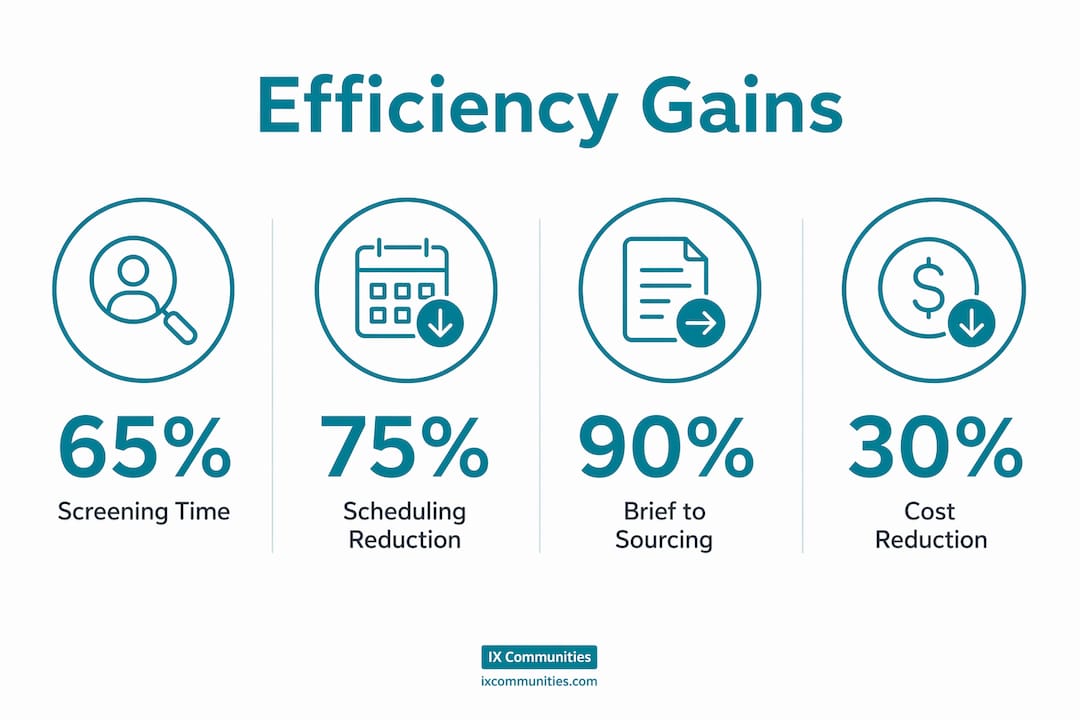
The efficiency gains from this model are measurable and significant. AI-first recruiting reduces recruiter time on screening from 35% to 8% and scheduling from 28% to roughly 3%. That freed capacity does not disappear. It redirects to sourcing, relationship management, and hiring manager advisory work, which are the activities that directly affect offer acceptance rates.
Structured gating and standardized role scoping compress brief-to-sourcing time from two weeks to under 24 hours. Hiring manager interview burden drops by 75–80%, reducing the typical 20–25 hours of screening interviews to a single structured round. That reduction alone improves hiring manager satisfaction and accelerates time-to-fill.
The core problem in most organizations is linear headcount scaling. When requisition volume rises, the default response is to hire more recruiters. This approach does not fix broken workflows. It replicates them at higher cost. Redesigning capacity ratios, so that one recruiter supported by RecOps and AI can handle a higher requisition load, is the actual fix.
Pro Tip: Before any technology investment, audit your current recruiter time allocation. If more than 20% of recruiter hours go to scheduling and status updates, you have a workflow problem, not a headcount problem.
Cost impact: tactical model vs. redesigned operating model
| Metric | Tactical Model | Redesigned Model |
|---|---|---|
| Cost-per-hire inflation | 25–40% above baseline | Reduced through workflow redesign |
| Brief-to-sourcing time | Up to 2 weeks | Under 24 hours |
| Hiring manager screening hours | 20–25 hours per role | Single structured round |
| Recruiter screening time share | 35% of capacity | 8% of capacity |
What organizational changes does the new model require?
Implementing the new talent acquisition framework requires structural changes, not just technology purchases. The most critical change is creating a dedicated RecOps team that is organizationally separate from recruiters. RecOps owns systems and process workflows. Recruiters own relationships and decisions. Mixing these responsibilities is the most common failure point.
The shift from recruiter as doer to recruiter as advisor depends entirely on the RecOps layer being functional first. Without operational infrastructure in place, recruiters absorb administrative work by default. The advisor role is not aspirational. It is a structural outcome of proper model design.
System integration is non-negotiable. Disconnected systems without a single source of truth create manual reconciliation overhead that negates AI-driven efficiencies. Your ATS, HRIS, and collaboration tools must share data through clean API integrations. Without this, your team spends time reconciling records instead of recruiting.
The recommended implementation sequence for most organizations follows four stages:
- Audit current state. Map all recruiter activities, time allocations, and system touchpoints. Identify where manual work is highest.
- Define RecOps scope. Establish which processes, tools, and data ownership belong to RecOps before hiring or reassigning anyone.
- Run a pilot program. Apply the new model to one business unit or job family. A pilot-then-scale approach typically delivers a 15–25% reduction in time-to-fill before enterprise rollout.
- Measure and scale. Use pilot data to build the business case for full deployment. Stakeholder resistance drops significantly when you present results rather than projections.
RecOps maturity follows a predictable progression. Early-stage teams focus on process documentation and basic ATS hygiene. Mid-stage teams add analytics and capacity modeling. Advanced teams operate as strategic partners to the business, providing workforce forecasting and talent market intelligence. Understanding where your organization sits on that spectrum determines which investments to prioritize first.
How can organizations balance AI and human judgment in recruiting?
AI in recruiting is defined by its appropriate scope: early funnel tasks where volume and consistency matter. AI handles signal extraction and screening automation, not cultural fit assessment or offer negotiation. This boundary is not a limitation. It is a design principle.
The human-centric functions in the new model include candidate relationship management, high-touch executive recruiting, hiring manager advisory work, and final-stage assessment. These are the activities where recruiter judgment, contextual knowledge, and interpersonal skill produce outcomes that AI cannot replicate. Recruiters who understand this distinction become more effective, not less relevant.
Governance frameworks for AI in recruiting require three components:
- Bias monitoring protocols. Regular audits of AI screening outputs to identify demographic patterns that may indicate model drift or training data issues.
- Continuous calibration. Structured feedback loops between recruiters and AI outputs, so the system improves based on actual hiring outcomes rather than proxy signals.
- Defined escalation paths. Clear rules for when AI recommendations are overridden by human judgment, and documentation of those decisions for future calibration.
Ungoverned AI adoption is a real risk. Organizations that deploy AI tools without these governance structures often see initial efficiency gains followed by quality degradation in candidate selection. The transparency and defined handoffs that characterize well-designed models are what prevent this outcome. Recruiter trust in AI tools is built through demonstrated accuracy and clear accountability, not through vendor promises.
For practical guidance on where AI adds value and where it falls short, the Ixcommunities resource on AI in executive search provides a grounded assessment from in-house talent leaders.
Key takeaways
The new talent acquisition operating model succeeds when RecOps owns the infrastructure, AI handles early funnel tasks, and recruiters focus on judgment-intensive advisory work.
| Point | Details |
|---|---|
| RecOps is the foundation | Create a dedicated RecOps team before deploying AI tools or redesigning recruiter roles. |
| AI reduces administrative load | Screening time drops from 35% to 8% of recruiter capacity with AI-first workflows. |
| Pilot before scaling | A pilot program typically delivers 15–25% time-to-fill reduction and builds stakeholder buy-in. |
| Integration is non-negotiable | ATS, HRIS, and collaboration tools must share a single source of truth to avoid manual reconciliation. |
| Linear scaling fails | Adding recruiters without redesigning workflows replicates inefficiency at higher cost. |
What i have observed after years of watching TA redesigns succeed and fail
The organizations that struggle most with this transition are not the ones that lack technology. They are the ones that buy technology before they have defined their operating model. I have seen teams deploy sophisticated AI screening tools into workflows that were never documented, and then wonder why adoption stalled. The tool was not the problem. The absence of operational design was.
The second pattern I see consistently: RecOps gets created as a title, not a function. Someone gets labeled a "Recruiting Operations Manager" but continues to own a requisition load. That is not RecOps. That is a recruiter with a different job title. Real RecOps means the person owns systems, data, and process, with no direct recruiting responsibilities. That separation is what makes the model work.
The pilot approach is not optional for large organizations. An enterprise-wide rollout without a proof of concept creates resistance at every level, from hiring managers who distrust the new process to recruiters who feel their judgment is being replaced. A well-run pilot in a single business unit, with clear metrics and visible results, changes that conversation entirely. For teams building this function from the ground up, the step-by-step guide from Ixcommunities is a practical starting point.
What this model ultimately does is restore recruiting to a strategic function. Recruiters who spend 35% of their time on screening are not strategic partners to the business. Recruiters who spend that same capacity on talent advisory work, pipeline development, and hiring manager coaching are. The model does not change what good recruiting looks like. It removes the structural barriers that prevent recruiters from doing it.
— Simon
How Ixcommunities supports TA leaders adopting modern operating models
Ixcommunities provides corporate talent acquisition leaders with the peer networks, benchmarking data, and expert resources needed to implement modern recruiting operating models with confidence.
Through ESIX and TLIX communities, TA leaders access structured peer discussions on RecOps design, AI governance, and capacity planning. The benchmark surveys allow teams to compare their cost-per-hire, time-to-fill, and recruiter capacity metrics against peer organizations. The technology stack reference tool helps TA leaders evaluate and integrate recruiting technologies before committing to a full deployment. For teams focused on recruiter development within the new model, the ESIX Recruiter Peer Mentorship Programs provide structured skill development aligned to the advisor role. Explore membership options to access the full resource library and peer network.
FAQ
What is the new talent acquisition operating model?
The new talent acquisition operating model is a structural redesign that organizes recruiting around three capability centers: Talent Intelligence and Strategy, Candidate Experience and Relationships, and Recruiting Operations. It replaces reactive, recruiter-as-doer workflows with a proactive, system-driven function supported by AI and a dedicated RecOps team.
What does RecOps own in this model?
RecOps owns process design, tech stack management, data analytics, capacity planning, recruiter enablement, and candidate experience infrastructure. It does not carry a requisition load. Its function is to build and maintain the operational systems that allow recruiters to focus on judgment-intensive work.
How much can AI reduce recruiter administrative time?
AI-first models reduce recruiter screening time from 35% to 8% of weekly capacity and scheduling time from 28% to roughly 3%. That freed capacity redirects to sourcing, relationship management, and hiring manager advisory work.
Why do most TA operating model redesigns fail?
The most common failure points are deploying technology before defining the operating model, creating RecOps as a title rather than a distinct function, and attempting enterprise-wide rollout without a pilot program. Disconnected systems without ATS and HRIS integration also create manual reconciliation overhead that negates efficiency gains.
How long does implementation take before showing results?
A pilot-then-scale approach typically delivers a 15–25% reduction in time-to-fill before full enterprise rollout. Most organizations see measurable results within one business unit within 60–90 days of structured pilot deployment.