

Retained search is defined as an exclusive, fee-based engagement where a firm commits full resources to identifying and placing senior leadership. The future of retained search no longer centers on who can source the fastest. Clients now pay for judgment, cultural insight, and strategic advisory. The global executive search market is valued at $20.8 billion in 2025, projected to reach $29.25 billion by 2029. That growth is not driven by volume. It is driven by the premium clients place on intelligence over process. Firms that understand this shift will hold their fees. Firms that do not will face commoditization.
What is the future of retained search?
The future of retained search is an advisory model where firms monetize judgment, not sourcing speed. AI now delivers qualified candidate longlists within 36–72 hours versus 10–14 days for traditional human-only methods. That gap eliminates sourcing speed as a competitive differentiator. What remains is the quality of the recommendation, the accuracy of the cultural read, and the confidence behind the hire.
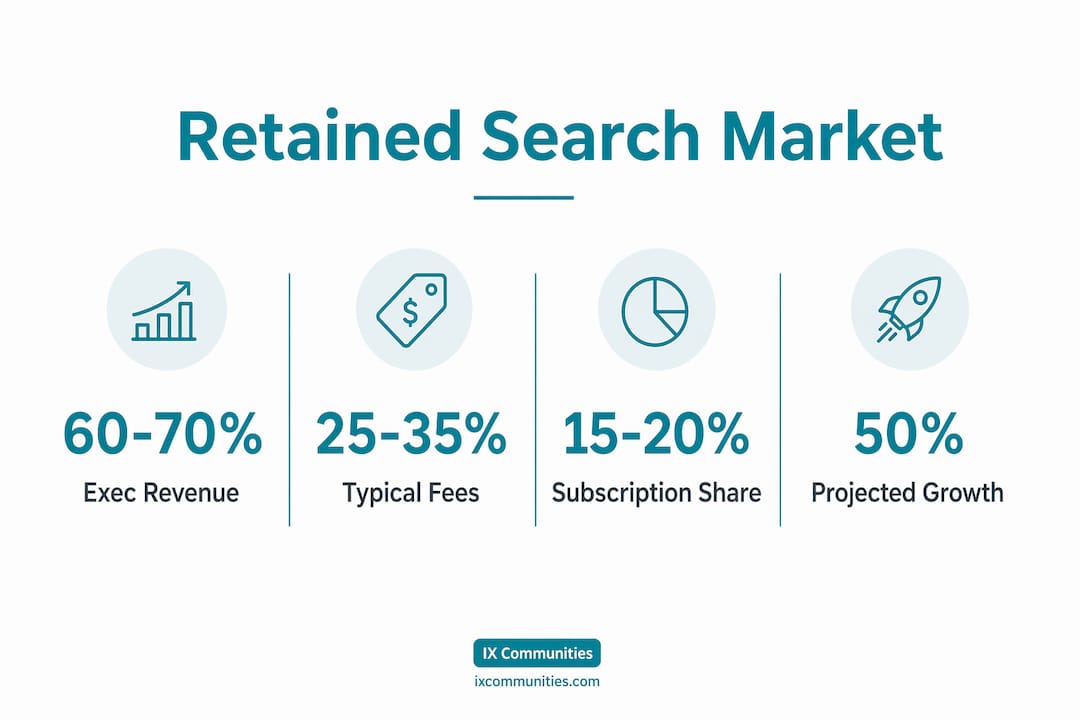
Retained search commands 60–70% of global executive search revenue despite lower total volume than contingency. Fees hold at 25–35% of first-year compensation for retained engagements. That pricing reflects the depth of commitment, not just the output. Clients who understand this distinction keep paying it. Clients who do not are the ones pushing back on fees.

The core shift is this: retained search firms are moving from information providers to conviction deliverers. Information is abundant. Confident, evidence-backed recommendations backed by deep market knowledge are not. That is what the premium buys.
How is AI reshaping the retained search operating model?
AI reduces the operational burden of retained search by automating resume parsing, candidate outreach, and reference checks. AI-augmented retained search compresses timelines from 18–20 weeks to 14–16 weeks, a reduction of approximately 20%. That efficiency is not the end product. It is the foundation that frees consultants to do higher-value work.
The time recaptured from automation shifts directly into advisory capacity. Retained search recruiters are moving from 60% sourcing and 40% advisory to 20–30% sourcing and 70–80% advisory roles. This is not a gradual drift. It is a structural change in how retained firms create and defend their fees.
For mid-to-senior roles, AI-augmented models now operate at 15–25% lower fees than traditional high-touch engagements. This creates a two-tier market. Clients filling director-level roles may accept the faster, lower-cost model. Clients filling C-suite and board positions still require the full advisory experience. Knowing which model fits which mandate is itself a form of advisory value.
- Resume and longlist generation: AI tools produce structured longlists in 36–72 hours, compared to 10–14 days manually.
- Candidate outreach automation: Personalized outreach at scale reduces consultant time on early-stage communication.
- Reference and background checks: Automated reference platforms cut verification time significantly.
- Role brief shaping: Firms embedding AI into core infrastructure use data to shape role briefs before clients finalize them.
- Market mapping: Real-time talent intelligence replaces static research decks.
Pro Tip: Ask your retained search partner how AI is used in their process specifically. If the answer focuses only on sourcing speed, that firm has not yet made the shift to advisory-led delivery.
What do clients actually want from retained search firms now?
Clients want firms that help define what success looks like before the search begins. The shift is from transactional sourcing to monetizing recruiter judgment. Firms that help clients articulate success criteria, assess cultural alignment, and manage integration risk hold premium fees. Firms that deliver resumes do not.
"Executive search is pivoting to decision intelligence. The firms that will thrive are those that deliver conviction, not just candidates." Executive search decision intelligence
This shift has direct pricing consequences. Firms focused on advisory and cultural fit maintain premium fees. Transactional sourcing models face price compression. The difference is not the quality of the candidates presented. The difference is the quality of the recommendation behind them.
Clients increasingly expect retained firms to operate at board level. That means advising on organizational design, succession risk, and leadership team composition. Firms that bring organizational psychology expertise and board-level perspective into their process retain the highest fees. Those that limit their scope to candidate delivery are competing on a shrinking margin.
The demand for specialized roles is also reshaping client expectations. Succession planning and AI governance leadership roles are among the fastest-growing mandates in retained search. Clients filling these roles need partners who understand the function deeply, not just the talent market broadly.
How are retained search business models evolving?
Subscription and retainer models are the most significant structural shift in retained search fee design. Subscription models now account for 15–20% of the retained market, with 50% of executive search revenue projected to come from non-traditional fee structures by 2030. Traditional stage-based payment still holds 75–80% adoption, but the trajectory is clear.
| Model | Structure | Best fit | Fee implication |
|---|---|---|---|
| Traditional retained | Three-stage payment tied to milestones | Single critical hires | 25–35% of first-year comp |
| AI-augmented retained | Compressed timeline, lower touch | Mid-to-senior director roles | 15–25% lower than traditional |
| Subscription/retainer | Ongoing access, recurring revenue | Repeat clients, pipeline building | Predictable monthly or annual fee |
| Advisory partnership | Consultancy-style engagement | CHROs, boards, succession planning | Project or retainer-based |
The subscription model creates predictable revenue for firms and deeper relationships for clients. It resembles management consultancy more than vendor sourcing. Clients gain continuous access to market intelligence, succession bench support, and leadership advisory without triggering a new engagement for every search. Firms gain stability and the ability to invest in client knowledge over time.
Pro Tip: If your organization runs more than three executive searches per year, ask your retained partner about a subscription or retainer arrangement. The economics and the relationship quality both improve.
How should corporate talent leaders engage retained search firms in 2026?
Corporate talent leaders who get the most from retained search treat it as a strategic partnership, not a reactive transaction. The firms that deliver the best outcomes are engaged early, before a vacancy becomes urgent. Retained searches are most effective when they begin long before leadership gaps appear, allowing for succession bench building and leadership risk mitigation.
Here is a practical framework for maximizing retained search outcomes in 2026:
- Engage before the vacancy. Start conversations with retained partners during annual talent reviews, not when a leader announces departure. Early engagement produces better outcomes and stronger candidate pools.
- Prioritize advisory conversation over role specification. Share organizational context, culture, and strategic direction. The best retained firms use this to shape the brief, not just fill it.
- Pay for judgment, not just names. Expect your retained partner to push back on role requirements, challenge assumptions about the candidate profile, and offer a recommendation with conviction.
- Ask about AI integration specifically. Understand how your partner uses AI for sourcing, market mapping, and reference automation. This tells you how much of their time goes to advisory versus administration.
- Evaluate integration support. The best retained firms do not disappear after the offer is signed. Ask what support they provide during the first 90 days of a new leader's tenure.
- Avoid commoditized models for critical roles. Clients who misunderstand retained search as a simple fee-for-service arrangement consistently underinvest in the advisory component and get worse outcomes.
Hiring freezes are also a signal to engage, not pause. Executives are more receptive during hiring freezes due to reduced external distractions. Early advisory engagement during these periods yields better candidate conversations and stronger eventual hires.
Key Takeaways
Retained search delivers its highest value when firms operate as strategic advisors, not sourcing vendors, and clients engage proactively before leadership gaps become urgent.
| Point | Details |
|---|---|
| Advisory over sourcing | Retained firms shifting to 70–80% advisory roles hold premium fees; sourcing-only models face price compression. |
| AI compresses timelines | AI-augmented searches run 14–16 weeks versus 18–20, freeing consultant time for higher-value work. |
| Subscription models are growing | Subscription and retainer structures now hold 15–20% market share and improve both revenue predictability and client relationships. |
| Engage early for best outcomes | Retained searches started before vacancies arise produce stronger succession pipelines and reduce leadership risk. |
| Clients pay for conviction | The premium in retained search reflects the quality of the recommendation, not the speed of the candidate list. |
Where retained search is actually heading
The firms I see holding their fees in 2026 share one characteristic. They have stopped selling search and started selling decisions. That is a meaningful distinction. A search produces a shortlist. A decision produces a hire the board trusts, the team follows, and the organization retains.
The shift from process to intelligence is not theoretical. It shows up in how firms structure their first client conversation. Firms still leading with process credentials are competing on the wrong dimension. Firms leading with market insight, organizational context, and a point of view on the role are the ones getting retained at full fee.
AI is a genuine operational enabler. It is not a replacement for the judgment that justifies the retained premium. The firms that use AI to free up consultant time for advisory work will outperform those that use it only to accelerate sourcing. The distinction matters because clients notice. When a retained partner shows up with a perspective on the role, the market, and the risk, that is worth paying for. When they show up with a faster resume list, it is not.
My prediction for the next three years is that subscription models will move from 15–20% market share to closer to 30%. Corporate talent leaders who build ongoing advisory relationships with one or two retained partners will outperform those who run one-off searches. The economics favor continuity. So does the quality of the outcomes.
— Simon
How Ixcommunities supports talent leaders in retained search strategy
Ixcommunities provides corporate talent acquisition leaders with direct access to peer benchmarking, thought leadership, and structured mentorship programs designed for the realities of modern executive search.

The ESIX Recruiter Peer Mentorship Programs and the Talent Leaders Peer Mentoring Program give talent leaders a structured environment to develop the advisory skills and strategic partnerships that retained search now demands. Members gain access to benchmarking data, peer networks, and industry insights that inform better decisions on retained search engagement, fee negotiation, and firm selection. For talent leaders navigating the shift from transactional to advisory search partnerships, Ixcommunities provides the peer community and resources to do it with confidence.
FAQ
What is retained search, and how does it differ from contingency?
Retained search is an exclusive engagement where a firm is paid upfront to conduct a dedicated leadership search. Contingency search is paid only on placement, which creates different incentives and typically lower advisory depth.
Why do retained search fees remain high despite AI?
Retained fees reflect advisory judgment, cultural assessment, and leadership risk mitigation, not sourcing speed. AI compresses timelines but does not replace the conviction behind a recommendation, which is what clients pay the premium for.
What percentage of executive search revenue comes from retained engagements?
Retained executive search commands 60–70% of global executive search revenue, with fees typically set at 25–35% of first-year compensation.
How are subscription models changing retained search?
Subscription models now account for 15–20% of the retained market and are projected to represent 50% of executive search revenue from non-traditional structures by 2030. They create predictable revenue for firms and continuous advisory access for clients.
When should a company start a retained search engagement?
The most effective retained searches begin before a leadership vacancy is urgent, allowing firms to build succession pipelines and reduce organizational risk rather than simply reacting to an open role.