

Hiring risk is defined as the measurable probability that a recruitment decision will produce legal, financial, or operational harm to an organization. The biggest hiring risks leaders face today converge around four pressure points: AI-driven candidate fraud, persistent skilled talent shortages, extended leadership hiring timelines, and escalating legal exposure from AI-powered screening tools. Each risk compounds the others. A talent shortage pushes leaders to fill roles faster, which increases susceptibility to fraud, which then triggers legal liability. Understanding how these forces interact is the first step toward managing them.
What are the biggest hiring risks leaders face today?
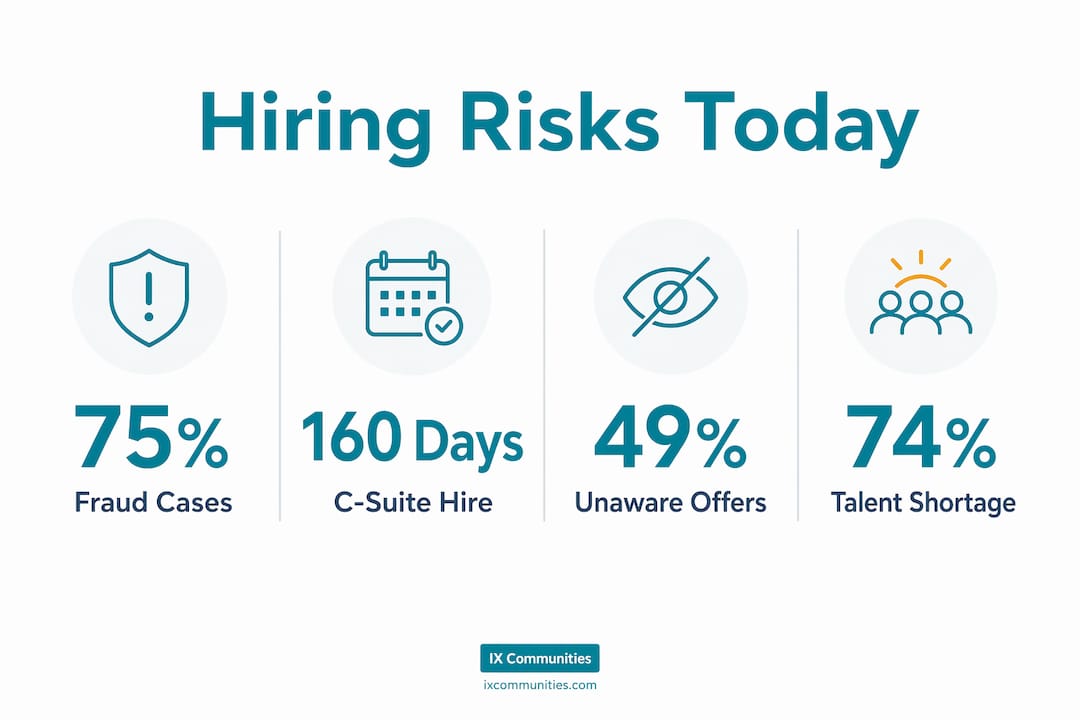
AI-enabled candidate fraud is now the top operational risk in recruitment. 75% of HR leaders have encountered fraudulent candidates recently. That number signals fraud is no longer an edge case. It is a standard feature of the hiring environment.

The fraud takes three primary forms. First, AI-generated resumes inflate credentials, skills, and employment history in ways that pass standard applicant tracking system filters. Second, candidates use AI tools during live assessments to generate answers in real time, making skills evaluations unreliable. Third, deepfake video technology allows candidates to impersonate other individuals during remote interviews. 69% of UK hiring leaders identify deepfakes and AI-enabled impersonation as sophisticated emerging threats capable of causing financial and reputational damage.
The consequences extend beyond a bad hire. A fraudulent employee who gains access to systems, client data, or financial controls creates cybersecurity exposure and potential negligent hiring liability. Courts have found employers responsible for harm caused by employees whose backgrounds were not adequately verified, even when third-party screening vendors were involved.
Verification practices must evolve alongside fraud tactics. Structured multi-stage verification now includes skills-based work samples completed under observed conditions, reference checks that go beyond listed contacts, and credential verification through issuing institutions rather than self-reported documents.
- Require live, proctored skills assessments for technical roles
- Verify credentials directly with issuing institutions, not from resume copies
- Use video interview platforms with liveness detection features
- Cross-reference employment history with professional networks and public records
- Involve IT and Legal immediately when fraud is suspected, and preserve all data before taking further action
Pro Tip: When candidate fraud is suspected, suspend the process immediately and do not alert the candidate. Collect all submitted materials, preserve system access logs, and loop in IT and Legal before any further contact. Delay increases both legal and security risk.
How does the talent shortage affect recruitment outcomes?
The skilled talent shortage is not a temporary market condition. 74% of employers report persistent difficulty finding qualified candidates, and AI-generated application volume has made the problem harder to solve, not easier. That finding reframes the talent shortage as a signal quality problem, not just a supply problem.
AI tools allow candidates to apply to hundreds of roles with minimal effort, flooding pipelines with applications that look qualified on paper but are not. 62% of employers say traditional resume screening is now obsolete because of this inflation. Recruiters spend more time processing volume and less time evaluating genuine candidates, which drives burnout and extends time-to-fill.
The practical impact on organizations is significant. Longer searches increase interim staffing costs. Recruiter burnout leads to turnover within talent acquisition teams, compounding the problem. And when pressure to fill a role becomes intense, hiring managers lower standards or skip verification steps, which is precisely when fraud risk peaks.
Addressing the shortage requires a shift in sourcing strategy. The most effective approaches in 2026 focus on building talent pipelines before roles open, not after. This means maintaining active relationships with passive candidates, investing in internal mobility programs, and using skills-based hiring criteria rather than credential-based filters that exclude qualified candidates who lack traditional credentials.
- Define roles by skills and outcomes, not job titles or degree requirements
- Build and maintain a warm candidate pipeline through ongoing engagement, not reactive outreach
- Use structured interviews with consistent scoring rubrics to reduce evaluator bias
- Prioritize internal mobility before opening external searches
- Track time-to-productivity for new hires, not just time-to-fill, to measure sourcing quality
For a broader view of what is driving these conditions, the 2026 hiring challenges analysis from Ixcommunities covers the structural forces behind the current market.
What makes leadership hiring uniquely risky?
C-suite hiring carries a distinct risk profile that standard recruitment frameworks do not fully address. The average time to fill a US C-suite role is projected at 160 days in 2026, up from 120 days in 2023. That 40-day increase reflects boards that are more risk-averse, not more thorough. The distinction matters.
Risk aversion at the board level often produces two counterproductive outcomes. First, boards pursue an idealized candidate profile that rarely exists in the market, extending searches indefinitely. Second, internal candidates with proven track records get passed over in favor of external candidates who appear more impressive on paper but carry unknown execution risk. 88% of companies report struggling to find leaders skilled in managing rapid change, yet many of those leaders already exist inside their organizations.
| Leadership hiring risk | Root cause | Mitigation approach |
|---|---|---|
| Extended time-to-fill | Idealized candidate profiles | Define minimum viable criteria, not perfect profiles |
| Groupthink in panel interviews | Social pressure to align with senior opinions | Require written independent feedback before group discussion |
| Overlooking internal candidates | Board preference for external hires | Formalize internal candidate evaluation in every search |
| Post-hire performance gap | Insufficient onboarding and role clarity | Conduct structured 90-day and 12-month reviews |
High-level hiring should be treated as organizational risk management, requiring oversight comparable to financial audits. That means defining success metrics before the search begins, not after the hire is made.
Pro Tip: In executive panel interviews, require each interviewer to submit written feedback independently before any group debrief. This eliminates the anchoring effect where the most senior voice in the room shapes everyone else's assessment.
What legal risks come with AI-powered hiring tools?
AI adoption in hiring creates legal exposure that most organizations have not fully mapped. Employers remain liable for discriminatory outcomes produced by AI hiring tools, even when those tools are built and managed by third-party vendors. Legal responsibility cannot be transferred to a vendor through a contract. Courts assess outcomes, not intent.
The liability risk is specific. AI screening tools trained on historical hiring data can encode and amplify existing patterns of bias, producing disparate impact on protected groups. Disparate impact does not require discriminatory intent to trigger legal action. If a tool systematically screens out candidates from a protected class at a higher rate, the employer faces liability regardless of whether the tool was purchased off the shelf.
"The biggest barrier to AI adoption in hiring is often lack of transparency in decision logic, which creates severe regulatory and litigation risks. Governance is more critical than the technology itself."
78% of finance leaders express concern about the explainability and compliance of AI hiring tools. That concern is well founded. Jurisdictions including New York City and the European Union now require employers to conduct bias audits of automated hiring tools and disclose their use to candidates. More jurisdictions are moving in the same direction.
- Audit AI hiring tools for disparate impact before deployment, not after a complaint
- Require vendors to provide documentation of training data sources and model logic
- Maintain human review at every decision point where AI produces a recommendation
- Document all AI-assisted decisions to demonstrate explainability in litigation
- Govern AI tools internally rather than relying on vendor assurances alone
Privacy risk is a separate but related concern. Applicant data collected during AI-assisted screening must be handled in compliance with applicable data protection laws. Retention policies, consent requirements, and data minimization principles apply to recruitment data just as they do to employee data.
For a detailed breakdown of how AI tools are reshaping recruitment risk, the hidden costs of AI in recruiting guide from Ixcommunities covers both operational and legal dimensions.
Key Takeaways
The biggest hiring risks leaders face today require a portfolio approach to risk management, not isolated fixes applied to individual hires.
| Point | Details |
|---|---|
| AI fraud is now standard | 75% of HR leaders have encountered fraudulent candidates; verification must go beyond resume review. |
| Talent shortage is a signal problem | 62% of employers call traditional screening obsolete; focus on skills-based criteria to find real candidates. |
| Leadership hiring timelines are growing | C-suite roles average 160 days to fill in 2026; define minimum viable criteria to avoid indefinite searches. |
| Legal liability follows AI outcomes | Employers are liable for discriminatory AI tool results regardless of vendor involvement. |
| Post-hire reviews reduce long-term risk | Structured 12-month reviews owned by hiring managers improve decision accuracy over time. |
What I have learned about treating hiring as a risk portfolio
The framing that changed how I think about this topic is simple: hiring risk compounds. A single bad hire at the director level does not stay contained. It affects team performance, client relationships, and the next round of hiring decisions made by that leader. Treating each hire as an isolated event is the most common and most costly mistake I see in large organizations.
The organizations that manage hiring risk well share one habit. They conduct post-hire performance reviews at 12 months, owned by the hiring manager, not HR. That ownership matters. When hiring managers know they will be accountable for evaluating their own decisions, they make better decisions upfront. HR can design the process, but the accountability has to sit with the person who made the call.
On AI fraud specifically, the response I see most often is too slow. Organizations wait until a pattern emerges before acting. The correct response when fraud is suspected is immediate suspension of the candidate process, full data preservation, and same-day involvement of IT and Legal. Every hour of delay increases both the legal exposure and the security risk if the candidate has already accessed systems.
Recruiter burnout is the underreported risk in all of this. When recruiters are processing inflated pipelines, managing fraud investigations, and navigating legal compliance requirements simultaneously, quality of judgment drops. Leadership involvement in hiring is not just about making better decisions at the top. It is about reducing the cognitive load on the people doing the daily work.
— Simon
Peer networks that help leaders manage hiring risk
Hiring risk management is not a problem you solve once with a new policy. It requires ongoing exposure to how peer organizations are handling the same challenges, what is working, and what is creating new problems.
Ixcommunities runs the ESIX Recruiter Peer Mentorship Programs and the Talent Leaders Peer Mentoring Program, both designed for talent and recruiting leaders in large corporate environments. These programs give leaders direct access to benchmarking data, peer-tested practices, and structured dialogue on exactly the risks covered in this article, including AI fraud response, legal compliance, and leadership hiring governance. If your organization is navigating these challenges without that kind of peer context, you are working with incomplete information.
FAQ
What is the most common hiring risk leaders overlook?
Groupthink in executive interview panels is one of the most underreported risks. Requiring written independent feedback before group discussion significantly improves decision quality.
How widespread is AI-driven candidate fraud?
75% of HR leaders report encountering fraudulent candidates, and 49% have unknowingly extended offers to candidates who misrepresented skills using AI tools.
Are employers liable for AI hiring tool discrimination?
Yes. Employers are legally liable for discriminatory outcomes produced by AI hiring tools, even when the tools are built and operated by third-party vendors.
How long does it take to fill a C-suite role in 2026?
The average time to fill a US C-suite role is projected at 160 days in 2026, up from 120 days in 2023, driven by risk-averse boards and idealized candidate profiles.
What should organizations do when candidate fraud is suspected?
Suspend the hiring process immediately, preserve all submitted materials and system logs, and involve IT and Legal on the same day. Delay increases both legal exposure and security risk.