

The hidden costs of AI in recruiting are defined as the financial and operational expenses beyond software license fees, including implementation, integration, governance, change management, and ongoing maintenance, that collectively determine the true cost of ownership for AI recruiting platforms.
HR leaders at mid-to-large companies are adopting platforms like Workday, Greenhouse, and specialized AI tools at a rapid pace. The sticker price rarely tells the full story. AI recruitment expenses consistently exceed initial projections when implementation, training, and governance costs are factored in. Understanding where those costs accumulate is the first step toward budgeting accurately.
What are the hidden costs of AI in recruiting?
The core hidden expenses in AI recruiting fall into five distinct categories: seat license add-ons, API integration fees, recruiter training time, ongoing governance, and productivity losses during ramp-up. Each category is routinely underestimated during vendor selection.

Seat licenses and premium add-ons
AI recruiting platform seat licenses range from $120 to $450 per recruiter per month. That range sounds manageable until you add enterprise security requirements. Features like SSO, SCIM provisioning, and audit logging are frequently billed as premium tiers, adding 20%–40% to the base seat cost. An enterprise deployment across 20 recruiters can exceed $600 per seat per month once all add-ons are included.
API and integration fees
Connecting an AI recruiting platform to an existing ATS or HRIS system is rarely plug-and-play. Custom API integration development costs range from $5,000 to $50,000, and implementation requires 40–120 internal staff hours per platform rollout. That staff time has a real dollar value that never appears on a vendor invoice.
Training and onboarding costs
Recruiter training is a direct cost that most budgets undercount. Hiring managers need separate onboarding from recruiters, and both groups require time away from active requisitions. The internal hours spent on training translate directly into delayed fills and reduced throughput during the rollout window.
Governance and ongoing maintenance
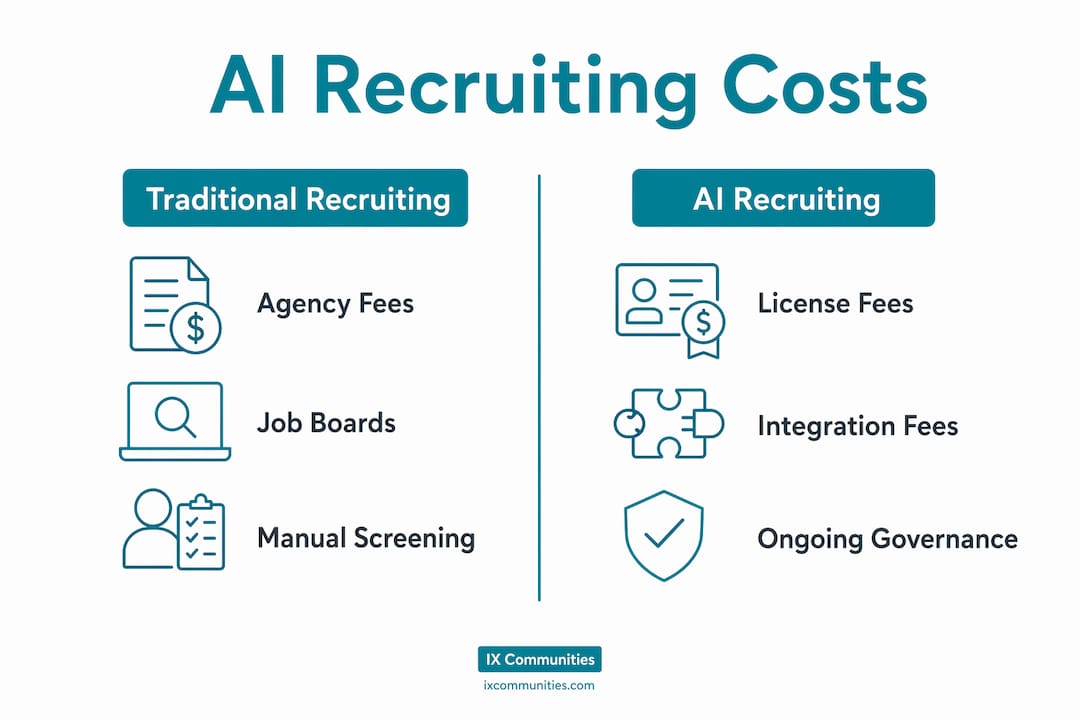
Ongoing governance requires 5–10 hours per week of dedicated talent acquisition operations time for bias audits, rubric tuning, and compliance monitoring. Without that allocation, organizations face increased mis-hire rates and regulatory exposure. This is a permanent operational cost, not a one-time setup fee.
Productivity dip during ramp-up
Real-world enterprise rollouts consistently show a 4–6 week productivity dip during AI tool onboarding. Recruiter bandwidth shrinks precisely when the organization expects efficiency gains. Planning for this window is critical to avoiding pipeline disruptions.
Pro Tip: Before signing any AI recruiting contract, request a full itemized list of every feature included in the base license. Identify which enterprise security features, integrations, and support tiers require separate purchase. This single step prevents the most common budget surprises.
How do AI recruiting costs compare to traditional hiring expenses?
Traditional recruiting and AI-augmented recruiting carry very different cost structures. Understanding where costs shift is as important as understanding where they disappear.
Traditional hiring hard costs average approximately $4,700 per hire, driven by agency fees, job board spend, and manual screening hours. AI workflows lower that figure to $3,000–$4,200 per hire through tool consolidation and reduced agency dependency. That is a real and meaningful reduction.
The savings, however, come with a cost transfer rather than a cost elimination. Agency fees and manual screening hours are replaced by software subscriptions, integration projects, and governance operations. The financial impact of AI in hiring shows up differently on the budget sheet, not necessarily at a lower total.
Traditional recruiting also carries soft costs that are easy to ignore. Vacancy days, hiring manager time in unstructured interviews, and rescheduling cycles all represent real productivity losses. AI platforms reduce these friction points, but only after the ramp-up period ends and the system is properly configured.
| Expense category | Traditional recruiting | AI-augmented recruiting |
|---|---|---|
| Cost per hire | ~$4,700 | $3,000–$4,200 |
| Agency fees | High | Reduced or eliminated |
| Job board spend | Moderate to high | Reduced through automation |
| Integration and API costs | Low | $5,000–$50,000 upfront |
| Governance and compliance | Minimal | 5–10 hours per week ongoing |
| Productivity during ramp-up | Stable | 4–6 week dip |
| Change management budget | Low | 20%–30% of direct costs |
The total cost of ownership model for AI recruiting requires honest accounting of both columns. Organizations that evaluate only the per-hire cost reduction miss the full picture of costs of automated hiring.
What contractual and operational risks inflate AI recruiting costs?
Contracts for AI recruiting platforms contain provisions that generate significant unexpected costs over time. Procurement teams focused on the initial license fee frequently miss these clauses entirely.
Renewal price escalators
Renewal-year price escalation clauses of 12%–18% annual increases are common in AI recruiting contracts. A $200,000 annual contract with an 18% escalator becomes a $236,000 contract in year two without any change in usage. Over a three-year term, that compounding effect is substantial.
Usage overage fees
AI platforms that charge per resume screened, per interview scheduled, or per assessment delivered can generate significant overage fees during high-volume hiring periods. These fees are often buried in usage appendices rather than the main contract body.
Compliance and premium support add-ons
Enterprise compliance requirements, including EEOC audit trails, data residency controls, and GDPR-adjacent data handling, frequently require premium support tiers. Integration connectors marketed as standard often fail to meet enterprise security requirements without these expensive upgrades.
Change management and workflow disruption
Formal change management budgets are recommended at 20%–30% of total direct costs for effective AI adoption. This covers process redesign, stakeholder communication, and organizational adaptation. Most TA leaders do not include this line item in their initial business case.
Candidate experience and trust costs
Poorly configured AI screening tools generate candidate experience problems that carry their own financial weight. Rejected candidates who feel the process was opaque or unfair reduce employer brand value. Rebuilding that trust requires investment in communication design and process transparency.
Pro Tip: Audit every vendor contract for three specific clauses before signing: the annual price escalator percentage, the overage fee structure for high-volume periods, and the data portability guarantee at contract end. These three clauses determine long-term cost exposure more than the base license price.
How can HR leaders manage and reduce hidden AI recruiting expenses?
Managing the financial impact of AI in hiring requires a structured approach to budgeting, vendor negotiation, and internal governance. The following steps reflect what enterprise rollouts consistently show works.
-
Build a total cost of ownership model before vendor selection. Include base license fees, integration development costs, training hours, governance staffing, and a change management reserve of 20%–30% of direct costs. This model should be the basis for any business case presented to finance.
-
Negotiate contract caps on usage fees and price escalators. Request a cap on annual price increases at or below 5%. Negotiate fixed pricing for usage tiers that reflect your realistic hiring volume, with defined overage rates rather than open-ended billing. AI recruiting software contracts are negotiable, especially at enterprise scale.
-
Allocate dedicated governance hours from day one. Budget 5–10 hours per week of TA operations time for bias audits, rubric reviews, and compliance monitoring. Assign this responsibility to a named role rather than treating it as a shared task. Governance without ownership does not happen consistently.
-
Plan the ramp-up period as a project, not a transition. The 4–6 week productivity dip is predictable. Reduce open requisition load during that window, assign a dedicated implementation lead, and set realistic throughput expectations with hiring managers before go-live.
-
Measure ROI against a defined baseline. Establish pre-implementation benchmarks for cost per hire, time to fill, and hiring manager satisfaction. Revisit those benchmarks at 90 days and 180 days post-launch. AI recruiting ROI is real, but it requires upfront planning and conservative budgeting to materialize on schedule.
-
Invest in recruiter training as a strategic priority. Recruiters who understand how AI scoring works are better positioned to catch configuration errors and advocate for candidates who may be incorrectly filtered. Recruiter training programs that address both technical skills and AI literacy reduce long-term governance risk.
-
Benchmark your technology spend against peers. Knowing what comparable organizations pay for similar platforms prevents overpaying and identifies where your cost structure is out of line. Peer benchmarking is one of the most underused tools in TA budget management.
Key Takeaways
The hidden costs of AI in recruiting consistently exceed license fees when implementation, governance, change management, and contractual escalators are included in the total cost of ownership calculation.
| Point | Details |
|---|---|
| License fees are only the starting point | Add-ons, overages, and premium tiers push enterprise seat costs beyond $600 per month. |
| Integration costs are significant | API development runs $5,000–$50,000, plus 40–120 internal staff hours per rollout. |
| Governance is a permanent expense | Bias audits and compliance monitoring require 5–10 hours per week of dedicated TA time. |
| Contracts carry compounding risk | Annual price escalators of 12%–18% materially increase multi-year contract costs. |
| Change management must be budgeted | Allocate 20%–30% of direct costs for process redesign and organizational adaptation. |
What I have learned about AI recruiting costs after years of watching enterprise rollouts
The most consistent mistake I see HR leaders make is treating AI recruiting as a technology purchase rather than an organizational change program. The license fee gets approved. The integration project gets scoped. Then, six months in, the governance work has no owner, the contract escalator has gone unnoticed, and the productivity dip lasted longer than anyone planned for.
The uncomfortable truth is that AI recruiting tools require more human oversight after deployment, not less. Bias audits, rubric tuning, and candidate experience reviews are not optional maintenance tasks. They are the work that determines whether the system produces better hires or simply faster bad ones. Organizations that skip this step pay for it in mis-hire costs and compliance exposure.
Cross-functional collaboration is also non-negotiable. Procurement, legal, IT, and TA leadership all need to be in the room during vendor selection. The clauses that generate the most unexpected cost, such as renewal escalators and overage structures, are legal and procurement issues that TA leaders are not trained to catch on their own.
The AI transformation in executive search and broader talent acquisition is real and the efficiency gains are achievable. But they require upfront investment in governance, training, and change management that most business cases do not include. Budget for the full cost from the start, and the ROI follows. Budget only for the license, and the hidden expenses will find you.
— Simon
Ixcommunities resources for navigating AI recruiting costs
HR leaders navigating AI recruiting adoption do not need to figure out total cost of ownership models alone. Ixcommunities provides peer networking and benchmarking resources built specifically for talent acquisition professionals at mid-to-large organizations.
The Talent Leaders Peer Mentoring Program connects TA leaders with peers who have completed enterprise AI rollouts and can share direct experience on budgeting, vendor negotiation, and governance frameworks. The Benchmark Surveys provide data on what comparable organizations are paying for AI recruiting platforms, giving procurement teams a factual basis for contract negotiations. The Technology Stack Reference Tool helps TA teams map integration requirements before vendor selection, reducing the risk of unexpected API costs. Ixcommunities ESIX Recruiter Peer Mentorship Programs support recruiters in building the AI literacy needed for effective governance.
FAQ
What are the biggest hidden costs in AI recruiting?
The largest hidden expenses are API integration development ($5,000–$50,000), premium add-ons for enterprise security features (20%–40% above base pricing), and ongoing governance staffing at 5–10 hours per week. Change management budgets of 20%–30% of direct costs are also frequently omitted from initial business cases.
Is AI worth it for recruiting at the enterprise level?
AI platforms reduce cost per hire from approximately $4,700 to $3,000–$4,200, making the financial case positive when total cost of ownership is managed correctly. The ROI depends on accurate upfront budgeting for integration, training, and governance rather than license fees alone.
How do renewal price escalators affect AI recruiting budgets?
Annual renewal escalators of 12%–18% are common in AI recruiting contracts. On a $200,000 annual contract, an 18% escalator adds $36,000 in year two without any increase in usage or features.
How long does the productivity dip last after AI recruiting tool deployment?
Enterprise rollouts consistently show a 4–6 week productivity dip during onboarding. Planning for reduced throughput during this window and assigning a dedicated implementation lead shortens the recovery period.
What governance does an AI recruiting platform require ongoing?
Effective AI recruiting governance requires 5–10 hours per week for bias audits, rubric tuning, and compliance monitoring. This work must be assigned to a named role to be performed consistently and to protect against mis-hire costs and regulatory risk.