

Talent acquisition is defined as the process of identifying, attracting, and hiring people who directly determine an organization's capacity to execute its strategy and grow. That definition places it far outside the traditional scope of HR administration. Workforce ranks third among CEO priorities globally, behind only growth and technology. That ranking is the clearest signal that why talent acquisition is becoming a business function not an HR function is no longer a theoretical debate. It is a structural reality that corporate leaders and recruiters must act on now. Only 14% of CHROs rate their talent acquisition functions as highly effective. That gap between expectation and execution is where organizations lose competitive ground.
Why talent acquisition is becoming a business function, not an HR function
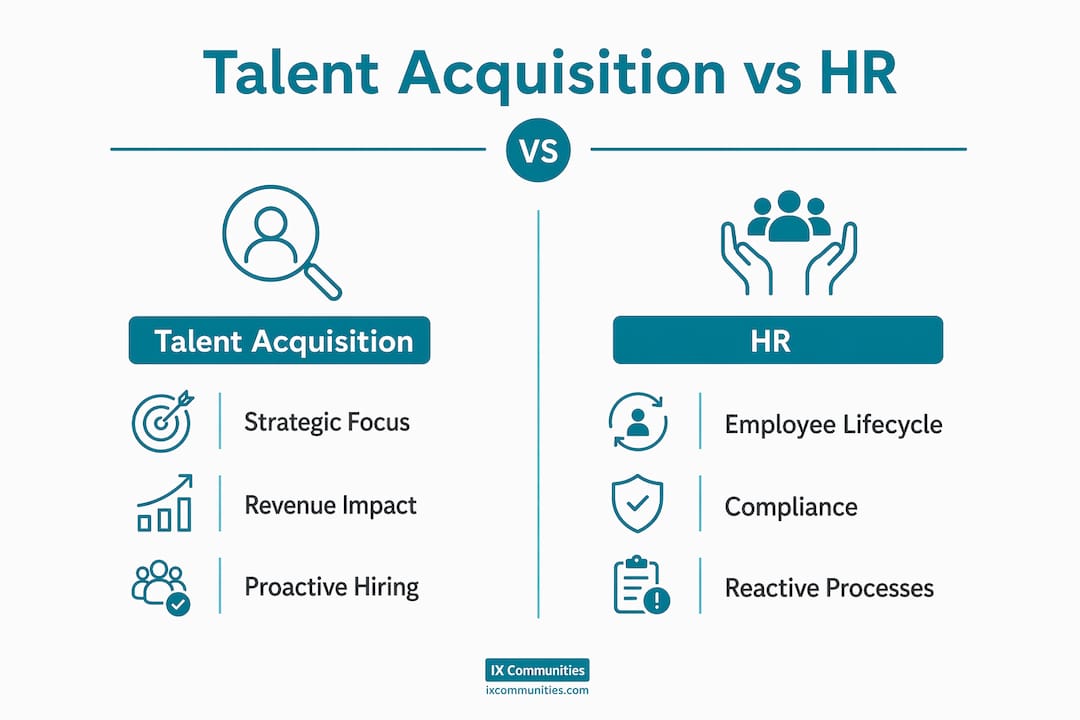
The core distinction is one of scope and timing. HR manages the full employee lifecycle after a person joins the organization. It handles onboarding, compensation, compliance, performance management, and offboarding. Talent acquisition, by contrast, operates before the hire. It reads labor markets, builds candidate pipelines, shapes employer brand, and aligns hiring plans with where the business is heading in the next 12 to 36 months.

When organizations treat talent acquisition as a subset of HR, they constrain it to a reactive, administrative role. Requisitions open, recruiters fill them, and the cycle repeats. That model worked when labor markets were stable and business plans changed slowly. Neither condition holds today.
Separating TA from HR roles, or realigning talent acquisition directly with business units, enables specialization in three areas that HR generalists are not structured to own:
- Market intelligence: Tracking competitor hiring patterns, salary benchmarks, and skills availability to inform workforce planning before a need becomes urgent.
- Employer branding: Positioning the organization as a destination for specific talent profiles, not just advertising open roles.
- Skills-based hiring: Designing selection criteria around demonstrated capability rather than credentials, which broadens the candidate pool and improves quality of hire.
Each of these functions requires dedicated focus, external data, and close collaboration with business leaders. Embedding them inside a generalist HR structure dilutes that focus and slows execution.
Why CEOs see hiring as a strategic bottleneck
CEOs do not think about hiring as a process. They think about it as a constraint on growth. When a product team cannot ship because three engineering roles have been open for four months, that is a revenue problem. When a sales region misses its number because quota-carrying reps were not hired on time, that is a financial problem. Hiring delays translate directly into missed targets.
"Reactive recruitment is a financial risk. Poor hiring decisions can cost up to $200,000 per employee in large organizations when you factor in turnover and lost productivity." — Industry cost estimates, 2026
That figure reframes the conversation entirely. A single mis-hire or a prolonged vacancy is not an HR inconvenience. It is a line-item loss that a CFO can calculate. When talent acquisition leaders present their work in those terms, they earn a seat at the table where growth decisions are made.
Workforce capability ranks third among CEO priorities in 2026 Gartner research covering 400-plus CEOs. That ranking places talent above supply chain, regulatory risk, and operational efficiency in the minds of the people setting organizational direction. Talent acquisition leaders who still report through a traditional HR chain, using time-to-fill as their primary metric, are misaligned with what the C-suite actually needs from them.
The shift also reflects a change in how boards evaluate organizational health. Talent density, retention rates among high performers, and the speed at which critical roles are filled now appear in board-level discussions alongside revenue and margin. Exec recruiters are becoming strategic advisors because the business demands it, not because the profession chose to rebrand itself.
What structural changes make talent acquisition a true business function?
Elevating talent acquisition requires deliberate redesign across four areas. The changes are operational, not cosmetic.
-
Move from reactive to proactive pipelining. Building talent communities, curated pools of pre-engaged candidates managed as ongoing assets, replaces the cycle of posting a job and hoping. When a business unit announces a new product line, a mature talent acquisition function already has qualified candidates in conversation. That speed is a competitive advantage.
-
Shift the metric language. Time-to-fill measures process efficiency. It does not measure business impact. CFO-friendly metrics such as revenue impact of faster hiring, cost avoided through reduced turnover, and quality-of-hire scores tied to performance ratings give finance and executive leadership a reason to invest in talent acquisition infrastructure.
-
Integrate TA into upstream program design. Moving talent acquisition into upstream planning phases, alongside business leaders during budget cycles and product roadmap sessions, prevents talent bottlenecks from forming in the first place. Talent acquisition leaders who only learn about a hiring need when a requisition arrives are always behind.
-
Invest in the right infrastructure. Skills-based assessment tools, employer brand content programs, and benchmark survey data on compensation and market positioning are not optional extras. They are the operating equipment of a business-grade talent acquisition function.
| Metric type | Traditional TA | Business-function TA |
|---|---|---|
| Primary KPI | Time-to-fill | Revenue impact of hire |
| Planning horizon | Reactive, role by role | 12–36 month workforce plan |
| Candidate sourcing | Job postings | Talent communities |
| Stakeholder | HR leadership | C-suite and business unit heads |
Pro Tip: Present your next talent acquisition review to the CFO using cost-avoided and revenue-per-hire figures. One meeting in that language does more to reposition your function than a year of internal HR reports.
How business-focused talent acquisition drives competitive advantage
The practical difference between a reactive hiring model and a business-aligned talent acquisition function shows up in speed, quality, and cost.
-
Pipeline management and market response. Organizations with pre-built talent pipelines fill critical roles significantly faster than those relying on reactive job postings. When a competitor exits a market or a technology shift creates sudden demand for a new skill set, a proactive pipeline is the difference between capturing talent and losing it.
-
Employer brand as a selection filter. A credible employer brand does not just attract more candidates. It attracts the right candidates and filters out poor fits before the first interview. Skills-based selection combined with a clear employer value proposition reduces time spent screening unqualified applicants.
-
Data-led decisions improving retention. 56% of HR professionals rate their recruiting as effective or very effective, yet analysts note those assessments rely on reactive models that do not hold up under strategic scrutiny. Organizations that replace gut-feel hiring with structured, data-driven selection see measurable improvements in 12-month retention and performance ratings.
-
Cost reduction through integration. When talent acquisition aligns with workforce planning, organizations reduce their dependence on expensive last-minute sourcing, agency fees, and interim staffing. The savings fund the infrastructure that makes the function more capable over time.
Pro Tip: Track quality-of-hire by linking new hire performance ratings at 6 and 12 months back to the sourcing channel and assessment method. That data gives you the evidence to defend investment in employer branding and structured interviewing.
How talent management and recruiting connect for measurable impact is a question more business leaders are asking. The answer always points back to integration, not separation.
Key takeaways
Talent acquisition becomes a true business function when it operates proactively, reports in financial terms, and integrates with executive planning cycles rather than responding to open requisitions.
| Point | Details |
|---|---|
| CEO-level priority | Workforce ranks third among CEO priorities, making TA a direct concern for the C-suite. |
| Effectiveness gap | Only 14% of CHROs rate their TA functions as highly effective, signaling a structural problem. |
| Metric language matters | Presenting TA results in CFO terms, such as revenue impact and cost avoided, shifts its perceived value. |
| Proactive pipelining | Talent communities replace reactive job postings and enable faster response to business needs. |
| Upstream integration | TA leaders must join budget and planning cycles early to prevent talent from becoming a bottleneck. |
The case for treating talent as a growth function
The organizations I see getting this right share one characteristic: their talent acquisition leaders speak the language of the business, not the language of HR administration. They walk into executive meetings with data on revenue impact, not headcount reports. They have a point of view on where the labor market is moving, and they use that view to shape hiring plans before a need becomes urgent.
The common mistake I observe is over-reliance on traditional metrics. Time-to-fill and cost-per-hire are useful for managing process efficiency. They are not useful for making the case that talent acquisition deserves a seat at the strategy table. When a CHRO presents those numbers to a CFO, the conversation stays at the operational level. When a talent acquisition leader presents the revenue impact of filling a sales role two months faster, the conversation moves to investment.
The other pitfall is treating employer branding as a marketing project rather than a talent acquisition asset. A well-defined employer value proposition reduces sourcing costs, improves candidate quality, and shortens time-to-productivity for new hires. Those are financial outcomes. Organizations that fund employer branding through the marketing budget and measure it with click rates are leaving the real return unmeasured.
The structural shift from HR function to business function is not a rebranding exercise. It requires new reporting lines, new metrics, new planning rhythms, and new relationships with business unit leaders. The organizations that make that investment now will have a hiring capability that others cannot replicate quickly.
— Simon
Ixcommunities resources for talent acquisition leaders
Talent acquisition leaders making this transition need more than frameworks. They need peers who have navigated the same shift, data to benchmark their progress, and access to practitioners who have built business-grade TA functions at scale.
Ixcommunities operates ESIX, TLIX, and the broader IXCommunities network as the preeminent peer networking and benchmarking groups for talent leadership professionals worldwide. Large corporate talent and recruiting departments use these communities to share practices, benchmark performance, and learn in a secure environment. The ESIX Recruiter Peer Mentorship Programs connect recruiters with experienced talent leaders who have already made the transition to a business-aligned function. The Talent Leaders Peer Mentoring Program provides structured guidance for leaders ready to reposition talent acquisition as a core driver of organizational performance.
FAQ
What is the difference between HR and talent acquisition?
HR manages the full employee lifecycle after hire, including compliance, compensation, and performance. Talent acquisition focuses on market intelligence, proactive pipelining, and aligning hiring with future business strategy before a role opens.
Why do CEOs now prioritize talent acquisition?
Workforce capability ranks third among CEO priorities in 2026 Gartner research, behind only growth and technology. Hiring delays directly constrain execution speed and revenue outcomes, making talent acquisition a C-suite concern.
What metrics should talent acquisition leaders use?
Business-function TA reports in CFO-friendly terms such as revenue impact of faster hiring, cost avoided through reduced turnover, and quality-of-hire scores. Time-to-fill measures process efficiency but does not demonstrate strategic value.
How does proactive pipelining differ from reactive recruiting?
Proactive pipelining builds curated talent communities of pre-engaged candidates managed as ongoing assets. Reactive recruiting opens a job posting after a need arises, which is slower and more expensive.
What is the cost of poor hiring in large organizations?
Poor hiring decisions can cost up to $200,000 per employee in large organizations when accounting for turnover and lost productivity. That figure makes the business case for investing in structured, data-driven talent acquisition practices.