

Recruitment process optimization is the strategic practice of refining and automating recruiting workflows to reduce time-to-hire, improve candidate quality, and elevate recruiter effectiveness. Organizations deploying integrated AI recruitment workflows achieve a 30–40% reduction in time-to-hire. That number reflects what happens when automation, metrics, and workflow design work together rather than in isolation. This guide walks HR professionals and talent acquisition leaders through the core components, step-by-step methods, key recruiting metrics, common pitfalls, and strategies for sustaining improvement over time.
What are the core components of recruitment process optimization?
Effective recruiting workflow optimization starts with a clear picture of your current state. Before adding any new tool or automation, audit your pipeline stage by stage to identify where candidates stall and where recruiters lose time. A 30-day sprint to baseline your metrics is the recommended starting point. Without that data, technology purchases solve the wrong problems.
The applicant tracking system (ATS) is the foundation. Every other tool, whether it handles resume screening, interview scheduling, or candidate communications, must connect to the ATS as the single source of record. When tools operate independently, you create automation sprawl. Three well-integrated platforms outperform eight loosely connected ones because they reduce the manual handoffs that slow recruiters down and introduce errors.

The table below outlines the primary tool categories and what integration each requires.
| Tool category | Primary function | Integration requirement |
|---|---|---|
| Resume screening | Filter applicants by criteria | ATS data sync |
| Interview scheduling | Automate calendar coordination | ATS + calendar systems |
| Candidate communications | Automate status updates and outreach | ATS + email/SMS platforms |
| Evaluation and scoring | Standardize interview feedback | ATS + structured rubric templates |
| Sourcing and analytics | Track channel performance and cost | ATS + reporting dashboards |
Pro Tip: Measure your current time-in-stage and passthrough rates for 30 days before evaluating any new tool. The data will tell you exactly where to focus first.
How to implement recruitment process optimization step by step
A phased approach produces more durable results than deploying everything at once. Start with the stage that consumes the most recruiter time or creates the most candidate drop-off. For most large organizations, that stage is screening.
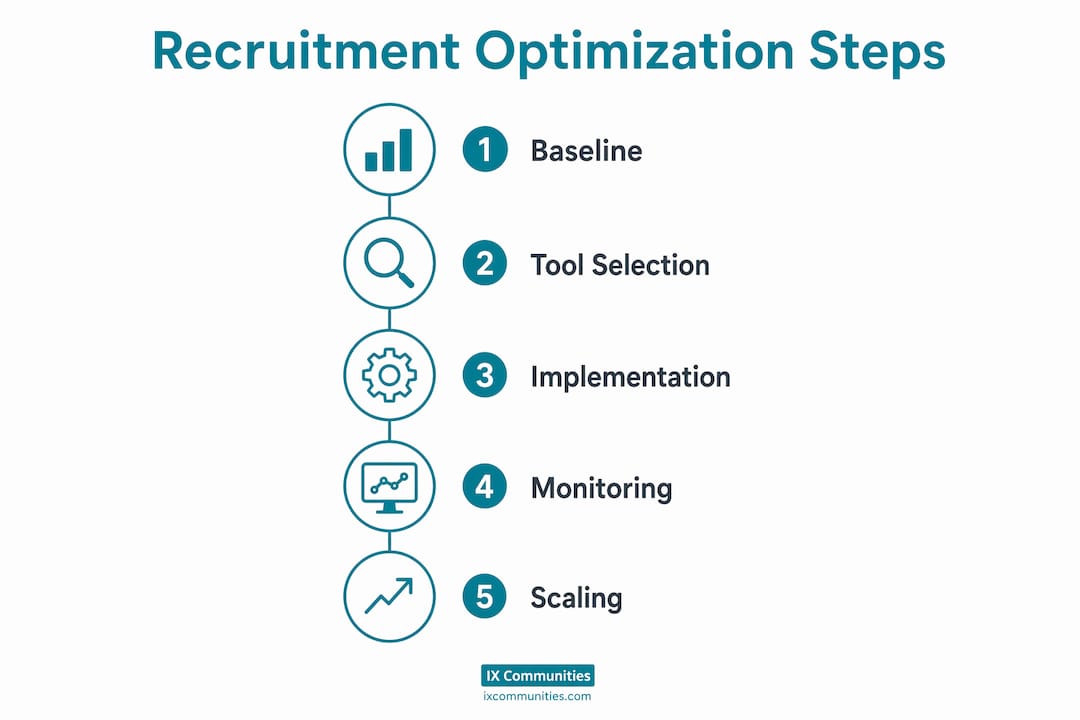
- Baseline your metrics. Capture time-in-stage, passthrough rates, and source data for every active pipeline. This is your benchmark.
- Automate screening first. Deploy resume filtering rules within your ATS before adding external tools. This reduces volume without adding complexity.
- Add interview scheduling automation. Automated scheduling is 26% faster than manual methods and cuts scheduling time by up to 82%. Candidate show rates also increase by 31% when self-scheduling links replace back-and-forth email.
- Standardize evaluation artifacts. Introduce structured interview rubrics and scorecards at every stage. Structured interviews predict performance twice as well as unstructured formats and reduce the screening burden from 20–25 hours to a single structured round.
- Automate candidate communications. Set up status update triggers within your ATS so candidates receive timely feedback without recruiter intervention.
- Connect sourcing data to your analytics layer. Track which channels produce candidates who advance furthest. Referral candidates consistently show higher passthrough rates at nearly every funnel stage.
- Run a pilot with one team. Involve recruiters in the design phase. Their feedback during the pilot prevents adoption failures at scale.
Each step builds on the previous one. Skipping the baseline phase is the most common reason optimization projects stall after the first deployment.
Pro Tip: When deploying self-scheduling links, embed them directly in the initial outreach message rather than waiting for a separate follow-up. Response rates increase significantly when the action is immediate.
What recruiting metrics best measure optimization success?
Recruiting metrics are the data points that tell you whether your process changes are working. Aggregate numbers like total time-to-fill can mask serious problems. Stage-specific velocity and passthrough analysis reveals the hidden bottlenecks that summary metrics conceal. A pipeline that looks healthy overall may have a severe delay between the final interview and the offer stage.
The most useful metrics for a recruiting metrics workflow include:
- Time-to-hire by stage. Measures how long candidates spend in each pipeline phase, not just the total.
- Passthrough rate. The percentage of candidates who advance from one stage to the next. Low rates at screening suggest sourcing problems. Low rates at offer suggest compensation or process issues.
- Cost-per-hire. Organizations that track source effectiveness and optimize their channel mix reduce cost-per-hire by up to 30%.
- Candidate NPS. Measures candidate satisfaction with the process. A low score often correlates with scheduling delays or poor communication.
- Recruiter satisfaction. Tracks whether process changes reduce or increase administrative burden.
- Disposition speed. The target window for candidate disposition is 3–5 days post-interview. 42% of candidates withdraw when scheduling takes too long. That withdrawal rate represents real hiring losses, not just a candidate experience problem.
Use these metrics together rather than in isolation. A drop in passthrough rate at the phone screen stage, combined with a rise in time-to-hire, points to a sourcing quality issue rather than a scheduling problem. The metrics guide the fix.
Pro Tip: Review your recruiting benchmarks against peer organizations at least once per quarter. Internal trends only tell part of the story.
Common pitfalls in recruiting workflow optimization
The most frequent mistake in recruiting workflow optimization is treating speed as the primary goal. Rapidly pushing unqualified candidates through an accelerated process harms hiring quality. Automation should reduce administrative friction for recruiters, not replace the judgment required to evaluate candidate fit.
Automation sprawl is the second major risk. When teams add tools without integrating them into the ATS, recruiters end up managing multiple systems manually. That defeats the purpose of automation entirely.
"Measuring current recruiting pipelines in detail is essential before adding new technology. Data-driven audits prevent wasted spend and ineffectiveness." — Cadient Talent Recruitment Optimization Framework
Ignoring recruiter feedback during implementation is a third common error. Recruiters who were not involved in the design phase often work around new tools rather than with them. This creates shadow processes that are invisible to leadership and impossible to measure.
The biggest challenges talent acquisition teams face often trace back to these three root causes. Fixing them requires discipline in tool selection, integration standards, and change management, not more technology.
How to sustain and scale recruitment process optimization over time
Sustained improvement requires treating optimization as a continuous cycle rather than a one-time project. Iterative improvements, A/B testing, and team collaboration are the mechanisms that keep a recruiting operation improving after the initial deployment.
Quarterly KPI reviews are the minimum cadence for large organizations. Review time-in-stage trends, passthrough rates, and cost-per-hire against your baseline and against peer benchmarks for operational excellence. When a metric shifts, investigate the cause before changing the process.
The table below compares initial deployment priorities with ongoing optimization activities.
| Activity | Initial deployment | Ongoing optimization |
|---|---|---|
| Metrics baseline | Establish 30-day benchmark | Quarterly review against targets |
| Automation scope | Highest-impact stage first | Expand to adjacent stages and departments |
| Tool integration | ATS as system of record | Audit integrations for data gaps |
| Recruiter involvement | Design and pilot phase | Feedback loops and process refinement |
| Testing approach | Single team pilot | A/B testing across multiple pipelines |
Team collaboration in recruiting workflow design is not optional at scale. Recruiters, hiring managers, and HR operations leaders each see different parts of the process. Peer benchmarking through networks like Ixcommunities gives talent leaders access to what high-performing organizations are doing differently, without requiring internal trial and error.
Pro Tip: Structure your high-performing talent acquisition team with a dedicated recruiting operations role. That person owns the metrics, the tool integrations, and the continuous improvement cycle.
Key Takeaways
Effective recruitment process optimization requires a data-driven baseline, integrated tools anchored to the ATS, standardized evaluation methods, and a continuous improvement cycle to sustain gains over time.
| Point | Details |
|---|---|
| Baseline before automating | Capture 30 days of stage-by-stage metrics before selecting or deploying any new tool. |
| Integrate, do not accumulate | Three well-integrated platforms outperform eight disconnected ones for recruiter efficiency. |
| Standardize evaluation | Structured interview rubrics predict performance twice as well as unstructured formats. |
| Track stage-level metrics | Passthrough rates and time-in-stage reveal bottlenecks that total time-to-fill numbers hide. |
| Treat optimization as ongoing | Quarterly reviews, A/B testing, and recruiter feedback loops sustain long-term improvement. |
Where most optimization efforts actually break down
The conventional advice on recruitment optimization focuses almost entirely on technology selection. In practice, the technology is rarely the limiting factor. The limiting factor is almost always data discipline and recruiter buy-in.
I have seen large organizations invest significantly in scheduling automation and ATS upgrades, then watch adoption rates stall at 40% because recruiters were not part of the design process. The tools worked. The workflows did not, because nobody asked the people doing the work what they actually needed.
The other pattern I see repeatedly is organizations skipping the baseline audit. They know their time-to-hire is too long, so they buy a tool to fix it. Six months later, time-to-hire has not moved because the bottleneck was never scheduling. It was the three-day lag between a completed interview and a hiring manager submitting feedback. No scheduling tool fixes that.
The organizations that get this right treat recruiting as a mature operational system. They measure everything, standardize their evaluation criteria, and involve recruiters in every process change. They also benchmark externally, because internal data alone creates blind spots. The AI in talent acquisition conversation is useful, but only after you have the fundamentals in place. Speed without signal quality is not optimization. It is just faster noise.
— Simon
How Ixcommunities supports talent leaders in recruiting excellence
Ixcommunities connects HR professionals and talent acquisition leaders at large organizations through structured peer networks focused on operational excellence. The Talent Leaders Peer Mentoring Program gives senior talent leaders direct access to peers who have navigated the same optimization challenges. The ESIX Recruiter Peer Mentorship Programs provide recruiters with a structured forum to share workflow practices and benchmark their results.
Members also access Ixcommunities benchmark surveys that provide data on time-to-hire, cost-per-hire, and sourcing effectiveness across comparable organizations. That external reference point is what separates teams that improve continuously from those that plateau. Membership is available to corporate talent and recruiting departments seeking a secure, peer-driven environment for learning and benchmarking.
FAQ
What is recruitment process optimization?
Recruitment process optimization is the practice of refining recruiting workflows through automation, standardized evaluation, and metrics tracking to reduce time-to-hire and improve candidate quality. It treats hiring as an operational system rather than a series of ad hoc decisions.
What recruiting metrics should HR leaders track first?
Start with time-in-stage, passthrough rates by pipeline phase, and candidate disposition speed. These three metrics reveal bottlenecks that aggregate numbers like total time-to-fill consistently hide.
How long does recruitment process optimization take to implement?
A phased implementation typically requires 3–5 months from baseline audit to full deployment. Organizations that skip the baseline phase and pilot stage extend that timeline significantly due to adoption failures.
Why do 42% of candidates withdraw during the hiring process?
Scheduling delays are the primary cause. When candidates wait too long for next steps, they accept other offers. The target disposition window is 3–5 days post-interview to prevent withdrawal.
How does peer benchmarking support recruiting improvement?
Peer benchmarking provides external reference points that internal data cannot supply. Organizations that compare their recruiting metrics against peers identify performance gaps and proven practices faster than those relying on internal trends alone.