

Recruitment benchmarking is the practice of measuring your hiring metrics against industry standards and peer organizations to identify gaps and improve talent acquisition performance. Corporate talent acquisition leaders who know how to benchmark recruiting gain a clear picture of where their process excels and where it loses candidates, time, or money. SHRM, the Bureau of Labor Statistics, and industry associations publish reference data that make external comparison possible. Without that comparison, internal metrics tell you what is happening but not whether it is good enough.
What key recruiting metrics should be benchmarked?
The right metrics reveal where your process breaks down, not just how fast it runs. Tracking the wrong numbers produces confident conclusions based on misleading data.
Time to hire vs. time to fill is the most important distinction in recruiting measurement. Recruiting leaders favor time to hire over time to fill because it measures the candidate's experience from application to offer, exposing specific stage delays. Time to fill includes open requisition time before a candidate even applies, which obscures where the real friction lives. Shifting your focus to time to hire gives you a metric you can actually act on.

Cost per hire captures recruiter salaries, job board fees, agency costs, background checks, and onboarding expenses. Tracking each component separately shows which cost driver is growing fastest. Quality of hire, measured through 90-day retention rates and first-year performance ratings, tells you whether speed came at the expense of fit.
Source of hire data reveals which channels produce the best candidates at the lowest cost. Referrals consistently outperform job boards and social media on quality and retention. Recruiter productivity metrics, including interview-to-offer ratios and submittals per week, expose individual and team capacity constraints. Diversity metrics, tracked by stage, show where underrepresented candidates drop out of the funnel.
Pro Tip: Track offer acceptance rate by source. A low acceptance rate from a specific channel often signals a mismatch between how you describe the role and what candidates find when they arrive.
What tools and data sources enable reliable benchmarking?
Reliable benchmarking requires clean internal data before any external comparison is meaningful. Collect 30–60 days of consistent internal data before drawing conclusions or comparing against industry figures. Pulling benchmarks from a two-week snapshot during a hiring surge produces numbers that will mislead every decision that follows.
External data sources fall into three categories:
| Source type | Examples | Best used for |
|---|---|---|
| Industry associations | SHRM, NACE | Cost per hire, time to fill norms |
| Government labor data | Bureau of Labor Statistics | Compensation, labor market trends |
| Recruitment analytics | HRIS platforms, ATS reporting | Internal funnel and stage metrics |
Your HRIS and applicant tracking system are the foundation. They capture stage-by-stage timing, source attribution, and offer outcomes. Market intelligence tools add candidate experience data and competitor offer benchmarks, which matter when you are losing finalists to the same three employers every quarter.
Segmentation is non-negotiable. Benchmark by job function, seniority level, and geography before comparing any metric externally. A 30-day time to hire for a software engineer in San Francisco and a 30-day time to hire for an operations coordinator in a mid-sized market are not the same achievement. Mixing them produces an average that accurately describes neither.
Pro Tip: Build a data dictionary before you start. Define exactly how your ATS calculates "time to hire" and confirm it matches the definition used in any external benchmark you plan to reference. Definitional mismatches are the most common source of false comparisons.
Step-by-step recruitment benchmarking process
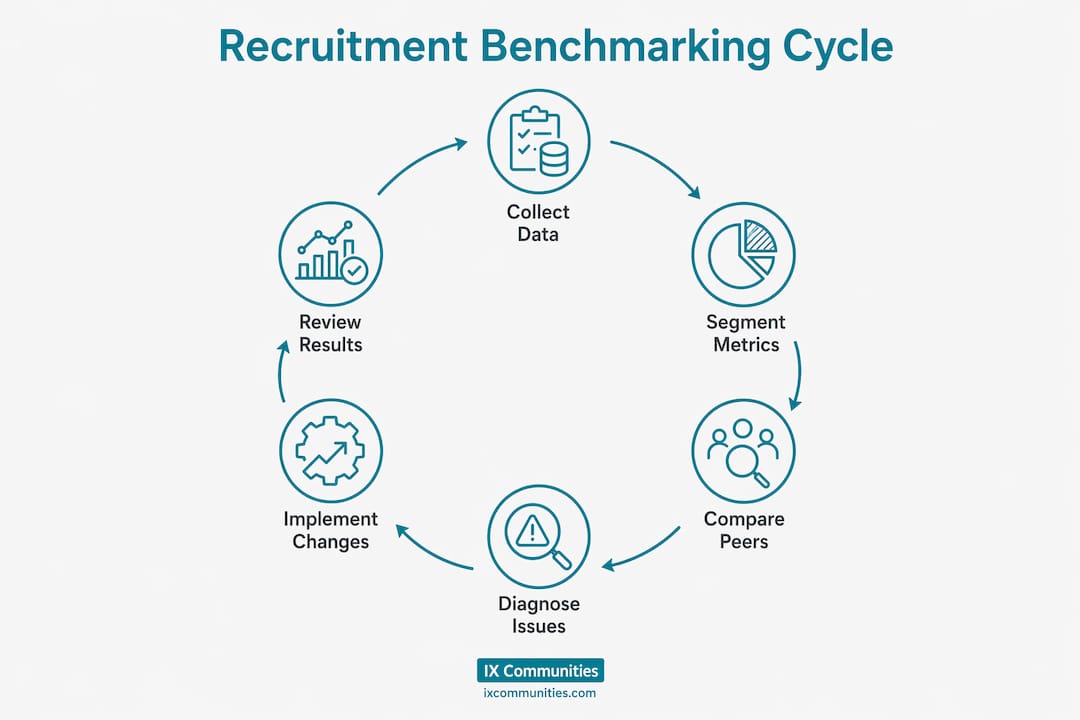
A structured 6-step benchmarking cycle converts raw data into measurable hiring improvements. Each step builds on the previous one, and skipping any step breaks the chain between insight and action.
-
Establish your baseline. Collect 30–60 days of clean internal data across all key metrics. Flag any anomalies from unusual hiring spikes or system migrations that would distort the baseline.
-
Identify gaps. Compare your baseline against external benchmarks from SHRM, industry associations, or peer data. Note which metrics fall outside acceptable ranges and by how much.
-
Conduct root cause analysis. Aggregate gaps rarely have a single cause. A high time to hire usually reflects multiple small delays across stages. Analyze each substage: posting to first screen, first screen to hiring manager interview, interview to offer.
-
Set specific targets. Vague goals produce vague results. If your posting-to-first-interview time runs 10 days and the benchmark is 4 days, set a 60-day target to reach 5 days. That specificity makes progress measurable.
-
Execute process changes. Link every target to a concrete change. Reducing posting-to-first-interview time requires either faster requisition approval, pre-scheduled screening slots, or both. Addressing micro-bottlenecks in the funnel produces faster gains than broad process overhauls.
-
Measure and repeat. Pull updated metrics after 30 days. Compare against your baseline and your target. Document what changed and why, then begin the next cycle.
The iterative nature of this process is what separates benchmarking from a one-time audit. Each cycle produces a tighter baseline and more precise targets. Teams that run this cycle quarterly build a compounding advantage over those that benchmark once a year.
For a deeper look at applying this cycle to leadership performance, the 6-step benchmarking process for recruiting leaders covers execution at the team level.
Common challenges in benchmarking recruiting and how to overcome them
The most common mistake is treating benchmarking as a scoreboard rather than a diagnostic tool. Benchmarking only delivers ROI when findings connect directly to process changes. Knowing you are 8 days slower than the industry average on time to hire is useless without a plan to address the specific stage causing the delay.
Aggregate metrics hide more than they reveal. Time to fill, averaged across all roles, can look acceptable while masking a 25-day delay in engineering requisitions and a 12-day delay in finance roles. Breaking metrics down by function and level is the only way to find the actual problem.
Three pitfalls account for most failed benchmarking efforts:
- Dirty data. Inconsistent ATS usage, manual data entry errors, and undefined metric calculations produce benchmarks that are precise but wrong. Audit your data inputs before you trust your outputs.
- Mismatched definitions. External benchmarks define metrics differently than your internal system. Confirm definitions match before comparing any number.
- Ignoring candidate experience. Quantitative metrics measure speed and cost. They do not measure whether candidates felt respected, informed, or fairly evaluated. Candidate survey data fills that gap and often explains offer decline rates that the numbers alone cannot.
Pro Tip: Run a quarterly data audit. Pull a sample of 20 recently closed requisitions and manually verify that the ATS timestamps match the actual process dates. Even well-configured systems accumulate errors over time.
How to sustain recruiting benchmarks for ongoing performance
Benchmarking works as a continuous system, not a periodic project. The following practices keep it functional and relevant over time:
- Refresh data on a defined schedule. Monthly metric pulls for high-volume roles, quarterly for specialized or executive hiring. Stale benchmarks produce outdated decisions.
- Audit your internal methods annually. Process changes, new tools, and team restructuring all affect how metrics are generated. Confirm your measurement approach still reflects your actual workflow.
- Integrate candidate feedback. Net Promoter Score data from candidates, combined with stage-level drop-off rates, shows where the process loses people for reasons that do not appear in the funnel data.
- Monitor market shifts. Labor market conditions change compensation expectations, candidate availability, and time-to-hire norms. Talent acquisition trends affect what "good" looks like in any given quarter.
- Use peer communities for market intelligence. Peer groups give talent leaders access to real-world benchmarks from organizations of similar size and complexity. Ixcommunities provides exactly this environment, where large corporate talent teams share data and compare practices in a secure, confidential setting.
Embedding benchmarking insights into leadership decisions, rather than leaving them in analyst reports, is what separates organizations that improve from those that simply measure. The executive recruiting metrics that matter most are the ones tied to decisions, not dashboards.
Key Takeaways
Effective recruitment benchmarking requires clean internal data, segmented external comparisons, and a direct link between findings and process changes to produce measurable results.
| Point | Details |
|---|---|
| Prioritize time to hire | Track time to hire over time to fill to find specific stage delays you can fix. |
| Build a clean baseline first | Collect 30–60 days of consistent internal data before any external comparison. |
| Segment before comparing | Break metrics down by function, seniority, and geography to avoid misleading averages. |
| Link findings to actions | Every benchmark gap needs a named process change and a target date to produce ROI. |
| Benchmark continuously | Run the 6-step cycle quarterly to build compounding improvements over time. |
Benchmarking is a diagnostic tool, not a report card
Most talent acquisition teams I have worked with treat benchmarking as a performance review. They pull the numbers, compare them to industry averages, and file the results. That approach produces interesting reading and zero improvement.
The teams that actually move their metrics treat benchmarking as a diagnostic. They use the data to ask "why is this stage slow?" not "how do we look compared to the market?" The distinction sounds minor. The operational difference is significant.
The other thing I have seen consistently is that data hygiene gets skipped when teams are under pressure. That is exactly when it matters most. A benchmark built on inconsistent ATS data will send your team chasing problems that do not exist while the real bottlenecks go unaddressed. Rigorous data hygiene is not a compliance exercise. It is the foundation of every valid insight you will ever draw from your recruiting process.
The best talent leaders I know combine internal metrics with peer data from communities where real organizations share real numbers. That combination, internal precision plus external context, is what makes benchmarking a competitive tool rather than a reporting exercise.
— Simon
Ixcommunities supports talent leaders with benchmarking and peer learning
Ixcommunities is the preeminent peer networking and benchmarking organization for corporate talent acquisition leaders worldwide. Large recruiting departments use the platform to share data, compare practices, and access industry benchmark surveys in a secure, confidential environment.
The ESIX Recruiter Peer Mentorship Program connects talent acquisition professionals with experienced peers who have solved the same benchmarking and process challenges. Members gain access to structured data-sharing frameworks, peer-validated metrics, and a network of TA leaders who benchmark at scale. For organizations serious about turning recruiting data into operational improvement, Ixcommunities provides the community and the tools to make it happen.
FAQ
What is recruitment benchmarking?
Recruitment benchmarking is the process of measuring your hiring metrics against industry standards, peer organizations, or historical internal data to identify performance gaps and improvement opportunities.
What metrics should talent teams benchmark first?
Time to hire, cost per hire, and offer acceptance rate are the highest-priority starting points because they directly reflect process efficiency, budget performance, and candidate experience.
How long does it take to establish a reliable recruiting baseline?
A 30–60 day period of consistent internal data collection is the minimum required before external benchmarking comparisons produce valid conclusions.
Why is time to hire more useful than time to fill?
Time to hire measures the candidate's progression through your process and exposes specific stage delays. Time to fill includes pre-application requisition time, which obscures where the actual friction occurs.
How often should recruiting benchmarks be updated?
High-volume roles warrant monthly metric reviews. Specialized and executive roles benefit from quarterly benchmarking cycles to account for market shifts and process changes.