

Benchmarking search firms is the practice of measuring executive search partners against defined performance standards to verify they consistently deliver quality leadership hires. HR professionals in large corporations use specific KPIs, including placement success rate, time-to-fill, and 12-month retention, to compare search firm performance objectively. Without a structured evaluation process, organizations risk renewing vendor contracts based on relationship familiarity rather than measurable outcomes. This guide presents the frameworks, metrics, and transparency standards that talent acquisition leaders need to assess search agencies with precision in 2026.
How to benchmark search firms: core KPIs and metrics
Placement success rate is the primary outcome metric for evaluating retained executive search. Retained searches average 71% success, while top boutique firms reach 85% to 95%. That 14-point gap represents a meaningful difference in leadership continuity and hiring cost for large organizations.
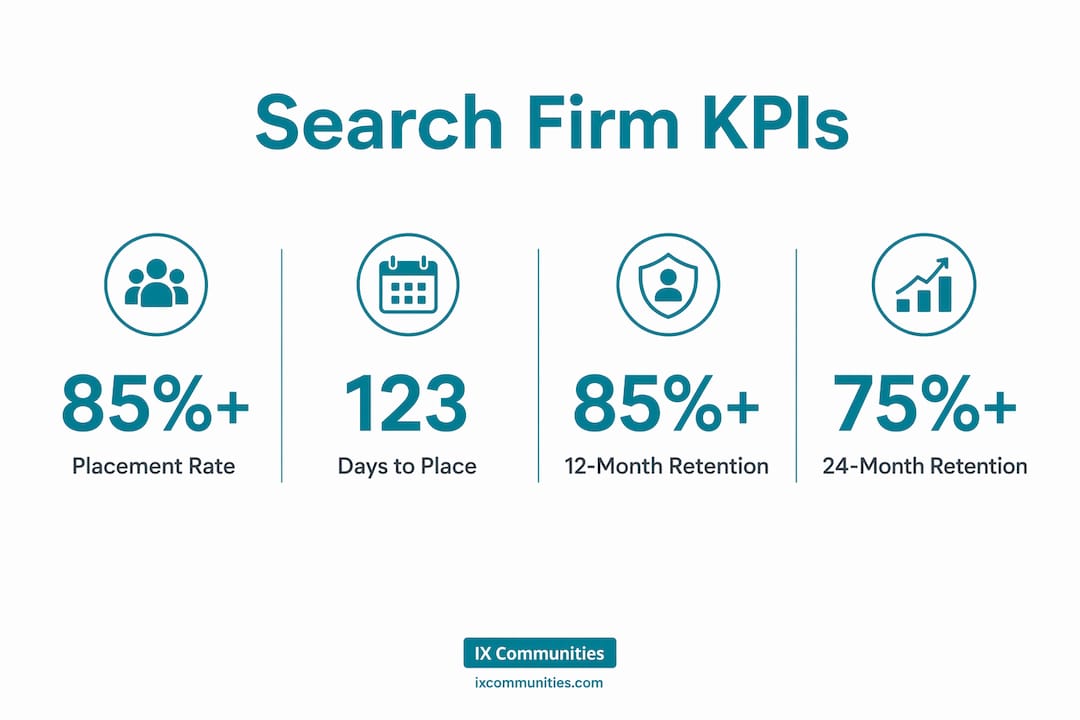
Time-to-placement is the second critical metric. Industry average time-to-placement sits near 123 days for retained executive searches, with practical ranges of 90 to 120 days depending on seniority and sector. Breaking this figure into stage-level milestones, from intake through shortlist to offer, reveals whether delays originate in sourcing, assessment, or client-side decision-making.

Retention rates define hire quality over time. Retention benchmarks of 85%+ at 12 months and 75%+ at 24 months indicate a strong placement. Rates below 70% at 12 months signal potential misalignment in role definition or candidate fit assessment.
Additional KPIs worth tracking include:
- Search completion rate: Firms maintaining above 80% completion signal sourcing discipline and process reliability. Rates below 80% require immediate governance review.
- Net Promoter Score (NPS): Measures hiring manager and candidate satisfaction. High NPS correlates with repeat business and indicates consistent service quality.
- Client repeat business rate: A firm retained for multiple searches by the same organization reflects demonstrated delivery, not just a single successful placement.
- Diversity pass-through rate: Tracking sourced to placed diversity data across each funnel stage identifies where bias or engagement gaps reduce diverse candidate conversion.
| KPI | Industry Benchmark | Target for Top Performers |
|---|---|---|
| Placement success rate | 71% | 85%+ |
| Time-to-placement | 123 days | 90 to 120 days |
| 12-month retention | 70% minimum | 85%+ |
| 24-month retention | Not tracked by most | 75%+ |
| Search completion rate | Variable | 80%+ |
Pro Tip: Segment all KPI data by role seniority and practice area before drawing conclusions. Firm-wide averages hide performance gaps at the consultant or vertical level, which is where remediation decisions need to be made.
How to assess search firm methodology and operational transparency
Methodology transparency is the most important qualitative factor in search firm evaluation. A firm that cannot clearly articulate how it defines role success criteria, identifies passive candidates, and evaluates finalists is functioning as a CV dispatch service rather than a structured search partner. Request written documentation of the firm's process before engaging.
Reviewing redacted example searches and scorecards is the most direct way to verify methodology claims. Ask the firm to provide a sample search deliverable showing how candidates were assessed against a competency model. If the firm cannot produce this, that absence is itself a data point.
Candidate assessment rigor separates high-performing firms from average ones. A minimum of six references, structured as three backward and three lateral checks, combined with competency-mapped behavioral interviews, distinguishes thorough evaluation from surface-level screening. Psychometric assessments add a further layer of objectivity.
Key transparency indicators to evaluate:
- Role success criteria: Does the firm define measurable competencies before candidate identification begins?
- Passive candidate access: What percentage of presented candidates were not actively seeking roles?
- Communication cadence: Does the firm provide structured milestone updates, or only ad hoc check-ins?
- Governance documentation: Are search progress reports provided in writing at defined intervals?
- AI and technology use: Does the firm use tools like ThriveRM, Clockwork Recruiting, or similar platforms to support pipeline management and reporting?
Pro Tip: Ask the firm directly: "How do you define a successful placement?" If the answer focuses only on offer acceptance rather than 12-month retention, that tells you where their accountability ends.
What tools and frameworks can HR professionals use for benchmarking?
A structured benchmarking process requires three components: a KPI dashboard, a comparative scorecard, and a qualitative audit cycle. Each serves a distinct function and together they provide a complete picture of search firm performance.
A KPI dashboard tracks quantitative metrics in real time. Stage-level reporting that details each search from intake through offer acceptance allows HR teams to diagnose delays accurately. Platforms like Execsmart provide structured frameworks for tracking these metrics within professional services contexts.
A comparative scorecard summarizes performance across multiple firms on a single view. Build it using the following steps:
- Define evaluation dimensions: Speed, quality, process discipline, diversity outcomes, and stakeholder satisfaction.
- Assign weights by priority: For senior leadership roles, weight retention and methodology transparency above speed.
- Collect data at consistent intervals: Monthly for KPIs, quarterly for qualitative feedback.
- Score each firm per dimension: Use a 1 to 5 scale with defined criteria at each level to reduce subjectivity.
- Review segmented data: Separate scores by role type and seniority to avoid misleading composite averages.
A qualitative audit cycle captures what dashboards miss. Conduct stakeholder satisfaction surveys with hiring managers at 30, 90, and 180 days post-placement. Collect candidate experience feedback to identify communication or process gaps. Review 12 and 24-month retention outcomes against role-specific benchmarks to close the feedback loop that speed metrics alone cannot provide.
Pro Tip: Build role-specific benchmark profiles before evaluating any firm. A 90-day time-to-fill is excellent for a C-suite search but slow for a VP-level hire. Context determines whether a metric signals strength or underperformance.
What common benchmarking pitfalls should HR professionals avoid?
The most frequent error in evaluating search firms is measuring placement volume without tracking retention or quality. A firm that fills ten roles in a year but loses four of those hires within 12 months has a 60% retention rate. That outcome costs more than a slower firm with a 90% retention rate.
Ignoring role and industry segmentation produces misleading conclusions. A firm's aggregate placement rate may appear strong while masking poor performance in a specific function, such as technology or finance, where your organization hires most frequently. Always request segmented data before drawing comparisons.
Failing to assess methodology transparency leads to superficial evaluations. Boards should require proof of delivery excellence through placement data, retention outcomes, and documented methodology. Without this, evaluations default to subjective impressions of account management quality.
"Methodology transparency determines whether a search firm truly performs structured evaluation rather than acting as a CV dispatch service." — Advius Group
Two additional pitfalls deserve attention. First, misinterpreting speed metrics without quality context creates false confidence. A 60-day placement that results in a 6-month departure is a failed hire, not a fast one. Second, overlooking candidate experience data misses a signal about firm professionalism. Candidates who report poor communication or unclear process feedback reflect directly on your organization's employer brand.
How to implement an ongoing benchmarking and vendor governance process
A continuous benchmarking process requires defined review cadences, transparent reporting agreements, and clear escalation criteria. Without these, benchmarking becomes a one-time exercise rather than a governance tool.
Follow this implementation sequence:
- Establish monthly KPI reviews: Track placement success rate, time-to-stage milestones, and search completion rate each month. Flag any firm falling below defined thresholds for immediate discussion.
- Conduct quarterly retention and satisfaction check-ins: Collect hiring manager feedback and review 90-day post-placement outcomes. Compare results against the benchmarks established in your scorecard.
- Require stage-level reporting from all vendors: Segmented reports from intake through offer identify whether delays originate in sourcing, assessment, or internal decision cycles. This distinction is critical for accurate remediation.
- Identify consultant-level outliers: Firm-level data can mask individual consultant performance gaps. Request data segmented by lead consultant where possible.
- Incorporate benchmarking results into renewal decisions: Use scorecard data as the primary input for contract renewals, fee negotiations, and preferred vendor designations.
Calibrating your benchmarks against external data strengthens the validity of internal evaluations. Peer communities and industry surveys provide reference points that internal data alone cannot supply. The executive recruiting metrics tracked by talent acquisition leaders in comparable organizations offer practical calibration for placement rate, retention, and time-to-hire targets.
Pro Tip: Share your benchmarking framework with search firm partners at the start of each engagement. Firms that understand your evaluation criteria upfront deliver more structured reporting and are more likely to flag process issues proactively.
Key takeaways
Effective benchmarking of search firms requires combining quantitative KPIs, methodology transparency reviews, and structured governance cycles to produce accurate, actionable vendor assessments.
| Point | Details |
|---|---|
| Lead with placement and retention KPIs | Target 85%+ placement success and 85%+ 12-month retention as primary quality benchmarks. |
| Require methodology documentation | Request redacted scorecards and example search deliverables to verify process claims. |
| Segment all performance data | Break KPIs by role seniority and practice area to avoid misleading firm-wide averages. |
| Build a continuous governance cycle | Conduct monthly KPI reviews and quarterly retention check-ins to maintain ongoing accountability. |
| Calibrate against peer benchmarks | Use industry surveys and peer community data to validate internal benchmarks against market norms. |
What I have learned from years of watching benchmarking done wrong
Most HR teams approach search firm evaluation the same way they approach vendor management for software: they look at the invoice and ask whether the deliverable arrived. That approach misses the point entirely when the deliverable is a senior leader who will shape organizational culture for the next decade.
The gap I see most consistently is the absence of retention tracking. Organizations measure time-to-fill with precision and then lose track of the hire entirely after day 90. Speed metrics alone mask hire mismatches that only surface after onboarding. Closing that feedback loop at 12 and 24 months is not an administrative task. It is the most important data point in your entire evaluation.
AI tools are changing how search firms manage pipelines and report on candidate progression. Platforms like ThriveRM and Clockwork Recruiting give firms better data, but they do not replace the judgment required to assess cultural fit or long-term leadership potential. Use technology adoption as a positive signal, not as a substitute for methodology scrutiny.
The organizations that benchmark most effectively are those that treat search firms as long-term partners rather than transactional vendors. They share role success criteria upfront, provide structured feedback throughout the search, and use benchmarking data to improve the relationship rather than simply to justify contract decisions. That posture produces better data and better hires.
Peer communities matter here more than most HR leaders realize. Comparing your benchmarks against those of talent acquisition leaders in similar organizations reveals whether your standards are calibrated to market reality or set at levels that no firm can realistically meet. That calibration is what separates a useful benchmarking program from one that generates data without generating insight.
— Simon
How Ixcommunities supports search firm benchmarking
Ixcommunities operates ESIX, TLIX, and IXCommunities as peer networking and benchmarking groups for talent leadership professionals in large corporations worldwide. Members access structured benchmark data, peer insights, and community resources specifically designed for evaluating and improving search firm relationships.

The ESIX Recruiter Peer Mentorship Programs connect talent acquisition leaders with peers who have direct experience building and refining search firm evaluation frameworks. The Benchmark Surveys platform provides access to aggregated KPI data across placement success, time-to-hire, and retention metrics, giving HR teams the external reference points needed to calibrate internal standards. Members also gain access to guest speaker events and community discussions focused on executive search strategy and vendor governance.
FAQ
What is the average placement success rate for retained executive search?
Retained executive search averages a 71% placement success rate across the industry. Top boutique firms reach 85% to 95%, making this the primary benchmark for evaluating search firm quality.
How long should a retained executive search take?
The industry average time-to-placement for retained executive searches is approximately 123 days. Practical benchmarks range from 90 to 120 days depending on role seniority and sector complexity.
What retention rate should HR teams expect from a quality search firm?
A quality search firm should deliver 85%+ retention at 12 months and 75%+ at 24 months. Rates below 70% at 12 months indicate potential issues with candidate fit assessment or role definition.
How do you evaluate a search firm's methodology?
Request redacted example searches, candidate scorecards, and written documentation of the firm's competency evaluation process. Firms that cannot provide these materials are not conducting structured search.
Why does segmenting KPI data by role type matter?
Firm-wide averages can hide significant performance gaps at the function or seniority level. Segmenting data by role type and practice area reveals where a firm performs well and where remediation is needed.