

Time-to-fill is defined as the total number of days from requisition approval to accepted offer, and it is the most widely tracked recruitment metric in large corporations. The problem is that talent acquisition teams treat it as a success metric when it is actually a process metric. Speed-based metrics like time-to-fill create an illusion of operational control while masking deeper issues such as poor candidate assessment and job misalignment. The industry median time-to-fill sits at 36 days, with top-quartile performers averaging 22 days, yet neither number tells you whether the hire was good. Better alternatives, including quality of hire, offer acceptance rate, and first-year attrition, give talent acquisition professionals the signal they actually need.
Why time-to-fill is the wrong metric for recruitment success
Time-to-fill measures one thing: how long a seat stays empty. It does not measure whether the person who fills it can do the job, stays past six months, or fits the team. That distinction matters enormously when you are responsible for hiring at scale.
The metric also accumulates delays that have nothing to do with recruiter performance. Budget approvals, hiring manager availability, compliance sign-offs, and headcount freezes all inflate the number. Organizational delays like these are embedded in every time-to-fill calculation, yet they are rarely separated from recruiter-controlled activity. Holding a recruiter accountable for a number they cannot fully control produces the wrong incentives.
Time-to-fill and time-to-hire are also frequently conflated, and that confusion hides a different set of problems. Time-to-hire measures the period from when a candidate enters the pipeline to when they accept an offer. Conflating these two metrics obscures post-offer delays such as visa processing, background checks, and onboarding bottlenecks that sit entirely outside the sourcing and selection process. Treating them as interchangeable means you cannot identify where the real slowdown lives.
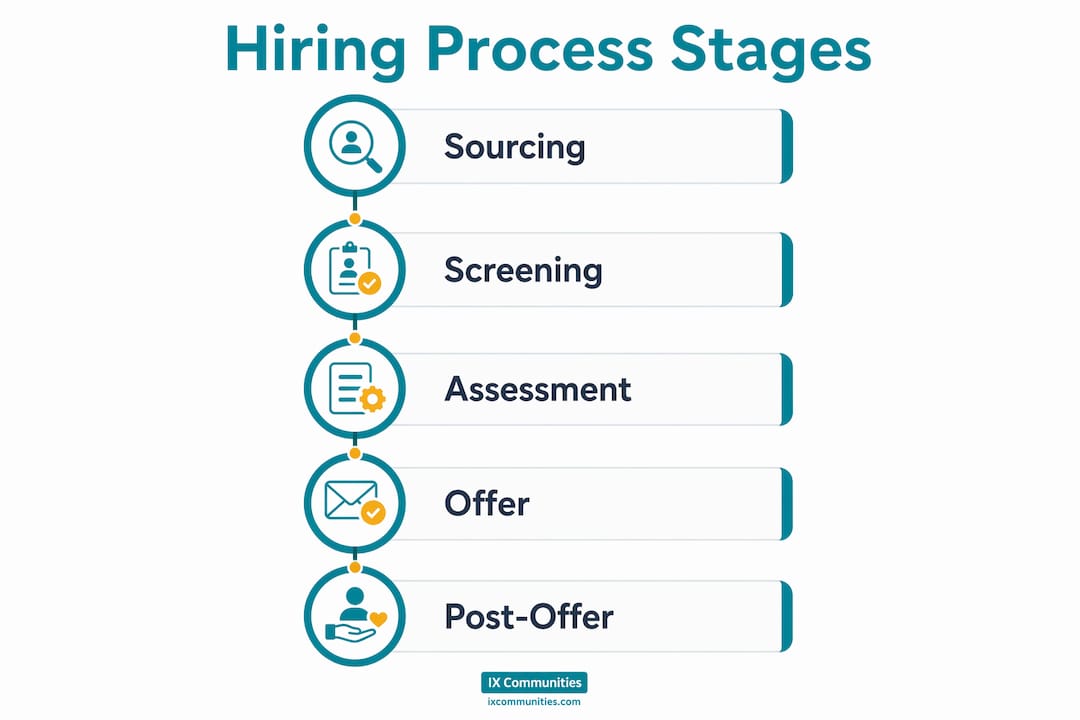
Pro Tip: Break your time-to-fill number into distinct stages: sourcing, screening, assessment, offer, and post-offer. Each stage has a different owner and a different fix. A single aggregate number tells you nothing about where to act.
How chasing faster time-to-fill raises costs and lowers quality
Pressure to reduce time-to-fill pushes recruiters toward the path of least resistance: active candidates who are already searching. Passive talent comprises roughly 70% of the global workforce. That is the majority of the best available candidates, and speed-focused hiring processes systematically exclude them because engaging passive candidates takes longer.

The financial consequences of rushing are well documented. The cost of a bad hire can exceed 30% of first-year earnings, and for senior technical roles it can reach over $28,000. That figure includes lost productivity, management time, re-recruitment costs, and the disruption to the team. A faster fill that produces a bad hire is not a win. It is a deferred cost with interest.
Early attrition is the clearest evidence that speed and quality trade off against each other. 31% of employees quit within six months, and rushed hiring decisions are a leading cause. When assessment is compressed to hit a time target, cultural misfit and role misalignment go undetected until the new hire is already on the payroll.
| Risk factor | Cause | Consequence |
|---|---|---|
| Compressed assessment | Speed pressure reduces interview depth | Poor role fit, early attrition |
| Active-only sourcing | No time to engage passive candidates | Smaller, lower-quality talent pool |
| Skipped reference checks | Deadline urgency cuts corners | Missed red flags |
| Offer-stage rushing | Less negotiation time | Lower offer acceptance rate |
Pro Tip: When a hiring manager pushes for a faster close, quantify the risk. Show the cost of a bad hire in dollars, not just days. That reframes the conversation from speed to value.
What metrics actually predict hiring success?
Quality of hire is the most strategic metric in talent acquisition, and leadership dashboards should prioritize it alongside retention. Quality of hire is typically a composite score combining performance ratings at 90 days and one year, manager satisfaction, and retention at 12 months. No single number captures it, which is exactly why it requires deliberate measurement.
Offer acceptance rate is a leading indicator that most teams underuse. The industry range runs from 83% to 93% or higher. A rate below 83% signals a problem in one of three places: compensation competitiveness, candidate experience during the process, or a mismatch between what was promised and what was offered. Each cause has a different fix, but you cannot diagnose any of them with time-to-fill alone.
First-year attrition and time to productivity complete the picture. Time to productivity measures how long it takes a new hire to reach full performance in their role. It varies by role family, which is why recruiting best practices for executive roles look different from those for high-volume operational roles. Segmenting metrics by role family removes the noise that comes from averaging across wildly different hiring contexts.
A well-designed metrics framework for talent acquisition combines operational indicators with outcome indicators:
- Operational metrics: Time-to-fill by stage, cost-per-hire, pipeline conversion rates
- Outcome metrics: Quality of hire, first-year attrition, offer acceptance rate, time to productivity
- Experience metrics: Candidate net promoter score, hiring manager satisfaction
Tracking only operational metrics is like measuring how fast a surgeon operates without checking whether the patient recovered. The executive recruiting metrics that matter most are always outcome-based.
Practical strategies to move beyond time-to-fill
Effective recruitment process optimization requires designing the entire hiring system, not just speeding up individual steps. Optimizing isolated steps without codified handoffs and service level agreements at each stage undermines the whole process. An SLA that defines how long each stage should take, and who owns it, converts time-to-fill from a vague aggregate into a diagnostic tool.
-
Define stage-level SLAs. Set time targets for each hiring stage: sourcing, screening, assessment, offer, and post-offer. Assign ownership to each stage. When a stage runs long, you know exactly where to intervene.
-
Automate administrative tasks, not assessment. Automated scheduling is 26% faster than manual methods. That efficiency gain should be redirected into more thorough candidate evaluation, not used to compress the overall timeline further.
-
Build passive candidate pipelines before roles open. Engaging passive candidates effectively requires relationship-building over time. Talent communities, alumni networks, and proactive sourcing reduce the urgency that drives rushed decisions when a role opens.
-
Use metrics as coaching signals, not performance judgments. Recruiting operations experts recommend treating time-to-fill as a signal for identifying bottlenecks and coaching opportunities rather than as a strict performance target. A recruiter with a long time-to-fill may be working on hard-to-fill roles or dealing with slow hiring managers.
-
Recalibrate metrics quarterly against business outcomes. Hiring goals shift. A metric framework built for a growth phase looks different from one built for a restructuring phase. Reviewing metrics against actual business outcomes keeps the measurement system honest.
Understanding what drives talent acquisition success at the organizational level requires connecting hiring metrics to business performance data, not just HR dashboards.
Key Takeaways
Quality of hire, offer acceptance rate, and first-year attrition are the metrics that predict hiring success; time-to-fill alone measures only how fast a seat was filled, not how well.
| Point | Details |
|---|---|
| Time-to-fill is a process metric | It measures vacancy duration, not hire quality, performance, or retention. |
| Organizational delays inflate the number | Approvals, compliance steps, and manager availability skew time-to-fill beyond recruiter control. |
| Speed pressure excludes passive talent | Roughly 70% of the workforce is passive; fast-fill mandates push recruiters toward a smaller active pool. |
| Bad hires cost more than slow hires | A bad hire can exceed 30% of first-year earnings; early attrition erases any speed-based savings. |
| Quality of hire requires composite measurement | Combine 90-day performance, manager satisfaction, and 12-month retention for a meaningful score. |
The case for retiring time-to-fill as a primary KPI
I have watched talent acquisition teams spend years optimizing for a number that does not predict anything they actually care about. Time-to-fill is easy to track, easy to report, and easy to misread as progress. That combination makes it dangerous.
The teams that produce the best hiring outcomes are not the fastest. They are the most deliberate. They know which roles justify a longer search because the cost of a bad hire is high. They track offer acceptance rate as a real-time signal of process health. They measure quality of hire at 90 days and 12 months, and they use that data to improve their assessment process, not just their speed.
The uncomfortable truth is that most organizations have not built the infrastructure to measure quality of hire consistently. It requires coordination between recruiting, HR business partners, and hiring managers. That coordination is harder than pulling a date-stamp report. But it is the only measurement that connects talent acquisition to business results.
My advice to any talent acquisition leader is to keep time-to-fill in your reporting, but demote it. Use it as a diagnostic tool at the stage level. Elevate quality of hire, first-year attrition, and offer acceptance rate to the top of your leadership dashboard. Then benchmark those numbers against peers who are operating at the same scale and complexity you are. That comparison is where the real learning happens.
— Simon
How Ixcommunities supports better hiring metrics
Ixcommunities connects talent acquisition leaders at large corporations through peer networking, benchmarking surveys, and structured learning programs designed for recruiting professionals who want to move beyond speed-based KPIs.

The benchmark surveys give members access to quality-of-hire and retention data from peer organizations, so you can calibrate your metrics against comparable hiring environments rather than generic industry averages. The ESIX Recruiter Peer Mentorship Programs pair recruiting professionals with experienced leaders who have built outcome-focused measurement frameworks in complex corporate environments. Both programs are built for talent acquisition teams that are ready to measure what actually matters.
FAQ
What is time-to-fill in recruitment?
Time-to-fill is the total number of days from requisition approval to accepted offer. It measures how long a role remains open, not whether the resulting hire was successful.
Why is time-to-fill considered a misleading metric?
Time-to-fill accumulates organizational delays outside recruiter control, such as budget approvals and compliance steps, and it does not measure hire quality, retention, or performance.
What is the difference between time-to-fill and time-to-hire?
Time-to-fill starts at requisition approval; time-to-hire starts when a candidate enters the pipeline. Conflating them hides post-offer delays like background checks and onboarding that are separate from sourcing and selection.
What are better alternatives to time-to-fill?
Quality of hire, offer acceptance rate, first-year attrition, and time to productivity are outcome-based metrics that predict hiring success more accurately than time-to-fill alone.
What does quality of hire measure?
Quality of hire is a composite metric that combines performance ratings at 90 days and 12 months, manager satisfaction, and retention. It connects recruiting activity directly to business outcomes.