

Many talent acquisition leaders are surprised when an executive search runs well past the three-month mark, and they assume something went wrong. The reality is more nuanced. Most executive searches run approximately 90 to 180 days from kickoff to signed offer, with C-suite roles often extending to eight months or more. The variables that drive those numbers have little to do with recruiter performance and everything to do with governance, stakeholder dynamics, and candidate transition logistics. This article breaks down real benchmarks, explains the phases that consume the most time, and offers a clear framework for reporting timelines to leadership.
Table of Contents
- What is the typical executive search timeline?
- Deconstructing the process: Executive search phases and their timing
- Key drivers of timeline variability: What actually slows searches down
- Time-to-fill, time-to-start, and time-to-impact: Reporting and stakeholder communication
- What most leaders miss about executive search timelines
- Advance your executive search strategy with IX Communities
- Frequently asked questions
Key Takeaways
| Point | Details |
|---|---|
| Expect 3–6 months | Most executive searches take 3–6 months, while C-suite searches often require even more time. |
| Delays are not just sourcing | Board approvals, stakeholder consensus, and candidate transitions contribute as much to delays as talent sourcing. |
| Break down by phase | Viewing executive search as phases with distinct timeframes clarifies where delays occur and which steps to optimize. |
| Report multiple metrics | Separating time-to-fill, time-to-start, and time-to-impact improves transparency and stakeholder trust. |
| Use structured project work | Optimize timelines by managing the search as a phased project and aligning stakeholders early. |
What is the typical executive search timeline?
With that context, let's clarify what typical executive search timelines actually look like and why they are so different from other hiring processes.
The executive search benchmarks that talent leaders rely on reflect a significant range. For most critical leadership roles, searches run approximately 3 to 6 months from initial briefing to signed offer. C-suite and President-level roles frequently extend to 4 to 8 months or more. Silicon Valley technology markets sometimes compress this to 90 to 120 days due to competitive talent dynamics, but those cases are the exception rather than the rule.
One critical benchmark stands out for internal teams: our peer benchmarking data shows that executive searches managed internally average 90 days, while searches executed externally by search firms average 138 days. That 48-day gap is significant, and it deserves careful interpretation. The difference is not simply a matter of efficiency. External firms often handle more complex, confidential, or strategically sensitive mandates where additional diligence, discretion, and broader market mapping are required. Internal teams frequently fill roles with more defined parameters and faster stakeholder access. Understanding why that gap exists, rather than assuming internal is always faster or better, is what separates strategic talent leaders from reactive ones.
Compare these numbers to standard time-to-fill, which SHRM reports as approximately one and a half months on average across all roles. Executive searches run two to five times longer. That difference is structural, not operational.
| Search type | Typical timeline | Notes |
|---|---|---|
| Non-executive (all roles) | 4 to 6 weeks | SHRM 2025 benchmark |
| Executive (VP/Director level) | 3 to 5 months | Varies by function and market |
| C-suite / President | 4 to 8+ months | Board involvement, complex transitions |
| Internal team execution | ~90 days | Peer benchmark average |
| External firm execution | ~138 days | Peer benchmark average |
Several factors explain why executive searches take significantly longer:
- Passive candidate pools. Most qualified executives are not actively applying. Firms and internal teams must identify, approach, and cultivate candidates over weeks before a formal conversation begins.
- Heightened evaluation standards. Multiple interview rounds, assessments, reference checks, and board presentations all add time.
- Governance requirements. Board sign-off, compensation committee approvals, and legal review extend the offer phase substantially.
- Market scarcity. At senior levels, the candidate universe is genuinely small. Compromising on fit to save time creates long-term risk.
For a full executive recruiting timeline framework, it helps to understand each phase in sequence rather than viewing the process as a single block of time.
Deconstructing the process: Executive search phases and their timing
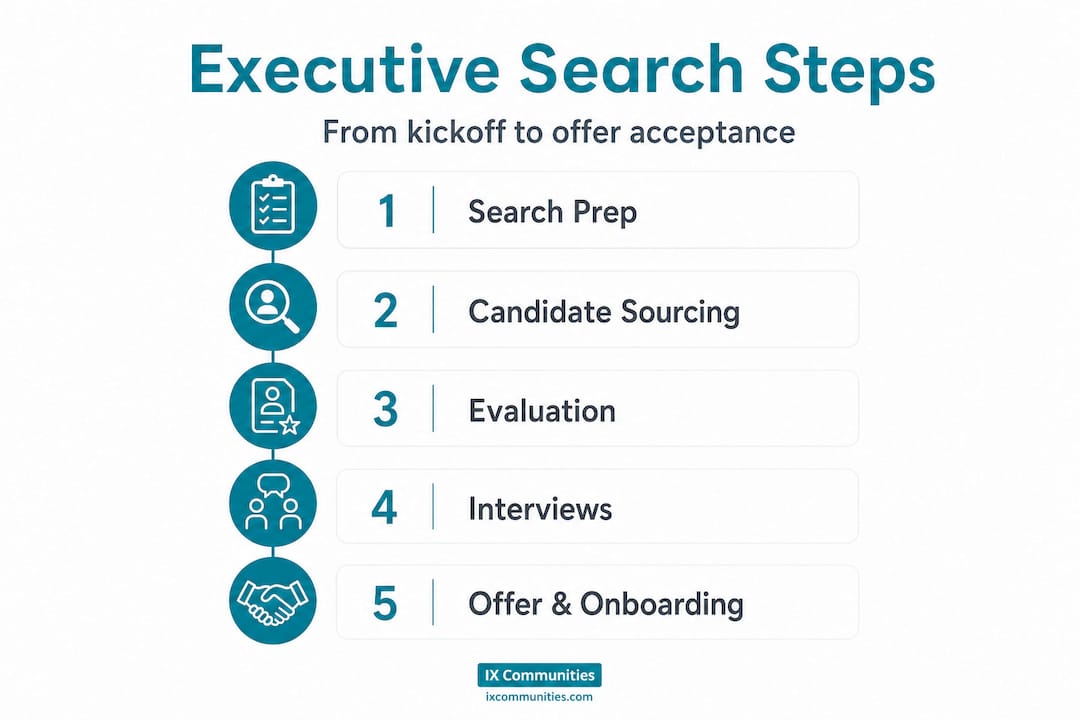
Understanding the total timeline requires breaking the process into its core phases. Each phase carries its own typical duration, and some absorb far more time than most leaders anticipate.
The retained executive search methodology typically decomposes an engagement into six core phases. Here is how those phases generally map to real-world timelines:
-
Intake and role scoping (weeks 1 to 2). This phase involves defining the role, competency requirements, compensation structure, and success criteria. Delays here often foreshadow delays later. Misalignment among hiring managers and stakeholders at this stage creates rework in every subsequent phase.
-
Market mapping (weeks 2 to 4). Researchers build a target universe of candidates based on scope, geography, function, and company profile. For niche or highly specialized roles, this step alone can take three to four weeks when done rigorously.
-
Outreach and candidate development (weeks 4 to 10). This is the most variable phase. Reaching passive executives, building enough trust for a conversation, and moving qualified candidates through initial screening takes time. Multiple touchpoints are often required before a candidate agrees to an exploratory call.
-
Evaluation and interviews (weeks 10 to 16). Structured interviews, assessments, and hiring manager meetings compress or expand based on calendar availability. Coordinating schedules across busy executives on both sides is consistently one of the most time-consuming practical challenges.
-
Offer negotiation (weeks 16 to 20). At senior levels, compensation packages are complex. Equity, deferred compensation, severance terms, and benefits each require careful structuring. Board or compensation committee review adds additional time before a formal offer can be extended.
-
Onboarding support and transition (weeks 20 onward). Many searches formally conclude at offer acceptance, but the transition phase, including notice periods and early integration, shapes whether the hire delivers the expected impact.
Pro Tip: Map each phase to a specific owner and a target completion date at the start of the engagement. Searches that lack phase-level accountability consistently run longer than those managed as structured projects.
The phase where most searches lose the most time is often the evaluation stage. Calendar conflicts, travel schedules, and indecisive hiring committees regularly add two to four weeks to what should be a straightforward interview process. Using a phase-managed approach with clear decision gates reduces this drag substantially. For teams focused on streamlining each phase, documenting time spent per phase over multiple engagements reveals where systemic bottlenecks exist.

Key drivers of timeline variability: What actually slows searches down
Once we separate the phases, the next question is: what actually creates delays in practice? The answer, consistently, is internal processes rather than external sourcing.
Protracted decision-making and stakeholder misalignment are the single largest contributors to extended search timelines. When key stakeholders do not agree on priorities early, the search process circles back repeatedly. Board processes alone commonly add two to six weeks to the overall timeline.
"The most preventable delays in executive search are rarely about finding candidates. They are about getting your own organization to a decision."
Here are the most common timeline stretchers talent leaders encounter:
- Stakeholder disagreement on role definition. When the CEO, CHRO, and board each have a different vision for the role, every shortlisted candidate gets evaluated against different standards.
- Slow feedback loops. After candidate presentations, delays in collecting structured feedback from multiple stakeholders add days and weeks to the calendar.
- Board or compensation committee scheduling. Boards often meet quarterly. If an offer requires approval and the next meeting is six weeks away, the timeline extends automatically.
- Candidate counteroffers. At senior levels, candidates frequently receive counteroffers from their current employer. Handling these negotiations adds time and sometimes restarts the process.
- Internal approvals for compensation exceptions. When the target package exceeds standard bands, additional finance or legal approvals are required before an offer can be formally extended.
The board approval impact on timelines is particularly pronounced for public companies and organizations with formal governance structures. Talent leaders who proactively brief board members during the search process, rather than only at the offer stage, consistently report faster final approvals.
Notice periods represent another substantial source of delay after offer acceptance. U.S. notice periods typically run two to four weeks, but European markets commonly require three to six months of notice. For global searches, this means that even a perfectly executed process concluding in month four may not result in an executive starting until month nine or ten.
Pro Tip: For roles with anticipated global candidate pools, factor regional notice period norms into your timeline projections from day one. Presenting leadership with a realistic start-date range based on candidate geography prevents significant expectation mismatches later.
There are also overlooked timeline challenges related to confidentiality requirements. When a search must remain undisclosed because it is a replacement role or involves an organizational restructure, the outreach process slows considerably. Candidates approached under confidential conditions often require additional time and context before agreeing to engage.
Time-to-fill, time-to-start, and time-to-impact: Reporting and stakeholder communication
Now that we have identified what extends the timeline, it is crucial to discuss how you should frame and report these durations to leadership.
Many talent leaders report a single number, time-to-fill, and leave leadership to interpret it. That single number creates misaligned expectations, particularly when a signed offer does not translate into a sitting executive for several months. Structured reporting should separate three distinct metrics:
- Time-to-fill (or time-to-offer acceptance). This measures the recruiter-controlled portion: from kickoff to signed offer.
- Time-to-start. This accounts for notice periods, relocation, and transition logistics. It is the metric that matters most for operational planning.
- Time-to-impact. This is the period after the executive starts until they reach full functional effectiveness.
Time-to-impact is defined by the Advius Group as approximately 90 to 120 days from the start date for a well-placed and well-integrated executive. That means the complete timeline from search initiation to full executive effectiveness can extend to five to seven months at minimum, and substantially longer for complex C-suite roles.
For reporting executive timeline metrics to boards and senior leadership, a three-column framework works effectively:
- Column one: Search phase duration (recruiter accountable)
- Column two: Transition period (candidate accountable, market-driven)
- Column three: Integration period (organization accountable)
This structure makes it immediately clear to leadership which portion of the timeline is within the recruiting team's control and which portions are driven by external factors.
Pro Tip: Present all three metrics together in your quarterly talent reporting. When leadership understands that time-to-start and time-to-impact are separate from time-to-fill, they make better operational decisions about succession timing and interim coverage.
The executive search knowledge hub at IX Communities provides peer-validated frameworks for standardizing these reporting categories across large corporate talent functions. Consistency in how you define and track these metrics is as important as the numbers themselves.
What most leaders miss about executive search timelines
Conventional wisdom in executive recruiting treats timeline compression as the primary goal. If the search takes less time, it performed better. This assumption is worth questioning directly.
The real differentiator between an ordinary search and an outstanding one is not speed. It is what the team optimized for during each phase. Searches that close quickly but misalign on cultural fit or leadership style often result in departures within 18 months. The cost of a failed executive hire, accounting for severance, organizational disruption, and restarting the search, far exceeds the cost of an additional four to six weeks in the original process.
The more productive question is: where can you reduce unnecessary delay without reducing diligence? The internal versus external benchmark gap of 90 days versus 138 days is instructive here. Internal teams are not simply faster because they work harder. They often have faster access to stakeholders, tighter role definitions, and less complex mandate structures. External firms carry the weight of greater market scope, confidentiality requirements, and more formal governance processes. Knowing which variables apply to each of your searches lets you set accurate expectations and find legitimate acceleration points.
AI and modern search strategy can assist with market mapping and candidate identification, but the human elements, stakeholder alignment, consensus building, and transition planning, remain the defining factors in search quality and speed. The most sophisticated AI tools will not substitute for a well-facilitated kickoff meeting where all decision-makers align on non-negotiable criteria.
Treating the post-offer transition as a parallel workstream rather than a sequential step is perhaps the most underutilized acceleration strategy available. Organizations that begin integration planning during the final stages of the search, before the offer is even signed, consistently report shorter time-to-impact and higher executive retention at the 12 and 24-month marks.
Advance your executive search strategy with IX Communities
For those wanting to lead the pack by leveraging new insights and peer benchmarks, IX Communities provides a direct pathway to evidence-based improvement.

IX Communities, through ESIX and TLIX, serves as the preeminent peer networking and benchmarking platform for corporate talent and recruiting leaders worldwide. The data points referenced in this article, including the 90-day internal versus 138-day external benchmark, come from the kinds of structured, peer-validated surveys that members participate in through benchmark surveys regularly. Members also access peer mentorship for recruiters that help translate benchmark insights into operational change. If your organization is ready to build a more rigorous approach to executive search planning and reporting, explore membership to see how IX Communities supports talent leaders at every level.
Frequently asked questions
Why does executive search take longer than regular hiring?
Executive search involves identifying and engaging passive candidates, coordinating multiple senior stakeholders, and navigating complex approvals or candidate transitions, all of which extend timelines well beyond standard recruiting. Supply and governance factors create constraints that do not exist in typical hiring processes.
How long should we expect a C-suite search to take?
Plan for 4 to 8 months or more from kickoff to signed offer for C-level roles, plus additional weeks or months for candidate transition depending on region and notice period requirements.
What is "time-to-impact" in executive hiring?
Time-to-impact is the period from an executive's start date until they reach full functional effectiveness, typically 90 to 120 days post-hire, meaning total elapsed time from search initiation to full productivity can reach five to seven months or more.
What steps can accelerate executive search without sacrificing fit?
Align all key stakeholders on role criteria before outreach begins, manage each search phase with defined owners and deadlines, and treat the offer and transition period as a separate, parallel workstream rather than a sequential step.
How do notice periods affect executive search timelines globally?
In the U.S., notice periods run 2 to 4 weeks, but European executives commonly require 3 to 6 months of notice, which means global searches may extend the total timeline significantly beyond the offer acceptance date.