

Executive search in 2030 will require human judgment in the areas AI cannot replicate: motivation diagnosis, board dynamics, trust building, and ethical governance. The recruiter role is already shifting from roughly 60% sourcing and 40% advisory to 20–30% sourcing and 70–80% advisory as AI handles volume tasks. That shift will accelerate. By 2030, the question for HR leaders and talent acquisition professionals is not whether AI will change executive search. It already has. The real question is which human roles remain non-negotiable, and how you position your team to own them.
How AI is reshaping executive search and where it falls short
AI has compressed the early stages of executive search in measurable ways. Search timelines have dropped from roughly 18–20 weeks to 14–16 weeks. That compression comes almost entirely from faster market mapping, automated longlisting, and AI-assisted candidate scoring. The final stages, including motivation assessment, offer negotiation, and closing, remain human-led.
The limitation is not speed. AI is fast. The limitation is judgment. When AI fully replaces sourcing and screening without human review, results become probability-driven without context. A candidate who scores well on an AI-generated profile may lack the board presence or cultural alignment that only a trained recruiter can detect through direct conversation. Firms that perform at the highest level have humans interrogate AI scores, not simply accept them.
Operational discipline also remains human-led. A retained executive search runs 90–150 days across seven stages, and elite firms achieve 80–90% placement success. Poor process produces roughly a 40% failure rate. That gap is not explained by AI capability. It is explained by the quality of human governance at each stage.
- Market mapping and longlisting: AI handles this well. Speed and volume are AI strengths.
- Candidate outreach and initial screening: AI assists, but human tone and relationship context matter from the first contact.
- Motivation and culture assessment: Fully human. AI cannot diagnose why a candidate is actually considering a move.
- Board presentation and dynamics: Human only. Political nuance and chemistry cannot be scored algorithmically.
- Offer negotiation and closing: Human-led. Conviction and trust close searches; algorithms do not.
Pro Tip: Use AI output as a starting point for candidate review, not a final ranking. Require your team to document one specific reason they agree or disagree with each AI-generated score before advancing any candidate.
Which human roles in executive search will remain essential by 2030
The human roles that will persist through 2030 are not the ones that are simply hard to automate. They are the ones where the cost of getting it wrong is highest and where clients pay a premium for judgment, not just process.

Trust and the trusted advisor relationship. Clients value human recruiters for empathy, honesty, and the ability to navigate complex board dynamics and motivation diagnosis. That trust is built over time through candid conversations, accurate assessments, and the willingness to tell a client when a candidate is not the right fit. AI can surface a name. It cannot build a relationship.
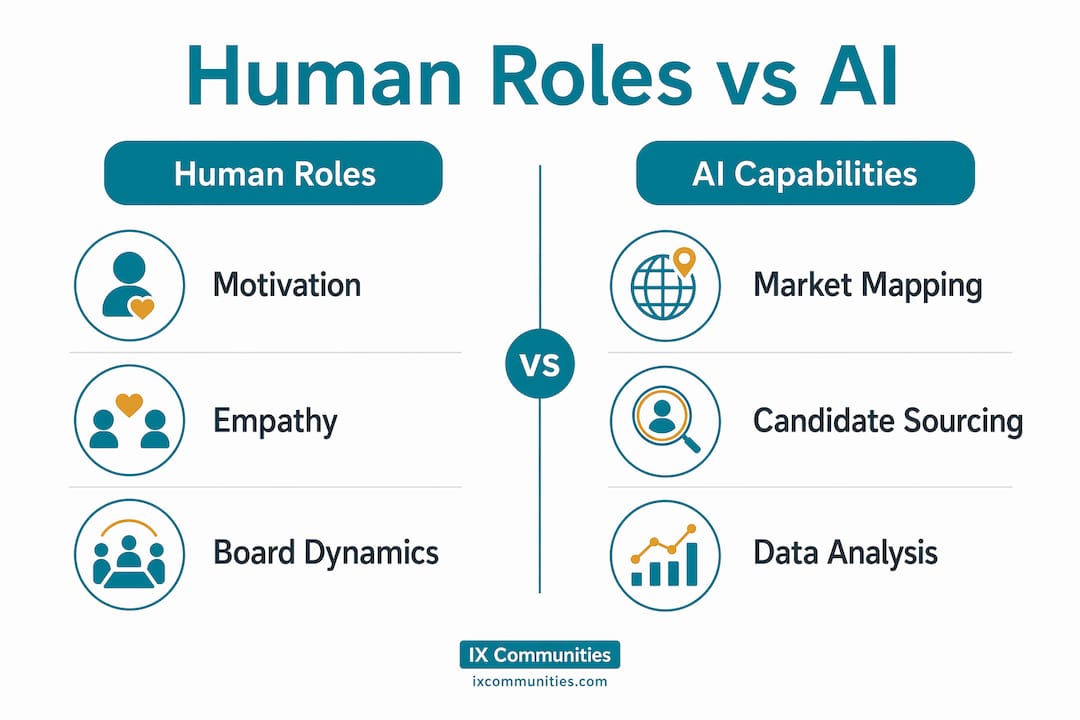
Board dynamics and political navigation. Every senior search involves stakeholders with competing priorities. A CHRO may want one profile; the CEO wants another; the board has a third view. Reconciling those perspectives requires reading the room, managing expectations, and sometimes delivering difficult feedback. These are judgment calls that depend on context AI does not have access to.
Motivation diagnosis. Understanding why a high-performing executive would leave a stable role requires direct conversation and the ability to detect what is not being said. A candidate may say compensation is the driver. An experienced recruiter knows to probe further. This skill is not replicable by a language model.
- Soft skills assessment, including communication style and leadership presence, requires in-person or video-based human evaluation.
- Cultural fit analysis depends on understanding the client organization at a depth that goes beyond a job description.
- Ethical judgment calls, including when to flag a conflict of interest or a candidate's undisclosed circumstances, require human discretion.
"AI amplifies recruiter reach and insight but cannot supplant human qualities like heart, curiosity, and conviction, which are essential for identifying exceptional leadership." — Hunt Scanlon Media
Legal compliance adds another layer. US federal guidance requires that AI hiring tools avoid screening out qualified individuals with disabilities, and employers must validate that automated assessments target only relevant skills. Human oversight is not optional. It is a legal requirement. By 2030, regulatory scrutiny of AI in hiring will be greater, not less.
Ai-augmented vs. traditional executive search: a direct comparison
The difference between AI-augmented and fully traditional executive search is not about which approach is better in principle. It is about where each model concentrates risk and where it concentrates value.
| Search Phase | Traditional Human-Led | AI-Augmented |
|---|---|---|
| Market mapping | 3–5 weeks, manual research | 1–2 weeks, AI-assisted |
| Longlisting | Researcher-driven, 4–6 weeks | AI-generated in days |
| Candidate outreach | Human relationship-led | AI drafts, human reviews |
| Motivation assessment | Human-only, 2–4 weeks | Human-only, unchanged |
| Board presentation | Human-only | Human-only |
| Offer and close | Human-led, 2–4 weeks | Human-led, unchanged |
| Total timeline | 18–20 weeks | 14–16 weeks |
The time savings are real and concentrated in the early stages. A winning candidate is typically presented within 14–21 days of search launch, but total time-to-close remains around three months because of the intensive leadership and culture evaluation that follows. AI does not shorten that phase. It cannot.
The risk point in AI-augmented search is over-reliance on early-stage scores. A recruiter who presents a candidate because the AI ranked them highly, without conducting a substantive motivation conversation, is taking on placement risk that structured human evaluation would have caught. Structured, multi-method assessments yield 80–95% placement success. Unstructured, intuition-only hiring produces roughly 50% success. The data supports process discipline, not AI dependence.
Pro Tip: Map your current search process against these seven stages and identify which phases your team has handed to AI without a documented human review checkpoint. That gap is your placement risk.
How HR leaders should balance AI tools with human judgment
The firms that will lead executive search by 2030 are not the ones with the most advanced AI stack. They are the ones that treat AI as a controlled system and invest in the human capabilities that AI cannot replicate.
-
Treat AI as a controlled system. Effective AI governance requires documentation, bias mitigation, and impact validation at every stage. A black-box AI approach risks both placement failure and legal exposure. Every automated assessment should have a human review checkpoint and a documented rationale.
-
Validate for bias and legal compliance. The ADA and emerging state-level AI hiring regulations require that automated tools measure only job-relevant skills and do not disproportionately screen out protected groups. Assign a specific team member to own compliance review for every AI tool in your search process. This is not a one-time audit. It is an ongoing function.
-
Reposition your team as strategic advisors. The shift toward advisory roles is already underway. Recruiters who spend the majority of their time on sourcing will be displaced by AI. Recruiters who spend the majority of their time on client advisory, motivation diagnosis, and board-level consultation will become more valuable. Invest in developing those skills now.
-
Use AI data to inform, not decide. AI-generated candidate scores should trigger questions, not conclusions. When a score diverges from a recruiter's direct assessment, that divergence is information. Require your team to document and discuss those gaps rather than defaulting to the algorithm.
-
Stay current on AI tools through peer benchmarking. The technology in talent acquisition is moving faster than any single firm can track independently. Peer networks and AI governance resources give HR leaders access to validated practices across organizations, reducing the risk of adopting tools that create compliance exposure.
Key takeaways
By 2030, executive search will require humans for judgment-heavy functions including motivation diagnosis, board dynamics, trust building, and legal compliance, while AI handles sourcing and screening volume.
| Point | Details |
|---|---|
| AI compresses timelines, not judgment | AI reduces search timelines to 14–16 weeks but final stages remain fully human-led. |
| Structured assessment drives success | Multi-method human evaluation yields 80–95% placement success versus roughly 50% for unstructured approaches. |
| Legal compliance requires human oversight | ADA guidance mandates human validation of AI hiring tools to prevent discriminatory screening. |
| Advisory roles are the growth area | The recruiter role is shifting to 70–80% advisory as AI absorbs sourcing and longlisting tasks. |
| AI governance is a team function | Treating AI as a controlled system with documentation and bias review protects both placement quality and legal standing. |
Where i think the industry is getting this wrong
The conversation about AI in executive search tends to focus on what AI can do. That is the wrong frame. The more useful question is what happens when firms stop investing in the human capabilities that AI cannot replace.
I have watched firms adopt AI sourcing tools and quietly reduce investment in recruiter development, particularly in areas like motivation interviewing, board advisory, and stakeholder management. The short-term efficiency numbers look good. The placement quality numbers, measured 12–18 months out, tell a different story.
The firms I respect most treat AI as a capability multiplier for their best people, not a substitute for developing those people. They also take compliance seriously before a regulator forces them to. The ADA guidance on AI hiring tools is not theoretical. It is the floor, not the ceiling, of what responsible governance looks like.
By 2030, the recruiters who matter will be the ones who have spent the intervening years deepening their advisory skills, building genuine board-level relationships, and learning to interrogate AI output with the kind of contextual knowledge that only comes from experience. The technology will keep improving. The human judgment required to use it well will not automate itself.
Curiosity and conviction are still the differentiators. They were before AI, and they will be after whatever comes next.
— Simon
How Ixcommunities supports recruiters navigating this shift
Ixcommunities operates ESIX, TLIX, and IXCommunities as peer networking and benchmarking groups for talent leadership professionals at large corporate organizations worldwide. The focus is on giving talent and recruiting leaders a secure environment to share validated practices, benchmark against peers, and build the capabilities that matter most as AI reshapes executive search.
The ESIX Recruiter Peer Mentorship Programs are specifically designed to develop the strategic advisory and governance skills that will define recruiter value by 2030. Members also gain access to the Technology Stack Reference Tool to evaluate and benchmark AI tools against peer organizations. If you are responsible for executive search quality and compliance at a large organization, Ixcommunities provides the peer context and structured resources to make better decisions faster.
FAQ
What will executive recruiters still do in 2030?
By 2030, executive recruiters will focus primarily on motivation diagnosis, board advisory, stakeholder management, and offer negotiation. These judgment-heavy functions cannot be automated because they require contextual understanding, trust, and direct human interaction.
How much does AI actually speed up executive search?
AI compresses search timelines from roughly 18–20 weeks to 14–16 weeks by accelerating market mapping and longlisting. Final evaluation and closing stages remain unchanged in duration because they require intensive human assessment.
Does AI in hiring create legal risk for employers?
Yes. US federal guidance under the ADA requires employers to validate that AI hiring tools measure only job-relevant skills and do not screen out qualified individuals with disabilities. Human oversight and documentation are legally required, not optional.
What placement success rate do structured human assessments achieve?
Structured, multi-method assessments yield 80–95% placement success. Unstructured approaches that rely on intuition alone produce roughly 50% success, making process discipline a direct driver of search outcomes.
How should HR leaders govern AI tools in executive search?
HR leaders should treat AI hiring tools as controlled systems with documented validation, bias review, and human checkpoints at every stage. Assigning a specific owner for compliance review and requiring recruiters to document their reasoning when they agree or disagree with AI scores are the two most practical starting points.