

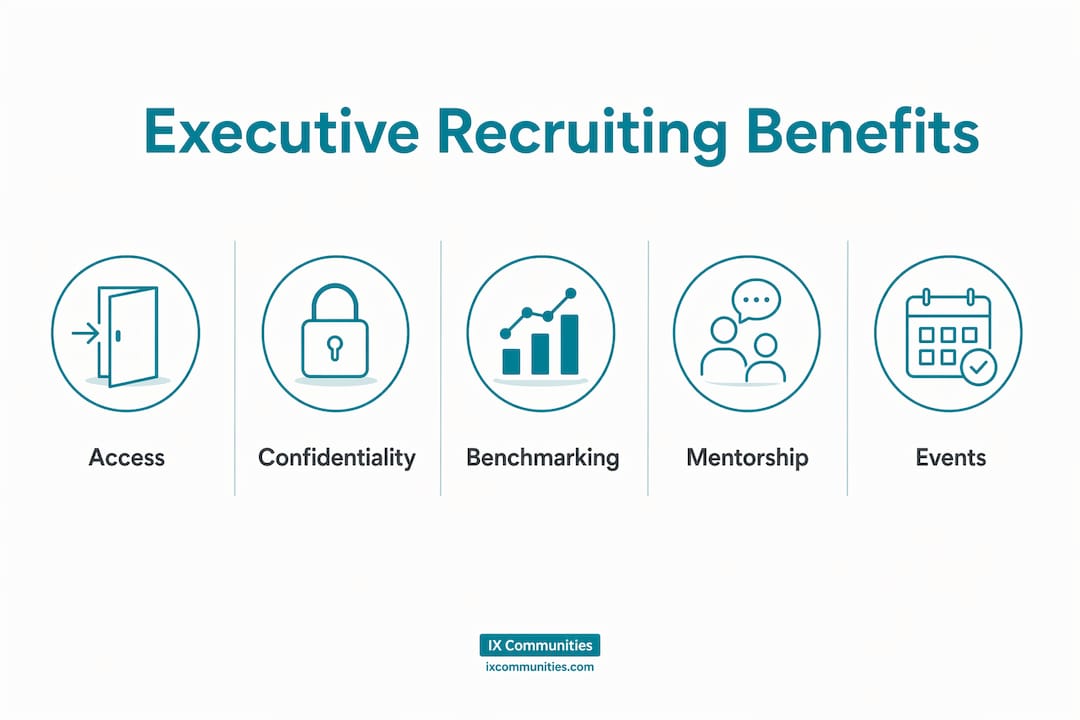
Membership in executive recruiting peer groups delivers peer-tested benchmarks, confidential knowledge exchange, proprietary research, curated events, and measurable hiring outcomes including faster placements and fewer costly mis-hires. SHRM's executive membership and talent pipeline research from TriSearch both confirm that structured peer access and continuous talent mapping materially improve executive search results.
TL;DR — what membership delivers:
- Proprietary benchmarks and compensation data for boardroom-level decisions
- Confidential peer exchange through closed, secure forums
- Curated events, mentorship, and consultant briefings that shorten time-to-hire
- Access to vetted search consultant databases and recruiter training
- Measurable outcomes: faster placements, stronger offer acceptance, fewer regrettable hires
Groups such as ESIX, TLIX, and Ixcommunities are built specifically for corporate talent and recruiting leaders who need these capabilities at scale.
Table of Contents
- What are the core benefits of executive recruiting groups?
- Why executive recruiting benefits uniquely from peer benchmarking
- What a strong membership should include
- How to evaluate and justify membership to stakeholders
- Outcomes members can expect
- Key Takeaways
- Why peer benchmarking memberships are worth the investment
- Ixcommunities gives you the peer benchmarking capability described above
- Useful sources
What are the core benefits of executive recruiting groups?
Executive recruiting peer groups translate abstract membership value into concrete tools that talent leaders can use in day-to-day search operations and in boardroom presentations.

Peer insight and confidential problem-solving. Closed forums and curated roundtables give members access to how peer organizations handle high-stakes searches, from structuring a confidential CFO replacement to managing a board-directed succession. Generic HR content cannot replicate this because the specifics, the actual practices peer teams use, are not published anywhere.
Benchmarks and proprietary research. SHRM's executive membership lists workforce trends, compensation benchmarks, white papers, and C-suite briefings as core member benefits. These reports give talent leaders comparable metrics they can present to finance and the board, rather than relying on estimates or publicly available salary surveys that rarely reflect the actual market for senior roles.
Curated events and mentorship. Invite-only events and executive peer mentoring programs connect members with practitioners who have solved the same problems. Consultant briefings within these groups surface market intelligence on passive candidate availability, which directly affects how quickly a search can move from mandate to shortlist.
Vetted consultant databases and recruiter training. Access to a curated search consultant database reduces the time spent evaluating external partners. Recruiter training courses, available to both members and non-members through platforms like Ixcommunities, build internal capability that reduces dependency on external search for every hire.
Competitive intelligence and market mapping. Understanding where comparable organizations are sourcing talent, and at what compensation levels, gives recruiting teams a structural advantage. This is especially relevant for passive candidate access, where market intelligence and targeted outreach are the primary differentiators between a search that closes in 90 days and one that stalls.
Statistic callout: Talent mapping run as a continuous ecosystem delivers measurable benefits including 40% faster executive placements and fewer regrettable hires, according to TriSearch.
Pro Tip: Use your membership's benchmark survey data specifically when negotiating offer packages. Compensation benchmarks tied to peer-group data carry more weight with candidates and internal finance teams than third-party salary guides, because they reflect actual peer-organization practice rather than broad market averages.
Why executive recruiting benefits uniquely from peer benchmarking
Executive searches are longer, higher-stakes, and more confidential than standard hiring, which means generic HR guidance is rarely sufficient. C-suite searches typically span several months and require strict confidentiality protocols throughout. Without comparable benchmarks, decisions at the final stage become subjective, which slows consensus and increases the risk of a costly mis-hire.
Average C-suite time-to-fill can be several months without specialized support, according to The Richmond Group. Peer benchmarking addresses this directly by giving teams pre-validated timelines, assessment frameworks, and compensation ranges that reduce the back-and-forth that typically extends searches.
The table below maps the specific challenges of executive search to what peer benchmarking supplies:
| Challenge | What peer benchmarking supplies |
|---|---|
| Confidentiality requirements | Invite-only forums with NDA-backed access controls |
| Extended time-to-hire | Talent mapping pipelines and peer-validated search timelines |
| Compensation uncertainty | Proprietary salary and total-compensation benchmarks |
| Subjectivity in final-stage assessment | Peer-tested competency frameworks and structured evaluation criteria |
| Board-level consensus delays | Comparable data from peer organizations to anchor decisions |
A practical example: When a large organization needs to replace a CFO without alerting the market, the recruiting team faces simultaneous pressure on confidentiality, speed, and compensation accuracy. A peer group member can query the closed forum for how comparable organizations structured that search, access benchmark data on CFO compensation at peer companies, and consult a vetted search consultant database, all within the same membership. That combination can compress the decision timeline and reduce the probability of a failed search.
The role of benchmarking in hiring is well-documented in HR technology research: structured comparison data reduces subjectivity and accelerates consensus, particularly at the board level where multiple stakeholders must align before an offer is extended.
What a strong membership should include
A well-structured executive recruiting peer group membership delivers a defined set of features. Evaluators should expect the following from any group they consider:
Must-have features:
- Secure, closed member forum with access controls and confidentiality agreements
- Proprietary benchmark reports (compensation, time-to-fill, retention, search firm performance) delivered at least quarterly
- Curated in-person and virtual events with peer practitioners and expert guest speakers
- Vetted search consultant database with performance data
- Dedicated relationship manager or concierge support
- On-demand advisory access between scheduled events
Nice-to-have features:
- Recruiter training courses available on demand
- Technology benchmarking tools for evaluating ATS and assessment platforms
- Guidebooks and best-practice playbooks for specific search types (succession, diversity, international)
- Integration with assessment platforms to align peer data with internal evaluation design
Privacy and confidentiality safeguards are non-negotiable for executive-level groups. Look for NDAs as a condition of membership, closed-platform architecture that prevents content from being indexed or shared externally, and limited-access events where attendance is verified.
Pro Tip: Before committing to a membership, ask specifically for access to historical benchmark archives, not just the current report. A group that has been running benchmark surveys for multiple years gives you trend data, which is far more useful for boardroom presentations than a single-year snapshot.
How to evaluate and justify membership to stakeholders
Use five criteria to evaluate any executive recruiting peer group: features and deliverables, membership eligibility fit, activity cadence, privacy and governance, and measurable outcomes. The table below applies those criteria across membership tiers:
| Dimension | What to look for |
|---|---|
| What you get | Benchmark reports, secure forums, events, consultant database, training |
| Who it's for | Corporate TA and executive recruiting leaders at mid-to-large organizations |
| Activity cadence | Monthly roundtables, quarterly benchmark reports, annual in-person retreats |
| Cost model | Annual membership subscription; some training and database access sold separately |
| Privacy safeguards | NDAs, closed-platform architecture, limited-access events |
| Measurable outcomes | Reduced time-to-fill, lower mis-hire rate, benchmark-driven compensation accuracy |
ROI metrics procurement will ask for:
- Reduction in time-to-fill for C-suite roles
- Mis-hire cost avoided (a failed executive hire can cost up to 200% of annual salary in lost productivity, severance, and replacement)
- Faster executive onboarding to productivity through structured integration practices
- Compensation benchmark accuracy, measured by offer acceptance rate
Statistic callout: SHRM notes that attending member events can recoup membership costs, with considerable combined member resource value.
Procurement checklist:
- Confirm trial period or pilot access options before full commitment
- Verify data ownership terms: member-contributed benchmark data should remain confidential
- Review confidentiality clauses covering forum content and member identity
- Clarify cancellation terms and notice periods
- Confirm NDA requirements for all members and event attendees
For a structured approach to evaluating search partners alongside membership, the search firm benchmarking guide from Ixcommunities provides a practical framework.
Outcomes members can expect
Members of well-structured executive recruiting peer groups typically see three categories of improvement: faster placements, stronger compensation benchmarking, and fewer regrettable hires.
- Faster placements. Continuous talent mapping and peer-validated pipelines reduce executive time-to-hire significantly, according to TriSearch. Members who apply peer-sourced talent mapping practices convert reactive searches into repeatable processes.
- Reduced mis-hire risk. Peer-tested assessment frameworks and structured onboarding practices reduce early failure rates for executive hires. Structured onboarding and integration accelerate time-to-productivity and lower early attrition.
- Compensation accuracy. Access to proprietary peer benchmarks improves offer acceptance rates by grounding compensation packages in actual market data rather than estimates. This is particularly relevant for roles where public salary data is sparse or unreliable.
- Improved decision speed. Benchmark data reduces the number of revision cycles during final-stage assessments, shortening the time between shortlist and offer. For teams tracking executive recruiting metrics like first-year retention and cultural-fit indicators, membership provides the comparable data needed to set meaningful targets.
Note: these outcomes reflect the documented benefits of peer benchmarking and talent mapping practices. They are not client-specific claims.
Key Takeaways
Membership in executive recruiting peer groups delivers measurable improvements in time-to-fill, compensation accuracy, and mis-hire risk when members actively use benchmark data, secure forums, and curated events.
| Point | Details |
|---|---|
| Peer benchmarks drive decisions | Proprietary compensation and timeline data replace estimates in boardroom presentations. |
| Confidentiality is a structural feature | Closed forums with NDAs protect sensitive search information throughout the process. |
| Time-to-hire improves with mapping | Continuous talent mapping significantly reduces executive placement time. |
| ROI is measurable | Mis-hire costs can be substantial relative to annual salary; membership offsets this risk directly. |
| Ixcommunities is a recommended option | ESIX and TLIX communities provide secure forums, benchmark surveys, and mentorship programs for corporate recruiting leaders. |
Why peer benchmarking memberships are worth the investment
The conventional argument against joining a peer group is that the information is available elsewhere. That argument does not hold at the executive level. Generic HR content, public salary surveys, and industry reports do not reflect what peer organizations are actually doing in a confidential CFO search or a board-directed succession. The gap between published guidance and actual practice is where most executive searches lose time and where most mis-hires originate.
What peer benchmarking groups provide is not information in the abstract. They provide comparable information: what organizations of similar size, structure, and industry are paying, how long their searches are taking, which assessment frameworks they are using, and which search consultants they are working with. That comparability is what makes benchmark data useful in a boardroom conversation and what makes it worth the membership investment.
The shift from process to intelligence in executive recruiting is real, and peer groups are one of the primary mechanisms through which that shift happens in practice. Teams that integrate membership insights into their executive hiring playbook, rather than treating them as a supplementary resource, see the clearest results.
Pro Tip: Build a simple one-page summary of benchmark findings from each quarterly report and share it with your CHRO or CPO before each board talent review. It positions the recruiting function as a data-informed strategic partner rather than a transactional service.
Ixcommunities gives you the peer benchmarking capability described above
Corporate talent and recruiting leaders who need secure peer exchange, proprietary benchmarks, and recruiter mentorship programs now have a direct path through Ixcommunities. The ESIX and TLIX communities are built specifically for executive recruiting and talent acquisition leaders at mid-to-large organizations, with the features this article describes: closed member forums, quarterly benchmark surveys, curated events, a vetted search consultant database, and dedicated relationship management.
Membership access includes benchmark surveys that deliver proprietary compensation and search performance data, and the ESIX Recruiter Peer Mentorship Programs that connect recruiting leaders with experienced peers in a structured cohort format. Both are available as part of an annual membership subscription. To explore membership eligibility and current cohort availability, visit ixcommunities.com.
Useful sources
- SHRM Executive Membership — peer interaction, exclusive events, proprietary research, and C-suite briefings available to executive members
- TriSearch — Executive Talent Acquisition Strategies — timeline data, talent mapping benefits, and structured onboarding research for C-suite hires
- The Richmond Group USA — C-suite time-to-fill data and the case for specialized search support
- Hunt Scanlon — 10 Benefits of Using an Executive Search Firm — passive candidate access, market intelligence, and confidentiality as executive search advantages
- Richard, Wayne & Roberts — ROI of Executive Search — mis-hire cost data and the financial case for structured executive recruiting
- Ixcommunities Benchmark Surveys — proprietary recruiting benchmarks gathered from peer organizations for member decision-making
- How to benchmark recruiting leaders for operational excellence — practical guidance on applying peer benchmarks to executive hiring processes