

What is talent acquisition, and what does it actually involve?
Talent acquisition is a strategic, ongoing process for identifying, attracting, evaluating, and onboarding the people an organization needs, both now and in the future. Unlike filling a single open role, it operates as a continuous function within human capital management, focused specifically on the acquisition stage of the employee lifecycle. The goal is workforce readiness, not just headcount.
The function sits at the intersection of workforce planning, employer branding, and candidate experience. Talent acquisition teams are responsible for understanding where the business is going and ensuring the right talent is available when it gets there.
Core elements of talent acquisition include:
- Workforce planning: Forecasting future talent needs based on business strategy and anticipated skill gaps
- Sourcing: Identifying and engaging both active and passive candidates through multiple channels
- Screening and assessment: Evaluating candidates against role requirements and organizational fit
- Interviewing and selection: Structured processes to assess competency, culture, and potential
- Offer management: Negotiating and extending competitive offers aligned with market data
- Onboarding: Integrating new hires into the organization to accelerate productivity and retention
- Pipeline development: Building ongoing relationships with talent before a need arises
Key roles within a talent acquisition team typically include:
- Talent acquisition director or VP, who owns strategy and alignment with business leadership
- Talent acquisition partners or business-aligned recruiters, who manage end-to-end hiring for specific functions
- Sourcers, who focus exclusively on identifying and engaging passive candidates
- Employer brand specialists, who manage how the organization presents itself to the market
- Recruiting coordinators, who handle logistics, scheduling, and candidate communication
- HR analytics leads, who track KPIs and translate data into process improvements
The proactive, pipeline-building approach is what separates talent acquisition from traditional recruiting. Rather than waiting for a vacancy to open, talent acquisition teams cultivate relationships with high-value candidates continuously, so hiring decisions are made from a position of choice rather than urgency.

Why talent acquisition matters to your organization's performance
Organizations that treat talent acquisition as a core business function, rather than an HR administrative task, build a measurable competitive advantage. The quality of people you hire directly shapes product output, customer experience, and long-term growth. A weak hiring process compounds over time, while a strong one compounds in your favor.
The business case is concrete:
- Quality of hire improves when sourcing is proactive and selection is structured, reducing the cost of mis-hires
- Turnover decreases when candidates are evaluated for long-term fit, not just immediate availability
- Employer brand strengthens when candidate experience is consistent and positive, even for those not selected
- Future skill gaps are anticipated rather than discovered at crisis point, giving the organization time to respond
Stat to know: Organizations using best-in-class TA systems average significantly more applicants per opening, according to Nucleus Research's 2026 benchmark report. More applicants at the top of the funnel means more selection power throughout the process.
Employer branding is a direct output of how talent acquisition operates day to day. Every candidate interaction, from the first outreach message to the final offer call, shapes how the organization is perceived in the market. Teams that invest in candidate experience consistently report stronger offer acceptance rates and higher referral volumes.
Long-term workforce planning is another area where talent acquisition creates value that recruiting alone cannot. Identifying leadership pipeline gaps two or three years out, and building relationships with the right candidates now, is a capability that requires dedicated strategy and consistent execution.
How talent acquisition differs from recruitment
Recruitment and talent acquisition are not interchangeable terms, though they are frequently used as if they were. Recruitment is a component of talent acquisition, not a synonym for it.

Recruitment is reactive and transactional. A role opens, a job is posted, candidates apply, and the best available option is selected. Speed is the primary metric. The process ends when the role is filled.
Talent acquisition is proactive and strategic. It encompasses workforce planning, pipeline development, employer branding, and long-term relationship management with passive candidates. The process never fully ends because the organization's talent needs never stop evolving.
| Dimension | Recruitment | Talent acquisition |
|---|---|---|
| Trigger | Open vacancy | Ongoing workforce planning |
| Time horizon | Short-term | Long-term |
| Candidate focus | Active job seekers | Active and passive candidates |
| Primary metric | Time-to-fill | Quality of hire, pipeline health |
| Scope | Single role | Workforce-wide |
| Approach | Reactive | Proactive |
| Ownership | Often shared or outsourced | Dedicated TA function |
Key distinctions worth noting:
- Talent acquisition targets senior leaders, specialized technical talent, and passive candidates who are not actively looking
- Recruitment prioritizes speed; talent acquisition prioritizes fit and long-term retention
- Talent acquisition integrates with business planning cycles; recruitment responds to them
- A strong talent acquisition function reduces dependence on reactive recruitment by maintaining ready pipelines
Neither approach is wrong in isolation. High-volume, time-sensitive hiring often requires recruitment-style execution. The distinction matters when organizations try to solve a strategic talent problem with a transactional tool.
What the talent acquisition process looks like step by step
A well-structured talent acquisition process follows a defined sequence, though the work within each stage varies by role type, seniority, and organizational context. The stages below reflect standard practice across large corporate environments.
Stage 1: Workforce planning
The process begins before any requisition is opened. Talent acquisition partners work with business leaders to map current capabilities against future needs, identify skill gaps, and prioritize hiring based on strategic impact. This stage also includes succession planning for critical roles.
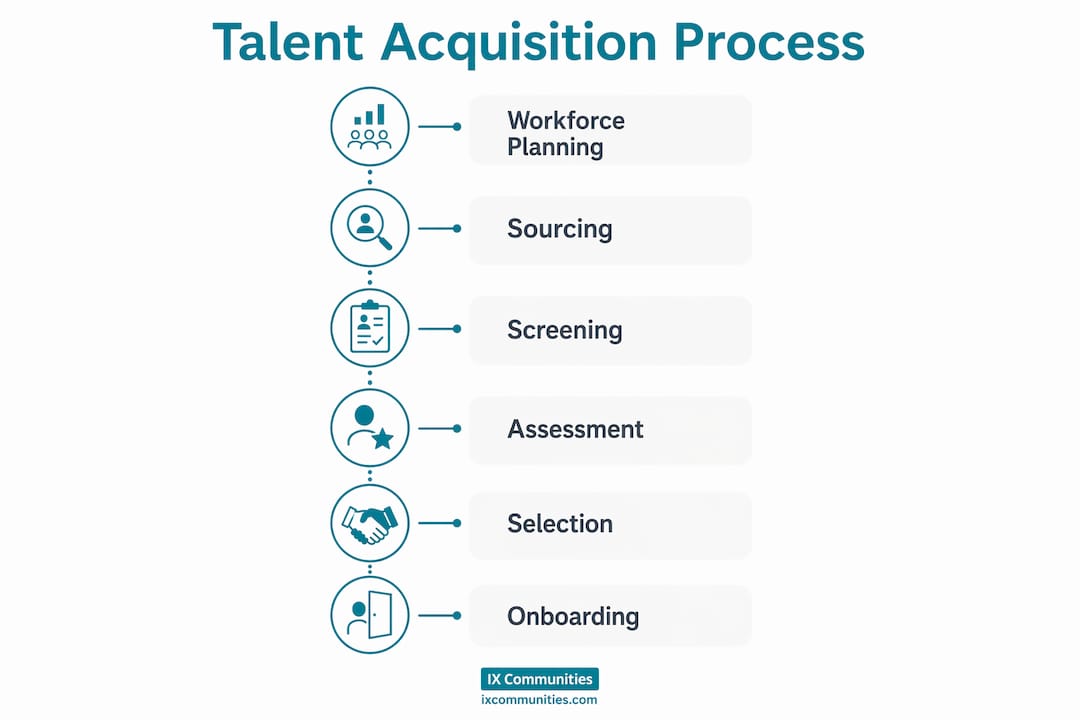
Stage 2: Sourcing
Sourcers and recruiters identify candidates through job boards, LinkedIn, employee referrals, talent communities, university partnerships, and direct outreach. Passive candidate engagement, reaching people who are not actively looking, is a defining capability of mature talent acquisition functions. Recruitment marketing tools and employer brand content support this stage.
Stage 3: Screening
Initial screening filters candidates against minimum qualifications, compensation expectations, and availability. Phone screens, asynchronous video interviews, and AI-assisted resume review tools are commonly used at this stage to manage volume efficiently.
Stage 4: Assessment and interviewing
Structured interviews, competency-based assessments, and technical evaluations provide consistent data across candidates. Structured interview guides reduce bias and improve predictive validity. Panel interviews involving hiring managers and cross-functional stakeholders are standard for senior roles.
Stage 5: Selection and offer
The hiring team reviews assessment data, aligns on a decision, and extends an offer. Compensation benchmarking, internal equity checks, and market data inform offer construction. Speed matters here; top candidates typically hold multiple offers simultaneously.
Stage 6: Onboarding
Onboarding begins at offer acceptance, not on day one. Pre-boarding communication, equipment setup, and early role clarity reduce new hire anxiety and accelerate time-to-productivity. Structured 30/60/90-day plans are a practical tool for this stage.
Continuous pipeline development runs in parallel with all stages. Talent acquisition teams maintain relationships with candidates who were strong but not selected, track passive candidates over time, and build talent communities for anticipated future needs. This ongoing work is what makes the function genuinely strategic rather than transactional.
How to build a talent acquisition framework that actually works
A talent acquisition framework gives the function structure, accountability, and a clear connection to business goals. Without it, even experienced teams default to reactive hiring when pressure builds.
Steps to design a working framework:
- Align with business planning: TA leaders should participate in annual and quarterly planning cycles to understand growth targets, new market entries, and capability gaps before they become urgent
- Define your sourcing model: Decide which roles will be filled through internal mobility, direct sourcing, agency partnerships, or contingent workforce arrangements. The build, buy, or borrow framework is a practical model for this decision
- Select and integrate technology: An applicant tracking system (ATS) is the operational backbone of any TA function. AI-assisted sourcing tools, candidate relationship management (CRM) platforms, and assessment software extend its capability. Technology without integrated KPIs and workforce planning, however, will not produce the outcomes organizations expect
- Set clear KPIs: Quality of hire, time-to-fill, offer acceptance rate, pipeline coverage ratio, and diversity of slate are the metrics that reflect both efficiency and effectiveness. Benchmarking these KPIs against industry standards helps identify where the process is strong and where it needs investment
- Build in diversity and inclusion: Diverse slates, structured interviews, and bias-aware sourcing practices are not separate initiatives. They belong inside the core process, not alongside it. The EEOC's prohibited employment practices provide the legal baseline; leading organizations go well beyond compliance
- Establish team roles and collaboration norms: TA partners need clear ownership of business units, defined SLAs with hiring managers, and regular calibration sessions to stay aligned on priorities and standards
Employer branding deserves its own line in the framework. How the organization presents itself to candidates, through its careers site, social presence, employee stories, and review management, directly affects pipeline quality. A strong employer brand reduces cost-per-hire and improves offer acceptance without additional sourcing spend.
Pro Tip: When setting KPIs, use them to diagnose bottlenecks rather than as rigid targets. A drop in time-to-fill is only positive if quality of hire holds steady. Tracking both together, rather than in isolation, gives a more accurate picture of process health.
Diversity metrics belong in the same dashboard as efficiency metrics. Tracking diversity of applicant pool, interview slate, and hire by function and level makes inclusion visible and measurable, not aspirational.
For teams looking to structure their TA function around these principles, clear role definition and stakeholder alignment are the two variables that most often determine whether a framework holds under pressure.
What the research and benchmarking data say about talent acquisition in 2026
The gap between organizations with mature talent acquisition functions and those without is measurable and growing. Benchmarking data from 2026 makes the performance differential concrete.
Key findings from current research:
- Organizations using leading TA systems average significantly more applicants per opening, giving them a meaningful selection advantage at the top of the funnel
- Benchmarking KPIs such as time-to-hire, cost-per-hire, and quality of hire must be normalized by company size and industry context. Applying generic targets without that context can reduce candidate quality rather than improve it
- Organizations that measure and apply benchmarking findings see improvements in retention, reduced hiring bias, and expanded diversity of hire
- APQC's Open Standards Benchmarking data tracks cycle time from job requisition approval to offer acceptance, cost-per-hire, and new hires per TA FTE across industries, providing a cross-industry baseline for performance comparison
Where organizations most commonly fall short:
- Adopting TA technology without connecting it to workforce planning or KPI frameworks
- Measuring time-to-fill in isolation, which can incentivize speed at the expense of quality
- Treating pipeline development as optional rather than as a core operational activity
- Misaligning KPIs with business outcomes, tracking activity metrics rather than impact metrics
The shift from reactive to proactive is the defining challenge. Most organizations understand the value of a strategic talent acquisition function. Fewer have built the internal processes, team structures, and data infrastructure to sustain it. The organizations that have made this shift consistently report stronger hiring outcomes, better retention, and a more competitive position in the talent market.
Balancing internal development, lateral hiring, and contingent workforce use requires deliberate planning. The build, buy, or borrow model gives TA leaders a practical framework for making those decisions in alignment with long-term goals rather than short-term pressure. Peer benchmarking through networks like Ixcommunities, where large corporate talent teams share data and practices in a secure environment, gives leaders the context they need to apply these findings to their own organizations. Ixcommunities benchmark surveys provide that cross-industry comparison in a format designed specifically for talent leadership teams.
For teams working to move from reactive to proactive, tracking talent acquisition trends and applying benchmarking data consistently are the two practices that most reliably accelerate that transition. KPI optimization resources from partners like Way of Work can also support teams building data-driven planning capabilities.
Key Takeaways
Talent acquisition is a strategic, proactive function that builds sustainable talent pipelines aligned with long-term business goals, and it consistently outperforms reactive recruitment on quality of hire, retention, and workforce readiness.
| Point | Details |
|---|---|
| Talent acquisition vs. recruitment | Talent acquisition is proactive and long-term; recruitment is reactive and focused on filling immediate vacancies. |
| significantly more applicants | Organizations using best-in-class TA systems average significantly more applicants per opening, per Nucleus Research 2026. |
| KPIs require context | Benchmarking metrics like time-to-fill must be normalized by industry and company size to avoid reducing candidate quality. |
| Framework essentials | Effective TA frameworks combine workforce planning, structured KPIs, technology integration, and diversity practices. |
| Build, buy, or borrow | Balancing internal development, lateral hires, and contingent workforce use aligns sourcing decisions with long-term goals. |
Take the next step with Ixcommunities
Ixcommunities operates ESIX and TLIX, the preeminent peer networking and benchmarking groups for talent leadership professionals worldwide. Large corporate talent and recruiting departments use these communities to share data, compare practices, and learn from peers in a secure environment.
For HR leaders and talent acquisition professionals looking to benchmark their function against industry standards, the ESIX Recruiter Peer Mentorship Programs provide structured peer learning alongside practitioners who are solving the same challenges at scale. Membership connects you to a global network where talent acquisition strategy is discussed at the level of depth your role requires.