

Succession planning is a strategic HR process that identifies business-critical roles and prepares internal talent to fill them when needed. The goal is leadership continuity, reduced operational disruption, and the preservation of institutional knowledge that would otherwise leave with a departing leader. According to SHRM's succession planning toolkit, the process operates on a 12–36 month readiness horizon, focused on building a pipeline rather than reacting to an emergency vacancy.
This guide covers:
- Why succession planning matters and the business case for investment
- Who owns the process and how governance should be structured
- The core components of an effective program
- A step-by-step process from assessment through transition
- A practical checklist and template for your first plan
- Common challenges, DEI considerations, and how to measure impact
- A worked example for a senior role
Key Takeaways
Succession planning is most effective when it operates as a continuous talent management discipline, not an annual HR exercise, with clear ownership, objective assessments, and KPIs tracked against external benchmarks.
| Point | Details |
|---|---|
| Start with critical roles | Identify 5–10 high-risk roles and run a pilot before scaling to a full program. |
| Use a 12–36 month horizon | Assign readiness ratings (ready now / 12 months / 36 months) and build development plans accordingly. |
| Govern with shared accountability | HR owns the process; business leaders own nominations and final decisions; an executive sponsor removes barriers. |
| Measure bench strength and retention | Track internal hire rate, time-to-fill, successor readiness distribution, and successor retention at 12 and 24 months. |
| Ixcommunities supports benchmarking | Members access anonymized succession KPIs, peer case studies, and mentorship programs to accelerate program adoption. |
Table of Contents
- Why succession planning matters for your organization
- Who owns succession planning in your organization?
- What are the core components of an effective succession program?
- How does the succession planning process work, step by step?
- How to build your first succession plan: a practical checklist
- How do you avoid bias and protect DEI goals in succession decisions?
- How do you measure the success of a succession program?
- A worked example: succession planning for a VP of Finance role
- What do HR authorities recommend for succession planning?
- The part of succession planning most guides skip
- Peer benchmarking accelerates succession program adoption
- Sources
Why succession planning matters for your organization
Leadership gaps are expensive. When a critical role goes vacant without a ready successor, organizations face extended time-to-fill, disrupted team performance, and the loss of tacit knowledge that took years to accumulate. The cost of an unplanned senior departure extends well beyond the recruiting fee.
Robert Half's research confirms that a significant share of organizations still lack formal succession plans, leaving them exposed to exactly these risks. The gap is not a knowledge problem. Most HR leaders understand the value. It is a prioritization and resource problem, which makes the business case for a structured program all the more important to articulate clearly.
Succession planning functions as both a continuity tool and a retention mechanism. When high-potential employees see a visible development pathway tied to a real role, their engagement increases and voluntary attrition decreases. Organizations that treat succession as a development program, not just a replacement plan, get both outcomes.
The retention effect is often underestimated. Talent who know they are being developed for advancement are less likely to look externally. That dynamic makes succession planning one of the more cost-effective talent retention investments available to a mid-to-large organization.
Who owns succession planning in your organization?
Accountability is the most common point of failure. When succession planning belongs to everyone, it belongs to no one. A clear governance model prevents that.
The recommended structure assigns shared accountability: HR owns the process, tools, and documentation standards; business leaders own the role definitions, candidate nominations, and final decisions. Neither party can run an effective program alone.
Core governance roles:
- Executive sponsor: A C-suite leader (often the CHRO or CEO) who champions the program, removes barriers, and signals its strategic importance to the organization.
- Talent council: A cross-functional group of senior leaders who review succession slates, calibrate readiness ratings, and approve development investments.
- Role owners: The direct managers and business unit leaders accountable for identifying and developing successors within their functions.
- HR program lead: The HR professional responsible for process design, data integrity, timeline management, and reporting to the talent council.
Line managers assess performance and potential within their teams. HR facilitates calibration sessions, maintains documentation, and tracks development progress. Executive search partners may be engaged when internal bench strength is insufficient for a specific senior role, a decision point covered in more detail in guidance on when to involve external recruiters.
Pro Tip: Secure executive sponsorship before launching any pilot. A program without a named C-suite champion rarely survives the first budget cycle. Present the business case to the CHRO or CEO first, get a named sponsor on record, and then build downward from there.
What are the core components of an effective succession program?
A succession program is only as strong as its component parts. Missing one element, such as a competency model or a readiness assessment, creates gaps that surface during transitions.
The essential building blocks:
- Role mapping: A current inventory of business-critical roles, defined by impact on strategy, difficulty to fill externally, and knowledge concentration risk.
- Competency models: The skills, behaviors, and leadership attributes required for success in each critical role. These should reflect where the organization is going, not just what the current role holder does well.
- Talent identification and readiness levels: A structured process for nominating and rating potential successors, typically using a three-tier readiness scale: ready now, ready in 12 months, and ready in 36 months.
- Development interventions: Targeted actions for each successor, including stretch assignments, executive mentoring, cross-functional rotations, and formal leadership programs.
- Documentation and knowledge transfer: Structured handover plans, role-specific knowledge repositories, and onboarding guides for incoming successors.
- Reporting and data management: A dashboard or tracking system that shows bench strength, readiness distribution, and development progress across the critical role inventory.
CIPD recommends combining role-based succession (a named successor for a specific role) with pool-based approaches (a cohort of talent developed for a category of similar roles). The pool approach widens the candidate base and builds resilience when a single-role plan falls through. For a deeper look at how these pipelines are structured in practice, the guide on building leadership pipelines covers current program structures across large organizations.
Pro Tip: Build competency models against your three-year strategy, not the current job description. A competency model that reflects today's role will produce successors who are ready for a job that may no longer exist.
How does the succession planning process work, step by step?
The University of Washington's HR framework organizes the succession planning process into three phases: assessment, evaluation, and development. A fourth phase, transition, completes the operational cycle.
Phase 1: Assessment (months 1–3)
- Identify business-critical roles using a role-criticality matrix that scores each position on strategic impact, external replaceability, and knowledge concentration.
- Confirm role ownership and assign an HR program lead to each critical role cluster.
- Collect baseline data: current incumbents, estimated tenure, and any known departure risks.
Checklist:
- Critical role inventory documented and approved by the talent council
- Role-criticality scores assigned and validated by business leaders
- Baseline tenure and risk data collected for each role
Phase 2: Evaluation (months 3–6)
- Nominate potential successors through a structured process involving role owners and HR.
- Assess each nominee against the role's competency model using a combination of performance data, leadership assessments, and manager input.
- Assign readiness ratings: ready now, ready in 12 months, ready in 36 months.
- Run a calibration session with the talent council to validate ratings and reduce selector bias.
Checklist:
- Successor nominations collected for each critical role
- Readiness ratings assigned and calibrated across the talent council
- Assessment data documented and stored securely
Phase 3: Development (months 6–24)
- Design individual development plans for each rated successor, tied directly to the competency gaps identified in the evaluation phase.
- Assign development actions: stretch projects, mentoring relationships, cross-functional rotations, or formal programs.
- Schedule quarterly check-ins between the successor, their manager, and HR to track progress and adjust the plan.
Checklist:
- Individual development plans written and agreed upon with each successor
- Development actions assigned with named owners and target dates
- Quarterly review cadence confirmed
Phase 4: Transition (months 18–36)
- Activate the handover plan when a transition is triggered, whether planned or unplanned.
- Execute structured knowledge transfer: documented role guides, stakeholder introductions, and a defined onboarding period for the incoming successor.
- Monitor successor performance at 30, 60, and 90 days post-transition.
Checklist:
- Handover plan drafted and reviewed with the outgoing incumbent
- Knowledge transfer sessions scheduled and completed
- Post-transition check-ins confirmed at 30, 60, and 90 days
How to build your first succession plan: a practical checklist
The template below applies to a single critical role. Run it as a pilot before scaling to a full program. DDI advises starting with 5–10 high-risk roles to demonstrate value and build organizational momentum.
Succession plan template: one-role format
- Role profile: Title, function, reporting line, and a brief description of strategic impact.
- Success criteria: Three to five measurable outcomes that define what "ready" looks like for this role.
- Named successors: Up to three candidates, listed with their current title and function.
- Readiness rating: Ready now / ready in 12 months / ready in 36 months, with a brief rationale for each rating.
- Development plan: For each successor, list two to three specific development actions with target completion dates and named owners.
- Plan owner: The HR program lead and the business-unit leader jointly accountable for this plan.
- Review timeline: Scheduled review dates (quarterly recommended) and the trigger conditions for an unplanned activation.
Pilot checklist
- Confirm executive sponsor and talent council membership
- Select 5–10 critical roles for the pilot cohort
- Brief role owners on the process and their responsibilities
- Collect performance and potential data for nominee pool
- Run calibration session and finalize readiness ratings
- Distribute individual development plans and confirm ownership
- Set up a secure documentation system for plan records
- Schedule the first quarterly review
On documentation standards: Store succession plans in a system with access controls. These records contain sensitive personnel data. Limit access to HR program leads, the executive sponsor, and relevant talent council members. Avoid shared drives without permission settings.
How do you avoid bias and protect DEI goals in succession decisions?
Succession planning carries real bias risk. Without structured processes, selectors tend to favor candidates who resemble current leaders, which concentrates opportunity and narrows the pipeline over time.
Common failure modes:
- Lack of executive support, which allows the program to stall after the first review cycle
- Resource constraints that reduce the process to an annual checkbox rather than an ongoing program
- Informal selections based on visibility and personal relationships rather than assessed readiness
- Insufficient data, leaving calibration sessions dependent on anecdote rather than evidence
DEI risks specific to succession:
- Affinity bias: selectors favor candidates with similar backgrounds, communication styles, or career paths
- Over-reliance on current performance ratings, which can reflect access to opportunity rather than potential
- Excluding non-traditional pipelines, such as candidates from adjacent functions, different geographies, or underrepresented groups
Practical mitigations:
- Use structured assessments with defined competency criteria for every candidate, not just finalists
- Run calibrated panel reviews rather than single-selector nominations
- Actively broaden candidate pools by including nominees from underrepresented groups and non-traditional career paths
- Track diversity metrics across the successor pool and report them to the talent council alongside readiness data
- Use objective assessment data to replace informal judgment with evidence about leadership potential
Pro Tip: Document the rationale for every readiness rating and every development decision. Written rationale creates an audit trail that makes bias visible and decisions defensible. If a pattern emerges where certain groups are consistently rated lower, the documentation makes that pattern detectable and correctable.
How do you measure the success of a succession program?
KPIs turn a succession program from a process exercise into a business outcome. Track these metrics at the program level, not just for individual roles.

| KPI | Definition | Reporting cadence |
|---|---|---|
| Internal hire rate for critical roles | Percentage of critical role vacancies filled by internal successors | Quarterly |
| Time-to-fill for critical roles | Average days from vacancy to filled for business-critical positions | Quarterly |
| Successor readiness distribution | Percentage of critical roles with a successor rated ready now / 12 months / 36 months | Quarterly |
| Successor retention at 12 and 24 months | Percentage of placed successors still in role at 12 and 24 months post-transition | Annual |
| Critical roles with a named successor | Percentage of the critical role inventory that has at least one identified successor | Monthly for program owners |
Leading indicators to watch:
- Bench strength ratio: the number of ready-now successors per critical role (target: at least one per role)
- Development plan completion rate: the percentage of successors who complete their planned development actions on schedule
- Calibration session participation: whether talent council members attend and engage, or delegate to proxies
Report the full KPI set to senior leadership quarterly. Program owners should review the leading indicators monthly to catch slippage early. External talent data can supplement internal KPIs by providing market benchmarks for time-to-fill and internal hire rates, giving leadership a reference point for what "good" looks like across comparable organizations.
A worked example: succession planning for a VP of Finance role
Role: VP of Finance, reporting to the CFO. Strategic impact: owns the annual planning cycle, manages a team of 18, and leads all board-level financial reporting. External replaceability: moderate to difficult. Knowledge concentration risk: high.
Criticality assessment outcome: High priority for succession planning. Included in the pilot cohort.
Successor identification:
- Candidate A: Senior Finance Manager, 7 years in the organization. Strong technical skills, limited cross-functional exposure. Readiness rating: ready in 12 months.
- Candidate B: Finance Director (adjacent business unit), 4 years in the organization. Broader leadership experience, less familiarity with the board reporting process. Readiness rating: ready in 18 months.
Development plan: Candidate A (12-month horizon)
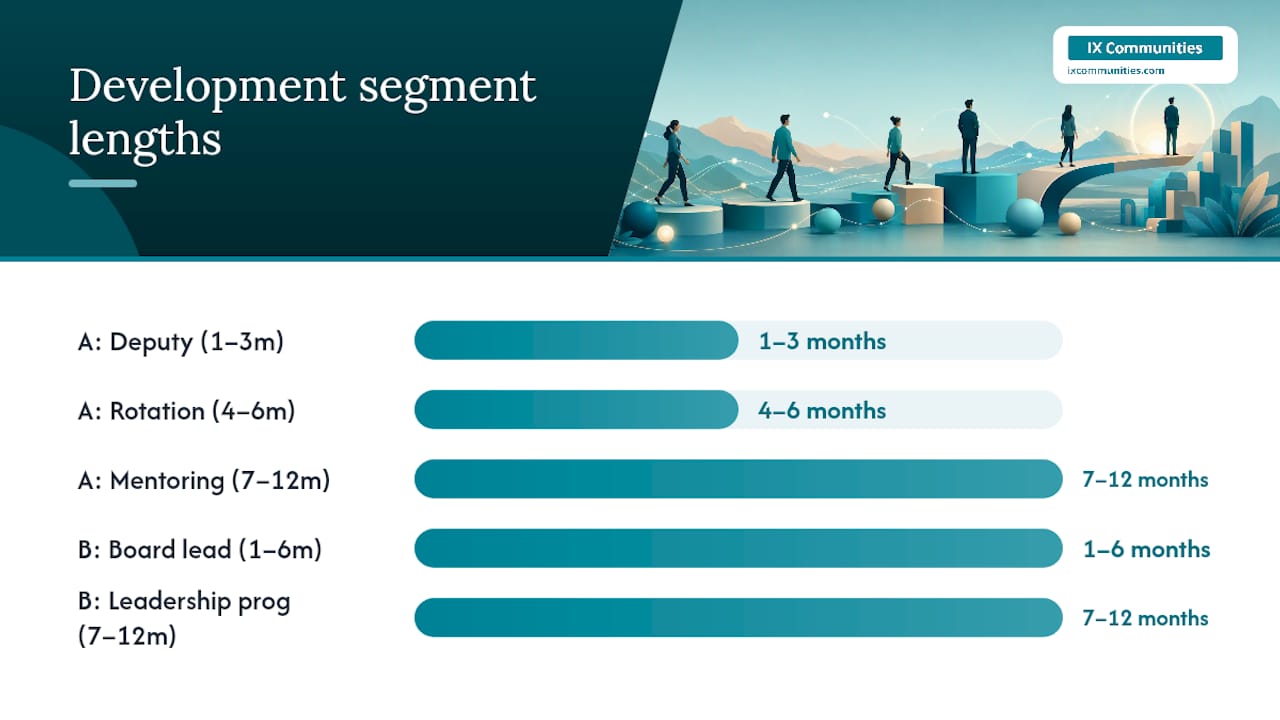
- Month 1–3: Assigned as deputy lead on the next annual planning cycle, with direct exposure to the CFO and board preparation process.
- Month 4–6: Cross-functional rotation into the Strategy team for one quarter to build enterprise-level perspective.
- Month 7–12: Assigned executive mentor (current VP of Finance). Monthly coaching sessions focused on stakeholder management and board communication.
Development plan: Candidate B (18-month horizon)
- Month 1–6: Leads the board reporting process for one quarter under the current VP's supervision.
- Month 7–12: Participates in a formal leadership program targeting enterprise financial leadership competencies.
- Month 13–18: Assigned stretch project as interim lead during a planned leave of the current VP.
Transition milestones:
- Month 12: Candidate A readiness re-evaluated by talent council.
- Month 15: Handover plan drafted with current VP.
- Month 18: Structured knowledge transfer completed. Candidate A or B activated based on readiness re-rating.
Egon Zehnder notes that executive-level succession, particularly at the C-suite level, benefits from planning across strategic cycles, with some organizations maintaining an eight-year perspective for top roles. For a VP-level role, an 18-month horizon is a practical and defensible starting point.
What do HR authorities recommend for succession planning?
The strongest succession programs share a set of consistent practices, regardless of organization size or industry.
Start small and prove value. DDI's guidance on succession planning best practices recommends beginning with the most critical roles and running a focused pilot before scaling. A pilot of 5–10 roles generates real data, surfaces process gaps, and builds the organizational credibility needed to expand the program.
Use objective assessments. Leadership readiness is not the same as current performance. High performers in their current role are not automatically ready for the next one. Structured leadership assessments, calibrated against a defined competency model, replace subjective judgment with evidence.
Align to strategy, not the org chart. The roles that matter most for succession are the ones tied to your next strategic cycle, not necessarily the most senior titles. A critical technical role or a regional general manager position may carry more succession risk than a VP title with a deep external talent market.
Peer benchmarking consistently surfaces one finding: organizations that treat succession planning as an ongoing talent management discipline, rather than an annual HR exercise, report stronger bench strength and higher internal hire rates for critical roles. The difference is cadence and ownership, not program complexity.
CIPD's factsheet on succession planning reinforces the value of combining role-based and pool-based approaches to widen the candidate base and improve resilience across the organization. For HR leaders looking to identify emerging candidates earlier in their careers, guidance on characteristics of emerging leaders offers a practical lens for spotting potential before it becomes obvious.
The part of succession planning most guides skip
Most succession planning guides focus on process. Fewer address the organizational dynamics that determine whether a program actually runs.
The most common reason succession programs fail is not a missing template or an incomplete competency model. It is the absence of a real consequence for not doing it. When succession reviews are optional, when talent council attendance is inconsistent, and when development plans are written but never tracked, the program exists on paper and nowhere else.
The second underappreciated factor is the relationship between succession planning and day-to-day talent management. Organizations that treat succession as a separate annual exercise, disconnected from performance reviews, hiring decisions, and L&D investments, consistently report lower bench strength than those that integrate it into their regular talent cadence. The process steps matter. The integration matters more.
A pilot also does something that a full program launch cannot: it generates proof. One well-executed succession for a single critical role, with documented readiness ratings, a development plan that was actually followed, and a smooth transition, is worth more for organizational buy-in than any business case presentation. Start there.
Peer benchmarking accelerates succession program adoption
HR teams building or refreshing a succession program often face the same question: how does our bench strength, internal hire rate, or development investment compare to organizations of similar size and complexity? Without external reference points, it is difficult to set credible targets or make the case for additional resources.
Ixcommunities provides talent and recruiting leaders at mid-to-large organizations with access to anonymized benchmark data, peer case studies, and practitioner forums specifically designed for this purpose. Members of the ESIX and TLIX communities can compare succession KPIs against peers, access practitioner-tested frameworks, and participate in expert speaker sessions covering talent development and leadership continuity.
For HR leaders who want structured peer coaching alongside benchmarking data, the ESIX Recruiter Peer Mentorship Programs connect talent leaders with experienced practitioners who have built and scaled succession programs in comparable organizations. Benchmark surveys from Ixcommunities provide the comparative KPI data needed to set realistic targets and report program performance to senior leadership with confidence.
Sources
The following resources were referenced in this guide and provide additional depth for HR teams building or refining a succession program.
- SHRM: Modernize succession planning toolkit
- Succession planning | Factsheets - CIPD
- Succession planning best practices - Egon Zehnder
- Succession planning: New data reveals why it matters more than ever - Robert Half
- Succession planning - Professional & Organizational Development