

A leadership pipeline is a proactive system for identifying and developing internal talent for future critical roles, rather than filling jobs as they become vacant. How companies are building leadership pipelines instead of filling jobs has become a defining question for HR leaders and CEOs in 2026. 63% of organizations now treat talent pipelines as a key business goal, and 75% report challenges filling full-time roles through traditional hiring. That gap explains why the most forward-looking organizations have shifted from reactive recruiting to structured succession development. The industry term for this approach is succession pipeline management, and it requires board-level ownership, competency-based development tracks, and ongoing measurement to work.
How companies are building leadership pipelines instead of filling jobs
The core shift is simple: organizations stop waiting for a role to open and start preparing people for roles that do not yet exist. This requires defining which leadership positions are critical, mapping who could fill them in 12, 24, or 36 months, and building a development path for each candidate. A talent pipeline is an operating model, not a spreadsheet of names. The difference matters because a passive list produces no leaders. An active pipeline produces measurable readiness.
The most effective pipelines focus first on recurring and hard-to-fill roles rather than trying to map every position in the organization. That focus keeps the effort manageable and delivers faster results. Over time, the model expands to cover a broader set of future leadership roles as the process matures.
What are the key components of an effective leadership pipeline?
Effective pipelines share five structural elements. Each one addresses a specific failure point that causes most pipeline efforts to stall.
- Role-specific development tracks. Generic leadership training does not prepare people for specific roles. Each track should align with the competencies required for a defined future position.
- A 36-month capability horizon. Durable pipelines bridge gaps between a candidate's current abilities and the business needs three years ahead. This horizon forces the organization to think about future conditions, not just current gaps.
- Experiential learning as the primary method. 70% of leadership development happens through on-the-job experiences such as rotational assignments, cross-functional projects, and crisis roles. Formal training accounts for only 10%. That ratio should guide how you allocate development time and budget.
- Integrated mentoring and coaching. Coaching and mentoring account for 20% of leadership growth. They work best when paired with experiential assignments, not delivered as standalone programs.
- Dynamic development plans with regular checkpoints. Development plans must function as living documents with scheduled reviews, mentor conversations, and reassessments. A plan that sits unchanged for 12 months is not a development plan. It is a filing exercise.
Organizations using five or more integrated development approaches are 4.9 times more likely to improve critical leadership capabilities. That figure makes the case for combining experiential learning, coaching, formal training, rotational assignments, and peer learning rather than relying on any single method.
Pro Tip: Use a career development framework to map specific competencies to each leadership level. This gives candidates a clear picture of what readiness looks like and removes ambiguity from the development process.
How do organizations ensure leadership pipeline accountability at the board level?
Leadership pipeline success depends on CEO and board accountability, not HR ownership alone. When pipeline development sits only in the HR function, it gets treated as an administrative task rather than a business priority. The result is underfunded programs, inconsistent participation from senior leaders, and candidates who never receive the visibility they need to develop.
Board-level accountability works through four specific practices:
- Assign the Nominating and Governance Committee formal responsibility for CEO and C-suite succession planning. This removes succession from the informal conversations it typically occupies and places it on the governance calendar.
- Conduct formal succession reviews twice per year. Semi-annual reviews of C-suite succession plans with independent board oversight create accountability and surface gaps before they become crises.
- Communicate pipeline status directly to high-potential leaders. Visibility of succession plans and clear communication with pipeline candidates increases retention and engagement. Leaders who know they are being developed for a specific future role stay. Leaders who receive no signal about their trajectory leave.
- Tie executive performance reviews to pipeline development. When senior leaders are evaluated on whether their direct reports are developing, the behavior changes. Development conversations happen because they are measured, not because they are encouraged.
Pro Tip: Connect your executive search and talent management processes so that external hiring data informs internal development gaps. This prevents the pipeline from operating in isolation from market realities.
What are common challenges and misconceptions in building leadership pipelines?
Most pipeline efforts fail not from lack of intent but from structural errors that are easy to avoid once you know what to look for.
- Treating pipeline development as an HR-only function. Leadership development is often misclassified as an HR responsibility. When line managers and executives are not active participants, candidates receive development plans but no real sponsorship, stretch assignments, or visibility.
- Overreliance on classroom training. Formal programs feel productive because they are scheduled and measurable. But with only 10% of leadership growth coming from formal education, organizations that invest the majority of their development budget in classroom training are misallocating resources.
- Static development plans. Plans that are written once and reviewed annually do not reflect how people actually grow. Candidates change, business conditions shift, and role requirements evolve. A plan without regular checkpoints becomes irrelevant within six months.
- Failing to connect sourcing with onboarding and development. Pipeline strength depends on linking external sourcing directly to onboarding and internal development. Organizations that treat these as separate processes create gaps where candidates enter the organization but never enter the pipeline.
- Using tenure as a readiness proxy. Readiness criteria should focus on proven behaviors and agility, not time in role. A candidate who has been in a position for five years is not automatically ready for the next level. Demonstrated competencies and adaptability are the actual indicators.
How can companies practically build and maintain leadership pipelines?
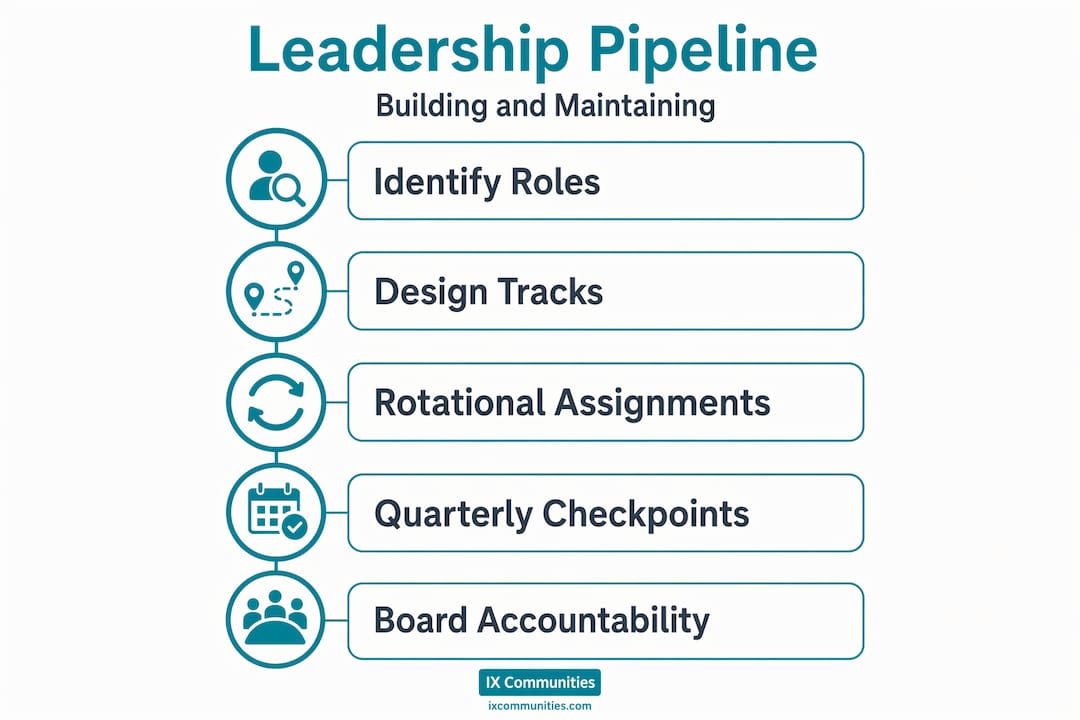
The practical process for building a pipeline follows a clear sequence. Start narrow, build rigor, then expand.
Start with critical and recurring roles
Identify the five to ten leadership positions that are hardest to fill externally or most critical to business continuity. These are the roles where a vacancy creates the most organizational risk. Focusing the initial pipeline effort here produces visible results quickly and builds internal credibility for the program.
Design measurable competency-based development tracks
Each track should define what "ready" looks like for a specific role. Readiness criteria should include demonstrated behaviors, not just completed training modules. Use benchmark surveys to compare your competency frameworks against peer organizations and identify where your standards are misaligned with market expectations.

Use rotational assignments and cross-functional projects
Rotational assignments place candidates in unfamiliar functions where they must build new skills under real conditions. Cross-functional projects expose them to different stakeholder groups and decision-making contexts. Both methods develop the agility that readiness assessments measure. Crisis roles, where a candidate leads a team through an unplanned challenge, are particularly effective because they reveal behavior under pressure.
| Development method | Primary benefit | Recommended frequency |
|---|---|---|
| Rotational assignments | Builds cross-functional competency | Once per development cycle |
| Cross-functional projects | Expands stakeholder management skills | Quarterly |
| Crisis or stretch roles | Tests agility and decision-making | As opportunities arise |
| Coaching and mentoring | Reinforces learning and builds self-awareness | Monthly |
| Formal training | Provides conceptual frameworks | Supplementary only |
Institute quarterly leadership checkpoints
Active candidate nurturing and measurement over time separates a real pipeline from a passive talent list. Quarterly checkpoints with the candidate, their manager, and an HR business partner keep development plans current and surface obstacles before they derail progress. Use self-assessment practices at each checkpoint to give candidates structured input into their own development trajectory.
Pro Tip: Revisit your leadership hiring best practices annually to confirm that your internal pipeline criteria still reflect what the external market values. Pipelines that ignore external benchmarks produce leaders who are ready for the organization as it was, not as it needs to be.
Key takeaways
Building leadership pipelines requires integrating experiential development, board-level accountability, and dynamic planning into a single operating model rather than treating them as separate HR initiatives.
| Point | Details |
|---|---|
| Pipelines replace reactive hiring | Develop internal candidates for critical roles before vacancies occur. |
| Experiential learning drives growth | Assign rotational, cross-functional, and crisis roles as the primary development method. |
| Board ownership is non-negotiable | Conduct formal succession reviews twice per year with independent oversight. |
| Readiness requires behavior, not tenure | Assess candidates on demonstrated competencies and agility, not time in role. |
| Plans must stay current | Review development plans quarterly to reflect changing business needs and candidate progress. |
Why pipeline building belongs on the CEO's agenda, not just HR's
The organizations I have seen build the most durable pipelines share one trait: the CEO treats succession development as a personal responsibility. Not a program to sponsor. Not a committee to chair. A direct, ongoing conversation with the people being developed.
That distinction matters more than any framework or process. When a CEO knows the names, development status, and next assignments of the top 20 pipeline candidates, those candidates feel it. They stay. They perform. They develop faster because they know the organization is paying attention.
The uncomfortable reality is that most organizations still treat pipeline development as an annual HR deliverable. A succession chart gets updated in the fall, reviewed by the board in december, and filed until the following year. That cycle produces the illusion of a pipeline without the substance of one.
The most effective approach I have observed combines three things: a small set of critical roles with defined readiness criteria, quarterly development conversations that are owned by line leaders rather than HR, and direct communication from senior executives to pipeline candidates about their trajectory. None of those three things require a new technology platform or a large budget. They require commitment from the top.
Organizations that get this right also tend to use peer benchmarking to calibrate their standards. Knowing how your pipeline depth compares to peer organizations in your industry gives you a factual basis for investment decisions. Without that external reference, it is easy to believe your pipeline is stronger than it actually is.
— Simon
How Ixcommunities supports leadership pipeline development
Ixcommunities operates ESIX, TLIX, and the broader IX Communities network as the preeminent peer networking and benchmarking groups for talent leadership professionals worldwide. For HR leaders and talent executives building or refining their pipelines, the network provides direct access to how peer organizations structure their development programs, measure readiness, and govern succession planning.
The ESIX Recruiter Peer Mentorship Program connects recruiting leaders with experienced peers who have built pipelines at scale. The Talent Leaders Peer Mentoring Program provides structured mentoring for talent executives navigating the shift from vacancy-based hiring to proactive pipeline management. Both programs operate in a secure environment where members share real data, real challenges, and real solutions. Ixcommunities membership gives your team ongoing access to benchmarking, peer learning, and the professional network that makes pipeline development a sustained organizational capability.
FAQ
What is a leadership pipeline?
A leadership pipeline is a structured system for identifying and developing internal candidates for future critical roles before those roles become vacant. It differs from traditional succession planning by combining active development tracks, experiential learning, and regular readiness assessments.
How does a leadership pipeline differ from succession planning?
Succession planning identifies who could fill a role if it opened today. A leadership pipeline actively develops candidates over a 12–36 month horizon so they are ready when the role opens, rather than identifying them after the fact.
Why does experiential learning matter more than formal training?
70% of leadership development comes from on-the-job experiences like rotational assignments and crisis roles. Formal training contributes only 10%, making experiential methods the primary driver of readiness.
How often should leadership development plans be reviewed?
Development plans should be reviewed at least quarterly. Plans function as living documents and require regular checkpoints with the candidate, their manager, and an HR business partner to stay relevant.
Who should own the leadership pipeline process?
The CEO and board hold primary accountability for pipeline success, with the Nominating and Governance Committee owning C-suite succession. HR designs and administers the process, but line leaders and executives must actively participate for the pipeline to produce results.