

Interim recruiting is the fast deployment of experienced leaders or specialists on a fixed, short-term mandate to deliver measurable outcomes while you search for a permanent hire or complete a defined project. When a CFO departs without notice, a transformation stalls without a capable program lead, or a regulatory crisis demands immediate specialist oversight, interim recruiting closes the gap. Organizations like Korn Ferry and InterimExecs have built entire practices around this discipline, and best-practice playbooks such as LHH's interim recruitment guide treat it as a distinct hiring category with its own process, governance, and success metrics.
Choose interim over permanent hiring when:
- Speed and situational expertise matter more than long-term cultural fit (crisis, turnaround, M&A integration, regulatory response)
- A defined project or transition has a clear end date (maternity cover, ERP implementation, restructure delivery)
Table of Contents
- What interim recruiting means in practice
- When do organizations use interim talent?
- Which functions and roles do interim professionals typically fill?
- How does the interim recruitment process work?
- How long do interim assignments last, and how is pay structured?
- How do you evaluate and onboard interim candidates?
- What are the benefits and risks of interim hires?
- Buyer's checklist: questions to ask before you hire
- How Ixcommunities members approach interim hiring
- Key Takeaways
- When interim beats permanent: a practical perspective
- Ixcommunities gives talent leaders a faster path to better interim decisions
- Useful sources and further reading
What interim recruiting means in practice
Interim recruiting is not the same as temporary staffing or fractional work, and the distinction matters when you are scoping a mandate.
Temporary or contract hiring typically fills operational or administrative gaps at lower seniority levels, often through staffing agencies, with no expectation of immediate strategic delivery. Fractional work describes part-time advisory arrangements where a senior professional splits time across multiple clients. Interim recruiting occupies a different space: it sources experienced leaders or deep specialists who commit full-time to a single organization for a fixed period, with a clear mandate and measurable deliverables from day one.
"Interim recruitment is a strategic, flexible solution used across sectors to bring in professionals who can step into critical roles at short notice and deliver results from day one." — Intelligent People
Interim executive recruitment focuses on rapid deployment of experienced leaders for 3–12 month mandates, assessing situational expertise over cultural fit. The candidate pool consists largely of professionals who have chosen interim careers, meaning they arrive with a track record of stepping into unfamiliar organizations and producing results quickly. A turnaround CFO brought in to stabilize cash flow and restore reporting integrity, an M&A integration lead managing a defined post-close workstream, or an interim CHRO overseeing a workforce restructure — these are the roles this discipline is built for.
Korn Ferry and InterimExecs both describe interim leadership as a component of a total talent strategy, not a fallback option. That framing is worth adopting: interim recruiting is a deliberate choice, not a compromise.
When do organizations use interim talent?
The business scenarios that justify interim recruiting share a common thread: urgency combined with a defined scope. The following situations consistently drive demand.
- Sudden executive departure — A CEO, CFO, or CHRO leaves without a successor in place. An interim leader stabilizes the function while a permanent search runs in parallel, typically over 3–6 months.
Interim recruitment allows rapid workforce adjustment, access to diverse specialist talent, and can provide a pipeline to permanent hires — particularly when the organization uses the interim period as an extended assessment.
Which functions and roles do interim professionals typically fill?
Interim professionals are placed across nearly every corporate function, though demand concentrates in areas where leadership gaps carry the highest operational or financial risk.
- Finance (CFO, VP Finance, Controller) — The most common interim mandate. Typical deliverables include cash management, audit readiness, financial reporting integrity, and lender or board communications during a transition or distress event.
Sector concentration is worth noting. Private equity portfolio companies, life sciences and pharmaceutical firms, regulated financial services organizations, and nonprofit institutions are among the most consistent users of interim talent, given their exposure to rapid change, regulatory scrutiny, and defined project cycles.
How does the interim recruitment process work?
The interim recruitment process is faster and more focused than permanent hiring. Best-practice playbooks recommend clear mandates, starter packs, governance maps, and measurable outcomes to accelerate interim value and prevent scope drift. The typical workflow runs as follows:
- Sourcing — Engage an interim executive search firm, a specialist interim platform, or a curated independent network. Internal talent pools and peer referrals (see Section 10) can also surface qualified candidates quickly.
Typical timeline and early deliverables
| Phase | Timeframe | Expected deliverables |
|---|---|---|
| Mandate scoping to start | — | Signed contract, starter pack delivered, stakeholder introductions complete |
| Early impact | Days 10–30 | Situation assessment, quick wins identified, governance cadence established |
| Core delivery | Days 30–90 | Primary mandate deliverables in progress, weekly reporting active |
| Transition or extension | Days 90+ | Knowledge transfer initiated, permanent hire onboarding or mandate extension agreed |
Pro Tip: Write the mandate as a list of 5–10 specific, measurable outcomes rather than a job description. "Stabilize weekly cash reporting by day 30" is a mandate outcome. "Oversee finance function" is not. Outcome-based mandates prevent scope drift and give both parties a clear basis for evaluating success.
How long do interim assignments last, and how is pay structured?
Assignment length and compensation model are two of the most practical questions budget owners ask before approving an interim hire.
Duration ranges:
- Medium-term (3–6 months): The most common range. Covers most executive transitions, transformation phases, and M&A integration workstreams. Many HR policies describe interim roles as short-term, often around six months or less.
Compensation models:
- Day rate — The most common model for senior interims. The interim (or their personal service company) invoices a daily fee. Flexible and easy to extend or terminate.
Cost comparison: Interim contracts commonly run between one month and up to a year, and day rates can be higher than the salaried equivalent., but may still be cost-effective because long-term liabilities are avoided. No benefits package, no severance, no pension contributions, and no long-term headcount commitment. For a 90-day mandate where speed and specialist expertise are critical, the total cost of an interim hire often compares favorably to the cost of a vacant senior role.
Validate day-rate benchmarks against current market data before finalizing a budget. Rates vary significantly by function, seniority, sector, and geography.
How do you evaluate and onboard interim candidates?
Evaluating interim candidates requires a different lens than permanent hiring. Cultural fit matters less than situational track record and the ability to assimilate quickly.
Evaluation checklist:
- Situational experience. Has the candidate done this specific type of mandate before? A turnaround CFO and a growth-phase CFO are not interchangeable.
- Demonstrable deliverables. Can they cite specific outcomes from prior interim assignments, with measurable results?
- Fast assimilation. Ask how they typically approach the first two weeks in a new organization. Look for a structured, repeatable process.
- Stakeholder management. Interims operate without the authority that comes from tenure. Probe for examples of influencing without formal power.
- Risk and ethics checks. Reference checks should focus on delivery, not personality. Verify the outcomes they claim.
Sample 30/60/90-day success metrics:
- Day 30: Situation assessment complete, key risks documented, quick wins delivered, governance cadence running
- Day 60: Primary mandate workstreams active, stakeholder alignment confirmed, first progress report to board or sponsor
- Day 90: Core deliverables at 50–70% completion, knowledge-transfer plan drafted, permanent hire transition plan in place
Onboarding essentials:
- Starter pack: organizational chart, current-state data, board or sponsor priorities, key contacts, and first 30-day task list
- Governance: weekly check-in with the hiring sponsor, agreed escalation path, and a defined decision-making authority matrix
- Stakeholder alignment: introductions to the top 5–8 stakeholders in the first week, with context on each relationship
- Knowledge transfer: build in a formal handover checkpoint at 60 days and again at mandate close
Interim recruitment emphasizes situational expertise and rapid deployment, which means the onboarding process must be equally rapid and structured. A well-prepared starter pack can compress time-to-impact from weeks to days.
What are the benefits and risks of interim hires?
Interim recruiting offers clear advantages, but it also carries risks that HR leaders should plan for explicitly.
| Benefit | Risk | Mitigation |
|---|---|---|
| Speed to start (days, not months) | Cost premium over salaried equivalent | Compare total cost including benefits and vacancy cost |
| Specialist expertise for a defined situation | Short-term orientation; may optimize for mandate, not long-term health | Tie payments to outcomes, not just time |
| Flexibility: extend, reduce, or exit cleanly | Knowledge-transfer risk at mandate close | Require a formal handover plan from day 60 |
| No long-term headcount or benefits liability | Cultural disruption from an external authority figure | Brief the team on the interim's role and authority scope |
| Objective leadership during sensitive change | Dependency risk if mandate extends without review | Set a formal review at 90 days with clear extension criteria |
Interim professionals are typically engaged for a limited time to bridge urgent leadership gaps and often do not receive permanent-employee benefits, which is both a cost advantage and a structural difference that shapes how they operate. They are outcome-focused by design. That focus is an asset in a crisis; it can become a liability if the organization needs someone to build for the long term.
The most common failure mode is a poorly scoped mandate. When the brief is vague, the interim defaults to what they know, scope expands, costs rise, and outcomes are disputed. Clear mandates with measurable deliverables are the single most effective risk control.
Buyer's checklist: questions to ask before you hire
Before engaging an interim search firm or an independent interim, use this checklist to assess readiness and provider quality.
Mandate readiness:
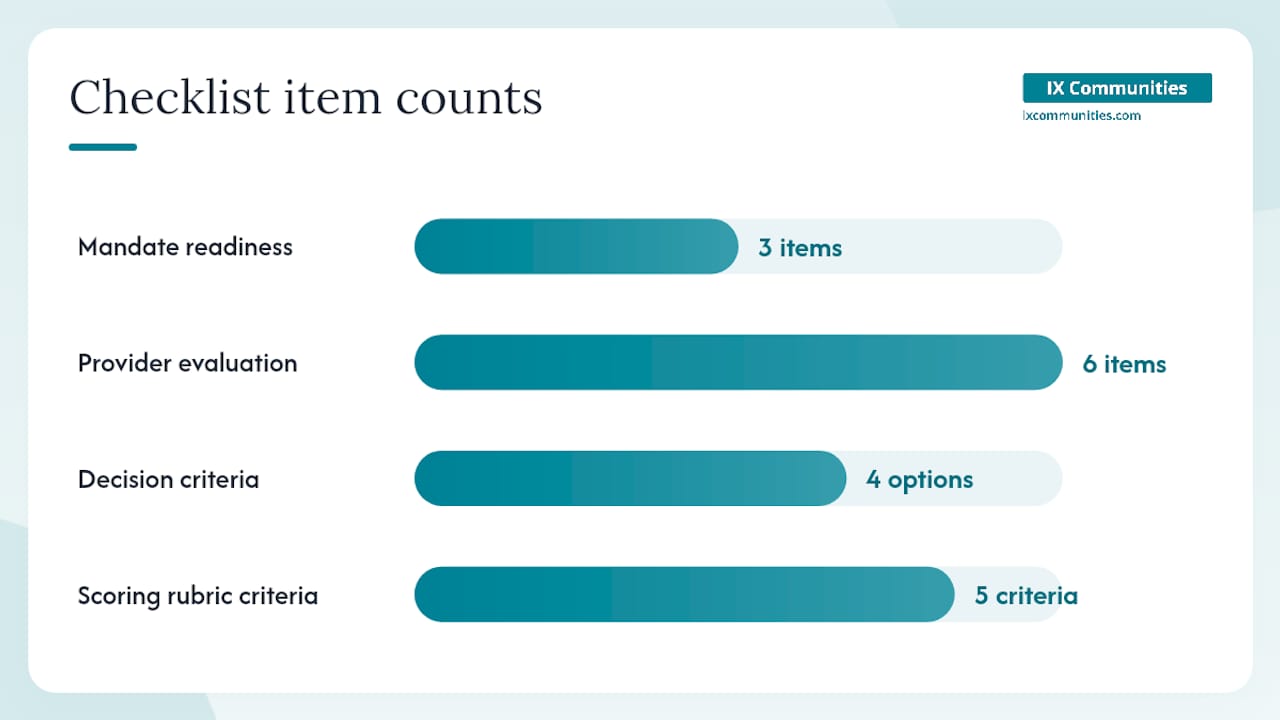
- Is the business problem clearly defined, with specific deliverables and a success metric for each?
- Is the reporting line and decision-making authority agreed internally?
- Is the budget approved, including a day-rate range and a maximum mandate duration?
Provider evaluation questions:
- How many mandates of this type (function, sector, situation) have you closed in the past 12 months?
- What is your typical time-to-shortlist for a mandate at this level?
- How do you vet candidates for situational track record rather than general seniority?
- Who supports governance and reporting once the interim is placed?
- What is your process if the interim is not delivering at day 30?
- Do you maintain a curated network of senior professionals who choose interim careers, or do you source from the general market?
Decision criteria: which sourcing route fits your situation?
| Situation | Recommended sourcing route |
|---|---|
| C-suite or senior VP, complex mandate | Specialist interim executive search firm |
| Functional specialist, mid-senior level | Specialist interim platform or curated network |
| Known candidate from peer network | Direct engagement with independent interim |
| Ongoing interim program across multiple roles | Preferred supplier agreement with interim search firm |
Scoring rubric for RFPs and briefings:
Rate each provider or candidate on a 1–5 scale across: mandate-specific experience, speed-to-shortlist, vetting rigor, governance support, and knowledge-transfer process. A provider scoring below 3 on mandate-specific experience or vetting rigor should not advance, regardless of other scores.
Recruiting best practices for permanent hires apply here too, with one key difference: the evaluation window is compressed. You are making a faster decision with less information, which makes the quality of the provider's vetting process more important, not less.
How Ixcommunities members approach interim hiring
Peer benchmarking data from Ixcommunities members provides practical reference points that are difficult to find in public sources. Talent leaders in the ESIX and TLIX communities report using interim hires most frequently for executive transitions, transformation programs, and talent acquisition leadership gaps during high-volume hiring cycles.
Common benchmarks reported by peers:
- Time-to-start for a well-scoped interim mandate through a specialist firm: typically 10–15 business days from brief to day one
Pro Tip: Ixcommunities members use peer referrals to speed interim vetting significantly. When a peer has placed the same interim professional and can speak to their situational track record, you compress the reference-check process from weeks to a single conversation. The community connection platform makes those referrals accessible.
Member resources that directly support interim decisions include:
- Benchmark surveys covering day-rate ranges, time-to-start, and mandate lengths by function and sector, updated regularly
The benefits of talent acquisition groups for HR leaders extend directly to interim decisions: shared experience reduces the risk of a poorly scoped mandate or a mismatched provider selection.
Key Takeaways
Interim recruiting delivers the fastest path to experienced leadership when a defined mandate, clear deliverables, and a structured governance process are in place from day one.
| Point | Details |
|---|---|
| Definition and scope | Interim recruiting sources experienced leaders for fixed, short-term mandates focused on measurable outcomes, not cultural fit. |
| Cost and duration | Assignments typically run 1–12 months; day rates can be 10–30% higher than the salaried equivalent but may be more cost-effective overall because permanent-employee benefits and long-term liabilities are avoided. |
| Process discipline | Clear mandates with 5–10 specific outcomes, a starter pack, and a weekly governance cadence are the primary controls against scope drift and poor ROI. |
| Evaluation criteria | Assess situational track record and fast-assimilation skills; use 30/60/90-day outcome metrics to measure delivery from the start. |
| Ixcommunities resources | Ixcommunities benchmark surveys, peer referrals, and ESIX mentor programs help talent leaders calibrate day rates, vet providers, and reduce interim sourcing risk. |
When interim beats permanent: a practical perspective
The conventional framing of interim recruiting as a "stopgap" understates what it actually does well and overstates what it does poorly.
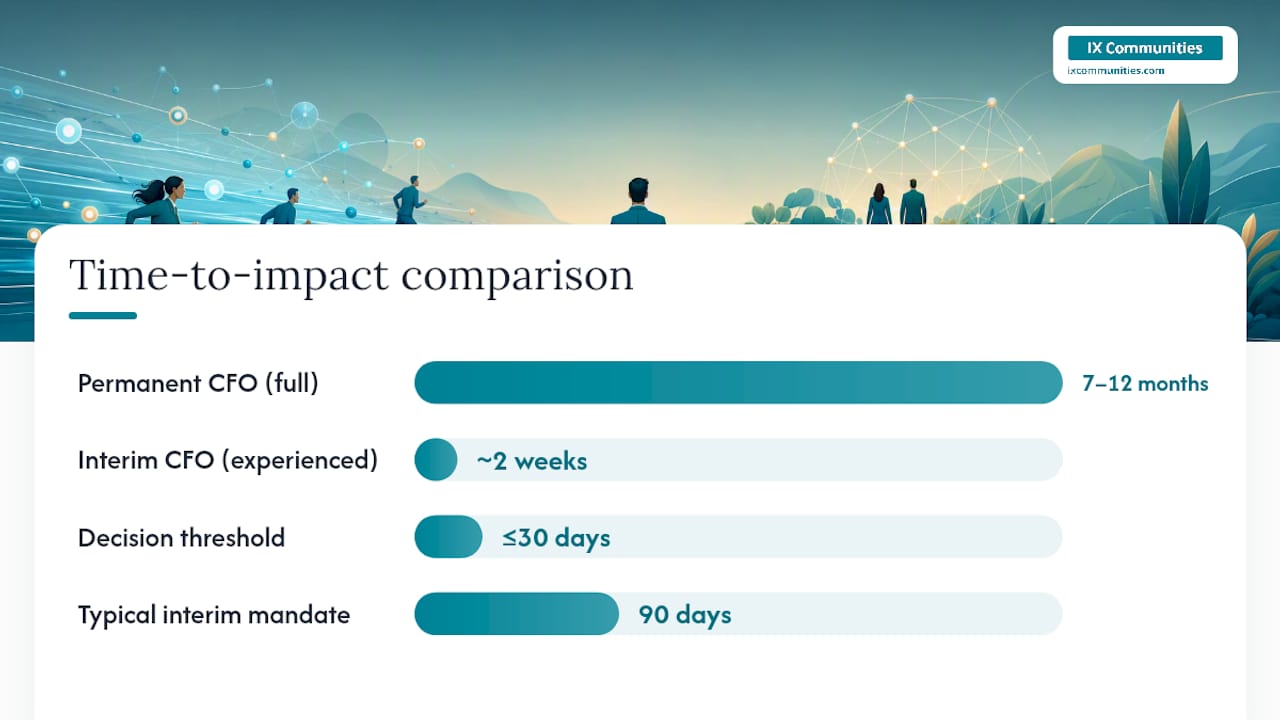
The strongest case for interim is not speed alone. It is the combination of speed and situational specificity. A permanent hire for a turnaround CFO role takes 4–6 months to close and another 3–6 months to reach full effectiveness. An interim CFO with three prior turnarounds can be productive in week two. For a 90-day cash crisis, that difference is the difference between survival and failure.
Where interim consistently underperforms is in roles that require long-term relationship capital. A Head of Sales who needs 18 months to build a territory and a team is not an interim role. A General Counsel who needs to develop deep institutional knowledge of a complex regulatory environment is not an interim role. The test is simple: if the value of the hire compounds over years, choose permanent. If the value is front-loaded in a defined situation, interim is the right tool.
Three practical rules of thumb worth applying:
- If time-to-impact must be under 30 days, the mandate is interim by definition.
- If the role requires building something that outlasts the person, prioritize a permanent hire.
- If you are unsure, scope a 90-day interim mandate with a conversion option. The interim period functions as an accelerated assessment, and the best interims are sometimes the right permanent hire.
The risk most HR leaders underestimate is not cost or cultural fit. It is the knowledge-transfer gap at mandate close. Build the handover plan into the contract from day one, not as an afterthought in week 11.
Ixcommunities gives talent leaders a faster path to better interim decisions
Scoping an interim mandate, validating a day rate, and vetting a provider without peer data takes longer and carries more risk than it should. Ixcommunities membership gives corporate talent leaders direct access to the benchmarks, peer referrals, and governance templates that make those decisions faster and more defensible.
The ESIX recruiter peer mentorship programs connect talent leaders with experienced peers who have managed interim engagements across functions and sectors. The Ixcommunities benchmark surveys provide current data on day-rate ranges, time-to-start, and mandate lengths by function, so you can validate a provider's proposal against what peers are actually paying and experiencing. Member communities include starter-pack templates, governance dashboards, and a searchable network of talent leaders who can provide direct referrals for interim professionals they have placed and evaluated.
For talent leaders who manage interim hiring regularly or are approaching their first senior interim mandate, Ixcommunities membership is the most direct route to peer-validated data and practical tools. Review Ixcommunities membership options to see which community fits your function and organization size.
Useful sources and further reading
The following sources were used in preparing this guide and provide useful follow-up reading for HR leaders who want to go deeper on specific aspects of interim recruiting.
- Interim Executive Recruitment | Interim Executive Search Firms | Interim Quest
- Interim Executive Recruitment - Keller Executive Search
- Interim Recruitment Playbook | LHH
- Your guide interim recruitment | The Work Crowd
- Interim Recruitment | COREcruitment
- What does interim mean? | Basico
- What Does an Interim Manager Do? - NMS Consulting
- Interim Recruitment | Contract Roles - Intelligent People