What is global talent strategy, and what does it include?
Global talent strategy is a business-led approach to identifying and managing the roles that have the greatest impact on an organization's competitive advantage across global operations. Research from INSEAD and Cornell defines three core components:
- Identifying pivotal positions that differentially contribute to sustainable competitive advantage on a global scale
- Building a global talent pool of high-potential and high-performing individuals who reflect the multinational's geographic scope
- Developing a differentiated HR architecture that prioritizes investment in those pivotal roles over general headcount management
Global talent management (GTM) is not a static framework. It must adapt continuously to demographic shifts, political-economic changes, and the declining half-life of skills. Top management governs GTM as a business imperative; HR facilitates the processes, communications, and measurement that support it.
Table of Contents
- How global talent strategy differs from talent acquisition
- Why alignment with corporate strategy matters
- Key principles of an effective global talent strategy
- How multinational corporations implement global talent strategy
- Metrics and KPIs that measure global talent strategy success
- Legal and compliance considerations in international talent management
- How cultural diversity and inclusion strengthen global talent strategy
- Key Takeaways
How global talent strategy differs from talent acquisition
Talent acquisition is a specialized HR function focused on proactively sourcing, recruiting, and onboarding candidates to meet current and future organizational needs. GTM is the broader strategic layer within which talent acquisition operates.
Key distinctions:
- Talent acquisition is cyclical and role-focused; GTM spans retention, development, succession, and alignment with global business objectives
- Talent acquisition asks "who fills this role?"; GTM asks "which roles matter most, and how do we build the capability around them?"
- GTM is business-owned, with HR as facilitator; talent acquisition is primarily an HR or standalone TA function
AI and evolving global mobility patterns are shifting both functions away from static career paths toward dynamic capability-building models.
Why alignment with corporate strategy matters
Effective global talent strategies align talent practices with corporate strategy to address demographic shifts, political-economic changes, and skill obsolescence. The contingent view now dominates the research: GTM effectiveness depends on fit with the multinational's specific strategy, whether global, transnational, or multi-domestic.
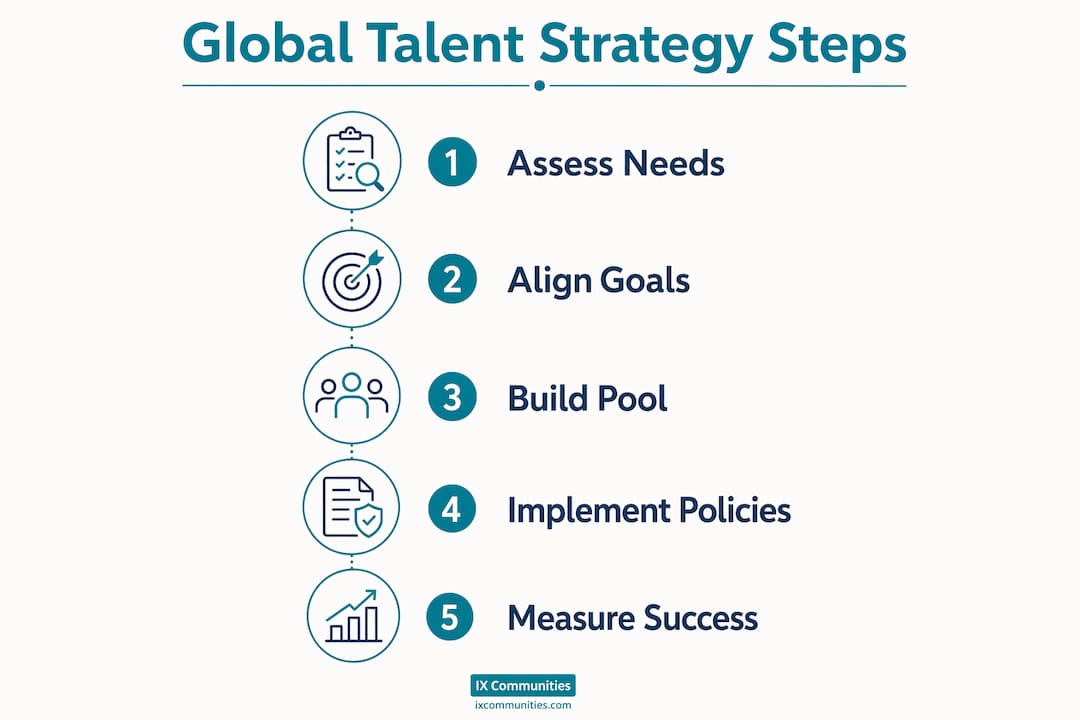
A transnational strategy calls for a globally diverse talent pool combining parent-firm knowledge with local contextual expertise. A multi-domestic strategy requires multiple localized talent pools with high local-market specificity. Misalignment between GTM design and corporate strategy reduces the return on talent investment across regions.
Key principles of an effective global talent strategy
Research from a multi-year study with 33 MNEs across 11 countries identified six features that contribute to GTM performance:
- Alignment with strategy — talent practices designed around the MNE's competitive model
- Internal consistency — coherence among staffing, training, appraisal, rewards, and succession
- Cultural embeddedness — talent practices embedded in the organization's culture
- Management involvement — senior and line manager participation in identification and development
- Balance of global and local needs — global standards adapted to local legal and economic contexts
- Employer branding through differentiation — a distinct value proposition for pivotal talent
Organizations that applied all six reported improved attraction and retention outcomes.
How multinational corporations implement global talent strategy
Progressive GTM strategies build diverse global talent pools aligned with the multinational's operating model. In practice, this means designing high-potential programs, global talent pools, and development tracks that reflect the MNE's strategic priorities, not just its open requisitions.

Senior and line manager support is critical to implementation. A talent-focused culture, or talent mindset, determines whether GTM operates as a genuine business process or remains an HR administrative exercise. Integrating talent management and recruiting coherently at scale is where most organizations face the steepest execution challenge.
Metrics and KPIs that measure global talent strategy success
Measuring GTM effectiveness requires metrics tied to strategic outcomes, not just hiring activity. Relevant KPIs include:
- Time-to-fill for pivotal roles — tracks responsiveness of the global talent pipeline
- Internal mobility rate — measures how effectively talent moves across geographies and functions
- High-potential retention rate — indicates whether differentiated investment is sustaining commitment
- Succession coverage ratio — the proportion of critical roles with identified, ready successors
- Talent pool diversity — reflects alignment with transnational or multi-domestic strategy requirements
Pro Tip: Link each KPI directly to a specific strategic objective. A high internal mobility rate means little without context on whether moves are filling pivotal roles or simply lateral transfers.
Legal and compliance considerations in international talent management
Cross-border talent deployment introduces legal complexity that GTM must account for from the outset. Key areas include:
- Work authorization and visa compliance — requirements vary significantly by country and role type
- Employment law differences — termination rights, benefits mandates, and working-time regulations differ across jurisdictions
- Data privacy — the EU's General Data Protection Regulation (GDPR) and equivalent frameworks govern how employee data is collected and transferred globally
- Permanent establishment risk — extended remote work arrangements can create unintended tax obligations in foreign jurisdictions
- Pay equity and transparency laws — expanding in the U.S. and internationally, affecting how compensation for global roles is structured and disclosed
Corporate advisory expertise in target markets is often necessary to navigate these requirements without creating compliance exposure.
How cultural diversity and inclusion strengthen global talent strategy
MNEs that fail to adapt GTM to local cultural, legal, and economic contexts risk reduced effectiveness. Cultural diversity within a global talent pool is not only a compliance or values consideration; it is a strategic asset when the MNE's competitive model depends on local market knowledge.
Inclusion practices determine whether diverse talent pools deliver their potential. Without psychological safety and equitable access to development opportunities, high-potential employees from underrepresented groups exit before contributing to pivotal roles. Embedding inclusion into the HR architecture, not treating it as a separate initiative, is what separates organizations that benefit from diverse talent from those that simply report on it.
Key Takeaways
A global talent strategy succeeds when it is business-owned, aligned with corporate strategy, and built around the roles that drive competitive advantage, not around headcount targets.
| Point | Details |
|---|---|
| GTM is business-owned | Top management governs GTM; HR facilitates processes, measurement, and communications. |
| Three core components | Pivotal position identification, global talent pool development, and differentiated HR architecture. |
| Internal consistency matters | Coherence across staffing, training, appraisal, rewards, and succession is a defining feature of effective GTM. |
| Strategy alignment is contingent | GTM design must match the MNE's specific corporate strategy: transnational, global, or multi-domestic. |
| Inclusion is structural | Embedding inclusion into HR architecture, not treating it separately, determines whether diverse talent pools deliver value. |
Ixcommunities connects talent leadership professionals at large corporate organizations through peer networking, benchmarking, and secure knowledge sharing. The ESIX peer mentorship programs and benchmark surveys give HR and talent acquisition teams the data and peer perspective needed to build and refine global talent strategies grounded in real practice.