

The rise of internal mobility has fundamentally changed how TA teams operate, and the shift is accelerating in 2026. External hiring is no longer the default response to an open role. Forward-thinking talent acquisition professionals and HR leaders are treating their existing workforce as a primary talent channel, and the results on cost, speed, and retention are measurable. This article covers the strategic drivers behind the shift, the operational components that make internal mobility work, the technology enabling it, and the metrics that define success.
Table of Contents
- Key takeaways
- The rise of internal mobility: why TA teams are shifting focus inward
- Core components of an effective internal mobility program
- Technology trends elevating internal mobility
- Balancing internal mobility with external hiring
- Measuring success and overcoming common challenges
- My perspective on TA's evolving internal mobility role
- Build your internal mobility strategy with Ixcommunities
- FAQ
Key takeaways
| Point | Details |
|---|---|
| Internal mobility as workforce strategy | Leading organizations now treat internal mobility as a workforce allocation model, not simply a retention tactic. |
| Skills data is foundational | Effective programs require a validated skills inventory with proficiency levels before technology or processes can function. |
| Manager behavior is a bottleneck | Training managers to release talent and mandating structured internal interviews drives measurable fill rate improvement. |
| Technology enables but does not replace governance | AI-powered talent marketplaces only perform when underlying skills data is current and adoption practices are consistent. |
| Measure four core metrics | Track internal fill rate, time-to-productivity, attrition impact, and skill coverage to demonstrate program ROI. |
The rise of internal mobility: why TA teams are shifting focus inward
The numbers driving this shift are concrete. Many HR leaders have moved away from an external-hire-first mindset, now treating internal mobility as a workforce allocation strategy rather than a secondary option. One documented example showed an internal panel using skills profiles to complete a redeployment within a week, a timeline that routinely beats external search by weeks or months.
The cost case is equally direct. SHRM notes that internal fills are typically completed within weeks, carry minimal recruiting fees, and require significantly less onboarding time. When you compare that against agency fees, extended time-to-fill, and the productivity ramp on a net-new hire, the financial argument for internal mobility strategies writes itself.
Beyond cost, the retention data matters to every HR leader managing turnover budgets. Employees who move internally tend to stay longer. They see a functioning career development pathway, which directly affects engagement scores and reduces voluntary attrition. Enterprises are now shifting 25 to 40 percent of roles into internal mobility channels over two-year periods, while preserving external hiring for genuine strategic gaps.
Pro Tip: Before building any internal mobility program, audit the last 12 months of external hires. Calculate what percentage of those roles could have been filled internally with modest upskilling. The gap is usually larger than leadership expects, and it makes the business case without needing a consultant.
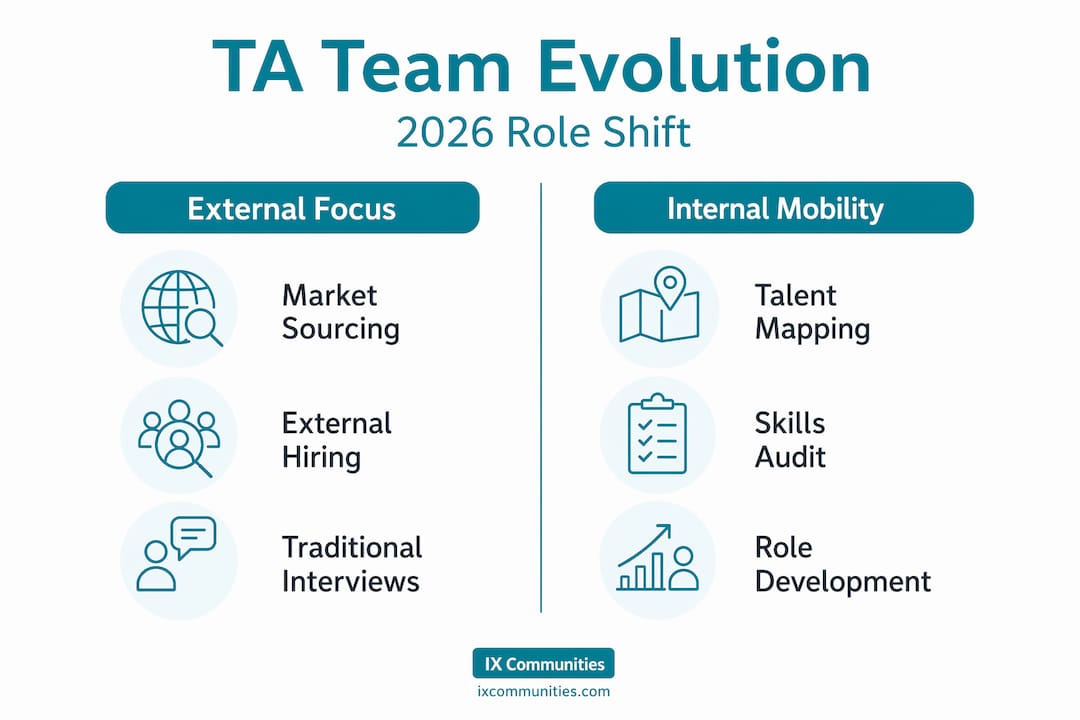
The TA team's role evolves with this model. Recruiting teams are evolving from purely external market operators to hybrid practitioners managing both internal and external pipelines across integrated platforms. That change requires new skills in workforce planning, skills assessment, and program management. TA professionals who build those capabilities now are positioning themselves at the center of organizational agility, not just headcount planning.
Core components of an effective internal mobility program
Building a program that actually produces results requires more than opening an internal job board. These five components form the operational foundation that distinguishes programs with measurable outcomes from those that exist on paper only.
-
Skills inventory with proficiency levels. Job titles rarely reflect true skills, which means you cannot build a reliable internal talent pool on org chart data alone. An effective skills taxonomy names 200 to 400 specific skills with defined proficiency levels, validated by both employees and their managers. This is the data layer everything else depends on.
-
A talent marketplace with development pathways. Internal talent marketplaces are evolving from job-listing boards to platforms that show employees exactly what skills they need to reach a target role. The distinction matters because a list of open jobs is not a career development program. A genuine marketplace surfaces viable next moves based on current skills and identified gaps.
-
Structured internal application and interview processes. Informal nomination systems create fairness risks. SHRM emphasizes pairing any manager nominations with clear documentation and structured processes. Requiring managers to interview every internal applicant who clears the published skills bar, with documented feedback on any denial, is the governance element that actually moves the needle.
-
Manager training on releasing talent. Talent hoarding is a real and well-documented behavior. Cultural transformation including manager training on releasing talent and aligning leadership incentives is critical to overcoming this pattern. Organizations that tie manager performance metrics to talent-release behavior report faster cultural change than those relying solely on policy.
-
Consistent metric tracking. The core metrics for a functional program are internal fill rate, time-to-productivity, attrition reduction, and skill coverage across critical role families. Tracking these quarterly creates accountability and provides the evidence base TA leaders need to sustain program investment.
Pro Tip: Requiring managers to interview internal applicants who meet the skill bar can shift internal fill rates by five to eight percentage points within two quarters. That single governance rule is one of the highest-return interventions available.
The table below illustrates benchmarks TA teams can use to assess program maturity.
| Metric | Early-stage program | Mature program |
|---|---|---|
| Internal fill rate | 10–15% of roles | 30–45% of roles |
| Time-to-productivity vs. external hire | Comparable | 20–30% faster |
| Voluntary attrition among mobile employees | Similar to average | Measurably lower |
| Skills inventory coverage | Under 50% of workforce | 80%+ of workforce validated |
Technology trends elevating internal mobility
The technology supporting workforce mobility initiatives has matured considerably. The shift from basic internal job boards to AI-powered, skills-driven platforms represents a meaningful change in what TA teams can actually do with internal talent data.
Several trends are reshaping how organizations approach this:
- By 2027, one quarter of enterprises will use AI-supported, skills-driven talent marketplaces to improve engagement and retention. These platforms do more than surface job openings. They recommend upskilling paths, flag stretch assignments, and map employee skills to future capability needs.
- Integrated Human Capital Management platforms that unify recruiting, skills data, and internal movement workflows reduce the manual overhead that has historically made internal mobility programs difficult to scale.
- Integrated TA recruiting suites have increased recruiter capacity by up to 54% and reduced hiring manager review time by up to 35%, creating space for the internal mobility work that previously fell through the cracks.
- Genuine talent marketplaces function as two-way collaborations where both the organization and the employee drive the interaction, not just the TA team pushing roles.
The technology is only as good as the data feeding it. Stale skills profiles and outdated role requirements do not produce useful recommendations. They produce distrust.
The most common failure mode in technology-enabled internal mobility is treating the platform launch as the finish line. Continuous updates to skills and opportunity data are necessary to keep marketplaces relevant and trusted by employees. When stale data produces irrelevant role matches, employees disengage and stop using the platform entirely. That outcome is worse than not launching, because it actively signals that the organization's internal mobility commitment is performative.
For TA teams exploring talent acquisition trends that are driving these platform changes, the critical evaluation question is not which platform has the best features. It is which platform your team will actually maintain.
Balancing internal mobility with external hiring
Internal mobility strategies are not a universal replacement for external hiring. The highest-performing organizations treat them as complementary channels with defined triggers, not competing philosophies.
The case for prioritizing internal mobility includes:
- Faster fill timelines, often completing in weeks versus months for external searches
- Lower cost per hire when recruiting fees, onboarding time, and productivity ramp are fully accounted for
- Positive retention effects on both the individual being moved and peers who observe visible career development opportunities
- Faster time-to-productivity because the internal candidate already knows the organization, its systems, and its culture
External hiring remains the right choice in specific situations. Truly novel capability requirements that do not exist internally, planned diversity interventions targeting demographic representation gaps, and greenfield business areas with no internal precedent all represent legitimate external hiring scenarios.
| Scenario | Recommended approach |
|---|---|
| Existing skill with proven performers available | Internal mobility first |
| Net-new capability not present in workforce | External hiring |
| Mid-level role with 6-plus week acceptable fill time | Internal mobility first |
| Senior leadership with specific domain credential required | Hybrid: internal candidate plus external benchmark |
| Diversity target for underrepresented group | External pipeline with internal development track |
The diagnostic question for TA leaders is what percentage of external hires in the past year could have been internal moves with modest upskilling investment. Examining succession decisions with both internal and external talent data in parallel produces more defensible channel decisions than gut judgment alone.
Measuring success and overcoming common challenges
Four metrics define a functional internal mobility program and create the reporting structure TA leaders need to sustain organizational investment.
- Internal fill rate. The percentage of open roles filled by internal candidates. Tracking this quarterly reveals whether the program is producing volume or remaining a pilot initiative.
- Time-to-productivity. How quickly internal hires reach full performance in the new role compared to external hires in equivalent roles. This metric quantifies the onboarding advantage.
- Attrition impact. Voluntary attrition rates among employees who have made at least one internal move versus those who have not. The gap typically justifies the program cost on its own.
- Skill coverage. The percentage of the workforce with validated, current skills data in the system. Below 60%, the program's matching capability degrades significantly.
The most common challenges TA teams face are manager resistance, data quality, and employee awareness. Manager resistance is best addressed through incentive alignment. The quality of skills data and manager incentives consistently surface as the primary limiting factors in unlocking full program potential, ahead of technology limitations.
Employee awareness is often underestimated. A well-designed talent marketplace with excellent data still fails if employees do not know it exists or do not believe the organization will actually act on internal applications. Communication cadence and visible examples of internal moves matter as much as the technology stack.

Pro Tip: Publish internal mobility success stories through internal channels at least monthly. Visibility of real moves, with real people, reduces skepticism faster than any policy document or launch event.
Most organizations see measurable operational results within two quarters of implementing structured governance. Cultural normalization, meaning that managers routinely think internally first, typically takes four to six quarters and requires consistent reinforcement from senior leadership.
My perspective on TA's evolving internal mobility role
I've seen a consistent pattern in organizations that struggle with internal mobility programs. The technology gets purchased, the policy gets written, and then the program underperforms. The diagnosis almost always comes back to two things: managers who are not actually rewarded for releasing talent, and skills data that nobody maintains after the initial data load.
What I've found actually works is treating internal mobility like any other recruiting channel, meaning it needs defined owners, clear SLAs, and regular audits. The organizations that get traction are the ones where the TA leader sits in workforce planning conversations, not just headcount conversations. That shift in where TA is invited changes everything about the program's strategic relevance.
The technology question is also misframed in most discussions I've been part of. Teams spend months evaluating platforms and then underinvest in the data governance and change management that determine whether the platform delivers value. A simpler platform with disciplined data maintenance outperforms a sophisticated one with stale profiles every time.
My honest read on 2026: internal mobility is not a trend. It is a durable organizational capability that will separate high-performing talent functions from reactive ones over the next three to five years. The teams building that muscle now are going to find external hiring easier, faster, and cheaper too, because they will understand their workforce in a way that makes every talent decision more precise.
— Simon
Build your internal mobility strategy with Ixcommunities
Ixcommunities provides TA and HR leaders with the peer networks, benchmark data, and professional resources needed to build and scale internal mobility programs that produce measurable results.
Through the Talent Leaders Peer Mentoring Program, senior talent leaders share direct experience on what internal mobility operating models work across different industry and organizational contexts. The ESIX Recruiter Peer Mentorship Programs offer a structured environment for TA practitioners to refine internal hiring practices with peers facing the same challenges. For teams that need data to build the business case, the Benchmark Surveys provide current metrics on internal fill rates, program structures, and workforce mobility initiatives across large corporate talent functions worldwide.
FAQ
What is internal mobility in talent acquisition?
Internal mobility refers to the process of filling open roles or developing workforce capability by moving existing employees rather than hiring externally. TA teams manage this as a defined recruiting channel with structured processes, skills matching, and governance policies.
Why are TA teams prioritizing internal mobility in 2026?
Cost control, faster fill times, and retention benefits are the primary drivers. Internal fills carry minimal fees and reduce training needs, while employees who move internally show measurably lower voluntary attrition rates.
How do you measure the success of an internal mobility program?
Track four core metrics: internal fill rate, time-to-productivity compared to external hires, attrition rates among mobile employees, and skills inventory coverage across the workforce. Reporting these quarterly creates the accountability structure programs need to sustain investment.
What is the biggest barrier to effective internal mobility?
Manager resistance and stale skills data are the two most cited limiting factors, ahead of technology gaps. Aligning manager incentives to talent release behaviors and maintaining continuous data quality are the highest-priority governance interventions.
How does a talent marketplace differ from an internal job board?
An internal job board lists open roles. A talent marketplace surfaces viable development pathways, recommends upskilling steps, and matches employees to opportunities based on validated skills data. By 2027, one quarter of enterprises are projected to operate AI-supported, skills-driven marketplaces of this type.