

Executive search is a targeted, research-driven process for identifying and recruiting senior leaders, typically at the C-suite, vice president, or board level. Unlike traditional recruiting, which relies on job postings and inbound applications, executive search involves proactive outreach to passive candidates who are not actively looking for new roles. These positions commonly carry annual compensation of $150,000 or more and require rare combinations of leadership experience, domain expertise, and cultural fit.
The core elements of executive search include:
- Market mapping: Systematic research to identify qualified candidates across target organizations and industries
- Discreet outreach: Confidential contact with candidates, often without disclosing the client's identity initially
- Rigorous assessment: Structured interviews, leadership evaluations, and reference verification
- Executive alignment: Calibrating candidate profiles against the organization's strategic direction and culture
- Confidentiality: Protecting both the client organization and the candidate throughout the process
This approach is also commonly called headhunting. The process is slower and more deliberate than standard recruiting, and that is by design. The stakes of a poor senior hire, in terms of organizational disruption, lost momentum, and cost, make speed a secondary concern.
How does executive search differ from traditional recruiting?
The differences between executive search and traditional recruiting run deeper than role level. They reflect fundamentally different operating models, candidate pools, and outcome expectations.

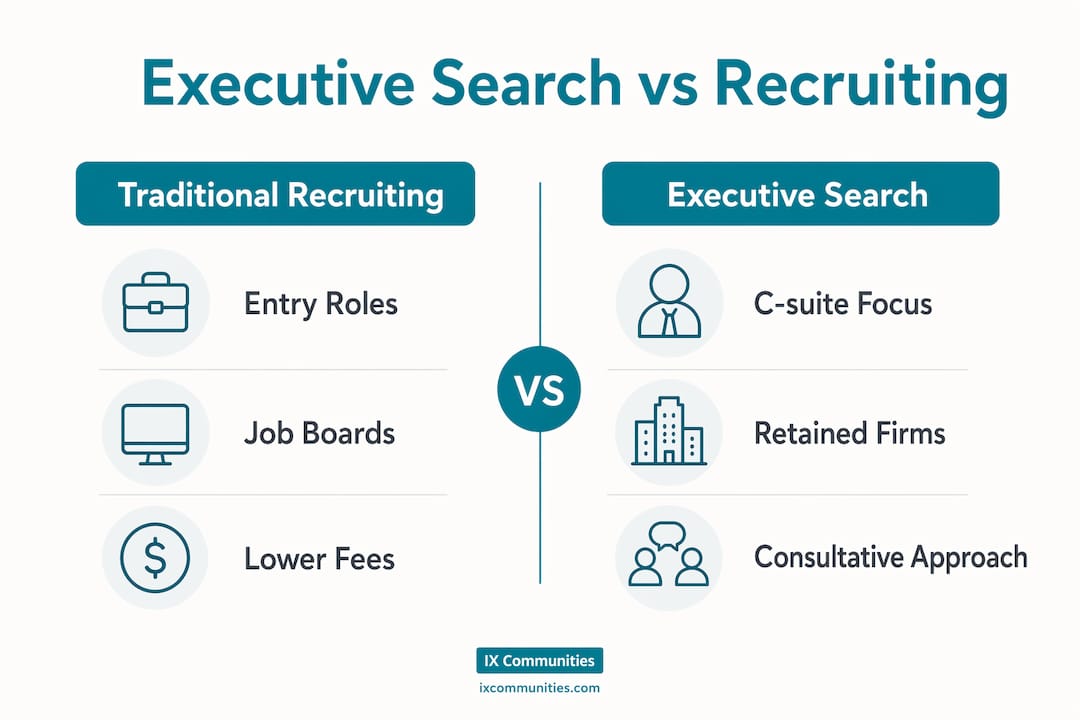
Traditional recruiting fills a broad range of positions, including entry-level and mid-level roles, using job boards, applicant tracking systems, and inbound applications. Executive search targets senior leadership roles exclusively, reaching candidates who are currently employed and performing well. Those candidates are not browsing job listings.
| Dimension | Traditional recruiting | Executive search |
|---|---|---|
| Role level | Entry to senior | C-suite, VP, board |
| Candidate pool | Active job seekers | Passive, employed leaders |
| Sourcing method | Job postings, applications | Targeted outreach, market mapping |
| Process depth | Faster, higher volume | Thorough, tailored, confidential |
| Fee structure | Contingency (paid on hire) | Retained (paid in stages) |
| Timeline | Weeks to 60 days | 90–150 days for C-suite roles (top-quartile firms consistently deliver these searches in 90–110 days, while the industry average is 120–150 days) |
| Confidentiality | Limited | High, often essential |
| Firm role | Transactional | Advisory and consultative |
Fee structures reflect this difference clearly. Retained executive search firms charge fees typically in the range of 30–35% of first-year compensation, with specialized technology searches sometimes reaching 40%. Contingency firms, by contrast, collect nothing unless a placement is made, which shapes how they prioritize searches.
The consultative dimension of executive search also sets it apart. A retained firm provides market intelligence, compensation benchmarking, and talent landscape analysis throughout the engagement. Organizations that receive only a list of candidate names are working with a sourcer, not a strategic partner.
Pro Tip: When evaluating whether to use retained executive search, consider whether the role is business-critical enough that a wrong hire would threaten organizational performance or long-term strategy. If the answer is yes, the retained model's depth and accountability justify the investment.
When and why should organizations use executive search firms?
Not every senior hire requires an executive search firm. The decision depends on the complexity of the role, the sensitivity of the situation, and the organization's internal capacity to reach the right candidates.
Common triggers for engaging an executive search firm include:
- Confidential replacements: When an incumbent is still in seat and the organization cannot advertise the opening publicly
- Business-critical roles: Positions where a wrong hire would damage enterprise value, culture, or long-term strategy
- Specialized or rare skill sets: Technical leadership roles such as Chief Technology Officer, Chief Data Officer, or Head of AI, where the qualified candidate pool is small and largely passive
- Cross-border or international searches: When the talent market extends beyond the organization's existing networks
- Board-level appointments: Where governance considerations and stakeholder sensitivity require a structured, discreet process
Executive search is used most frequently in industries where leadership continuity and specialized expertise are directly tied to competitive performance. Technology, financial services, healthcare, private equity-backed companies, and professional services firms are among the most active users. These sectors share a common characteristic: the cost of a leadership gap or a poor hire is high relative to the cost of a thorough search.
From a cost-benefit standpoint, a single CEO or CTO search can involve retained fees ranging from $250,000 to $900,000, and the cost of a failed placement is typically several times that figure in lost momentum and replacement costs. Organizations that weigh those numbers carefully tend to view executive search fees not as a recruitment expense but as risk management.
Medium to large organizations also use executive search to access candidates who are not reachable through internal networks or standard sourcing. When corporate entities lack the internal research resources, professional networks, or evaluative skills to recruit at the senior level, an outside firm fills that gap without requiring the organization to approach competitors directly.
How does the executive search process work?
A well-run executive search follows a structured sequence of stages. Each stage builds on the previous one, and the process is designed to surface the strongest candidates while protecting both the client and the candidates involved.
- Mandate intake and role calibration: The search firm meets with key stakeholders to define the role, success criteria, compensation range, and cultural requirements. This stage produces a position specification that guides the entire search.
- Market mapping and candidate research: The firm systematically identifies potential candidates across target organizations, industries, and geographies. This is original research, not a database query.
- Confidential outreach: Consultants contact candidates directly, often without initially disclosing the client's identity. The goal is to assess interest and fit before any formal introduction.
- Assessment and screening: Qualified candidates participate in structured interviews and, for senior roles, formal leadership assessments. Reference checks begin early, not at the end.
- Shortlist presentation: The firm presents a curated slate of candidates, typically four to eight, with detailed profiles and assessment summaries.
- Client interviews: The hiring organization meets shortlisted candidates. The search firm facilitates scheduling, prepares both parties, and gathers feedback.
- Offer negotiation and closing: The firm advises on compensation structure, manages expectations on both sides, and helps navigate the offer process.
- Onboarding support: Leading firms stay engaged through the candidate's first months to support a successful transition.
Key process considerations:
- Confidentiality is maintained at every stage, particularly during outreach and shortlisting
- Stakeholder alignment at the mandate stage prevents costly mid-search pivots
- Search consultants act as advisors throughout, not just candidate deliverers
- The relationship with candidates extends beyond a single search, with ongoing engagement and narrative management for C-suite professionals
For timeline expectations, top-quartile firms complete C-suite searches in 90–110 days. The industry average runs 120–150 days. Anything beyond 180 days typically signals a problem with the role specification, the candidate market, or the firm's network depth.
For organizations building or refining internal capabilities, understanding how executive search and talent management converge is useful context for structuring these engagements effectively.
Industry benchmarks and performance data for executive search
The most reliable way to evaluate an executive search firm is through outcome data, not reputation or anecdotes. Mature HR and talent acquisition leaders request role-matched historical data on retention, time-to-fill, and placement success before engaging any firm.
The KPIs that matter most in executive search are outcome-based, not activity-based. Outreach volume and partner hours billed are inputs. What clients actually purchase is a leader who lands, performs, and stays.
Key benchmarks for retained executive search:
- Placement success rate: The industry average for retained engagements sits at approximately 71%. Well-run boutique firms achieve 85–95%.
- Time-to-fill: Top-quartile firms complete C-suite searches in 90–110 days versus an industry average of 120–150 days.
- Retention at 12 months: Industry average is approximately 80%. Top-quartile firms report retention rates above 90%.
- Retention at 3 years: Industry average is approximately 60%, with top firms reaching 75% or higher.
- Replacement guarantee: A 12-month replacement guarantee is standard practice for retained engagements. Leading firms extend tracking to 24 months.
Vetting a firm's off-list percentage is also informative. A high off-list rate, meaning more than 30% of finalists came from outside the firm's initial sourcing map, indicates genuine market research rather than recycling existing relationships. A rate below 10% suggests limited reach.
For HR and talent acquisition professionals who want to go further, executive search benchmarking surveys provide structured data on how peer organizations measure and manage these engagements. Comparing your organization's outcomes against verified industry data is the most direct path to improving search quality over time.
Organizations looking to assess how executive search teams measure success in practice will find that the firms worth engaging are the ones that welcome these questions rather than redirect to case studies and testimonials. For CTO and technology leadership roles specifically, CTO-level executive search requires additional technical verification capabilities that not all retained firms provide.
How to evaluate and select an executive search firm
Selecting the right firm requires a structured evaluation, not a relationship decision. The criteria below apply regardless of firm size or brand recognition.
- Request role-matched data: Ask for the last ten searches comparable to your open role, with time-to-fill, retention at 12 months, and placement success rate. Firms that cannot produce this within ten business days raise a legitimate concern.
- Verify retention independently: Cross-check placed executives through public sources such as LinkedIn to confirm who remains in seat.
- Assess advisory depth: A firm that provides only candidate names is functioning as a sourcer. A true partner delivers market intelligence, compensation data, and talent landscape context throughout the search.
- Check the replacement guarantee: Confirm the terms in writing. The standard is 12 months; leading firms offer 24 months.
- Contact references from placed executives: Speak with executives placed two or more years ago, not just the hiring managers who commissioned the search. Long-term cultural fit and performance are what you are assessing.
Fee structures vary by engagement model. Retained search fees typically run 30–35% of first-year compensation, paid in stages regardless of outcome. This structure aligns the firm's incentive with thoroughness rather than speed. Contingency arrangements, where fees are paid only on a successful hire, tend to produce faster but less rigorous processes, and are generally not suited to C-suite mandates.
For a detailed framework on firm selection, Ixcommunities has published a practical guide on selecting an executive search firm that covers evaluation criteria, contract terms, and performance tracking.
Key Takeaways
Executive search is a retained, research-driven process targeting passive senior leaders, distinct from traditional recruiting in depth, confidentiality, fee structure, and strategic advisory scope.
| Point | Details |
|---|---|
| Definition and scope | Executive search targets C-suite, VP, and board roles with annual compensation typically at $150,000 or more. |
| Retained fee structure | Retained firms charge 30–35% of first-year compensation, paid in stages regardless of placement outcome. |
| Process timeline | Top-quartile firms complete C-suite searches in 90–110 days; the industry average runs 120–150 days. |
| Placement success rates | Retained boutique firms achieve 85–95% placement success versus an industry-wide retained average of approximately 71%. |
| Retention benchmarks | Industry average 12-month retention is approximately 80%; top-quartile firms report above 90%, with 3-year rates reaching 75% or higher. |
Develop your executive search capabilities with Ixcommunities

Ixcommunities operates ESIX, TLIX, and IXCommunities as peer networking and benchmarking groups for talent leadership professionals at large corporate organizations. These communities provide a secure environment where recruiting and talent acquisition teams share data, compare practices, and access structured benchmarking on executive search performance.
HR and talent acquisition professionals can access benchmark surveys that provide verified data on executive search outcomes across peer organizations, or participate in ESIX recruiter peer mentorship programs designed to build expertise in retained search, vendor evaluation, and talent leadership. Both resources are built for practitioners who need data and peer perspective, not general advice.