

Selecting an executive search firm is defined as the process of identifying a retained or contingency search partner with the sector expertise, candidate access, and methodology transparency required to place transformational leadership talent. Unlike general recruiters, executive search firms specialize in sourcing passive candidates who represent the majority of top executive talent. The criteria for selecting search firms go well beyond brand recognition or database size. This guide gives corporate leaders and hiring managers a structured framework for evaluating firms on the factors that actually predict placement quality and long-term leadership success.
How to select an executive search firm: four core criteria
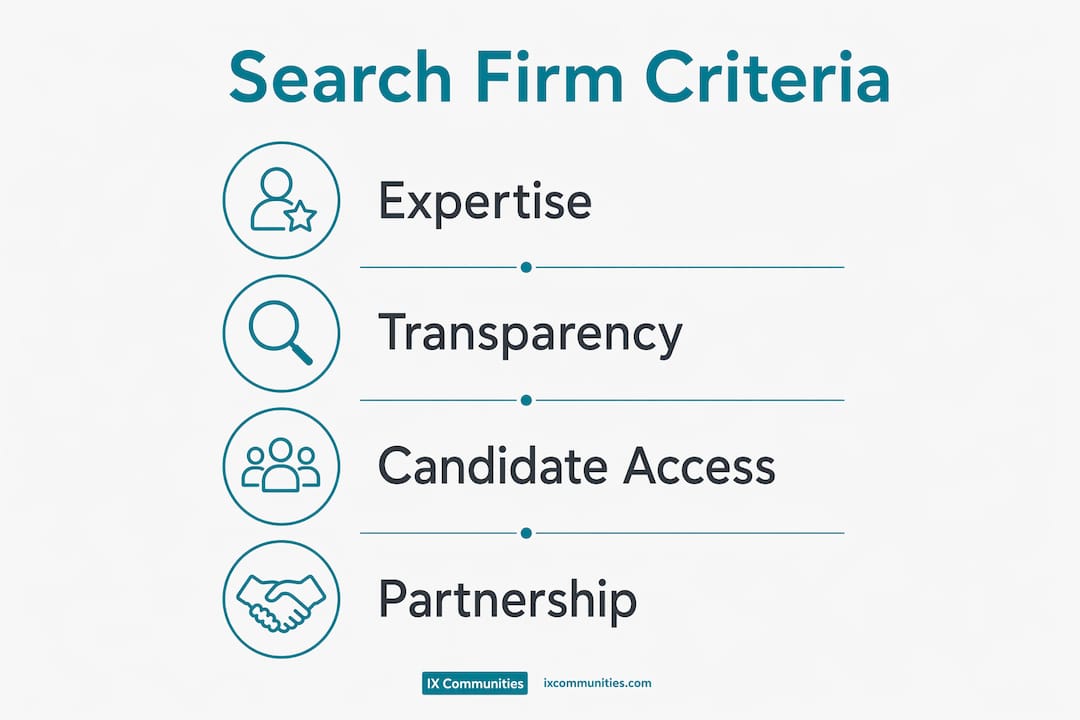
The four criteria that define a high-quality executive search firm are sector and role expertise, a transparent candidate evaluation methodology, direct access to passive candidate pools, and a commitment to long-term partnership. Each criterion serves a distinct function in predicting whether a search will produce a successful hire or a costly mis-hire.
Sector and role-specific expertise is the starting point. A firm that has placed Chief Financial Officers in mid-market manufacturing companies brings a fundamentally different network and success model than one that places general management roles across industries. Functional expertise offers deeper networks and more accurate candidate success prediction than broad industry knowledge alone. This distinction matters most when the role requires specialized technical knowledge or a specific leadership profile.

Methodology transparency separates average firms from exceptional ones. Exceptional firms provide detailed search maps, structured progress reports, and evidence-based leadership assessments rather than simply delivering a shortlist of candidates. A firm that cannot explain how it identifies, evaluates, and ranks candidates is operating without a repeatable process. That absence of process is a direct risk to your hire quality.
Passive candidate access is a structural advantage that separates retained search from most alternatives. 73% of top executive talent is passive and not actively seeking new roles. General recruiters primarily work with active candidates, which means they are drawing from a much smaller and less selective pool. A firm with a cultivated passive network reaches candidates who would never respond to a job posting.
Long-term partnership indicators include replacement guarantees, onboarding support, and post-placement check-ins. These are not standard across all firms, and their presence or absence signals how confident a firm is in its own process.
| Criterion | Retained search | Contingency search |
|---|---|---|
| Candidate pool | Passive and active | Primarily active |
| Fee structure | 25-35% of compensation, paid in milestones | Fee paid only on placement |
| Exclusivity | Yes, dedicated team | No, multiple firms compete |
| Replacement guarantee | Typically 90 days to 12 months | Rarely included |
| Best for | C-suite, confidential, strategic roles | Mid-level, urgent fills |
Pro Tip: Ask every firm you evaluate to walk you through their last three placements at your target level. If they cannot provide specifics on role scope, candidate evaluation process, and post-placement outcomes, treat that as a disqualifying signal.
How to assess a firm's expertise and alignment with your needs
Verifying a firm's claimed expertise requires direct, specific questioning rather than reviewing marketing materials or client logos. A structured assessment process protects you from selecting a firm based on reputation alone.
-
Request recent, relevant placements. Ask for three to five examples of completed searches at your target level, within your industry, and at a comparable organization size. Request specifics: the role title, the hiring company's revenue range, the search timeline, and the outcome at 12 months post-placement. Vague answers indicate limited relevant experience.
-
Identify the day-to-day search lead. Many firms present senior partners in the pitch meeting and then hand the actual search to junior associates. Confirm in writing who will lead candidate sourcing, who will conduct assessments, and who will be your primary contact throughout the engagement. The quality of the person running your search matters more than the firm's overall brand.
-
Evaluate pipeline readiness before signing. Ask the firm to describe the current state of their candidate pipeline for your specific role type. A firm with genuine market presence can name the types of candidates they are already in contact with and explain why those candidates are relevant to your search. A firm without pipeline readiness will give you a generic answer about their database.
-
Prioritize functional specialty over firm size. Functional role-specific expertise produces better candidate matches than broad industry coverage. A boutique firm specializing in Chief Human Resources Officer placements will outperform a global generalist firm for that specific role in most cases.
-
Validate reputation through peer references, not client lists. Relying solely on a website's client list can be misleading. Ask for direct references from hiring managers at organizations similar to yours, and ask those references specifically about methodology, communication quality, and candidate fit at 12 months. Repeat business from the same organizations is a stronger quality signal than a long list of one-time engagements.
Pro Tip: When speaking with references, ask: "Would you use this firm again for a role at the same level?" A yes with hesitation tells you as much as a no.
What executive search fees, guarantees, and contracts actually mean
Fee structures in executive search are more standardized than most hiring managers expect, but the contractual details around guarantees and scope vary significantly between firms.
Retained search fees typically range from 25% to 35% of the placed candidate's first-year total compensation, paid in three installments tied to search milestones. The first payment is due at engagement, the second at candidate presentation, and the third at placement. This structure aligns the firm's financial incentive with search progress rather than just placement speed.
Replacement guarantees are a direct proxy for firm confidence. Top retained search firms offer replacement guarantees ranging from 90 days up to 12 months. A 12-month guarantee reflects genuine confidence in the firm's candidate evaluation and cultural fit processes. A guarantee shorter than 90 days, or no guarantee at all, signals that the firm is not willing to stand behind its own assessment methodology.
Key contractual components to review before signing include:
- Scope definition: The specific role title, reporting structure, compensation range, and geographic parameters must be documented. Scope creep is a common source of disputes.
- Timeline and milestones: A credible firm will commit to specific deliverables at defined intervals, such as a candidate longlist within four weeks and a shortlist within eight.
- Exclusivity terms: Retained search agreements are exclusive by design. Confirm the duration and conditions under which exclusivity applies.
- Off-limits clauses: Most retained firms will not recruit from client organizations for a defined period. Understand the scope of this restriction before signing.
- Risk mitigation plan: Ask what happens if the search extends beyond the agreed timeline or if the initial shortlist does not meet your requirements.
The financial case for upfront search investment is straightforward. A mis-hire at the executive level costs an organization significantly more than the search fee itself, when accounting for severance, lost productivity, and the cost of a second search. Treating the search fee as a risk mitigation investment rather than a vendor cost changes how you evaluate firm quality.
How to conduct due diligence and avoid common selection mistakes
A structured due diligence process prevents the most frequent and costly selection errors. The single most common mistake is selecting a firm based on existing relationships or large databases rather than proven methodology and direct sourcing capabilities. Familiarity is not a substitute for demonstrated performance.
Follow this sequence when vetting executive search firms:
-
Begin the evaluation process before you have an urgent need. Starting firm selection late under hiring pressure leads to rushed choices and weak alignment with long-term leadership goals. Build a shortlist of qualified firms during periods of organizational stability so you are not making a high-stakes decision under time pressure.
-
Use structured questions to probe methodology. Ask each firm to describe their candidate identification process, their assessment framework, and how they evaluate cultural fit. Generic answers indicate a lack of process rigor. Specific, repeatable answers indicate a firm that can be held accountable.
-
Test their knowledge of passive candidate sourcing. Ask how the firm engages executives who are not actively looking. A firm that relies primarily on job boards or inbound applications is not operating as a true executive search partner.
-
Conduct a structured comparison across at least three firms. Evaluate each firm on the same criteria: relevant placements, methodology transparency, team composition, guarantee terms, and fee structure. A side-by-side comparison prevents selection based on presentation quality rather than substance.
-
Assess communication style during the pitch process. How a firm communicates during the sales process is a reliable indicator of how they will communicate during the search. Firms that are slow to respond, vague about process, or reluctant to provide references will exhibit the same behaviors once engaged.
"The quality of a search firm's questions about your organization tells you more about their capability than any case study they present. A firm that asks about your leadership culture, decision-making structure, and definition of success is operating at a different level than one that asks only about compensation range and start date."
For additional context on vetting search providers before an urgent need arises, the Ixcommunities blog provides practical frameworks used by corporate talent teams at large organizations.
Retained search vs. contingency recruiters: which model fits your hire?
The choice between retained executive search and contingency recruiting is determined by role complexity, confidentiality requirements, and the quality threshold your organization requires.
Retained search firms operate on an exclusive, partnership model. They invest significant time in understanding your organization's culture, leadership structure, and strategic direction before sourcing begins. This depth of engagement produces candidates who are evaluated against a specific success profile, not just a job description. The tradeoff is cost and timeline. Retained searches typically take 60 to 120 days and require upfront financial commitment.
Contingency recruiters are paid only when a placement is made. This model creates speed incentives but also creates misaligned priorities. A contingency recruiter working on multiple open roles simultaneously will prioritize the search most likely to close quickly, which may not be yours. The candidate pool is also narrower, drawing primarily from active job seekers rather than the passive executive talent that represents the highest-quality candidates.
When to use retained search:
- C-suite and senior leadership roles where a mis-hire carries significant organizational risk
- Confidential searches where discretion is required throughout the process
- Roles requiring a highly specific functional or industry background
- Situations where the organization lacks internal capacity to manage a complex search
When contingency search may be appropriate:
- Director-level or senior manager roles with a clear, well-defined profile
- Searches with a large pool of qualified active candidates
- Situations where speed is the primary constraint and role complexity is low
The executive search and talent management relationship matters here. Organizations that integrate their search model selection into a broader talent strategy consistently achieve better outcomes than those that treat each search as a standalone transaction.
Key takeaways
Selecting the right executive search firm requires evaluating methodology transparency, passive candidate access, and contractual accountability rather than firm size or existing relationships.
| Point | Details |
|---|---|
| Prioritize methodology over brand | Firms that provide detailed search maps and progress reports outperform those that only deliver candidate lists. |
| Verify passive candidate access | 73% of top executive talent is passive; retained firms with cultivated networks reach candidates general recruiters cannot. |
| Scrutinize guarantee terms | Replacement guarantees of up to 12 months signal genuine firm confidence in candidate evaluation quality. |
| Start vetting before urgency hits | Beginning firm evaluation before a hiring need arises prevents rushed decisions and weak strategic alignment. |
| Match model to role complexity | Retained search fits C-suite and confidential roles; contingency search suits mid-level, clearly defined positions. |
What I have learned about choosing an executive search partner
The most consistent pattern I have observed in organizations that make strong executive hires is that they treat the search firm selection process with the same rigor they apply to the hire itself. They start early, ask hard questions, and do not confuse a polished pitch with a proven process.
The firms that consistently deliver are not always the largest or the most recognized. They are the ones that can explain exactly how they will find candidates you cannot find yourself, how they will assess those candidates against your specific success criteria, and what they will do if the placement does not work out. That level of specificity is rare, and it is the clearest signal of quality available before you sign anything.
The risk of prioritizing speed over process is real and underappreciated. Organizations that engage a firm under time pressure, without completing due diligence, frequently end up with a placement that looks right on paper but fails within 18 months. The cost of that outcome, in financial and organizational terms, far exceeds the cost of a thorough upfront selection process.
The firms worth engaging are those that ask as many questions about your organization as you ask about them. That reciprocal curiosity is the foundation of a search partnership that produces lasting results, not just a filled position.
— Simon
How Ixcommunities supports leadership hiring decisions
Corporate talent leaders who want to sharpen their approach to executive search do not have to rely solely on vendor-provided information. Ixcommunities provides a secure peer environment where talent and recruiting professionals at large organizations share real-world experience, benchmark practices, and access expert perspectives on exactly these decisions.

The Talent Leaders Peer Mentoring Program connects senior talent professionals with peers who have direct experience selecting and managing executive search firm relationships. Ixcommunities also hosts guest speaker events featuring practitioners and thought leaders who address current challenges in executive search and leadership hiring. For talent leaders who want peer-validated insight rather than vendor marketing, Ixcommunities is the resource built specifically for that purpose.
FAQ
What is the standard fee for a retained executive search firm?
Retained executive search fees typically range from 25% to 35% of the placed candidate's first-year total compensation, paid in three milestone-based installments. The first payment is due at engagement, not at placement.
How do I verify an executive search firm's track record?
Request three to five recent placements at your target level with specifics on role, industry, company size, and 12-month outcomes. Peer references from hiring managers at comparable organizations are more reliable than client lists or published rankings.
What is the difference between retained and contingency executive search?
Retained search firms work exclusively on your role, access passive candidates, and are paid in milestones regardless of placement. Contingency recruiters are paid only on placement and primarily source active candidates, which suits lower-complexity or mid-level roles.
How long should a replacement guarantee be?
Top retained search firms offer replacement guarantees from 90 days up to 12 months. A 12-month guarantee is the strongest available signal that a firm stands behind its candidate evaluation process.
When should I start evaluating executive search firms?
Begin evaluating firms before a specific hiring need becomes urgent. Starting the selection process early allows for thorough due diligence and prevents rushed decisions that compromise long-term leadership alignment.