

The executive hiring process is a structured, consultative system designed to secure leaders who drive measurable business impact and shape organizational culture. For HR leaders and talent acquisition professionals in large corporations, getting this process right is not optional. Up to 40% of C-suite searches fail, and around 50% of newly hired executives leave or fail within 18 months without structured onboarding. This executive hiring process guide covers every critical stage, from defining outcome-based success profiles to post-hire integration, so your team can reduce mis-hires and accelerate leadership value.
What does a strong executive hiring process guide include?
The executive selection process is not a scaled-up version of standard recruiting. It is a distinct discipline that requires stakeholder alignment, market intelligence, and a structured evaluation framework. Each stage builds on the last, and skipping any one of them increases the risk of a costly mis-hire.
The most effective executive recruitment guide treats the search as a strategic initiative, not a transactional fill. That means defining what success looks like before the search begins, not after the first shortlist arrives.

Why role clarity is the foundation
A vague brief leads to technically qualified but misaligned hires. This is the most common and most preventable failure in executive recruitment. When the brief confuses candidate preferences with actual requirements, the search produces candidates who look right on paper but underperform in practice.
Role clarity also protects the search timeline. A precise brief allows the recruiting team to move faster, screen more accurately, and present a tighter shortlist.
How do you define success profiles for executive roles?
Outcome-based success profiles replace traditional job descriptions as the standard for executive role definition. A success profile defines the measurable business outcomes the executive must deliver within 6–24 months, the leadership competencies tied to those outcomes, and the cultural contribution the role requires.
Traditional job descriptions list credentials and responsibilities. Success profiles define impact. The difference matters because credentials are easy to verify and hard to act on. Impact expectations create a shared language between the hiring committee, the search team, and the candidate.
When building a success profile, focus on these elements:
- Business outcomes: What must change or be built within the first year? Define metrics where possible.
- Leadership competencies: Which behaviors are non-negotiable given the organization's current stage and strategic direction?
- Cultural contribution: What does this leader need to add to the culture, not just fit within it?
- Future readiness: Does the role require the executive to lead through transformation, stability, or both?
- Stakeholder map: Who does this executive influence, and what do those relationships require?
Pro Tip: Separate "must-have" competencies from "nice-to-have" credentials before the search begins. Mixing the two is the fastest way to derail a shortlist review.
Organizations that shift to outcome-based profiles improve leadership retention by 30%. That figure reflects a direct connection between role clarity at the start and executive performance over time.
What are the key stages and timeline of the executive hiring process?
The typical executive search takes 9–14 weeks for a comprehensive retained search, though some firms complete offers in as little as 3–5 weeks for well-defined roles with active candidate pools. Complexity, seniority, and market conditions all affect the timeline. Planning for 12 weeks is a reasonable default for most C-suite searches.
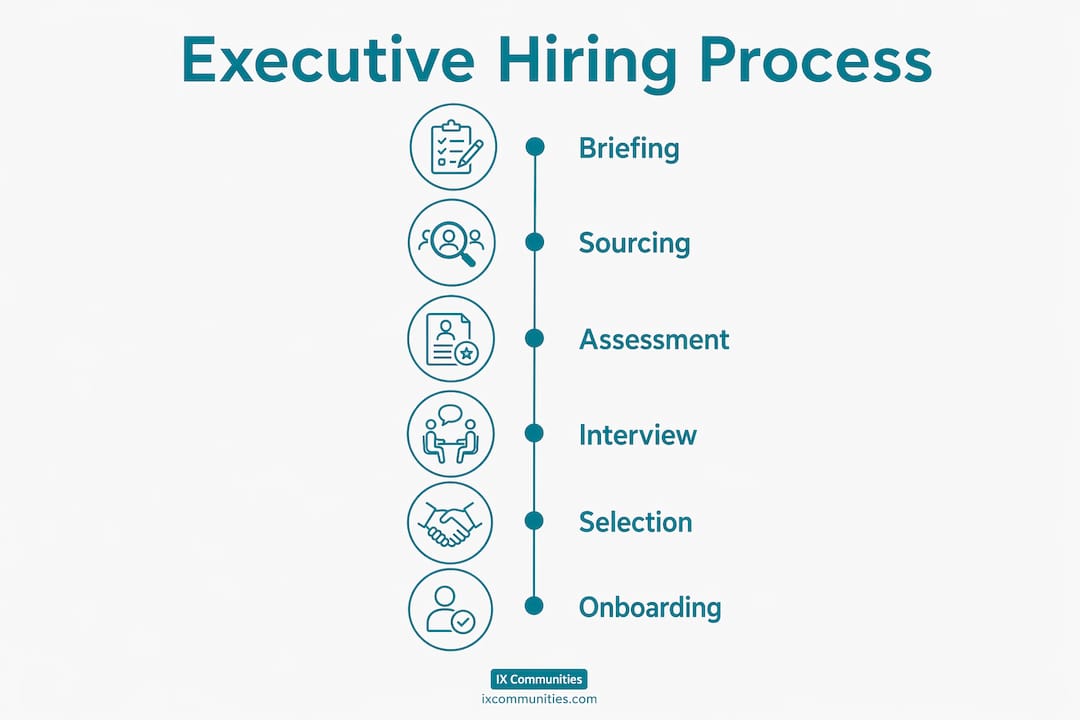
The stages below reflect best practices for executive recruitment in large corporate environments:
- Stakeholder alignment and briefing (weeks 1–2): Convene the hiring committee, define the success profile, and align on decision authority. Misalignment here causes delays at every later stage.
- Market mapping and candidate identification (weeks 2–4): Research the talent pool, identify passive candidates, and build a target list. This is intelligence work, not resume collection.
- Outreach and candidate engagement (weeks 3–6): Contact targets with personalized, mission-driven narratives. Assess initial fit through structured conversations.
- Shortlist presentation and stakeholder interviews (weeks 6–9): Present a curated shortlist. Run stakeholder-led interviews designed as a strategy sprint, balancing data with human judgment.
- Assessment and reference validation (weeks 8–10): Apply psychometric tools, conduct structured behavioral interviews, and probe references beyond candidate-provided contacts.
- Offer management and close (weeks 10–12): Manage the offer process with confidentiality. Align on compensation, start date, and transition logistics.
- Pre-start onboarding preparation (weeks 11–14): Begin stakeholder alignment and 90-day planning before the executive's first day.
| Stage | Key activity | Typical duration |
|---|---|---|
| Briefing and alignment | Success profile, stakeholder map | 1–2 weeks |
| Market mapping | Target list, intelligence gathering | 2–3 weeks |
| Outreach and engagement | Personalized candidate contact | 3–4 weeks |
| Interviews and assessment | Strategy sprint interviews, psychometrics | 3–4 weeks |
| Offer and close | Compensation alignment, confidentiality | 1–2 weeks |
| Onboarding preparation | 90-day plan, pre-start alignment | Concurrent |
For HR leaders building an internal executive recruiting function, the step-by-step recruiting function guide from Ixcommunities provides a detailed operational framework.
Which assessment methods ensure reliable leadership selection?
Assessment in executive hiring requires more than a strong interview. The most reliable selection processes combine structured behavioral interviews, validated psychometric tools, and rigorous reference checks conducted beyond the candidate's own contact list.
Structured behavioral interviews focus on specific leadership challenges the candidate has faced, the decisions they made, and the outcomes they produced. This format reduces the influence of first impressions and gives the hiring committee comparable data across candidates.
Psychometric and cognitive assessments add a layer of objectivity. They do not replace judgment, but they surface patterns that interviews miss, particularly around decision-making style, risk tolerance, and interpersonal dynamics under pressure.
Reference validation is where most organizations underinvest. Valuable references come from direct reports, board members, and peers, not from the general contacts a candidate provides. Probing how a leader handled conflict, managed underperformance, and responded to failure reveals far more than a standard reference call.
Key assessment principles for executive hiring:
- Use a consistent scoring rubric across all interviewers to reduce bias.
- Evaluate cultural contribution, not cultural fit. Fit preserves the status quo; contribution advances it.
- Avoid overweighting credentials. A strong CV is a starting point, not a selection criterion.
- Treat psychometric results as conversation starters, not verdicts.
Pro Tip: Ask references specifically about the candidate's behavior during a period of organizational stress or failure. That context reveals leadership character more clearly than any success story.
For HR leaders looking to sharpen their assessment frameworks, faster and better hiring practices require balancing data rigor with stakeholder intuition at every stage.
How do you attract and engage passive executive candidates?
Most executives at the top of their field are not actively searching. Proactive, credibility-driven outreach using personalized storytelling is the only reliable method for engaging this population. Volume-based sourcing does not work at this level.
Effective outreach leads with mission, authority, and support. The candidate needs to understand what the organization is trying to accomplish, what decision-making power the role carries, and what resources and backing are available. Generic outreach that leads with compensation or title generates low response rates from high-quality candidates.
Practical approaches for engaging passive executive talent:
- Personalized narratives: Tailor the initial message to the candidate's known career trajectory and publicly stated interests.
- Professional network activation: Use board members, investors, and senior advisors to make warm introductions where appropriate.
- Employer branding: A strong executive networking presence and credible public profile reinforce the organization's reputation before the first conversation.
- Confidential communications: Protect both the organization's search and the candidate's current position through discreet, direct contact.
- AI-assisted targeting: Use data tools to identify candidates whose career patterns match the success profile, then apply human judgment to prioritize outreach.
The goal is to create a conversation, not close a deal. The best executive candidates evaluate opportunities carefully. Rushing the engagement process signals poor organizational judgment.
What does successful executive onboarding look like?
Executive onboarding begins before the contract is signed. Aligning the board, the hiring manager, and the incoming executive on expectations before the start date is the single most effective way to reduce early attrition. Skipping this step is a primary driver of the 50% failure rate within 18 months.
A structured onboarding plan follows a 30-60-90 day framework:
- Days 1–30 (listening): The executive meets key stakeholders, learns the organization's current state, and builds relationships. No major decisions.
- Days 31–60 (diagnosing): The executive identifies gaps, opportunities, and priorities. Initial hypotheses are formed and tested.
- Days 61–90 (deciding): The executive presents a clear point of view on priorities and begins making decisions aligned with the success profile.
Onboarding failure rarely announces itself early. The warning signs are subtle: the executive stops asking questions, stakeholder feedback becomes vague, and early wins are absent by week eight. Catching these signals before day 60 gives the organization time to intervene.
Link every onboarding milestone back to the original success profile. If the profile defined a specific business outcome for month six, the 90-day plan should show a clear path toward it. This connection between the hiring brief and the onboarding plan is what separates organizations that retain executive talent from those that repeat the search cycle.
Key Takeaways
A structured executive hiring process, built on outcome-based success profiles, rigorous assessment, and pre-start onboarding alignment, is the most reliable way to reduce executive mis-hires and accelerate leadership impact.
| Point | Details |
|---|---|
| Define outcomes, not credentials | Build success profiles around measurable business impact within 6–24 months, not job description checklists. |
| Plan for a 9–14 week timeline | Comprehensive executive searches average 9–14 weeks; build this into workforce planning cycles. |
| Assess beyond the interview | Combine structured behavioral interviews, psychometrics, and reference checks from direct reports and peers. |
| Engage passives with personalized outreach | Top executives respond to mission-driven, credible narratives, not volume-based sourcing messages. |
| Start onboarding before day one | Pre-hire stakeholder alignment and a 30-60-90 day plan reduce the 50% early attrition rate significantly. |
What I have learned from watching executive searches go wrong
The most consistent mistake I see in executive hiring is treating the process as a recruiting problem when it is actually a strategic alignment problem. The search itself is rarely where things break down. The failure usually traces back to a hiring committee that never agreed on what success looks like, or an onboarding plan that existed only on paper.
The second pattern worth naming is the overconfidence that comes with a strong shortlist. When three credible candidates are on the table, the pressure to close accelerates. Committees start compressing assessment steps, skipping reference calls, and rationalizing gaps in the success profile. That compression is where mis-hires are made.
Technology is genuinely useful in executive search, particularly for market mapping and candidate identification. But I have seen organizations mistake data volume for insight quality. An AI-assisted target list is a starting point. The judgment about who to pursue, how to engage them, and whether they are the right fit still requires experienced human assessment. Recruiters who are becoming strategic advisors understand this distinction and use technology to sharpen their work, not replace it.
The organizations that consistently hire well at the executive level treat each search as a learning event. They debrief after every hire, track onboarding outcomes against the original success profile, and refine their process based on what they observe. That discipline compounds over time.
— Simon
How Ixcommunities supports HR leaders in executive hiring
HR leaders who want to sharpen their executive recruitment strategies benefit from peer-level insight that goes beyond published frameworks. Ixcommunities provides exactly that through its ESIX recruiter peer mentorship programs and talent leaders peer mentoring program, where recruiting professionals in large corporations exchange vetted practices, benchmark their processes, and access structured learning in a secure environment.
Members gain access to benchmark surveys that provide real data on executive search timelines, fee structures, and onboarding outcomes across peer organizations. For HR leaders who want to move from reactive hiring to a repeatable, data-informed executive selection process, Ixcommunities offers the peer network and resources to make that shift practical.
FAQ
What is the average timeline for an executive search?
The typical executive search takes 9–14 weeks for a comprehensive retained search. Some searches close in as little as 3–5 weeks for well-defined roles with active candidate pools.
Why do so many executive hires fail within the first year?
Around 50% of newly hired executives leave or fail within 18 months, most often due to poor onboarding, misaligned expectations, or a vague role brief that produced a mis-hire from the start.
What is an outcome-based success profile?
An outcome-based success profile defines the measurable business results an executive must deliver within 6–24 months, replacing traditional job descriptions that focus on credentials and responsibilities.
How should organizations approach executive reference checks?
Reference checks should go beyond candidate-provided contacts. Direct reports, board members, and peers provide the most accurate picture of how a leader performs under pressure and manages conflict.
When does executive onboarding begin?
Onboarding begins before the contract is signed. Pre-hire alignment among the board, hiring manager, and incoming executive sets expectations and reduces the risk of early attrition.