

A talent pipeline is defined as a curated, continuously managed group of pre-qualified candidates who are ready to fill specific roles as they open. Unlike reactive hiring, which starts from zero when a position becomes vacant, a pipeline keeps qualified candidates warm and engaged before the need arises. Companies with active talent pipelines fill roles 30%–40% faster than organizations that hire reactively. That speed advantage compounds over time, reducing cost-per-hire and improving the quality of each placement. For recruiters and HR leaders, understanding what is talent pipeline strategy means understanding the difference between always being behind and always being ready.
What is a talent pipeline, and how does it differ from a talent pool?
Confusing talent pipelines with talent pools is one of the most common mistakes in talent acquisition. The distinction matters because each requires a different investment of time, tools, and recruiter attention.
A talent pool is a broad, largely passive collection of candidates who have expressed interest in an organization or who a recruiter has identified as potentially relevant. Talent pools are wide by design. They may include thousands of profiles with varying levels of fit, and they require minimal ongoing engagement. Think of a talent pool as a database.
A talent pipeline, by contrast, is focused, vetted, and actively engaged for specific roles. Candidates in a pipeline have been screened, contacted, and are maintained through regular communication. They are aligned to particular job families or business-critical positions. The pipeline is dynamic. It moves candidates forward or sideways based on readiness and fit.

A talent community sits between the two. It is engagement-oriented, often built around employer brand content, events, and newsletters. Talent communities build affinity but are less role-specific than pipelines.
| Concept | Candidate readiness | Engagement level | Role focus |
|---|---|---|---|
| Talent pool | Low to moderate | Passive | Broad |
| Talent community | Moderate | Active but general | Moderate |
| Talent pipeline | High | Active and targeted | Specific roles |
The table above shows why confusing pipelines and pools leads to wasted recruiter effort. A pipeline demands ongoing relationship management. A pool does not.
What are the key components and benefits of an effective talent pipeline?
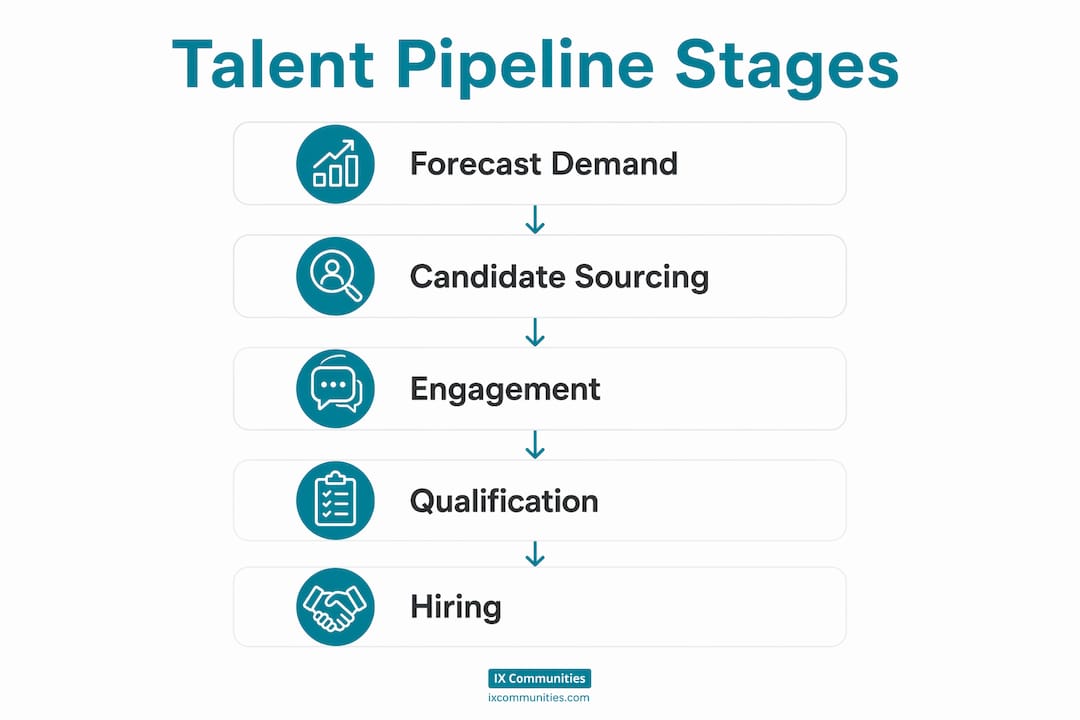
An effective talent pipeline is built in stages, each requiring deliberate action from the recruiting team. The five core stages are:
- Identification: Source candidates through referrals, LinkedIn, alumni networks, industry events, and internal mobility programs.
- Outreach: Make first contact with a personalized, value-driven message that explains why you are reaching out.
- Engagement: Maintain ongoing communication through relevant content, career updates, and periodic check-ins.
- Qualification: Screen candidates for skills, culture fit, and role alignment through structured conversations or assessments.
- Readiness tracking: Categorize candidates by how close they are to being hireable for a target role.
Effective pipeline management forecasts talent demand 12–36 months ahead, integrating workforce planning data and candidate relationship management (CRM) tools. That forward view is what separates pipeline strategy from ordinary sourcing. When a VP of Engineering role opens unexpectedly, a team with a pipeline already has three qualified candidates in conversation. A team without one starts searching.
The benefits of a well-run pipeline are concrete. Faster hires reduce the cost of vacancy. Higher-quality candidates reduce early turnover. Reduced time-to-productivity follows because pipeline candidates often arrive with context about the organization. Organizations with strong pipeline strategies see 3x higher candidate attraction and 35% lower turnover compared to those relying on reactive hiring.
Pro Tip: Set a quarterly calendar reminder for every candidate in your pipeline. Without a defined cadence, pipeline candidates become historical data rather than active assets. A brief check-in message every 90 days keeps relationships alive without overwhelming candidates.
How do recruiters and HR leaders build a high-performing talent pipeline?
Building a talent pipeline that actually produces hires requires discipline in four areas: sourcing focus, outreach quality, segmentation, and maintenance.
1. Start with priority roles
Do not try to build pipelines for every position at once. Focus first on roles that are hard to fill, high-impact, or frequently recurring. A pipeline for a niche data science role or a senior sales leader delivers far more value than a broad pipeline for entry-level positions that fill quickly through standard job postings.
2. Use personalized outreach
Personalized outreach messages achieve a 15% higher response rate than generic recruitment messages. Generic job pitches are ignored. Messages that reference a candidate's specific work, publications, or career trajectory perform significantly better. The goal of first contact is not to pitch a job. The goal is to start a conversation.
3. Segment by readiness
Segmenting candidates by readiness state improves engagement efficiency and pipeline conversion. Candidates who are ready now need frequent touchpoints, perhaps monthly. Candidates who are 12–18 months away from a move belong in an automated nurture sequence with lighter-touch content. Mixing the two groups with the same communication frequency wastes recruiter time and risks annoying candidates who are not ready to move.
4. Maintain the pipeline consistently
Pipelines decay without maintenance. Candidates accept other offers, change career directions, or simply go cold. A recruiter who built a strong pipeline in january and ignored it until october will find it largely useless. Assign ownership of each pipeline segment to a specific recruiter, and track engagement rates as a performance metric.
Pro Tip: Keep your first outreach message to 3–4 sentences maximum. Lead with a specific observation about the candidate's work, state why you are reaching out, and offer something of value such as a relevant industry report or an invitation to a peer event. Never open with a job description.
For teams working on internal mobility strategies, the pipeline-building process applies equally to internal candidates. Internal employees are an often overlooked but high-value pipeline source, offering better retention outcomes and faster onboarding compared to external hires.
What tools and metrics support talent pipeline management?
Technology does not build a pipeline. Recruiters do. But the right tools make pipeline management faster, more consistent, and measurable.
The core technology stack for pipeline management includes:
- Applicant tracking systems (ATS): Store candidate records and track application history. Most enterprise ATS platforms include basic pipeline tagging features.
- Candidate relationship management (CRM) tools: Purpose-built for pipeline management, CRM platforms allow recruiters to segment candidates, schedule outreach, and track engagement over time.
- Analytics and reporting dashboards: Surface metrics like pipeline coverage ratio, time-to-engage, and candidate conversion rates by role family.
- Workflow automation: Automate nurture sequences for long-term candidates, freeing recruiters to focus on high-readiness conversations.
The metrics that matter most for pipeline health are straightforward:
| Metric | What it measures |
|---|---|
| Time-to-fill | Speed of hire from pipeline vs. reactive sourcing |
| Pipeline coverage ratio | Number of qualified candidates per open role |
| Engagement rate | Percentage of pipeline candidates responding to outreach |
| Conversion rate | Percentage of pipeline candidates who become hires |
| Candidate decay rate | Percentage of pipeline candidates who go cold per quarter |
Tracking these metrics connects pipeline activity to business outcomes. A low conversion rate signals a qualification problem. A high decay rate signals a maintenance problem. Both are fixable once measured.
Integrating pipeline data with talent management and recruiting systems gives HR leaders a full view of workforce supply and demand. That integration is what makes 12–36 month demand forecasting realistic rather than theoretical.
Key Takeaways
A talent pipeline is the single most effective tool for reducing time-to-fill, improving hire quality, and shifting recruiting from reactive to proactive.
| Point | Details |
|---|---|
| Pipeline vs. pool | Pipelines are vetted, role-specific, and actively managed; pools are broad and passive. |
| Speed advantage | Organizations with active pipelines fill roles 30%–40% faster than reactive hiring teams. |
| Segmentation matters | Separate ready-now candidates from long-term prospects and engage each group differently. |
| Maintenance is non-negotiable | Without quarterly check-ins, pipeline candidates become inactive records rather than real options. |
| Metrics drive improvement | Track time-to-fill, conversion rate, and decay rate to identify and fix pipeline weaknesses. |
The shift I keep seeing recruiters miss
Talent acquisition has moved from transactional to relationship-driven over the past several years. Most recruiters understand this in theory. Fewer act on it consistently.
The biggest gap I observe is not in sourcing. Recruiters are generally good at finding candidates. The gap is in sustained engagement. A recruiter builds a strong pipeline in Q1, fills a role from it in Q2, and then stops maintaining it. By Q4, the pipeline is effectively dead. The candidates have moved on, mentally and professionally.
The second gap is internal talent. Most organizations have employees who are one development conversation away from being ready for a harder role. Those employees rarely show up in external sourcing efforts. Building a career pathing infrastructure that surfaces internal candidates is one of the highest-return investments a talent team can make. The retention data supports this clearly.
The recruiters who consistently outperform their peers treat their pipeline the way a sales team treats a CRM. They update it weekly, segment it deliberately, and never let a candidate go more than 90 days without contact. That discipline is not glamorous. It is what separates a pipeline that produces hires from one that just looks good in a slide deck.
— Simon
Ixcommunities resources for talent pipeline excellence
Ixcommunities connects talent acquisition professionals with the peer knowledge and benchmarking data needed to build and maintain high-performing pipelines.
The ESIX Recruiter Peer Mentorship Program pairs recruiters with experienced talent leaders who have built pipelines across large, complex organizations. Members gain direct access to tested frameworks, outreach templates, and segmentation strategies that go beyond generic advice. The Ixcommunities membership provides ongoing access to peer benchmarking surveys, community discussions, and exclusive events where pipeline strategy is a recurring topic. For talent leaders looking to move from reactive hiring to a proactive pipeline model, these resources offer a direct path forward.
FAQ
What is the talent pipeline definition?
A talent pipeline is a curated group of pre-qualified, actively engaged candidates maintained for specific future roles. It differs from a talent pool by requiring ongoing relationship management and role alignment.
How long does it take to build a talent pipeline?
Building a functional pipeline for a priority role typically takes 3–6 months of consistent sourcing, outreach, and engagement. The timeline depends on role complexity and the size of the available candidate market.
What is the difference between a talent pool and a talent pipeline?
A talent pool is a broad, passive collection of candidate profiles. A talent pipeline is a focused, vetted group of candidates actively engaged for specific roles, with regular communication and readiness tracking.
How do you measure talent pipeline effectiveness?
Track time-to-fill, pipeline coverage ratio, engagement rate, conversion rate, and candidate decay rate. These five metrics identify whether a pipeline is producing hires or simply accumulating inactive records.
Why do talent pipelines reduce turnover?
Pipeline candidates arrive with more context about the organization and role, which improves fit. Organizations with strong pipeline strategies see up to 35% lower turnover compared to those using reactive hiring methods.