

Technology plays a central role in talent acquisition by automating repetitive tasks, delivering data-driven insights, and enabling more precise hiring decisions. Applicant tracking systems (ATS), customer relationship management (CRM) platforms, and artificial intelligence (AI) now form the operational backbone of most large corporate recruiting functions. The result is faster hiring cycles, broader candidate reach, and stronger alignment between workforce planning and business outcomes. Key capabilities include:
- Automation of resume screening, interview scheduling, and candidate communications
- Data analytics for tracking pipeline health, quality of hire, and sourcing effectiveness
- AI-powered matching to connect candidates with roles based on skills and fit
- CRM tools for nurturing candidate relationships across long recruitment cycles
- Peer benchmarking to measure technology performance against industry standards
Table of Contents
- What core technologies drive modern talent acquisition?
- What trends are reshaping talent acquisition technology in 2026?
- How does technology affect recruitment strategy and candidate experience?
- What do research and expert analysis say about technology in talent acquisition?
- Ixcommunities supports TA leaders navigating technology decisions
- Key Takeaways
What core technologies drive modern talent acquisition?
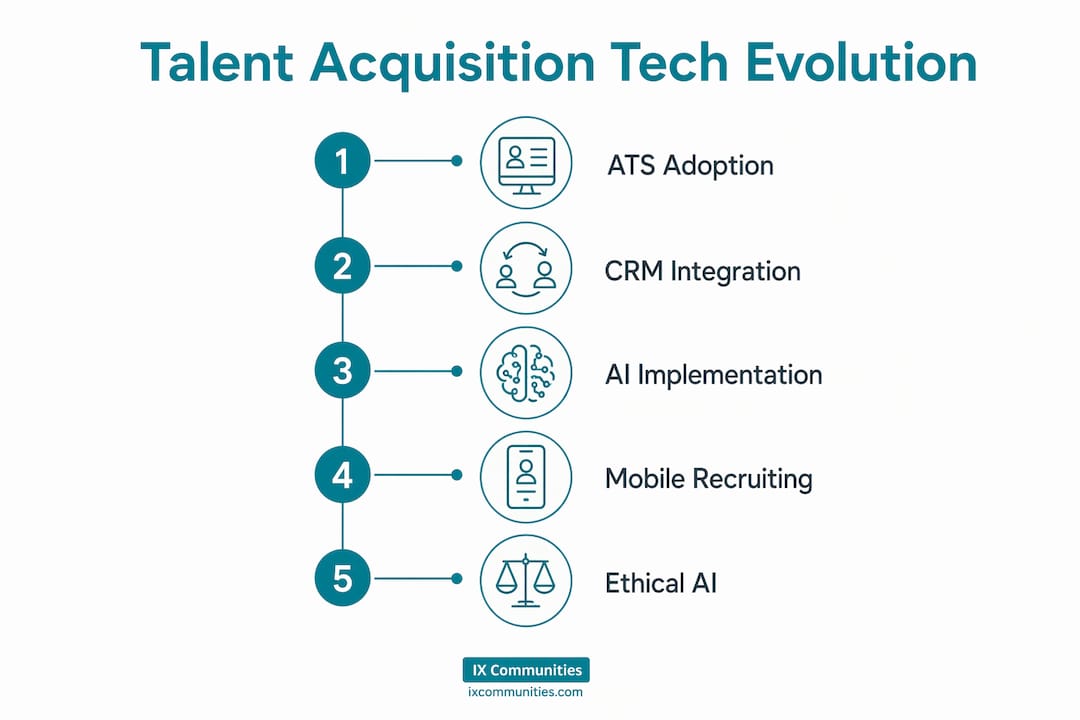
Applicant tracking systems remain the most widely adopted tool in the field. ATS adoption is widespread across organizations, making it the clear foundation of most recruiting tech stacks. It is also nearly universal among large multinational companies. Yet adoption of more advanced tools drops sharply: advanced tools like recruitment analytics and video interviewing remain less commonly adopted across organizations.
CRM systems address a gap that ATS platforms were never designed to fill. Where an ATS manages active applicants, a CRM manages relationships with passive candidates, alumni, and talent pools over time. For organizations with high-volume or specialized hiring needs, CRM tools maintain engagement between open requisitions and reduce sourcing costs when roles reopen.
AI applications in recruitment now span the full hiring lifecycle, as detailed in this multichannel AI agent deployment guide for enterprises. Resume parsing, candidate matching, chatbot-based screening, interview scheduling, and job description generation are all active use cases. That said, extensive AI use across recruitment remains limited, while many organizations apply AI selectively for tasks such as writing job descriptions and generating interview questions.
Mobile recruiting is another area where adoption lags behind opportunity. Many organizations offer mobile-friendly job application processes, but adoption of advanced mobile recruiting tools like text-to-apply, mobile recruitment apps, and chatbots remains relatively low. Candidates increasingly expect to complete the full application process from a phone, and organizations that do not meet that expectation lose candidates early in the funnel.
Integration remains one of the most persistent challenges across all of these tools. When ATS, CRM, AI modules, and analytics platforms operate independently, data does not flow between them and recruiters work across disconnected systems. Integration gaps and poor strategic alignment lead. Only 43% of HR professionals consider their talent acquisition technology stack to be good or excellent, highlighting a significant gap between adoption and effective utilization.
Pro Tip: Before adding new tools, audit your existing ATS for underutilized features. Many organizations pay for capabilities they have never activated.
What trends are reshaping talent acquisition technology in 2026?
AI has moved from pilot programs to embedded infrastructure. Josh Bersin Company research published in 2026 describes this shift clearly: leading organizations are no longer experimenting with isolated AI tools. They are building integrated talent architectures that connect sourcing, hiring, internal mobility, analytics, and workforce planning through a unified AI-enabled infrastructure. The measure of success has shifted away from time-to-fill and cost-per-hire toward productivity, talent density, and business growth outcomes. For a closer look at what AI actually delivers in practice, the gap between vendor claims and real-world results is worth examining carefully.

Skills-based hiring is gaining ground as a direct response to the limitations of credential-based screening. Deloitte identifies skills-based hiring as a key future trend in TA technology, with leading organizations replacing traditional resume review with validated skills assessments. This shift improves both hiring quality and fairness by focusing evaluation on demonstrated capability rather than educational background or job title history.
The candidate side of the AI equation has changed just as fast. Many candidates now use AI to assist in writing resumes, according to recent industry research. This volume of AI-generated applications reduces the signal value of the traditional resume and pushes organizations toward assessment-based screening to distinguish genuine capability from polished output.
Integrated talent ecosystems represent the next stage of maturity. Rather than a collection of point solutions, high-performing TA functions are building connected systems where hiring data informs internal mobility decisions, workforce planning feeds sourcing strategy, and analytics surface patterns across the entire talent lifecycle. This architecture supports internal mobility strategies that reduce external hiring costs and retain institutional knowledge.
Ethical AI governance is also becoming a standard expectation rather than an optional consideration. 77% of HR teams use AI weekly or daily, yet only 41% trust these systems. Top concerns include biased recommendations (46%), legal compliance (39%), and candidate perception (39%). Organizations that deploy AI without bias audits, explainability standards, and human oversight are exposed to both legal and reputational risk.
How does technology affect recruitment strategy and candidate experience?
The shift from volume-based hiring metrics to talent density and business impact is the most consequential strategic change technology has enabled. When TA functions connect hiring data to workforce planning and business outcomes, recruiters move from processing requisitions to advising on workforce strategy. AI-enabled TA delivers significantly faster time-to-hire and stronger candidate-role matching, according to Josh Bersin Company research, giving organizations a measurable competitive advantage in tight labor markets.
Personalized candidate engagement is one area where technology creates clear differentiation. AI-driven chatbots handle initial screening and answer candidate questions at any hour, while automated workflows keep candidates informed at each stage without requiring manual recruiter effort. The result is a more consistent experience across high-volume pipelines, where manual communication would otherwise create gaps.

Human interaction still matters to candidates, though. Research published in Current Psychology in 2026 finds that technology-mediated interviews can reduce organizational attractiveness. Separately, the 2026 Global AI in Hiring Report notes that 65% of candidates prefer interacting with a human over a chatbot during the hiring process. Technology handles scale; human judgment handles relationship and final evaluation. Organizations that replace human touchpoints entirely risk damaging their employer brand.
Reducing bias is one of the most cited benefits of AI in recruitment, but the evidence is more complicated than vendor marketing suggests. AI tools can reduce certain forms of human bias by applying consistent criteria across all applicants. At the same time, they can introduce new biases if trained on historical data that reflects past discrimination. The practical guidance from both SHRM and leading researchers is to treat AI as an augmentation tool, not a replacement for human judgment, and to require bias audits from any vendor before deployment.
For a practical view of where AI is being used across actual recruiting workflows today, the gap between stated capabilities and active deployment remains wide at most organizations.
What do research and expert analysis say about technology in talent acquisition?
The evidence on technology's impact in talent acquisition is substantial, but it comes with important qualifications. Josh Bersin Company's 2026 research describes talent acquisition as "a horizontal, AI-enabled integrated business process that orchestrates sourcing, hiring, mobility, and analytics to maximize talent density and measurable business impact." That framing reflects a fundamental change in how the function is designed and measured, not just a set of new tools layered onto existing workflows.
The bias research presents a more cautionary picture. A Stanford HAI study analyzing 3.4 million job applications found that AI hiring tools from a single vendor produced racial disparities across multiple employers. The study found that a substantial share of Black and Asian applicants applied to positions where the AI system discriminated against their racial group. If the AI had recommended Black and Asian candidates at the same rate as the most-favored group, a large number of additional applications from these groups would have advanced under equitable recommendations.
The concept of algorithmic monoculture compounds this risk. When many employers rely on the same AI vendor for candidate screening, a systematic bias in that vendor's model affects hiring outcomes across an entire industry sector, not just one organization. The Stanford research found that applicants who submitted multiple applications screened by the same vendor were more likely to be rejected everywhere they applied than would occur if each employer decided independently.
Separate research from Princeton University and the University of Chicago, published at ICML in 2026, found that large language models develop their own biases from experience, scoring roughly 65% higher on a segregation scale than human participants in equivalent hiring simulations. Newer reasoning models showed stronger biases, not weaker ones. The practical implication is that AI systems require ongoing human oversight, not a one-time audit at deployment.
The F1000Research analysis on AI bias and ethics in hiring reinforces this point: hybrid human-machine decision-making models with ethical guardrails are necessary to avoid inadvertent discrimination by AI systems that develop emergent biases from accumulated experience. Governance structures, not just technical controls, are required.
For TA leaders benchmarking their own technology performance against peers, Ixcommunities provides access to benchmark surveys that measure TA technology effectiveness across large corporate recruiting functions. Peer data from organizations at similar scale provides a more accurate baseline than industry averages drawn from surveys that include small and mid-size employers.
Ixcommunities supports TA leaders navigating technology decisions
Ixcommunities operates ESIX, TLIX, and IX Communities as peer networking and benchmarking groups for talent leadership professionals at large corporate organizations. Members share data, compare practices, and access expert analysis in a secure environment designed for senior TA and HR leaders. For professionals managing technology decisions at scale, peer benchmarking data and structured knowledge exchange provide context that vendor case studies cannot.
Access IX Communities membership to connect with TA leaders who are navigating the same technology decisions, or explore the talent acquisition trends for 2026 that are shaping how leading organizations structure their recruiting functions.
Key Takeaways
Technology's role in talent acquisition has shifted from operational support to strategic infrastructure, with AI-enabled integrated ecosystems now delivering measurable business impact for organizations that deploy them fully.
| Point | Details |
|---|---|
| ATS adoption is wide but uneven | 78% of organizations use an ATS, yet advanced tools like recruitment analytics (35%) and video interviewing (31%) remain underused. |
| AI is embedded but narrowly applied | Only 14% of organizations use AI extensively; most limit it to job description writing (65%) and interview question generation (67%). |
| Integrated ecosystems outperform isolated tools | Josh Bersin Company research shows AI-enabled TA delivers significantly faster time-to-hire when sourcing, hiring, mobility, and analytics are connected. |
| Bias risk requires active governance | A Stanford HAI study of 3.4 million applications found racial disparities in AI screening, with 26% of Black applicants affected by discriminatory recommendations. |
| Candidate AI use changes screening logic | 71% of candidates use AI to write resumes, reducing the traditional resume's value and pushing organizations toward skills-based assessment. |