

Structured collaboration across HR, hiring managers, business leaders, and IT is the single most reliable driver of faster hiring, stronger quality-of-hire, and higher retention of critical roles. Organizations that move from siloed HR processes to cross-functional talent coordination consistently outperform those that do not, according to research on collaborative talent intelligence. The academic framework of collaborative intelligence, which treats workforce decisions as a collective capability rather than an HR-owned function, provides the conceptual grounding. Peer networks such as Ixcommunities provide the practical proof points.
Three actions to start this quarter:
- Establish a cross-functional hiring forum with TA, the hiring manager, and one business-unit leader meeting weekly for active roles.
- Create a skills-first hiring checklist that includes team-fit criteria, not just individual competencies.
- Assign a single people-data owner across HR and IT to resolve data-trust disputes before they stall decisions.
Table of Contents
- Why collaboration produces measurable talent and business outcomes
- What frameworks help you design collaborative talent processes?
- Who does what: clarifying roles, governance, and meeting cadence
- Concrete actions HR leaders can implement this quarter
- How do you measure collaboration's impact on talent outcomes?
- What does a realistic rollout plan look like?
- What barriers will you face, and how do you address them?
- How do peer networks accelerate collaborative talent management?
- Training programs that build collaborative skills in HR and management teams
- Key Takeaways
- What actually changes when collaboration is embedded in talent management
- Ixcommunities supports your collaborative talent management work
- Useful sources and further reading
Why collaboration produces measurable talent and business outcomes
The case for investing in collaborative talent practices is not theoretical. Cross-functional collaboration reduces hiring cycle friction, improves workforce agility, and produces talent strategies that secure broader organizational buy-in because they connect people plans to measurable business results.
Research on collaborative talent intelligence confirms that organizations integrating workforce insights across functional boundaries tend to exhibit stronger innovation outcomes, greater adaptability, and improved operational performance. These effects are especially pronounced in knowledge-intensive industries where decisions must be made quickly and supported by accurate, comprehensive talent data.
The table below maps specific collaboration actions to the KPIs they affect and the business benefit each delivers.
| Collaboration action | KPI affected | Expected business benefit |
|---|---|---|
| Cross-functional hiring panels | Quality-of-hire, team-fit scores | Fewer early exits; stronger team performance |
| Shared workforce planning sessions | Time-to-fill, internal mobility rate | Faster backfill; reduced external hiring cost |
| Unified people-data platform | Data accuracy, decision cycle time | Faster approvals; fewer data-validity disputes |
| Manager-led talent reviews | Retention of critical roles | Earlier identification of flight risks |
| Collaborative skills gap analysis | Speed of skill development | Targeted L&D spend; faster capability build |
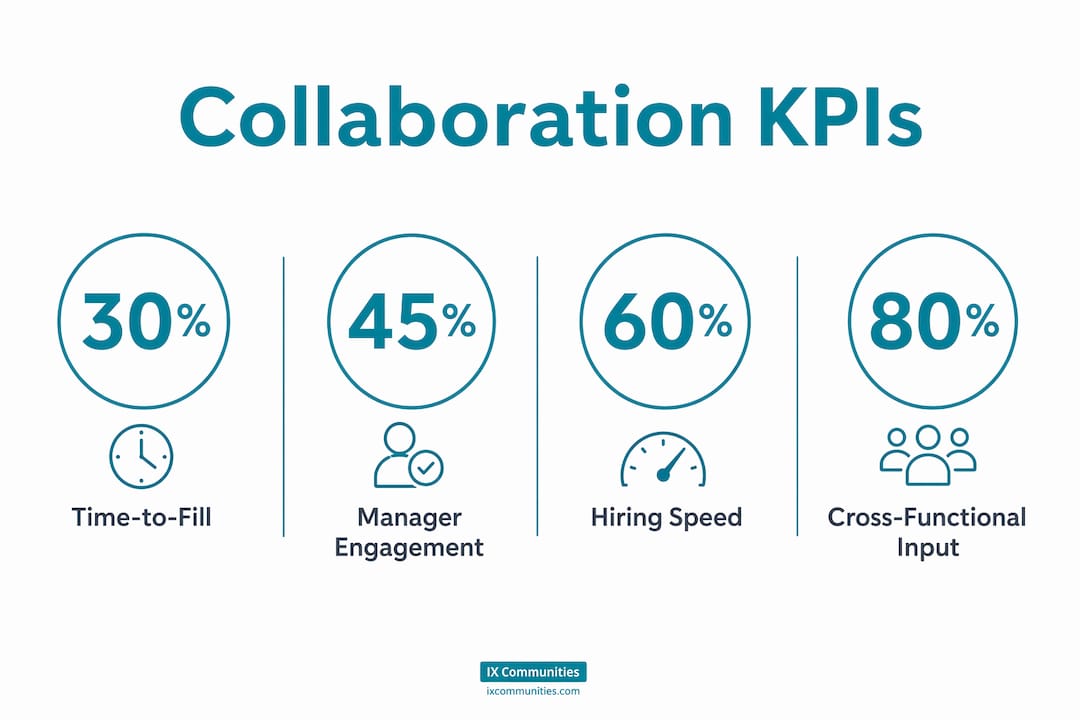
A few specific outcomes stand out. Shared ownership across HR, finance, and operations produces more practical, investable talent strategies tied to business outcomes. When talent plans involve leaders across functions, they secure more buy-in because they are connected to results those leaders are already accountable for. Organizations that prioritize individual star talent over how hires will function in teams frequently encounter performance issues that surface months after onboarding, a pattern that team-fit criteria in hiring processes directly address.
What frameworks help you design collaborative talent processes?
Two mental models give HR leaders the clearest foundation for designing collaborative talent processes: collaborative intelligence and ecosystem thinking.
Collaborative intelligence is an organization's ability to gather, interpret, and apply talent-related information through cross-functional collaboration and shared expertise, rather than through isolated HR datasets or individual managerial judgment. Ecosystem thinking positions talent as part of a larger system where shared objectives and partnerships improve adaptability and innovation, rather than treating talent management as a self-contained HR function.

Top-performing talent strategies shift from top-down control to ecosystem thinking and collaborative coordination. The distinction between coordination and control is the organizing idea here. Control-based models centralize decisions in HR, which creates bottlenecks and reduces manager ownership. Coordination-based models distribute decision rights while maintaining shared goals and interoperable data, which is where speed and quality gains come from.
Four principles for applying these frameworks:
- Shared goals. Talent outcomes (time-to-fill, retention, skill velocity) must be co-owned by HR and business leaders, not reported by HR to business leaders.
- Distributed decision rights. Hiring managers own the final hire decision; HR owns the process and the data. Blurring this creates friction.
- Interoperable data. A single, governed people-data foundation is a prerequisite for productive HR–IT collaboration. Without it, teams debate data validity instead of making decisions.
- Adaptive governance. HR–IT collaboration models range from strategic partnership to hybrid leadership to full merger. The right model depends on the organization's AI ambitions and cultural readiness, not a one-size-fits-all approach.
The HR–IT collaboration models described by Visier illustrate this well. Strategic partnership works when HR and IT have aligned mandates but separate reporting lines. Hybrid leadership works when AI-driven workforce intelligence is a board-level priority. Full merger is rare but appropriate when people analytics and technology are inseparable from the business model.
Who does what: clarifying roles, governance, and meeting cadence
The most common reason collaborative talent initiatives stall is not lack of intent. It is unclear ownership. HR leaders need a minimal governance model that answers three questions before any cross-functional work begins: Who owns talent strategy? Who approves headcount? Who owns hiring outcomes?
A practical answer: the CHRO or Head of TA owns talent strategy and the process. The business leader owns headcount approval and the business case. The hiring manager owns the hiring outcome and team-fit assessment. IT or the people-analytics team owns data infrastructure and reporting accuracy.
A simplified RACI for talent decisions:
| Decision | HR/Talent COE | Hiring manager | Business leader | IT/Data owner |
|---|---|---|---|---|
| Talent strategy design | Accountable | Consulted | Consulted | Informed |
| Headcount approval | Informed | Consulted | Accountable | Informed |
| Hiring decision | Responsible | Accountable | Informed | Informed |
| People-data standards | Accountable | Informed | Informed | Responsible |
| L&D program design | Accountable | Consulted | Informed | Informed |
Meeting cadence that sustains collaboration:
| Meeting | Frequency | Participants | Purpose |
|---|---|---|---|
| Hiring huddle | Weekly | TA, hiring manager | Review open roles, unblock decisions |
| Workforce planning review | Monthly | HR, business leaders, finance | Align headcount to business priorities |
| Talent COE sync | Bi-weekly | HR, IT/analytics, L&D | Data quality, tool performance, skill gaps |
| Quarterly talent review | Quarterly | CHRO, business unit heads | Retention, succession, mobility pipeline |
Managers who treat upward and downward communication as core competencies reduce friction when requesting headcount or budget. Formalizing this expectation in the governance model, rather than leaving it to individual manager initiative, is what converts good intent into reliable outcomes. Teams that formalize collaborative rituals such as regular cross-functional huddles, shared scorecards, and SLAs report faster decision cycles and clearer ownership.
Governance checklist:
- Name the accountable owner for each talent decision category above.
- Assign a single people-data owner with authority to resolve data disputes.
- Set SLAs for hiring manager response times on candidate feedback (recommended: 24–48 hours).
- Document the meeting cadence and make attendance a manager performance expectation.
Concrete actions HR leaders can implement this quarter
The following actions are organized by impact and effort. Quick wins are achievable within 30 days. Medium-term investments typically require 60–90 days to design and pilot.
Quick wins (0–30 days):
- Launch a cross-functional hiring forum. Bring TA, the hiring manager, and one business-unit representative together for a standing 30-minute weekly meeting on active roles. Use a shared tracking document, not a status email chain.
- Build a skills-first interview rubric. Add two to three team-fit questions to every interview guide. Examples: "Describe how you've worked with a team that had different priorities than yours" and "How do you handle disagreement with a peer on a shared project?"
- Create a single feedback loop. After each hire, send hiring managers a three-question survey (quality of process, quality of candidate slate, team-fit confidence). Review results monthly in the hiring huddle.
Medium-term investments (30–90 days):
- Assign a people-data owner. Identify one person in HR or IT who is accountable for data accuracy across your ATS, HRIS, and workforce planning tools. This role does not require a headcount addition; it requires a mandate.
- Pilot a collaborative workforce planning session. Run one joint session with HR, finance, and a single business unit. Use a shared template that maps open roles to business outcomes, not just headcount numbers.
- Introduce manager-led talent reviews. Shift quarterly talent reviews from HR-presented reports to manager-led conversations. HR facilitates; managers own the content and the action items.
Pro Tip: The fastest way to increase manager participation in talent processes is to reduce the time they spend on administrative steps. If your ATS requires managers to log in to a separate portal to give feedback, that friction is the problem. Move feedback collection to email, Slack, or Microsoft Teams, wherever managers already work.
A low-cost pilot worth testing: run the cross-functional hiring forum for one business unit for 60 days, track time-to-fill and hiring manager satisfaction scores, and use those results to build the case for a broader rollout. This approach keeps the initial investment small and generates the evidence needed to scale.
How do you measure collaboration's impact on talent outcomes?
The six to eight KPIs below cover both process activity (are people collaborating?) and outcome quality (is it working?). Start with the process metrics as proxies, then build toward outcome metrics as your data foundation matures.
Core KPIs for collaborative talent management:
- Time-to-fill by role category. Tracks whether cross-functional coordination is accelerating hiring cycles.
- Quality-of-hire score. A composite of hiring manager satisfaction and early performance ratings.
- Internal mobility rate. The share of open roles filled by internal candidates, indicating collaborative talent development.
- Retention rate for critical roles. Reflects whether collaborative talent reviews help retain high-impact employees.
- Cross-functional meeting attendance rate. A leading indicator of collaboration health; low attendance may predict decision delays.
- Time-to-decision on candidates. The typical time between a candidate interview and a hiring manager decision, tracking governance efficiency.
- Manager participation rate in talent reviews. The proportion of managers completing talent review inputs on schedule.
- Skill development velocity. The typical duration from recognized skill gap to completion of development action.
A lightweight measurement plan:
| KPI | Data source | Cadence | Owner | Reporting audience |
|---|---|---|---|---|
| Time-to-fill | ATS | Monthly | TA lead | CHRO, business leaders |
| Quality-of-hire | Hiring manager survey | Quarterly | HR analytics | CHRO, hiring managers |
| Internal mobility rate | HRIS | Quarterly | HR analytics | CHRO, business leaders |
| Cross-functional meeting attendance | Calendar/meeting tool | Monthly | HR operations | HR leadership |
| Time-to-decision | ATS | Weekly | TA lead | Hiring managers |
Start with proxies. Cross-functional meeting attendance and time-to-decision are easy to collect from existing tools and give you a signal within the first 30 days. Quality-of-hire and skill development velocity require survey infrastructure and a baseline, so plan for a 60–90 day setup period before the first meaningful read.
For leadership reporting, present collaboration metrics alongside business outcomes. A slide that shows "cross-functional hiring forum attendance increased from 40% to 85% over 90 days, and time-to-fill dropped by 12 days in the same period" is far more compelling than a standalone process metric. Pairing activity with outcome is what converts a collaboration initiative from an HR project into a business priority.
A governed people-data foundation is a prerequisite for this kind of reporting. Without it, cross-functional work stalls because teams spend meeting time debating data accuracy rather than making decisions.
What does a realistic rollout plan look like?
A three-phase roadmap gives HR leaders a structured path from pilot to embedded practice. Each phase has a clear owner, a realistic duration, and a defined output.
Phase 1: Pilot (months 1–3)
- Owner: Head of TA or Talent COE lead
- Activities: Select one business unit. Launch the cross-functional hiring forum, assign the people-data owner, and run the first collaborative workforce planning session. Collect baseline KPIs.
- Output: Baseline data, a tested governance model, and a documented set of what worked and what did not.
- Cost/effort signal: Primarily people-hours. Expect 5–10 hours per week across the core team. No new tooling required at this stage.
Phase 2: Scale (months 4–9)
- Owner: CHRO or Head of TA, with IT/analytics as co-owner
- Activities: Expand the model to two to four additional business units. Integrate people-data sources into a shared dashboard. Formalize the meeting cadence and SLAs. Begin manager-led talent reviews.
- Output: A repeatable operating model, a shared data dashboard, and initial outcome metrics.
- Cost/effort signal: Tooling integration and dashboard build require IT involvement. Budget for 20–40 hours of IT/analytics time plus any ATS or HRIS configuration costs.
Phase 3: Embed (months 10–18)
- Owner: CHRO, with business unit leaders as co-champions
- Activities: Make collaborative talent practices part of the annual planning cycle. Tie manager participation rates to performance expectations. Use benchmarking data from peer communities to validate and refine the model.
- Output: Collaboration embedded in governance, planning, and manager accountability frameworks.
- Cost/effort signal: Ongoing investment is primarily in training, benchmarking access, and community participation. Peer benchmarking through a network such as Ixcommunities can accelerate this phase by providing comparative data and tested templates, reducing the time needed to validate internal decisions.
Accelerating the roadmap with peer support:
- Peer benchmarking communities shorten Phase 1 by providing templates that have already been tested in comparable organizations.
- Benchmarking data from Phase 2 onward gives HR leaders the comparative evidence needed to justify tooling investments and governance changes to senior leadership.
- External community participation in Phase 3 sustains momentum by providing structured accountability and access to practitioners who have solved the same problems.
What barriers will you face, and how do you address them?
Five barriers consistently derail collaborative talent initiatives. Each has a practical mitigation.
1. Siloed data Teams debate data validity instead of making decisions when HR, finance, and operations each maintain separate workforce records. The mitigation is assigning a single people-data owner with the authority to set standards and resolve disputes, as outlined in the governance section above. Start with one shared metric (time-to-fill) before attempting full data integration.
2. Unclear decision rights When it is not clear whether HR or the hiring manager owns the final hiring decision, both parties defer to the other and decisions stall. The RACI model in the governance section resolves this. The key implementation note: document the RACI and review it in the first cross-functional hiring forum meeting so all parties confirm their role before a live decision is required.
3. Manager bandwidth Managers cite time as the primary reason they disengage from talent processes. The mitigation is reducing the administrative burden, not adding meetings. Move feedback collection to tools managers already use. Keep hiring huddles to 30 minutes with a standing agenda. Make the process faster for managers, and participation follows.
4. Incentive misalignment Managers are often evaluated on team output, not talent development. When talent collaboration requires time investment with no visible reward, it deprioritizes itself. The mitigation is adding one talent-related metric to manager performance expectations, such as talent review completion rate or internal mobility rate within the team. This is a Phase 3 action; attempting it in Phase 1 creates resistance before trust is established.
5. Tool proliferation Organizations that add collaboration tools without retiring old ones create confusion about where decisions are made and where information lives. The mitigation is a simple tool audit: identify the two or three platforms where talent decisions actually happen and consolidate communication there. A cross-functional hiring forum that runs in Microsoft Teams with a shared OneNote tracker is more effective than a purpose-built platform that managers do not log into.
A practical illustration: one large U.S. financial services organization found that its TA team and hiring managers were using three separate tools to track candidate feedback, none of which were connected to the ATS. Consolidating to a single shared ATS view, with automated feedback prompts sent via email, reduced time-to-decision by several days per role and increased hiring manager response rates substantially. The fix required no new technology, only a process change and a governance decision about where feedback would live.
How do peer networks accelerate collaborative talent management?
Peer communities accelerate collaborative talent management in three ways that internal initiatives cannot replicate: they provide transferable templates, comparative benchmarking data, and structured accountability from practitioners who have solved the same problems in comparable organizations.
Templates matter because designing a cross-functional hiring forum from scratch takes time and produces a model that has not been tested. A peer community provides formats that have already been refined across dozens of organizations, which shortens the pilot phase and reduces the risk of design errors.

Benchmarking data matters because internal decisions about talent operating models are difficult to justify without external comparisons. When a Head of TA wants to restructure the TA function around a collaborative model, a benchmarking survey that shows how peer organizations are structured, what they spend, and what outcomes they achieve converts an internal opinion into an investable proposal.
Structured accountability matters because collaborative talent initiatives require sustained behavior change, which is harder to maintain without external pressure. Peer communities provide a regular cadence of practitioner conversations that keep initiatives on track and surface course corrections before problems compound.
Peer benchmarking and practitioner communities accelerate adoption by providing templates, benchmarks, and safe, confidential spaces to test approaches. Membership communities provide structured accountability and comparative data that shorten pilots and justify investment.
What peer community membership typically provides:
- Access to benchmarking surveys covering TA operating models, compensation, technology spend, and hiring metrics
- Secure, confidential forums where practitioners share real data and tested approaches
- Mentorship programs that pair experienced talent leaders with peers navigating similar transitions
- Expert guest speaker sessions on specific talent challenges
- Proprietary databases and guidebooks for recruiting best practices
Confidentiality is a prerequisite for genuine sharing. The most useful benchmarking data, including what organizations actually pay, how they structure their TA teams, and where their processes break down, is not available in public research. It exists only in vetted, secure peer communities where members trust that their data will not be attributed or shared outside the group.
For talent networking specifically, the most effective communities are those with clear membership criteria that ensure participants are genuine peers, not vendors or consultants with a product to sell.
Pro Tip: When using benchmarking results to secure budget for a collaborative talent initiative, present the data as a gap analysis rather than a best-practice claim. "Our time-to-fill is 18 days longer than the peer median for comparable roles" is more persuasive to a CFO than "industry best practice recommends X." The gap framing makes the cost of inaction concrete.
Training programs that build collaborative skills in HR and management teams
Collaborative talent management requires skills that most HR and management teams have not been formally trained in: structured facilitation, cross-functional communication, shared decision-making, and the ability to interpret workforce data collectively rather than in functional silos.
Facilitation and meeting design
HR leaders who run cross-functional hiring forums and workforce planning sessions need facilitation skills, not just subject-matter expertise. Programs such as those offered through the International Association of Facilitators (IAF) or through university-based professional development programs (including Harvard DCE's management offerings) provide structured training in meeting design, conflict navigation, and group decision-making. The practical application is direct: a well-facilitated 30-minute hiring huddle produces better decisions than an unstructured 90-minute meeting.
Communication and "managing up"
Managers who treat upward and downward communication as core competencies reduce friction in talent processes. Training programs that develop this skill set typically cover how to frame talent requests in business-outcome terms, how to present workforce data to non-HR audiences, and how to build alignment across functions before a decision point is reached. This is distinct from general management training; it is specifically about translating talent insights into language that finance, operations, and senior leadership act on.
Data literacy for HR teams
Collaborative talent management depends on shared interpretation of workforce data. HR teams that lack data literacy defer to IT or analytics teams for interpretation, which slows decisions and reduces HR's credibility as a strategic partner. Short-form data literacy programs, available through platforms such as Coursera, LinkedIn Learning, and SHRM's professional development catalog, cover the fundamentals: reading a workforce dashboard, identifying trends, and presenting data-backed recommendations. These programs are accessible to HR generalists and do not require a statistics background.
Cross-functional collaboration skills for managers
Managers who participate in talent reviews, hiring forums, and workforce planning sessions need training in how to contribute effectively to cross-functional processes, not just how to manage their own teams. This includes skills such as giving structured candidate feedback, participating in calibration sessions, and co-owning talent development plans with HR. Organizations that include these skills in manager onboarding and annual development programs report higher participation rates in collaborative talent processes.
The IX Academy recruiter training programs offered through Ixcommunities address several of these skill areas specifically for talent acquisition and recruiting professionals, including courses available to both members and non-members.
Building a collaborative talent culture
Training programs are necessary but not sufficient. A collaborative talent culture requires that the behaviors trained are also modeled by senior leaders, reinforced in performance expectations, and supported by governance structures that make collaboration the path of least resistance. Organizations that invest in training without changing governance typically see short-term behavior change that reverts within six months. The combination of training, governance, and peer accountability, as provided through community membership, is what produces durable culture change.
Key Takeaways
Embedding collaboration into talent management requires governance clarity, a shared data foundation, and sustained manager involvement, not just better communication.
| Point | Details |
|---|---|
| Governance before tools | Assign clear decision rights and a single people-data owner before investing in new platforms. |
| Start with one business unit | Pilot the cross-functional hiring forum and collaborative workforce planning in one unit, collect baseline KPIs, then scale. |
| Measure process and outcome | Track both leading indicators (meeting attendance, time-to-decision) and outcome metrics (quality-of-hire, retention of critical roles). |
| Manager participation is the lever | Reducing administrative friction for managers increases participation more reliably than adding new requirements. |
| Ixcommunities accelerates the work | Peer benchmarking and community membership provide tested templates, comparative data, and structured accountability that shorten the pilot phase and justify investment. |
What actually changes when collaboration is embedded in talent management
The conventional wisdom on collaborative talent management focuses on communication and culture. Those matter, but they are not where the leverage is. The real change happens when decision rights are clarified, data ownership is assigned, and managers are treated as co-owners of talent outcomes rather than consumers of HR services.
Most organizations that struggle with collaborative talent management are not struggling because people do not want to collaborate. They are struggling because the governance model makes collaboration optional and the incentive structure makes it costly. A manager who is evaluated on team output but not on talent development will always deprioritize the hiring forum when a deadline conflicts. That is not a culture problem. It is a design problem.
The research on collaborative talent intelligence supports this view. Organizations that achieve stronger innovation outcomes and operational performance through collaborative talent practices are not simply more communicative. They have built structures where shared goals, distributed decision rights, and interoperable data make collaboration the default, not the exception.
Peer communities such as Ixcommunities matter in this context because they provide something internal initiatives cannot: external accountability and comparative evidence. When a Head of TA can show a CFO that peer organizations with similar collaborative models have reduced time-to-fill and improved retention rates, the conversation shifts from "should we do this?" to "how do we do this faster?"
The gap between organizations that talk about collaborative talent management and those that have actually embedded it is almost always a governance and incentive gap, not a communication gap. Fix the design, and the culture follows.
Ixcommunities supports your collaborative talent management work
Ixcommunities gives talent leaders direct access to the peer benchmarking data, tested templates, and practitioner mentorship that convert collaborative talent initiatives from internal proposals into funded, measurable programs.
Members use benchmark surveys to justify new TA operating models, compare their hiring metrics against verified peer data, and identify the governance gaps that are slowing their organizations down. The ESIX and TLIX communities provide secure, vetted forums where Heads of TA, Chief People Officers, and talent COE leaders share real data and tested approaches, without attribution or vendor interference.
For leaders building collaborative talent capabilities, the ESIX recruiter peer mentorship program pairs practitioners with experienced peers who have navigated the same transitions. The IX Academy offers recruiter training courses accessible to both members and non-members, covering the communication, facilitation, and data skills that collaborative talent management requires.
The next step is straightforward: review the Ixcommunities membership options and identify which community, ESIX for talent acquisition leaders or TLIX for executive recruiting, fits your function's current priorities.
Useful sources and further reading
- Collaborative Talent Intelligence and Business Performance: A Meta-Analysis of Empirical Studies — Peer-reviewed meta-analysis examining how cross-functional collaboration on talent data improves innovation, operational performance, and strategic agility.
- A Sustainable Collaborative Talent Management Through Collaborative Intelligence Mindset Theory — Systematic review proposing a collaborative intelligence mindset framework for sustainable talent management; useful for framework design.
- Coordination Over Control in Talent Strategy: Lessons from Ecosystem Thinking — Practitioner analysis of the shift from control-based to coordination-based talent models; directly applicable to governance design.
- Talent Management Strategy: Build A Plan That Drives Results — Practical guidance on shared ownership across HR, finance, and operations; includes templates for cross-functional talent planning.
- HR and IT Collaboration Models for AI Era — Visier's analysis of three HR–IT collaboration models (strategic partnership, hybrid leadership, full merger) and when each applies.
- Understanding the Core Functions of Talent Management — Harvard DCE overview of talent management functions, including the role of upward communication and manager competencies.
- The Link Between Talent and Teamwork: Why Is It So Undervalued? — ERE analysis of why team-fit criteria are underweighted in hiring and the performance consequences that follow.
- How talent management and recruiting connect for impact — Ixcommunities practitioner blog on integrating TA and talent management functions for measurable business outcomes.
- 7 Ways for Managers to Create a Culture of Collaboration — University of South Carolina Aiken overview of manager-led collaboration practices; useful for training program design and culture-building guidance.