

Talent analysis is a structured process of collecting, validating, and assessing workforce data against defined competency rubrics, then translating those findings into development, succession, and hiring decisions. The core sequence is: plan the scope → gather and validate data → assess against rubrics → calibrate in a structured talent review → map to actions → measure outcomes.
Quick-start checklist:
- Define the business objective and success criteria before collecting any data
- Audit existing data sources (HRIS, ATS, LMS, performance reviews) for completeness and recency
- Select a framework (9-box, competency model, or both) matched to the objective and scale
- Run calibration sessions with standardized rubrics, not ad hoc manager judgments
- Assign owners and deadlines to every development or succession action
- Schedule a quarterly refresh; skills gap data older than a few months is too stale for planning in the current US labor market
Pro Tip: Structured interviewing guidance from Google re:Work applies equally to talent reviews: identical questions, standardized rubrics, and defined scoring anchors reduce bias and make calibration decisions defensible. Apply the same discipline inside the organization that you apply at the hiring stage.
One data-quality warning before you proceed: duplicate employee profiles, stale job architectures, and unverified compensation figures silently corrupt downstream analytics. Fix the data before running any model.

Table of Contents
- What are talent analysis and talent reviews, and when should you run them?
- What objectives and outcomes should your talent analysis target?
- Which frameworks and assessment models should you use?
- How do you run the full talent analysis process step by step?
- How do you run calibration and talent review meetings effectively?
- What does the research say about data quality and analytics maturity?
- What templates and rubrics do you need for a talent review?
- How do you translate talent analysis findings into concrete HR actions?
- What timeline and resources does a talent analysis program require?
- Key Takeaways
- What practitioners actually learn running talent analysis programs
- Ixcommunities gives talent leaders a structured peer environment for calibration and benchmarking
- Useful sources and further reading
What are talent analysis and talent reviews, and when should you run them?
Talent analysis and talent review are related but distinct activities. Talent analysis is the broader, data-driven process of examining workforce capabilities, performance patterns, and potential across a population. A talent review is the structured meeting or series of meetings where leaders and HR calibrate individual assessments, make placement decisions, and assign development actions. The review is the governance layer on top of the analysis.
Run a talent analysis when:
- Preparing a strategic workforce plan or a Build-Buy-Borrow decision
- Entering succession planning cycles for critical or senior roles
- Responding to a reorganization, merger, or acquisition that changes role requirements
- Prioritizing a reskilling or upskilling investment across a business unit
- Identifying flight-risk segments before a compensation review
Business outcomes talent analysis supports:
- Succession readiness: identifying and developing internal candidates for critical roles
- Reskilling prioritization: directing L&D budgets toward the highest-impact skill gaps
- Location and sourcing strategy: informing where to hire versus develop versus contract
- Org design: surfacing capability concentrations and single points of failure
SHRM research consistently shows that organizations with formal talent review processes fill critical roles faster and with higher internal mobility rates than those relying on informal succession conversations. The talent management and recruiting connection is direct: analysis quality determines the quality of every downstream workforce decision.
What objectives and outcomes should your talent analysis target?
Starting without a defined objective is the most common reason talent analyses produce data but no decisions. Before collecting a single data point, the HR team and business sponsors must agree on what question the analysis is answering.
Common objectives and the decisions they drive:
- Identify high-potential leaders → succession slating, stretch assignments, accelerated development programs
- Spot near-term flight-risk segments → targeted retention offers, manager coaching, compensation adjustments
- Quantify skills gaps for reskilling → L&D budget allocation, vendor selection, build-versus-buy decisions
- Assess bench strength for critical roles → succession readiness ratings, external pipeline development
- Support M&A integration → capability mapping across merged entities, redundancy and retention planning
Suggested outcome metrics by objective:
| Objective | Primary KPI | Secondary KPI |
|---|---|---|
| Succession readiness | Internal fill rate for critical roles | Bench depth ratio (successors per role) |
| Flight-risk reduction | — | Retention rate post-intervention |
| Reskilling prioritization | Training completion rate | Performance uplift 6 months post-training |
| High-potential identification | HiPo-to-leadership promotion rate | Time-in-role before first promotion |
| M&A integration | Capability coverage score | Retention rate of identified key talent |
Defining metrics at the start, not after the analysis, prevents the common pattern of collecting data that cannot be connected to a business decision. Jobnest.ai recommends writing success criteria in advance as one of three non-negotiable pre-analysis steps, alongside defining the competency framework and involving stakeholders.
Which frameworks and assessment models should you use?
The framework you select determines what questions you can answer and what decisions you can make. No single model covers every objective, and combining methods is often the right call for senior or high-stakes assessments.
Core models compared
| Framework | Primary question answered | Best for | Limitations |
|---|---|---|---|
| 9-box grid (performance × potential) | Where does this person sit today, and where can they go? | Annual talent reviews, succession slating | Subjective without rubrics; prone to manager bias |
| Competency framework | Does this person demonstrate the behaviors required for this role? | Role-specific assessment, L&D targeting | Requires upfront framework design; time-intensive |
| Assessment center | Can this person perform under realistic job conditions? | Senior/executive selection, HiPo programs | High cost; not scalable for large populations |
| Structured interview | Does this person's past behavior predict future performance? | Hiring and internal mobility decisions | Requires trained interviewers and standardized scoring |
| 360-degree feedback | How do peers, reports, and managers perceive this person's behaviors? | Development planning, leadership effectiveness | Perception data, not performance data; needs calibration |
Selecting the right model:
- Use the 9-box for population-level talent reviews where you need to segment a large group quickly
- Use a competency framework when the objective is role-specific skill gap identification or L&D targeting
- Reserve assessment centers and work samples for final-stage evaluation of high-potential or senior candidates, consistent with the DoD multi-hurdle assessment approach of using scalable screens early and resource-intensive methods late
- Combine a competency framework with structured interviews for senior internal mobility decisions
9-box scoring discipline
The 9-box grid plots performance (x-axis: low/medium/high) against potential (y-axis: low/medium/high). Each axis must be scored against defined behavioral anchors, not manager intuition. Without rubrics, two managers using the same grid will rate the same employee differently, making calibration meaningless.
Pro Tip: Before any talent review, distribute a one-page rubric that defines what "high potential" means in your organization: specific behaviors, demonstrated learning agility indicators, and scope of impact. Managers who score without this anchor default to recency bias and personal affinity.
Google re:Work's structured assessment guidance applies directly here: identical evaluation criteria, applied consistently across all raters, are what make a talent review defensible rather than political.
How do you run the full talent analysis process step by step?
The Visier talent analytics framework outlines a standard sequence: define objective, build the team, select analytics form, define metrics, gather data, analyze, implement changes, measure, and repeat. The operational version for an HR team running a talent review cycle looks like this.

Phase-by-phase process
1. Plan Define scope (population, roles, business unit), select framework, assign owners, set timeline, and confirm legal/privacy review with HR Business Partners and Legal. Document the business question the analysis will answer.
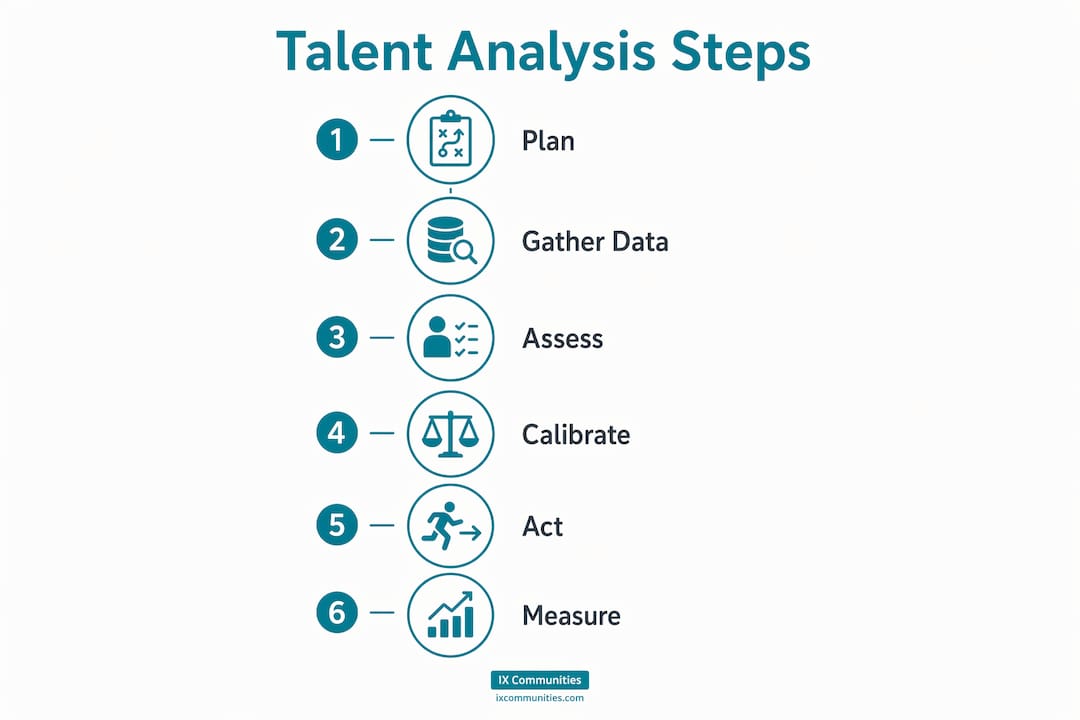
2. Gather and validate data Pull data from HRIS, ATS, LMS, performance management systems, and 360 feedback platforms. Run hygiene checks: deduplicate employee records, verify job architecture currency, confirm compensation data is current. Most organizations have several disconnected people-data systems without a shared employee identifier; a unified data layer or API integration is required before analytics can be trusted.
3. Assess against rubrics Managers complete structured assessments using standardized competency rubrics and scoring scales. HR collects and normalizes ratings across managers before the calibration meeting.
4. Calibrate Run structured talent review meetings (see Section 6) to align ratings, resolve outliers, and produce a calibrated talent map. Document decisions and rationales.
5. Act Assign development plans, succession slates, stretch assignments, or external hire decisions to named owners with deadlines.
6. Measure and repeat Track outcome KPIs (internal fill rate, training completion, retention) against baseline. Schedule the next cycle.
Roles and responsibilities
| Role | Responsibilities |
|---|---|
| HR Lead / Talent Management | Process design, rubric development, meeting facilitation, documentation |
| People Analytics | Data extraction, hygiene validation, model output, dashboard reporting |
| Business Leaders / Managers | Individual assessments, calibration participation, action ownership |
| HR Business Partner / Legal | Compliance review, privacy checks, documentation standards |
| IT | Data integration, system access, API or unified data layer support |
Draup identifies HR, IT, Legal, Finance, and business leadership as the five functions that must share ownership for talent analytics programs to produce durable results.
Data sources and hygiene checklist
- HRIS: headcount, tenure, role history, compensation bands
- ATS: internal mobility applications, interview scores, offer data
- LMS: training completion, certification currency, skill assessments
- Performance management: annual and mid-year ratings, goal completion
- 360 feedback: behavioral competency ratings from peers and direct reports
- External market data: compensation benchmarks, labor market supply data
Hygiene actions before analysis: deduplicate employee records, verify job titles against current architecture, confirm all performance data is from the current cycle, flag records with missing fields, and establish a unique employee identifier across systems.
Pro Tip: Audit your ATS and HRIS data and standardize field definitions before introducing any predictive model. Baseline metrics from clean existing systems are more valuable than sophisticated models built on dirty data.
Sample competency rubric outline
A five-point scale with behavioral anchors works for most talent reviews:
- 1 (Does not meet): Behavior is absent or inconsistent; requires significant development
- 2 (Developing): Behavior is emerging; inconsistent application in familiar situations
- 3 (Meets expectations): Behavior is consistent and effective in standard situations
- 4 (Exceeds): Behavior is consistent, effective, and applied in complex or ambiguous situations
- 5 (Exceptional): Behavior is a demonstrated strength; coaches others; applied at scale
Each competency (e.g., "Strategic Thinking," "Developing Others," "Execution") needs its own behavioral anchors at each level. Generic anchors produce generic ratings.
How do you run calibration and talent review meetings effectively?
A calibration meeting without structure produces the same outcome as no calibration at all: ratings drift toward the most vocal manager's opinion, and decisions become difficult to defend. A reproducible meeting blueprint prevents both problems.
Sample meeting agenda
- Pre-work (1–2 weeks before): Managers submit completed rubric-based assessments. HR normalizes data and prepares the talent map. Distribute pre-read materials including rating distributions and flagged outliers.
- Opening (10 minutes): Facilitator reviews ground rules: use rubrics, not anecdotes; no rank-ordering without evidence; all decisions are documented.
- Population review (60–90 minutes): Walk through each segment of the talent map. Discuss outliers and rating discrepancies. Apply calibration rules (see below).
- Decision and action assignment (20–30 minutes): Confirm placements, assign development actions, identify succession candidates, flag roles for external pipeline development.
- Close and documentation (10 minutes): HR Lead summarizes decisions, confirms owners and deadlines, and commits to distribution of meeting notes within 48 hours.
Roles during the meeting
- Facilitator (HR Lead): Keeps discussion anchored to rubrics; calls out anecdote-based reasoning; manages time
- HR Data Owner (People Analytics): Presents data, flags statistical outliers, answers data questions
- Business Leaders / Managers: Provide context for individual ratings; own action commitments
- HR Business Partner: Monitors for bias patterns; flags legal or compliance concerns in real time
Calibration rules to enforce
- All ratings must reference a specific rubric anchor, not a general impression
- No employee may be discussed without at least two data points (e.g., performance rating plus a specific behavioral example)
- Rating changes during calibration must be documented with the reason for the change
- Managers may not rate their own direct reports without a second reviewer present
- Decisions about high-potential designation or succession slating require consensus, not majority vote
Pro Tip: To prevent rank-order drift, set a distribution guideline before the meeting (e.g., no more than 15–20% of a population in the "high potential" box) and enforce it at the start, not after ratings are already anchored. Changing rating distributions mid-process after managers have committed risks conflict and reduces trust in the process.
What does the research say about data quality and analytics maturity?
The quality of talent analysis outputs is a direct function of data quality. Draup warns that data corruption, including duplicate profiles, stale job architectures, and unverified compensation figures, silently invalidates downstream decision-making. Predictive models built on corrupted data produce confident-looking but unreliable outputs.
Analytics maturity stages
Talent analytics capability progresses through four stages:
| Stage | Question answered | Data requirements | Example use case |
|---|---|---|---|
| Descriptive | What happened? | Clean historical data, consistent field definitions | Turnover rate by department and tenure band |
| Diagnostic | Why did it happen? | Linked data across systems, unique employee identifier | Correlation between manager tenure and team attrition |
| Predictive | What will happen? | Longitudinal data, validated models, recency | Flight-risk scoring for the next 90 days |
| Prescriptive | What should we do? | Predictive outputs plus decision rules and action workflows | Automated development plan triggers for at-risk HiPos |
Most organizations operate at the descriptive or early diagnostic stage. Moving to predictive requires a unified data architecture. Inop.ai's talent intelligence guidance is direct: build the API layer or unified data store before attempting predictive models, not after.
Data quality checklist
- Completeness: All required fields populated for every active employee record
- Accuracy: Job titles match current architecture; compensation figures verified against payroll
- Deduplication: One record per employee across all systems; no ghost profiles from system migrations
- Recency: Performance data from the current cycle; skills data no older than 90 days for planning purposes
- Linkage: A shared unique identifier (employee ID) across HRIS, ATS, LMS, and performance systems
The continuous analytics loop follows a simple sequence: collect → analyze → act → measure → repeat. Scheduling quarterly data refreshes and quarterly calibration meetings for critical talent segments keeps the program current rather than episodic.
Statistic callout: Draup recommends continuous updates or at minimum quarterly snapshots for skills and compensation data. In fast-moving US labor markets, data older than 90 days functions as a historical record rather than a planning input.
Common data integration failures include inconsistent job title taxonomies across business units, performance ratings stored in systems that do not connect to the HRIS, and LMS completion data that is never linked to performance outcomes. Fixing these integration gaps is a prerequisite for any analytics program above the descriptive stage.
What templates and rubrics do you need for a talent review?
Ready-to-adapt artifacts reduce the setup time for each talent review cycle and create consistency across managers and business units. The three core artifacts are a competency rubric, a 9-box template, and a meeting notes template.
Competency rubric structure
A well-designed rubric covers four to six competencies relevant to the role family being assessed. For each competency, define behavioral anchors at each scoring level. An example for "Developing Others":
| Score | Behavioral anchor |
|---|---|
| 1 | Rarely provides feedback; development conversations happen only when required |
| 2 | Provides feedback reactively; development plans exist but are not actively monitored |
| 3 | Conducts regular development conversations; tracks progress against agreed goals |
| 4 | Proactively identifies growth opportunities; adjusts plans based on individual needs |
| 5 | Builds development culture across the team; coaches peers and other managers |
Calibrating anchors across managers requires a norming session before the talent review: managers independently score two or three reference cases, then compare and discuss until ratings converge. This step is often skipped and is the primary reason rating distributions vary wildly across business units.
9-box template: what each cell means
The 9-box produces nine talent segments. The three most consequential cells for action planning are:
- High performance / High potential (top-right): Succession candidates; prioritize for stretch assignments and accelerated development
- High performance / Low potential (bottom-right): Strong contributors in current role; retain and recognize, but do not over-invest in upward development
- Low performance / High potential (top-left): Emerging talent in wrong role or with insufficient support; diagnose root cause before acting
Pro Tip: Never use the 9-box as a permanent label. Reassess every cycle. An employee rated "low potential" in one role context may rate "high potential" after a role change or a targeted development intervention. The grid is a planning tool, not a career verdict.
Meeting notes template
A meeting notes document should capture, at minimum:
- Employee name, role, business unit, and current rating
- Final calibrated placement on the talent map
- Rationale for the placement (specific behavioral evidence, not general impressions)
- Development or succession action assigned
- Named owner of the action and deadline
- Date of next review
Store documentation in a system accessible to HR Business Partners and Legal, with access controls that limit visibility to those with a need to know. Auditability is a compliance requirement in many jurisdictions; the OPM assessment guidance is explicit that documentation of the linkages between job tasks, competencies, and selection decisions is required to meet legal and professional standards.
How do you translate talent analysis findings into concrete HR actions?
Ratings and talent maps have no value until they drive decisions. The action-mapping step converts calibrated assessments into specific interventions with owners, timelines, and measurable outcomes.
Talent segment to intervention mapping
| Talent segment | Recommended intervention | Owner | Timeline |
|---|---|---|---|
| High potential / High performance | Succession slating, executive sponsor, stretch assignment | HRBP + Senior Leader | 30–60 days post-review |
| High potential / Moderate performance | Targeted development plan, mentoring, role clarity conversation | Manager + HRBP | 30 days post-review |
| Solid performer / Stable potential | Recognition, lateral development, skills deepening | Manager | Ongoing |
| Flight risk (high performer) | Retention conversation, compensation review, career path discussion | Manager + HR Lead | Within 2 weeks of review |
| Performance concern | Performance improvement plan, role reassessment | Manager + HRBP | Immediate |
| Succession-ready | Formal succession slate, readiness timeline, development gap plan | Talent Management | 60 days post-review |
External talent data strengthens succession decisions by providing labor market context: if a critical skill is scarce externally, internal development becomes the primary path and investment priority shifts accordingly.
Governance checklist for outcomes
- Assign a named owner to every action item before the meeting closes
- Set a 30-day check-in for high-priority actions (succession slating, retention interventions)
- Schedule a formal progress review at the next talent cycle (quarterly or semi-annual)
- Document the rationale for every placement decision in the meeting notes
- Review the talent map with senior leadership within two weeks of calibration
Communicating outcomes to employees
Employees do not need to know their exact 9-box placement, but they do need a development conversation that reflects the calibration outcome. Managers should communicate: what the employee is doing well, what the development priority is for the next period, and what support is available. Transparency about the process (not the individual ratings of others) reduces perceived unfairness and increases engagement with development plans.
What timeline and resources does a talent analysis program require?
Setting realistic expectations for effort and cost prevents programs from stalling after the first cycle. The resource requirements vary significantly between a cyclical talent review and a deeper analytics program pilot.
Timeline examples
6–8 week cyclical talent review:
| Week | Activity |
|---|---|
| 1–2 | Scope definition, stakeholder alignment, data pull and hygiene |
| 3–4 | Manager assessments using standardized rubrics |
| 5 | HR normalization, talent map preparation, pre-read distribution |
| 6 | Calibration meeting(s), decision documentation |
| — | Action assignment, development plan initiation, outcome tracking setup |
3–6 month analytics program pilot:
- Month 1: Data audit, system integration assessment, unified identifier implementation
- Month 2: Baseline metrics establishment, framework and rubric design, stakeholder training
- Month 3: First assessment cycle, calibration, initial talent map
- Months 4–6: Action implementation, outcome tracking, model refinement, scale decision
Resource estimate
| Role | Estimated effort (per cycle) | Tooling needs |
|---|---|---|
| HR Lead / Talent Management | — | Talent review platform or structured spreadsheet |
| People Analytics | 20 hours | HRIS reporting, data integration tools |
| Business Leaders / Managers | 4–8 hours per manager | Assessment rubric, calibration pre-read |
| HR Business Partner | 10–20 hours | Documentation templates, legal review checklist |
| IT | 10–30 hours (higher for first cycle) | API integration, access provisioning |
Pilot checklist before scaling:
- Minimum dataset: at least one full performance cycle of clean data for the pilot population
- Governance: legal and privacy review complete; documentation standards defined
- Success criteria: defined KPIs with baseline measurements in place
- Stakeholder buy-in: senior leadership sponsor confirmed
- Tooling decision: internal tools (spreadsheets, existing HRIS modules) versus dedicated platforms
Internal tools versus vendor platforms
For organizations running talent reviews for the first time, starting with structured spreadsheets and existing HRIS reporting is often the right call. The priority is process discipline, not tooling sophistication. Dedicated platforms add value when the population exceeds a few hundred employees, when analytics maturity has reached the diagnostic stage, or when calibration needs to happen across multiple business units simultaneously.
Three platforms that HR teams commonly evaluate for talent review support are Lattice, PerformYard, and Quantum Workplace. Lattice offers 9-box visualization, goal tracking, and performance review workflows in an integrated platform suited to mid-size and enterprise teams. PerformYard focuses on configurable review cycles and is well-regarded for its flexibility in matching existing HR processes rather than requiring teams to adapt to the tool. Quantum Workplace provides engagement and performance data in a combined view, which is useful when flight-risk identification is a primary objective. All three integrate with major HRIS platforms and support calibration workflows, though enterprise security and data residency requirements should be confirmed directly with each vendor before selection.
The new talent acquisition operating model increasingly treats talent analytics as a continuous capability rather than a project. Evaluating ROI on tooling investment should include the cost of analyst time saved, the quality of decisions enabled, and the reduction in external hiring costs when internal mobility improves.
Key Takeaways
A talent analysis produces reliable, decision-ready outputs only when data quality, standardized rubrics, and structured calibration are treated as non-negotiable prerequisites, not optional enhancements.
| Point | Details |
|---|---|
| Start with a defined objective | Agree on the business question before collecting data; objectives drive framework selection and metric design. |
| Fix data quality first | Deduplicate records, verify job architectures, and refresh skills data at least quarterly before running any model. |
| Use rubric-anchored scoring | Standardized behavioral anchors across all raters are what make calibration decisions defensible and consistent. |
| Assign owners to every action | Development plans and succession decisions without named owners and deadlines rarely produce outcomes. |
| Ixcommunities peer benchmarking | Ixcommunities benchmark surveys and peer mentorship programs give talent leaders external calibration data and shared practice to strengthen their talent review process. |
What practitioners actually learn running talent analysis programs
The gap between a well-designed talent analysis process and one that produces real decisions usually comes down to two things: data integration and calibration discipline. Organizations that invest in rubric design and manager norming sessions before the first talent review consistently produce more consistent ratings and more defensible succession decisions than those that distribute a blank 9-box and ask managers to fill it in.
The most common pitfall is over-reliance on manager judgment without structured anchors. When managers score potential based on general impressions rather than specific behavioral evidence, the calibration meeting becomes a negotiation rather than a review. Ratings cluster around personal relationships and recency bias. The talent map reflects who managers like, not who the organization needs.
A second, less-discussed pitfall is treating the talent review as an annual event rather than a continuous capability. Quarterly refreshes for critical talent segments, combined with a standing data hygiene protocol, are what separate organizations that use talent analysis for real decisions from those that produce an annual report that sits in a shared drive.
The practical lesson: invest the first cycle's effort in process design and data quality, not tooling. A structured spreadsheet with clean data and a well-facilitated calibration meeting will outperform a sophisticated platform built on dirty data every time.
Ixcommunities gives talent leaders a structured peer environment for calibration and benchmarking
Talent leaders who want to move from a one-off talent review to a repeatable, benchmarked program have a specific need that internal resources alone rarely meet: access to how peer organizations are running their processes, what rubrics they use, and what outcomes they are tracking.
Ixcommunities is the preeminent peer networking and benchmarking community for corporate talent and recruiting leaders, operating through ESIX, TLIX, and IX Communities in a secure, large-enterprise environment. Members access benchmark surveys that provide external calibration data on talent review cadences, succession readiness metrics, and skills gap priorities, giving HR teams the external reference points that internal data alone cannot provide. The ESIX Recruiter Peer Mentorship Programs connect talent leaders directly with peers who have run calibration cycles at scale, offering a practical exchange of rubrics, meeting agendas, and lessons learned that no vendor documentation replicates. To access peer benchmarking data and connect with talent leaders running programs like yours, explore Ixcommunities membership and request access to the next benchmark survey cycle.
Useful sources and further reading
The sources below support the guidance in this article. Each is listed with a note on where it is most relevant.
-
Google re:Work: Structured Interviewing Guide — Use for sections on rubric design, calibration rules, and reducing bias in assessment. The structured interviewing framework applies directly to internal talent reviews.
-
Draup: Practical Talent Data Guide — Primary reference for data hygiene requirements, analytics maturity stages, and the 90-day recency rule for skills data. Use for data quality and analytics sections.
-
Visier: Talent Analytics Definition and Examples — Foundational reference for the step-by-step analytics process (define → gather → analyze → implement → measure). Use for the planning phase and process overview.
-
OPM Assessment Decision Guide — Authoritative US government guidance on job analysis, competency mapping, assessment tool selection, and documentation standards. Use for legal and compliance sections and framework selection.
-
DoD Hiring Assessment and Selection Guide — Source for the multi-hurdle assessment design principle: scalable screens early, resource-intensive assessments late. Use for framework selection and rubric design.
-
Inop.ai: Talent Intelligence Guide — Reference for unified data architecture requirements and the challenge of disconnected people-data systems. Use for data integration and IT checklist sections.
-
PeopleFluent: Talent Gap Analysis for Succession Planning — Practical six-step framework for talent gap analysis linked to succession planning. Use for objectives, action mapping, and succession sections.
-
Jobnest.ai: Employee Skills Analysis Methods — Reference for pre-analysis steps: define competency framework, involve stakeholders, set success criteria. Use for framework and rubric design sections.
-
Pin: Talent Analytics Practical Guide for Recruiting Teams — Practical guidance on auditing ATS and HRIS data before introducing predictive models. Use for the data hygiene checklist and pilot checklist.
-
Ixcommunities Blog: The Talent Intelligence Revolution — Ixcommunities perspective on how talent intelligence is reshaping acquisition and management strategy. Useful background for HR leaders building the case for a formal analytics program.