

How does leadership shape talent acquisition strategy?
Leadership owns the connection between hiring and business direction. When that connection is weak, organizations fill roles reactively, pay more per hire, and struggle to retain the people they worked hard to bring in. When it is strong, talent acquisition becomes a forward-looking function that anticipates workforce needs before they become urgent.
Talent acquisition professionals are no longer expected to simply process requisitions. They are expected to interpret labor market signals, challenge unclear workforce assumptions, and advise executives on whether a business plan is executable from a talent perspective. That shift only works when leaders actively participate in it, not when they delegate hiring entirely to HR and check in at the offer stage.
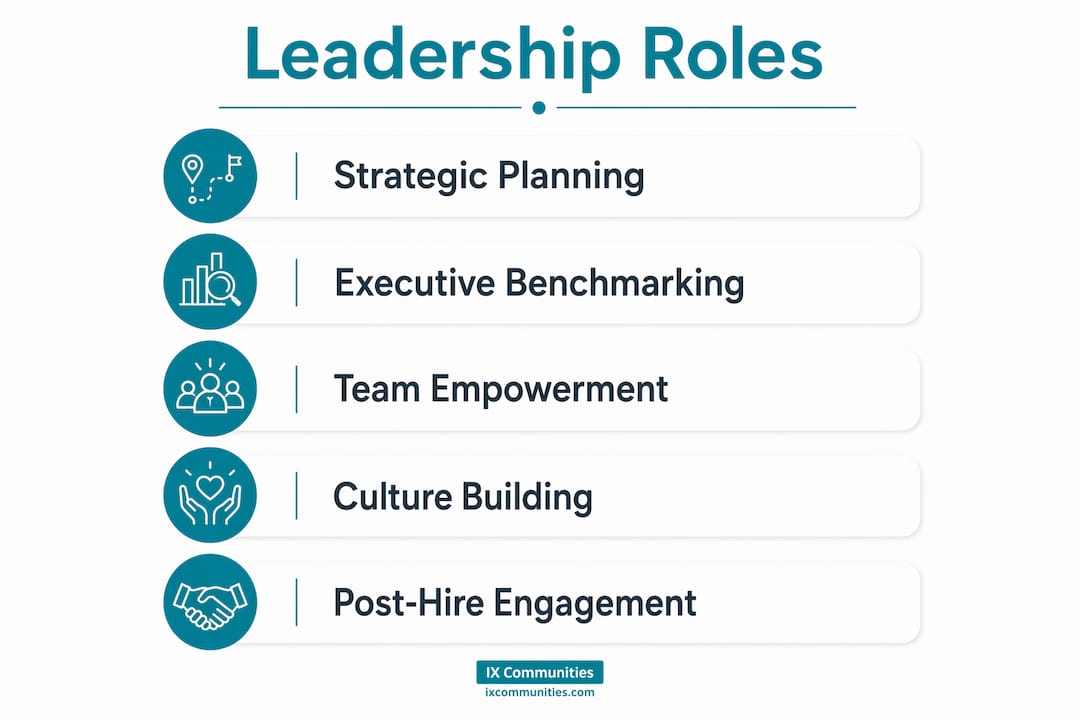
The role of leadership in talent acquisition covers several distinct areas:
- Workforce strategy alignment: Leaders connect hiring decisions to business objectives before requisitions open.
- Employer brand ownership: Executives communicate organizational values externally and internally, shaping how candidates perceive the company.
- Recruiting culture: Leadership behavior sets the standard for how recruiting teams operate, collaborate, and prioritize candidate experience.
- Credentials and development: Certifications such as the TMI Certification signal a leader's commitment to professional standards in talent management and build credibility with both teams and candidates.
- HR partnership: Leaders who collaborate closely with talent acquisition teams reduce friction, accelerate decisions, and produce better hiring outcomes.
Reactive hiring, by contrast, carries a measurable cost. Reactive recruiting inflates cost-per-hire compared to proactive, leadership-driven approaches. That figure alone makes the case for treating leadership involvement as a core operational priority, not an optional layer of oversight.
What are the primary responsibilities of leaders in talent acquisition?
Leaders who treat talent acquisition as a transactional support function leave their organizations exposed. The expectation has shifted from talent acquisition as a back-office function to a strategic driver of workforce capability. That shift places specific, concrete responsibilities on leaders at every level.
- Set a clear talent acquisition vision. Leaders define what hiring success looks like in terms of quality of hire, time-to-fill, and workforce capability, then communicate that vision to recruiting teams and hiring managers.
- Resource and empower recruiting teams. Providing adequate headcount, technology, and budget is a leadership decision. Empowering HR and talent acquisition teams with the right tools and authority enables them to pursue creative sourcing and candidate engagement strategies.
- Champion the employer brand. Leaders who speak publicly about organizational culture, career development, and mission give recruiting teams a credible story to tell. Candidates pay attention to what executives say and do.
- Facilitate cross-functional collaboration. Talent acquisition works best when leaders break down silos between HR, finance, and business units. Regular alignment meetings, shared workforce planning data, and joint accountability for hiring outcomes all depend on leadership initiative.
- Develop recruiting leaders through structured training. Programs like Recruiting Toolbox provide specialized training for talent acquisition leaders, covering sourcing strategy, hiring manager partnerships, and recruiting metrics. Investing in that development signals organizational commitment to the function.
- Use credentials to build professional credibility. The TMI Certification, offered through the Talent Management Institute, gives talent acquisition leaders a recognized framework for connecting people strategy to business outcomes. Leaders who hold such credentials bring structured thinking to workforce planning conversations.
Pro Tip: Leaders who participate in executive search benchmarking gain access to peer data on cost-per-hire, time-to-fill, and quality metrics that make workforce planning conversations with the C-suite far more concrete.
Gartner's research on recruiting leader priorities consistently identifies strategic alignment as the top capability gap for talent acquisition functions. Leaders who close that gap by taking ownership of the responsibilities above position their organizations to compete for critical skills rather than scramble for available ones.
How do different leadership styles affect recruitment success?
Leadership style must be intentionally selected to match recruitment needs, because it directly influences candidate engagement, decision speed, and culture fit. No single style works for every organization or every hire. The table below maps four common styles to their practical effects on talent acquisition.

| Leadership Style | Candidate Appeal | Decision Speed | Culture Fit Impact | Best Suited For |
|---|---|---|---|---|
| Democratic | High; candidates value inclusive environments | Moderate; consensus takes time | Builds collaborative, psychologically safe cultures | Organizations prioritizing retention and team cohesion |
| Transformational | High; attracts mission-driven, innovative talent | Moderate | Aligns roles to organizational vision, reducing early attrition | Growth-stage companies and innovation-focused teams |
| Autocratic | Lower; limits perceived autonomy | Fast | Can create uniformity but reduces creative appeal | High-volume, process-driven hiring contexts |
| Transactional | Moderate; appeals to goal-oriented candidates | Fast | Drives performance metrics but may reduce long-term satisfaction | Sales, operations, and quota-driven roles |
Democratic leadership promotes inclusive hiring practices and tends to produce stronger retention outcomes. When candidates observe that their future team makes decisions collaboratively, they are more likely to accept offers and stay. Transformational leadership attracts people who want their work to connect to something larger. A leader who clearly articulates organizational mission during the hiring process gives candidates a reason to choose this organization over a competitor offering a higher base salary.
Autocratic styles accelerate decisions, which matters in high-volume hiring where speed is a competitive advantage. The tradeoff is that candidates who value autonomy often self-select out, which can narrow the talent pool in creative or technical disciplines. Transactional leadership works well when roles have clear performance metrics and compensation is tied directly to output. The risk is that it attracts candidates motivated primarily by incentives, which can reduce engagement when conditions change.
The practical implication for talent acquisition leaders is that leadership style assessment should happen early in executive and critical hires, because it significantly predicts how new leaders will shape team culture and, by extension, future recruiting success.
How do leaders build and sustain a recruiting culture?
Culture is not a values statement on a wall. It is the sum of daily leadership behaviors that teams observe and replicate. Recruiting culture, specifically, is shaped by how leaders treat candidates, how they respond to hiring failures, and whether they hold themselves accountable to the same standards they set for their teams.
- Model the behaviors you want to see. Leaders who respond to candidates promptly, give honest feedback, and treat every interaction as a reflection of the organization set a standard that recruiting teams follow.
- Prioritize psychological safety. Recruiters who feel safe raising concerns about a candidate, a hiring manager's bias, or a flawed job description produce better hiring outcomes. That safety comes from leadership behavior, not policy documents.
- Recognize and reinforce good recruiting practice. Acknowledging a recruiter who improved candidate experience or closed a difficult search sends a clear signal about what the organization values.
- Communicate consistently. Leaders who share workforce priorities, business context, and hiring rationale with recruiting teams reduce the information gaps that lead to misaligned searches and wasted effort.
- Measure culture's impact on referrals and retention. Referral rates and early attrition are direct indicators of whether the culture candidates were sold during hiring matches what they experience after joining.
- Use peer networking to sustain culture standards. Participation in groups like Ixcommunities gives talent acquisition leaders access to benchmarking data and peer perspectives that help them identify where their culture practices lag behind industry norms.
- Pursue leadership certifications to formalize culture commitments. The TMI Certification and similar credentials provide frameworks for connecting culture-building to measurable talent outcomes, giving leaders a structured way to track progress.
Leaders who consistently communicate mission and maintain visible presence positively influence both recruiting outcomes and organizational culture. That visibility is not about executive appearances at job fairs. It shows up in how leaders talk about the recruiting function in all-hands meetings, how they respond when a key hire falls through, and whether they treat talent acquisition as a priority or an afterthought.
Attracting quality candidates remains the biggest challenge most recruiters face. A strong recruiting culture, built and sustained by leadership, is one of the most durable solutions to that problem.

What is leadership's role after the hire is made?
Leadership involvement does not end when an offer is accepted. The period between offer acceptance and the end of a new hire's first 90 days is where recruitment promises are either kept or broken. Leaders who disengage at that point undermine the work that went into the hire.
- Make onboarding a leadership priority, not an HR checklist. Strong leadership ensures onboarding is meaningful, provides role clarity, and integrates new hires into the culture effectively. That requires direct leader involvement, not just a welcome email and a benefits orientation.
- Clarify role expectations early. New hires who understand what success looks like in their first 30, 60, and 90 days perform better and stay longer. Leaders who communicate those expectations directly, rather than leaving them to a job description, reduce early attrition.
- Build regular feedback loops. Leadership involvement extends beyond hiring to role integration, and regular check-ins are the mechanism that makes integration work. A monthly conversation between a new hire and their leader in the first quarter is a low-cost, high-return practice.
- Connect onboarding to talent acquisition outcomes. When new hires leave within six months, the cost falls on the talent acquisition function. Leaders who track early attrition and connect it to specific onboarding gaps close the feedback loop between recruiting and retention.
- Support long-term career development. Retention is not only about the first 90 days. Leaders who actively discuss career paths, development opportunities, and internal mobility with their teams reduce the pull of external opportunities.
Empathetic leadership that values individuals increases referral rates, engagement, and hiring quality over time. A new hire who feels genuinely supported by their leader becomes one of the organization's most credible recruiting assets, referring peers and speaking positively about the organization in their professional networks.
For a deeper look at how leadership practices connect to onboarding and retention outcomes, Ixcommunities has published practical guidance drawn from peer benchmarking across large corporate talent functions.
Ixcommunities: peer collaboration that elevates leadership in talent acquisition
The most effective talent acquisition leaders do not operate in isolation. They benchmark their practices against peers, test new frameworks in trusted environments, and build the professional networks that give them access to real-world data when they need it most.
Ixcommunities operates ESIX, TLIX, and the broader IX Communities platform as the preeminent peer networking and benchmarking groups for talent leadership professionals worldwide. Large corporate talent and recruiting departments use these communities to share data, compare practices, and develop leadership capability in a secure, confidential environment.
What the data shows about leadership involvement:
- Proactive leadership involvement in recruiting reduces cost-per-hire by about 25%–40% compared to reactive models, a figure that translates directly to budget conversations with finance and the C-suite.
- Talent acquisition leaders who function as strategic advisors, interpreting market signals and advising on workforce risk, produce stronger long-term hiring pipelines than those who focus primarily on filling open roles.
- The build-buy-borrow-bridge framework gives talent acquisition leaders a structured way to design workforce capabilities proactively, deciding when to develop internal talent, hire externally, contract specialists, or redeploy existing employees.
Ixcommunities supports leaders in applying these frameworks through several programs:
- Peer mentoring: The ESIX Recruiter Peer Mentorship Programs connect talent acquisition leaders with experienced peers who have navigated the same workforce planning challenges.
- Benchmarking: Ixcommunities benchmark surveys provide leadership teams with comparative data on recruiting metrics, enabling evidence-based decisions rather than assumptions.
- Guest speakers and expert access: The IX Communities platform brings in practitioners and researchers who address the specific challenges talent acquisition leaders face in 2026, from AI-assisted recruiting to skills-first hiring.
- Leadership certifications as trust signals: Credentials like the TMI Certification and training through programs like Recruiting Toolbox signal professional commitment and give leaders a common language for workforce strategy discussions.
- Gartner Leadership Insights: Gartner's research on recruiting leader priorities provides an external benchmark that Ixcommunities members use to contextualize their own data and identify capability gaps.
Talent acquisition leaders who want to move from reactive hiring to workforce strategy ownership will find that peer collaboration accelerates that transition faster than internal development alone. Ixcommunities provides the environment, the data, and the professional network to make that shift practical and measurable. Explore membership options to see how peer benchmarking and leadership development programs can strengthen your talent acquisition function in 2026.
For organizations focused on attracting top talent in competitive markets, the combination of strong internal leadership and external peer benchmarking consistently produces better hiring outcomes than either approach alone.
Key Takeaways
Leadership that engages proactively in talent acquisition, from workforce planning through onboarding, reduces cost-per-hire and produces stronger long-term retention than reactive, transactional hiring models.
| Point | Details |
|---|---|
| Proactive leadership cuts hiring costs | Reactive recruiting costs about 25%–40% more per hire; early leadership involvement eliminates that premium. |
| Leadership style shapes candidate appeal | Democratic and transformational styles attract broader, more engaged talent pools than autocratic approaches. |
| Culture is built through daily behavior | Recruiting culture reflects how leaders treat candidates and teams, not what is written in a values statement. |
| Post-hire involvement drives retention | Leaders who engage during onboarding and provide regular feedback reduce early attrition and increase referral rates. |
| Peer benchmarking accelerates leadership growth | Platforms like Ixcommunities give talent acquisition leaders comparative data and peer networks that internal development alone cannot provide. |