

The best recruiting roundtable agenda follows a fixed structure with segments dedicated to framing, data-backed problem discussions, breakout for recommendations, and a decision window to assign ownership and deadlines. That structure produces three things a loose "let's discuss hiring challenges" meeting never does: alignment on which decisions actually get made, a named owner for each action, and a measurable follow-up date.
Choosing the right format depends on scope, not preference:
- 60 minutes for a single, well-defined problem with two or three stakeholders.
- 90 minutes for the standard cross-functional check-in on multiple priorities.
- Half-day for quarterly planning, budget cycles, or workforce strategy that needs breakout depth.
The agenda templates below are built for talent acquisition leaders who need working sessions, not open-ended venting.
Key Takeaways
A recruiting roundtable agenda works when it pairs a fixed time structure with mandatory, data-backed prework that turns discussion into assigned, deadline-bound decisions.
| Point | Details |
|---|---|
| Default to 90 minutes | Use a 90-minute structured agenda for most cross-functional roundtables; reserve half-day formats for quarterly planning. |
| Require prework | Ask every attendee for a one-page problem statement with one supporting metric before the session. |
| Assign four clear roles | Facilitator, timekeeper, presenter, and note-taker each own a distinct part of the agenda. |
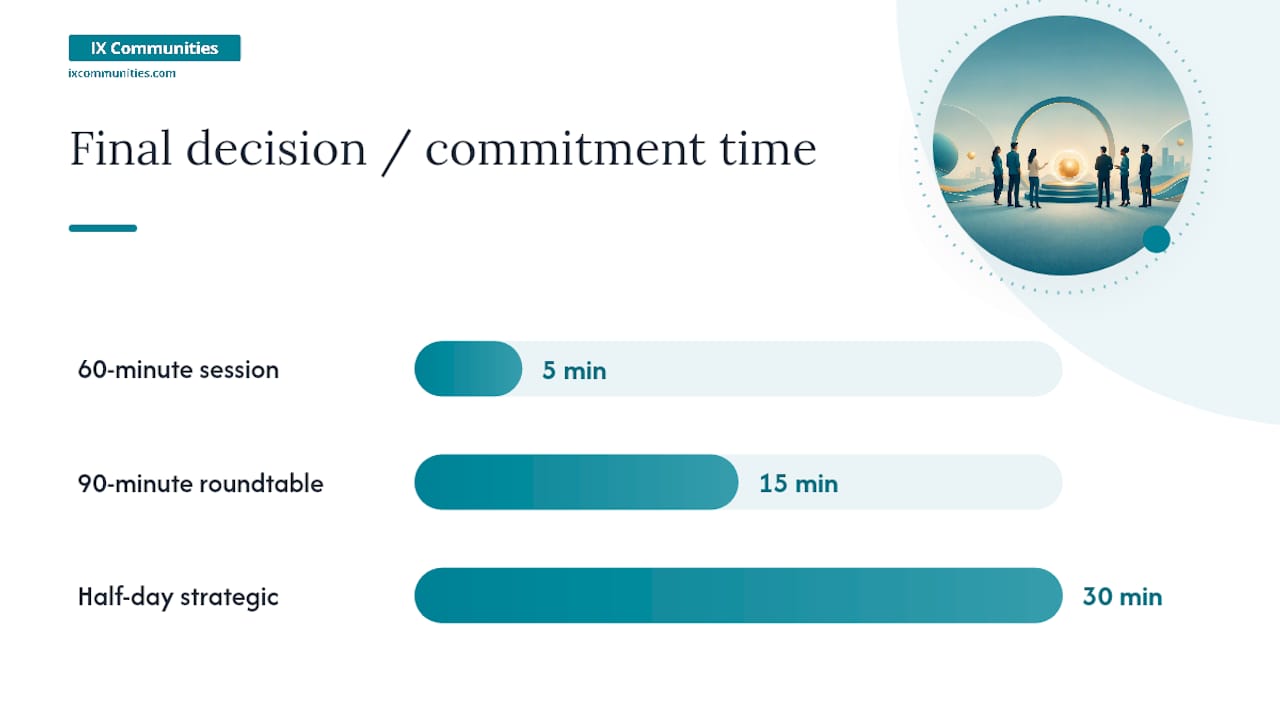
| Close with a decision window | End every session with 15 minutes dedicated to naming owners and deadlines, not open discussion. |
| Track outcomes on a fixed cadence | Use a one-page post-event template and re-run sessions quarterly for comparable benchmarking. |
| Sustain the program with peer structure | Ixcommunities's ESIX Recruiter Peer Mentorship Programs supply recurring agenda templates and facilitators for ongoing roundtable cohorts. |
Table of Contents
- Sample Recruiting Roundtable Agenda Templates for 60, 90, and Half-Day Formats
- How Do You Keep a Roundtable Discussion From Turning Into a Complaint Session?
- Who Should Run Each Part of the Agenda?
- What Topics Should Be on a Talent Acquisition Roundtable Agenda?
- What Prework Do Attendees Need Before the Session?
- How Do You Measure Whether the Roundtable Worked?
- Why Most Roundtable Advice Misses the Point
- Where to Find Ready-Made Agendas and Recurring Peer Cohorts
- Frequently Asked Questions
- Sources
Sample Recruiting Roundtable Agenda Templates for 60, 90, and Half-Day Formats
Every agenda below assumes participants have already submitted a short problem statement in advance. Skip that step and even a well-timed agenda drifts into anecdote-swapping.
1. The 60-minute focused session
- 0 to 5 min: Facilitator opens, states the one decision the group must reach.
- 5 to 20 min: Presenter walks through the data-backed problem (15 min, hard stop).
- 20 to 45 min: Structured discussion, timekeeper enforces 5 to 7 minute turns per speaker.
- 45 to 55 min: Group narrows to one recommendation with an owner attached.
- 55 to 60 min: Note-taker reads back the decision and deadline for confirmation.
2. The 90-minute standard roundtable
- 0 to 5 min: Framing and priority-setting by the facilitator.
- 5 to 41 min: Three 12-minute topic blocks, each with a named presenter and a specific ask (a decision, a resource, or data).
- 41 to 56 min: Breakout groups of four to six people draft one recommendation each.
- 56 to 71 min: Groups report back, two minutes each, no debate during readouts.
- 71 to 86 min: Decision window. The facilitator forces prioritization if more than two proposals compete for the same resource.
- 86 to 90 min: Note-taker confirms owners and deadlines aloud.
3. The half-day strategic session
Morning block covers workforce planning and data review with two 45-minute deep dives. After a break, breakout groups spend 90 minutes on a decision matrix exercise, then reconvene for a 45-minute cross-group synthesis and a closing 30-minute commitment round where each functional leader states what they will change in the next quarter.
Mixed formats, which pair short updates with focused breakouts and a firm decision window, consistently outperform open-discussion formats for busy senior leaders. For virtual sessions, assign a co-facilitator to run breakout rooms and a dedicated chat monitor. In-person half-day sessions benefit from physical decision boards, sticky notes for prioritization, and a visible countdown timer.
How Do You Keep a Roundtable Discussion From Turning Into a Complaint Session?
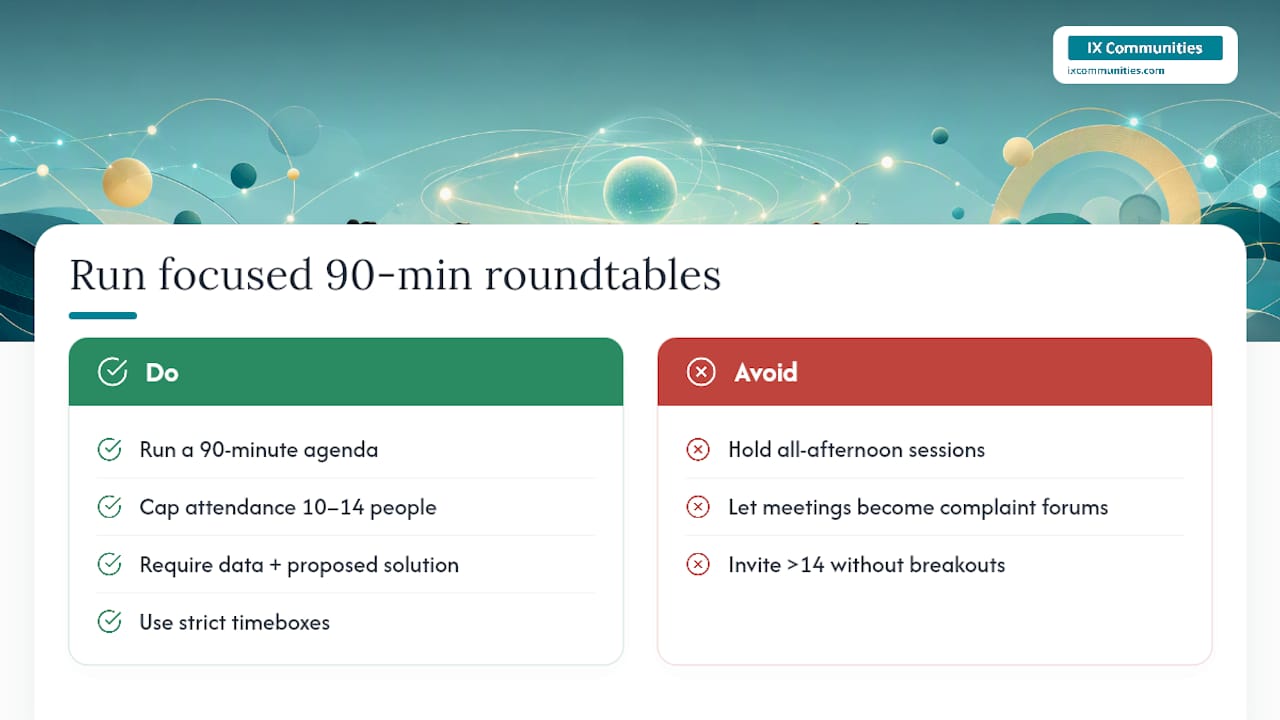
Venting happens when a group has no evidence to argue with and no deadline pushing them toward a decision. The fix starts before the meeting: require every participant to submit a short, data-backed problem statement with a proposed solution attached. A complaint with no data behind it doesn't make the agenda.
During the session, four techniques keep things moving:
- Structured go-rounds. Each person gets a fixed window, no interruptions, no rebuttals until the round finishes.
- A parking lot. Off-topic frustrations get written down publicly and addressed after the meeting, not during it.
- Strict timeboxes. A visible timer beats a facilitator's verbal warning every time.
- Directed questions. Replace "What's frustrating you about sourcing?" with "What's the one metric that would tell us sourcing is broken?"
Building rapport early and prioritizing high-impact problems before diving into detail also keeps stakeholder conversations grounded in data rather than frustration.
Pro Tip: When a comment turns into venting, ask "What would you need to see to know this is fixed?" It redirects emotion into a measurable target without shutting the person down.
Who Should Run Each Part of the Agenda?
Role confusion is the fastest way to turn a tight 90-minute plan into a two-hour ramble. Four roles cover most roundtables:
- Facilitator: owns pacing, redirects tangents, and forces the group toward a decision.
- Timekeeper: enforces the clock independently of the facilitator, so timing isn't a personal judgment call.
- Presenters: bring a one-page problem statement and speak for 5 to 7 minutes per structured update.
- Note-taker: captures decisions, owners, and deadlines in real time, then reads them back before the group disperses.
Cap attendance to a manageable number of people for a working session to ensure active participation and effective discussion. Beyond that, breakouts become necessary just to get everyone talking. Discussion windows should run 10 to 15 minutes per topic; anything longer usually means the topic needed its own meeting.
What Topics Should Be on a Talent Acquisition Roundtable Agenda?
The strongest prompts map directly to what senior TA leaders are already prioritizing: workforce planning, AI adoption, and recruiting velocity show up repeatedly in current roundtable discussions, alongside protecting culture while pushing productivity.
Sample prompts that force a decision rather than a discussion:
- "Where is our time-to-fill worst, and what's the one lever we control?" Bring a 90-day time-to-fill trend by department.
- "If AI tools cut sourcing time by a third, where does that capacity go?" Bring current sourcing hours by role type.
- "What's one retention risk tied to our hiring pace?" Bring first-year attrition by hiring manager.
Breakout formats work best when the deliverable is fixed in advance:
- 5-2-1: five minutes silent brainstorming, two minutes pairing, one shared recommendation.
- SWOT-lite: 10 minutes on strengths and gaps only, skip the full matrix.
- Decision matrix: rank three options against cost and speed, pick one.
Ground every prompt in a short pre-read or a screenshot of the relevant recruiting challenges dashboard so the group starts from shared facts, not memory.
What Prework Do Attendees Need Before the Session?
Stakeholder mapping done before the meeting is what separates a roundtable that reaches decisions from one that just airs opinions. Mapping who holds decision authority, what constraints they're under, and what incentives drive them prevents the common failure mode where two stakeholders argue past each other because they're optimizing for different goals.
Send this checklist at least five business days out:
- A one-page problem statement: what's broken, since when, and what's been tried.
- One supporting metric or dashboard screenshot, no exceptions.
- A stated desired decision, not just a topic.
- A quick note on who else needs to weigh in before this can move forward.
Useful metrics to request in advance include time-to-fill by department, offer-acceptance rate, and pipeline conversion by source. Leadership-level prioritization of high-impact issues before the session also keeps the agenda from bloating past its allotted time.
Pro Tip: If a stakeholder can't produce one supporting metric, that's a signal the problem isn't well enough understood yet to bring to the group. Push it to next quarter instead of forcing it onto this agenda.
How Do You Measure Whether the Roundtable Worked?
A roundtable succeeds when its decisions show up in a tracked follow-up document within 48 hours, not when the discussion felt productive in the room. A one-page post-event summary with decisions, owners, deadlines, and success metrics turns conversation into accountability.
| Field | What to record |
|---|---|
| Decision | The exact action agreed on, in one sentence. |
| Owner | One named person, not a team. |
| Deadline | A specific date, not "next quarter." |
| Success metric | The KPI that proves the decision worked (time-to-fill, offer-acceptance rate, pipeline conversion). |
| Recheck date | When the group revisits this metric. |
Recruiting velocity and hiring-manager satisfaction are the two metrics that most reliably show whether a roundtable's decisions actually stuck. Re-run the roundtable on a fixed cadence, typically quarterly, rather than reactively, so benchmarking data stays comparable across sessions.
Why Most Roundtable Advice Misses the Point
Most guidance on running a hiring strategy meeting focuses on who to invite and how long to talk. That's the easy part. The harder problem, and the one that determines whether anything changes afterward, is whether the room has evidence to argue with and a forcing function to reach a decision.
Conventional advice treats stakeholder alignment as a nice-to-have, something you do if there's time. It should be the first thing on the checklist, not the last. A group without pre-mapped incentives and pre-submitted data will default to the loudest opinion in the room, and that opinion is rarely the one backed by the best metric.
If you take one thing from this, prioritize the prework over the agenda design. A perfectly timed 90-minute session with no data behind it still produces vague action items nobody owns. A rougher agenda with a sharp, evidence-based problem statement in hand will outperform it every time. Build the discipline of requiring a metric before a complaint gets airtime, and the rest of the agenda mostly takes care of itself.
Where to Find Ready-Made Agendas and Recurring Peer Cohorts
Building a strong recruiting roundtable agenda once is achievable with the templates above. Sustaining a program of them, quarter after quarter, with fresh benchmarking data and facilitators who've run dozens of these sessions, is a different problem entirely.
Ixcommunities addresses that gap directly through the ESIX Recruiter Peer Mentorship Programs, which pair talent acquisition leaders with trained peer facilitators and pre-built agenda templates instead of leaving each organizer to design a session from scratch. Members also draw on Benchmark Surveys to frame discussions with real comparative data rather than assumptions, which fits the pattern of peer-led programs staying relevant when they're grounded in benchmarking inputs. If your roundtable program needs recurring structure, not a one-time agenda, check the IX Communities membership page for details on joining a peer cohort built for talent leaders.
Frequently Asked Questions
What is the ideal length for a recruiting roundtable agenda? Most talent acquisition teams get the best results from a 90-minute agenda. It's long enough for three focused topics and a breakout, but short enough to hold attention without needing a full afternoon.
How many people should attend a hiring strategy meeting? Cap attendance around 10 to 14 people. Larger groups need breakout structure just to give everyone a chance to speak, which is why half-day formats build that in from the start.
How do you stop a recruitment planning session from becoming a complaint session? Require a data-backed problem statement and a proposed solution from every participant before the meeting. Combine that with strict timeboxes and a parking lot for off-topic frustration during the session itself.
What should be on a staffing roundtable topics list right now? Workforce planning, AI adoption's effect on sourcing capacity, and recruiting velocity are the topics showing up most often in current HR roundtable discussions, alongside protecting culture while raising productivity.
How often should a talent acquisition agenda-style roundtable repeat? A quarterly cadence works for most organizations. It keeps benchmarking data comparable across sessions and gives owners enough time to act on the previous round's decisions before the next one.
Sources
- Internal stakeholder alignment (SmartRecruiters)
- Understanding and using smart technical assistance (UK gov resource)