

Internal mobility is defined as the practice of filling open roles by moving or promoting employees already within the organization, and it is now the dominant talent acquisition strategy at large companies. Internal mobility grew from 51% of all role fills in 2021 to 62% in 2025. That shift signals a fundamental change in how talent acquisition teams source, develop, and retain people. The rise of internal mobility raises a direct question for HR leaders: is external recruiting losing ground as the default first move? The answer, backed by cost data and retention research, is yes, for a growing share of roles.
Is external recruiting losing ground to internal mobility?
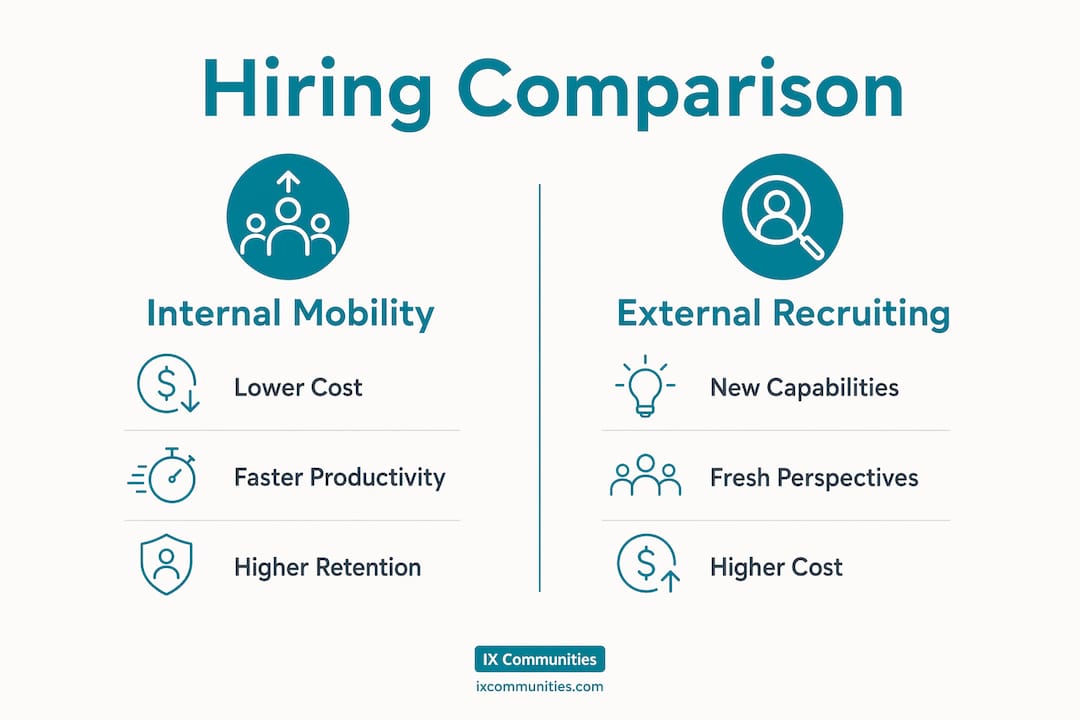
The short answer is yes, and the numbers explain why. External hires cost 50–60% of a role's annual salary when you include sourcing fees, recruiter time, and onboarding. Internal hires eliminate most of those costs and reach full productivity in roughly half the time. For a $120,000 role, that cost difference can exceed $60,000 per hire. At scale, across dozens of annual hires, the financial case for internal mobility trends toward undeniable.
The productivity gap matters just as much as the cost gap. Internal candidates already know the company's systems, culture, and stakeholders. They skip the orientation period that slows external hires for weeks or months. Talent acquisition teams that track time-to-productivity separately for internal and external fills consistently see this gap in their own data.

Despite the evidence, only 1 in 5 companies have formal internal mobility programs. That gap between the data and actual practice is where most organizations are leaving money and talent on the table. The recruitment strategies shift happening at leading companies is not accidental. It is the result of deliberate investment in internal sourcing infrastructure.
| Metric | External hire | Internal hire |
|---|---|---|
| Average cost | 50–60% of annual salary | Significantly lower, no sourcing fees |
| Time to full productivity | Baseline | Roughly half the time |
| Attrition intent reduction | Baseline | 41% lower for internal movers |
| Formal program adoption | N/A | Only 20% of organizations |
Pro Tip: Track internal fill rate as a standalone recruiting metric, separate from your overall fill rate. If you cannot see it clearly, you cannot improve it.
What retention benefits does internal mobility provide?
Retention is where internal mobility's impact on hiring becomes most visible. Employees who make internal moves show a 73% retention rate after three years, compared to 56% for employees who do not move internally. That 17-point gap compounds over time into a measurable reduction in turnover costs and knowledge loss. Internal mobility also doubles median employee tenure, from 2.9 years to 5.4 years.
The retention benefit is not just about keeping people longer. It is about keeping the right people. High performers who see a path forward inside the organization are less likely to test the external market. When they do leave, it is often because that internal path was blocked, not because a better external offer appeared first.
The impact on organizational culture is equally significant. Companies with active internal mobility programs build institutional knowledge that compounds over time. Employees who have worked across multiple functions understand the business more deeply and make better decisions faster. That depth does not transfer easily from external hires, regardless of their credentials.
"Internal mobility is not a nice-to-have retention tactic. It is the single most cost-effective way to keep your best people and grow your organization's capability at the same time." — Jeff Smith, former Head of HR at BlackRock
- Internal movers show 41% lower attrition intent compared to employees who have not moved internally.
- Median tenure rises from 2.9 to 5.4 years when internal mobility programs are active.
- 73% of internal movers remain with the organization after three years, versus 56% of non-movers.
- Reduced attrition directly lowers the volume of external searches required each year.
- Knowledge retention improves as experienced employees move across functions rather than out the door.
What obstacles block effective internal mobility programs?
Manager gatekeeping is the most common and most damaging obstacle. 60% of high-potential employees identify their direct manager as the primary barrier to an internal move. This behavior, sometimes called "job hugging," occurs when managers block or delay internal applications to protect their own team's headcount. The result is that top performers, who have the most options, eventually leave the organization entirely.
Opportunity visibility is the second major gap. 51% of employees are unaware of internal job openings at their own companies. If employees cannot see the opportunities, they cannot pursue them. This is a process failure, not a motivation failure. Most organizations post internal roles in the same systems as external roles, with no dedicated communication or proactive outreach to internal candidates.
The absence of dedicated internal recruiters compounds both problems. When internal mobility is treated as a side task for the same recruiters managing external pipelines, it gets deprioritized. The impact of internal hiring only materializes when someone owns it as a distinct function with its own metrics and workflows.
- Decouple manager approval from initial applications. Employees should be able to apply internally without their manager's permission as a prerequisite. Require manager notification only after a candidate advances.
- Assign a dedicated internal recruiter. Treat internal mobility as its own recruiting channel with a named owner, separate pipeline, and tracked fill rate.
- Post internal roles before external ones. Give current employees a defined window, typically five to seven business days, to apply before the role opens externally.
- Incentivize managers to release talent. Tie manager performance reviews to internal mobility outcomes, not just headcount retention.
- Audit internal job postings for visibility. Use targeted internal communications, skills-matching tools, and manager-led conversations to surface opportunities proactively.
Pro Tip: If your internal application process takes longer than your external one, fix it first. Speed signals seriousness. Slow internal processes tell employees that external moves are easier.
When does external recruiting still make sense?
External recruiting remains necessary when the skills required simply do not exist inside the organization. Digital transformation initiatives are a clear example. When a company needs capabilities it has never built before, such as AI engineering, cybersecurity architecture, or regulatory expertise in a new market, internal candidates cannot fill that gap regardless of program quality. External hiring in these cases is not a failure of internal mobility. It is the correct sourcing decision.
External perspectives also prevent organizational stagnation. A workforce that only promotes from within can develop blind spots over time. Bringing in external talent at key points injects new thinking, challenges existing assumptions, and introduces practices from other industries. Top talent teams integrate internal and external sourcing based on role requirements, not as competing philosophies but as complementary tools.
The practical target for most large organizations is to shift 25–40% of previously external roles to internal fills over a two-year period. That target preserves external hiring for roles that genuinely require it while capturing the cost and retention benefits of internal mobility at scale.
| Role type | Recommended sourcing approach |
|---|---|
| Roles requiring entirely new capabilities | External recruiting |
| Roles requiring fresh market perspective | External recruiting or hybrid |
| Roles with internal skill adjacency | Internal mobility first |
| Leadership and succession roles | Internal mobility with external benchmarking |
| High-volume operational roles | Internal mobility first |
How can HR leaders build a successful internal mobility program?
Building a program that actually works requires treating internal mobility as a recruiting channel, not a policy statement. That means dedicated resources, separate tracking, and a defined process that runs parallel to, not inside, the external pipeline. Organizations that treat internal mobility as a checkbox produce checkbox results.
Skills taxonomies are the foundation. Without a clear map of what skills exist inside the organization and where they are located, matching internal candidates to open roles is guesswork. Skills-based talent marketplaces, whether built on enterprise HR platforms or purpose-built tools, make internal opportunity matching faster and more accurate. HR leaders exploring this shift can find practical frameworks in TA team strategy guides that address program structure and success metrics.
Workflow speed is a critical and often overlooked factor. Internal candidates who wait three weeks for a hiring decision while external candidates move through a faster process draw the obvious conclusion. Compress internal mobility timelines aggressively. Set a target of 10 business days from application to decision for internal candidates.
- Build a skills taxonomy before launching an internal job marketplace.
- Assign one recruiter to own the internal pipeline with separate fill rate reporting.
- Post every role internally for at least five business days before opening it externally.
- Set manager mobility goals in annual performance reviews.
- Use targeted communications, not just job board posts, to surface internal opportunities.
- Track internal fill rate, time to fill, and internal mover retention as distinct program metrics.
- Review internal mobility trends regularly to benchmark your program against peer organizations.
Pro Tip: Compensation parity matters. If internal promotions consistently pay less than external hires for equivalent roles, your best performers will notice. Rebuild your compensation bands to close that gap before launching a mobility program.
Key takeaways
Internal mobility is now the most cost-effective and retention-positive talent strategy available to large organizations, and HR leaders who treat it as a core recruiting function rather than a secondary process will see measurable gains in fill cost, time to productivity, and employee tenure.
| Point | Details |
|---|---|
| Internal mobility is rising fast | Internal fills grew from 51% in 2021 to 62% in 2025, outpacing external recruiting at scale. |
| Cost savings are substantial | External hires cost 50–60% of annual salary; internal hires eliminate sourcing fees and cut onboarding time in half. |
| Retention improves significantly | Internal movers show 73% retention after three years versus 56% for non-movers, and tenure nearly doubles. |
| Manager gatekeeping is the top barrier | 60% of high-potential employees cite their manager as the primary obstacle to internal moves. |
| External recruiting still has a role | Use external hiring for genuinely new capabilities; target shifting 25–40% of external-fillable roles to internal fills. |
Internal mobility is the future of talent acquisition
I have spent years watching organizations invest heavily in external recruiting while their best people quietly applied elsewhere. The pattern is consistent. A high performer raises their hand for an internal opportunity. Their manager stalls. The process drags. The candidate accepts an external offer from a company that moved faster. The organization then spends 50–60% of that person's annual salary to replace them from the outside.
What strikes me most is that this is not a talent shortage problem. It is a process and culture problem. The organizations getting internal mobility right are not doing anything exotic. They are posting roles internally first, assigning a recruiter to own the internal pipeline, and holding managers accountable for releasing talent. Those three changes alone produce measurable results.
The skills-based workforce model accelerates this shift. As organizations move away from title-based hiring toward capability-based matching, internal candidates with adjacent skills become viable for a much wider range of roles. That changes the math on external recruiting significantly. The question stops being "who can we hire?" and starts being "who do we already have?"
HR leaders who treat internal mobility as a core function, with its own budget, metrics, and dedicated staff, will build organizations that retain more talent, spend less on recruiting, and develop deeper institutional knowledge over time. The leaders who continue treating it as a side project will keep paying external recruiting costs they could have avoided.
— Simon
Ixcommunities resources for talent acquisition leaders
HR leaders building or refining internal mobility programs benefit from peer-level benchmarking and structured knowledge sharing. Ixcommunities connects talent acquisition professionals at large organizations through secure peer networking groups, including ESIX and TLIX, where internal recruiting strategies, fill rate benchmarks, and program designs are shared openly among practitioners who face the same challenges.
The ESIX Recruiter Peer Mentorship Program gives internal recruiting teams direct access to experienced mentors who have built and scaled internal mobility programs at large organizations. For broader access to benchmarking data, peer connections, and talent leadership resources, Ixcommunities membership provides a structured environment where HR leaders can share what is working and learn from peers who have already navigated the shift from external-first to internal-first recruiting.
FAQ
What is internal mobility in talent acquisition?
Internal mobility is the practice of filling open roles by moving or promoting existing employees rather than hiring externally. It includes lateral transfers, promotions, and project-based assignments.
How much does external hiring cost compared to internal hiring?
External hires cost 50–60% of the role's annual salary on average, including sourcing fees and onboarding. Internal hires eliminate most of those costs and reach full productivity in roughly half the time.
Why do internal mobility programs fail?
The most common causes are manager gatekeeping, poor opportunity visibility, and the absence of dedicated internal recruiters. Fixing these three issues produces the largest gains in program performance.
Is external recruiting still necessary?
External recruiting remains necessary when the required skills do not exist inside the organization, such as entirely new technical capabilities or expertise in a new market. The recommended target is to shift 25–40% of previously external roles to internal fills over two years.
How does internal mobility affect employee retention?
Employees who make internal moves show a 73% retention rate after three years, compared to 56% for those who do not. Internal mobility also reduces attrition intent by 41% and nearly doubles median employee tenure.