

The executive search functions winning with AI aren't using it the way you think. They don't treat AI as a collection of standalone tools. They embed it as an operating infrastructure that connects sourcing, CRM, candidate intelligence, and outreach into a single, compounding system. According to Hunt Scanlon, leading firms have cut C-suite search timelines from 18–20 weeks down to 14–16 weeks by doing exactly this. That is not a productivity tweak. That is a structural shift in how executive search gets done. Platforms like Recruiterflow, research from McKinsey, and benchmarking data from Hunt Scanlon all point to the same conclusion: the firms pulling ahead are not experimenting with AI. They have institutionalized it.
How executive search functions win with AI differently than you think
The core distinction is infrastructure versus experimentation. Most firms have tried AI tools. Fewer have connected those tools into a unified workflow. Only 20% of executive search firms have achieved broad, institutionalized AI adoption, even though 67% report actively using AI. That gap between usage and integration is where competitive advantage lives. Firms stuck in experimentation run disconnected tools that generate data no one acts on. Firms that have crossed into institutionalization run AI as the backbone of every search, from the first sourcing pass to the final candidate brief.
The difference shows up in outcomes. Firms embedding AI into connected workflows report a 76% reduction in time-to-fill for targeted roles and a 40–50% gain in search efficiency. Those numbers reflect what happens when AI handles high-volume, repetitive tasks at scale, freeing senior recruiters to focus on judgment-intensive work.

What parts of executive search benefit most from AI?
AI delivers the clearest value in the early and middle stages of a search. These are the functions where volume, speed, and data processing matter most.
AI-augmented activities:
- Candidate sourcing and long-list generation across LinkedIn, proprietary databases, and public records
- Data enrichment: pulling compensation benchmarks, career trajectory analysis, and board affiliations
- Outreach sequencing and follow-up automation through CRM integrations
- Resume screening and initial qualification scoring
- Market mapping and competitor org-chart analysis
Human-only activities:
- Motivation diagnosis: understanding why a candidate would leave a stable role
- Board dynamics and stakeholder alignment conversations
- Offer negotiation and counter-offer management
- Cultural fit assessment and reference interpretation
- Final-round advisory conversations with hiring committees
Human judgment remains essential in final stages because AI cannot replicate relational and motivational assessments. A candidate's stated interest and actual readiness to move are two different things. Reading that gap requires experience, not an algorithm.
Pro Tip: Never automate the motivation diagnosis stage. A templated outreach sequence sent to a passive C-suite candidate signals exactly the wrong thing. Reserve direct, personalized contact for any candidate whose motivation you have not yet confirmed.
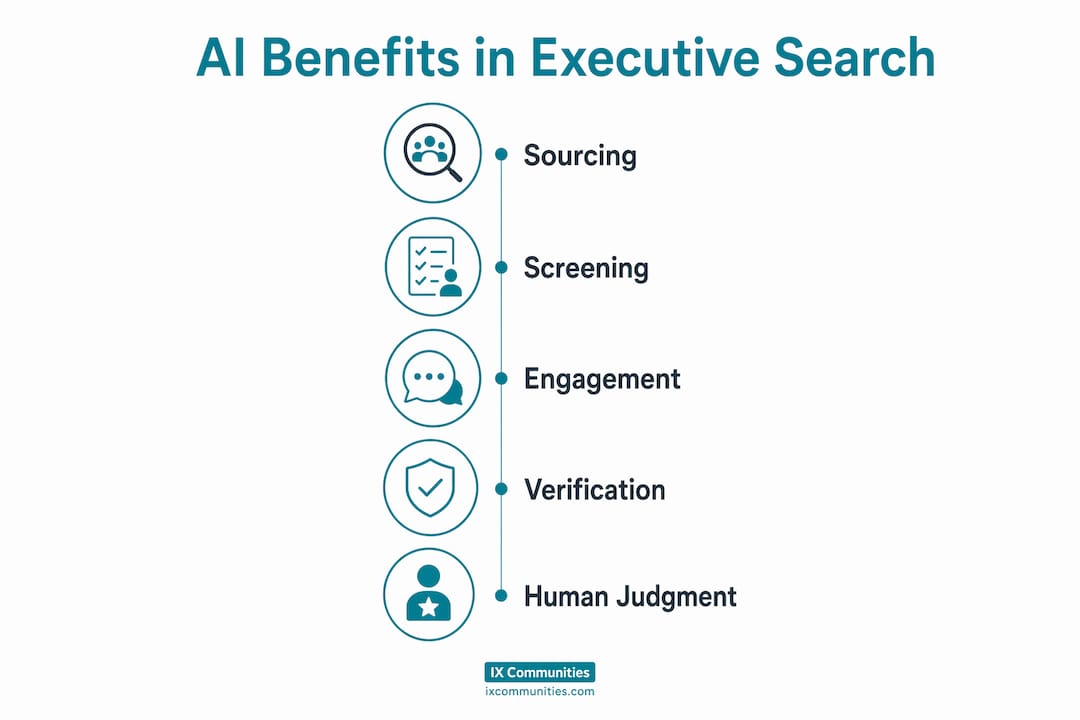
The hybrid search model is now the standard for firms performing at the top of the market. AI accelerates sourcing and intelligence gathering. Humans own the decisions that determine whether a search closes well.
How do leading firms institutionalize AI for compounding advantage?
Institutionalizing AI means building connected systems, not deploying isolated tools. Here is how the leading firms do it:
- Audit existing workflows first. Before any AI tool goes live, map the current search process end to end. Identify where delays occur, where data gets lost, and where human time is spent on tasks that do not require judgment.
- Connect CRM to sourcing and intelligence layers. Tools like Recruiterflow and similar platforms allow firms to link candidate data, outreach history, and search progress in one system. That connection creates data flow that improves over time.
- Deploy multi-agent AI workflows. Leading firms use AI agents that handle distinct tasks, such as sourcing, enrichment, and scheduling, and pass outputs between each other automatically. This removes manual handoffs and reduces errors.
- Build predictive analytics on top of connected data. Once CRM and sourcing data are unified, firms can model which candidate profiles convert at higher rates, which outreach sequences get responses, and which search parameters produce faster fills.
- Commit leadership to the model. Competitive advantage lies not in the number of AI tools but in their connectedness. That connectedness requires executive sponsorship, not just recruiter adoption.
"Winning firms institutionalize AI as an operating system with multi-agent workflows that link research, CRM, and candidate intelligence, creating compounding analytics advantage." — Hunt Scanlon, The Integration Gap Report
The compounding effect is the key point. A firm that runs connected AI systems gets smarter with every search. A firm running disconnected tools resets to zero each time.
Why do most AI efforts in executive search fail?
The most common failure mode is automating a broken process. AI accelerates both good and bad processes equally. If your sourcing criteria are too broad, AI will surface more irrelevant candidates faster. If your outreach messaging is generic, AI will send it to more people at higher volume with worse results.
| Pitfall | Solution |
|---|---|
| Automating poorly designed workflows | Audit and redesign processes before AI deployment |
| Using disconnected AI tools | Integrate tools into a unified CRM and data system |
| Over-relying on AI for candidate assessment | Reserve motivation diagnosis and negotiation for human recruiters |
| Ignoring verification in an AI-generated candidate pool | Add back-channel checks and multi-stage verification |
| No leadership commitment to integration | Assign executive ownership of AI adoption and workflow standards |
A second failure mode involves candidate verification. Generative AI enables candidates to produce polished resumes and rehearsed interview performances that do not reflect actual competence. Back-channel reference checks and structured multi-stage assessments are now more important, not less. Deepfake detection, relational trust, and nuanced motivation assessment remain human-only domains despite AI advances.
Pro Tip: Before deploying any AI tool in your search workflow, run a process audit with your team. Document every step, identify the three biggest time drains, and ask whether those drains exist because of a process problem or a volume problem. AI solves volume problems. Process problems require redesign first.
The firms that fail with AI in executive search are not failing because the technology is wrong. They are failing because they skipped the prerequisite work.
How can talent acquisition leaders implement AI strategically?
Corporate talent acquisition leaders have a specific set of levers to pull. The following steps reflect what the highest-performing functions are doing in 2026.
- Define clear workflow boundaries. Document which tasks are AI-automated, which are AI-assisted, and which are human-only. Ambiguity here creates inconsistency and erodes candidate experience at senior levels.
- Invest in systems integration. Prioritize platforms that connect to your existing ATS and CRM rather than adding standalone tools. The shift from process to intelligence requires data to flow between systems without manual intervention.
- Build recruiter skills around judgment-intensive tasks. As AI handles sourcing and enrichment, recruiter value shifts to motivation diagnosis, board fluency, and advisory conversations. Train and evaluate recruiters on those capabilities specifically.
- Track the right KPIs. Time-to-fill and search efficiency are table stakes. Add candidate quality scores, offer acceptance rates at the C-suite level, and retention at 12 months post-placement to measure whether AI is improving outcomes or just speed.
- Evaluate AI tools for executive search specifically. General-purpose AI tools built for high-volume recruiting do not always translate to executive search. Look for platforms with executive-grade data sources, compensation benchmarking, and board-level network mapping.
- Stay current on AI capabilities and limitations. The 2026 reality for AI in executive search is that capabilities are advancing faster than most firms' adoption frameworks. Build a quarterly review process to assess new tools and update your workflow standards.
The firms that get this right are not necessarily the ones with the largest technology budgets. They are the ones with the clearest thinking about where AI creates value and where human judgment is irreplaceable.
Key takeaways
The executive search functions winning with AI have institutionalized it as connected infrastructure, not a set of isolated tools, and that distinction determines whether AI creates compounding advantage or just added complexity.
| Point | Details |
|---|---|
| Integration beats adoption | Connecting AI tools into a unified workflow creates compounding advantage; isolated tools do not. |
| AI owns volume, humans own judgment | Sourcing and enrichment are AI territory; motivation diagnosis and negotiation remain human-only. |
| Audit before automating | Deploying AI on a broken process accelerates inefficiency, not performance. |
| Verification is now more critical | Generative AI raises candidate presentation quality; back-channel checks and multi-stage assessment are essential. |
| Leadership commitment drives results | Institutionalized AI requires executive sponsorship, not just recruiter-level tool adoption. |
Where AI raises the floor but human judgment sets the ceiling
I have watched a lot of talent functions invest in AI tools and then wonder why their search outcomes did not improve. The pattern is consistent. The tools were fine. The integration was not. Firms bought AI for sourcing and kept everything else manual. The sourcing got faster, but the bottleneck just moved downstream.
The firms I find most credible are the ones that treat AI adoption as an organizational question, not a technology question. They ask who owns the data, how systems connect, and what recruiters need to do differently. That framing produces real change. The technology-first framing produces a longer list of subscriptions.
The market is shifting from individual recruiter performance to intelligence platform performance. That shift is real and it is accelerating. But the ceiling in executive search still belongs to human judgment. A recruiter who can read board dynamics, diagnose a candidate's actual motivation, and manage a complex offer process is more valuable now than before AI arrived, not less. AI raises the floor for everyone. The best recruiters use that to focus on what only they can do. That is the model worth building toward.
The evolving role of exec recruiters as strategic advisors is not a distant future state. It is already the operating model at the firms pulling ahead.
— Simon
Connect with peers who are getting AI right in executive search
Knowing what the winning approach looks like is one thing. Implementing it inside a large corporate talent function is another challenge entirely.
Ixcommunities provides talent acquisition leaders with a secure peer environment to benchmark AI adoption, share workflow standards, and learn from functions that have already made the transition. The ESIX Recruiter Peer Mentorship Program connects senior recruiters with peers who have navigated exactly the integration challenges described in this article. For leaders building out their AI strategy, Ixcommunities membership provides access to benchmarking data, peer networks, and structured learning resources designed specifically for large corporate talent departments. The firms moving fastest on AI are not doing it alone.
FAQ
What is the biggest misconception about AI in executive search?
The biggest misconception is that deploying more AI tools produces better results. Research from Hunt Scanlon shows that competitive advantage comes from the connectedness of AI tools within a firm's workflow, not the number of tools deployed.
How much can AI reduce executive search timelines?
Leading firms with integrated AI have reduced C-suite search timelines from 18–20 weeks to 14–16 weeks, a reduction of approximately 20–25%, according to Hunt Scanlon's Integration Gap Report.
Which executive search tasks should never be automated?
Motivation diagnosis, offer negotiation, board dynamics assessment, and final-round advisory conversations should remain human-led. AI cannot yet replicate the relational and motivational assessments these tasks require.
Why do so many AI initiatives in executive search fail?
Most failures trace back to automating poorly designed processes or deploying disconnected tools without systems integration. AI accelerates existing workflows, whether those workflows are effective or not, so process redesign must come before AI deployment.
How should talent leaders measure ai's impact on executive search?
Track time-to-fill, search efficiency gains, offer acceptance rates at the C-suite level, and 12-month retention post-placement. Speed metrics alone do not capture whether AI is improving search quality or just search volume.