

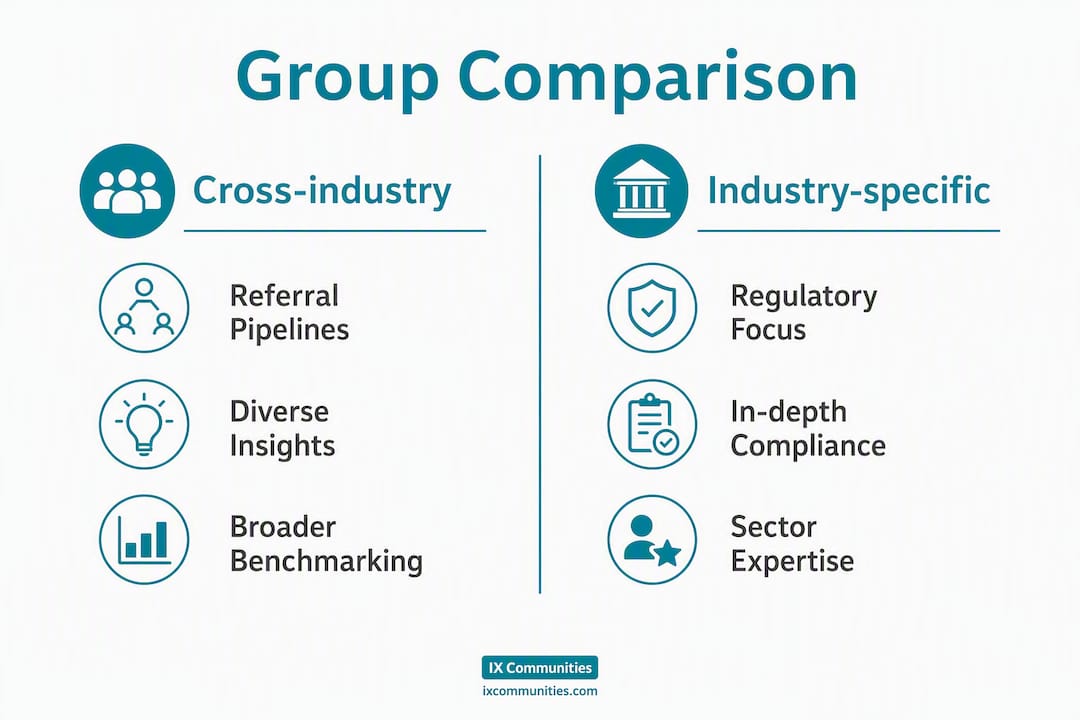
Cross-industry talent groups are the right strategic move when your TA team needs benchmarked hiring data, referral pipelines that don't compete with your own sourcing, and peer counsel from leaders who face the same problems in different verticals. For recruiting leaders at mid-to-large companies, the three groups worth evaluating are Ixcommunities (which operates ESIX and TLIX), each structured around secure peer networking, proprietary benchmarking surveys, and vetted membership composition. The immediate next step: request a benchmark sample or schedule a pilot membership inquiry before your next planning cycle.
- Cross-industry groups generate referral pipelines; industry-specific groups generate supplier relationships and advocacy.
- Vetted membership (one professional per specialty) eliminates internal competition and creates proactive referral behavior.
- Proprietary benchmark surveys give TA leaders data that is not available through public sources or single-industry peers.
- Companies that hire outside their industry are 1.7x more likely to report significant innovation, per LinkedIn Talent Solutions data.
Table of Contents
- What cross-industry groups deliver that industry-specific groups usually don't
- What you should expect from a cross-industry talent group's calendar
- Who benefits most and the use cases that deliver fastest ROI
- How to evaluate and choose a cross-industry talent group
- Time to value and ROI metrics worth tracking
- Research and real-world evidence that validate cross-industry membership
- Key Takeaways
- A practitioner's perspective on making membership work
- Ixcommunities gives TA leaders a vetted cross-industry peer community
- Useful sources and further reading
What cross-industry groups deliver that industry-specific groups usually don't
The core difference is structural. In an industry-specific group, members compete for the same candidates, the same clients, and sometimes the same roles. That dynamic suppresses candor and limits referrals. Cross-industry groups function as referral ecosystems precisely because members don't overlap on business objectives.
Five concrete benefits:
- Diversity of thinking. Recruiting from adjacent industries breaks internal silos and surfaces leaders with transferable skills, adaptability, and crisis management experience that industry-only pipelines rarely produce.
- Non-competing referral pathways. Members refer freely when they know no one in the room is a direct competitor. Rhythm of Business identifies this as the primary driver of referral volume in cross-industry models.
- Access to candidate DNA. Skills like data analytics and digital transformation experience transfer across sectors in ways that industry-specific hiring managers routinely underestimate.
- Proprietary benchmarking data. Peer surveys within a cross-industry group capture compensation, time-to-fill, and quality-of-hire data across multiple verticals, giving members a broader calibration baseline.
- Knowledge not available inside a single vertical. Open innovation research confirms that cross-industry collaboration surfaces solutions to multi-industry challenges that no single sector can generate alone.
Cross-industry groups are where revenue-generating referrals happen. Industry groups are better for supplier relationships and advocacy. — Rhythm of Business
| Dimension | Cross-industry group | Industry-specific group |
|---|---|---|
| Best for (use case) | Referral pipelines, benchmarking, innovation hiring | Supplier relationships, regulatory advocacy, sector norms |
| Membership activities/outputs | Peer surveys, mentorship, training, secure forums, benchmark reports | Conferences, trade advocacy, sector-specific research |
| Confidentiality & security | High: vetted membership, one-per-specialty rules, secure platforms | Variable: members may be direct competitors |
| Time to value | 3–6 months for first referral or benchmark output | Immediate for sector news; slower for hiring impact |
| Pricing model | Annual subscription, per-seat, or survey access fees | Annual dues, event fees |
| Benchmarking access | Cross-vertical data; broader calibration baseline | Single-sector data; useful for sector norms only |

What you should expect from a cross-industry talent group's calendar
Recurring benchmark surveys are the anchor deliverable. Members submit anonymized hiring data two to four times per year; the group aggregates and returns calibrated reports showing time-to-fill, offer acceptance rates, and cost-per-hire across industries. TA teams use these reports to validate internal targets, justify headcount requests, and calibrate compensation bands.
Secure peer calls and forums run monthly or quarterly. These are structured discussions, not open chat rooms. Topics rotate across sourcing strategy, technology evaluation, and leadership hiring. The outputs are shared notes, anonymized case examples, and occasionally co-developed playbooks that members adapt for their own teams.
Mentorship cohorts pair senior TA leaders with peers at different career stages or company sizes. The pairing is cross-industry by design, which means a Head of TA at a financial services firm might mentor a counterpart in healthcare. That cross-sector exposure accelerates perspective-taking in ways that same-industry mentorship rarely does.
Training programs and expert speaker sessions round out the calendar. These cover recruiter skills, technology benchmarking, and best practices in executive and diversity recruiting. Members access these as part of their subscription; non-members can often purchase individual courses.
Pro Tip: Schedule a standing 30-minute monthly block to review benchmark report outputs and map findings to your current open requisitions. Teams that build this habit see faster calibration on offer decisions and fewer extended time-to-fill cycles.
Who benefits most and the use cases that deliver fastest ROI
Role-to-value mapping:
- Head of TA. Gains benchmarking data for board-level reporting and peer validation for TA strategy decisions.
- Executive recruiting lead. Accesses referral pipelines for senior roles where candidate pools are thin and industry-specific sourcing has plateaued.
- Diversity recruiting lead. Uses cross-industry candidate profiles to expand sourcing beyond conventional pipelines; diverse leadership teams correlate with stronger financial and social impact outcomes across McKinsey's dataset of 1,265 companies.
- TA operations. Applies benchmark survey data to calibrate SLAs, technology spend, and recruiter productivity targets.
- Employer branding. Draws on peer examples from other industries to test messaging frameworks before committing to campaigns.
Four use cases with measurable outcomes:
- Benchmarking hiring velocity. A TA leader uses quarterly survey data to identify that their time-to-fill for senior roles runs 20% above the cross-industry median, then restructures the interview process accordingly.
- Building a referral pipeline for hard-to-fill roles. An executive recruiting lead surfaces three qualified candidates through peer referrals within 60 days, roles that had been open for over 90 days through traditional sourcing.
- Validating competency models. A TA operations team uses cross-industry peer input to stress-test a new leadership competency framework before rolling it out globally.
- Sourcing adaptable leaders. A diversity recruiting lead identifies candidates with transferable capabilities from adjacent sectors, expanding the qualified pool for a transformation-focused leadership role.
When industry-specific groups still win: If the primary need is regulatory intelligence, sector-specific compliance benchmarking, or supplier relationship management, an industry-specific group delivers faster and more targeted value. Cross-industry membership is not a replacement for sector expertise; it is a complement to it.
How to evaluate and choose a cross-industry talent group
Evaluation checklist:
- Membership composition: does the group enforce one professional per specialty?
- Cohort size and rebalance cadence: how often does the operator audit and rebalance membership?
- Confidentiality safeguards: what platform security and data-sharing protocols are in place?
- Benchmarking methodology: what is the sample size, how is data anonymized, and how frequently are reports published?
- Mentorship and training offerings: are these included in the subscription or priced separately?
- Pricing model and cancellation terms: is the contract annual with a defined exit clause?
Questions to ask during a vetting call:
- How many members currently hold a role similar to mine, and in which industries?
- Can you share a sample benchmark report or anonymized output?
- What is the average referral-to-hire conversion rate among active members?
- How are new members vetted, and what happens when a member's role changes?
Red flags that predict low ROI: overlapping specialties within the same cohort; no published benchmarking methodology; weak or absent vetting processes; no confidentiality agreements; operators who cannot provide member references.
Pro Tip: Run a 90-day pilot with a minimum commitment of two peer calls and one benchmark survey submission. Measure referrals initiated, benchmark reports accessed, and at least one calibration decision made using group data. If none of those three signals appear within 90 days, the group's engagement model is not structured for your needs.
Time to value and ROI metrics worth tracking
Typical timeline:
- Months 1–3. Onboarding, first peer call, first benchmark survey submission. Leading indicator: number of peer connections made and benchmark reports accessed.
- Months 3–6. First referral initiated or candidate profile shared. Benchmark data applied to at least one open requisition. Leading indicator: referrals in pipeline.
- Months 6–12. First referral-to-hire conversion. Benchmark data used in board or leadership reporting. Lagging indicator: cost-per-hire delta versus pre-membership baseline.
Priority metrics:
- Referrals closed (number of hires sourced through group referrals)
- Time-to-fill improvement for benchmarked roles
- Quality-of-hire proxies (90-day retention, hiring manager satisfaction scores)
- Benchmark report utilization (number of reports accessed and applied to decisions)
- Cost-per-hire delta versus pre-membership baseline
Simple ROI formula: (Value of referral hires + cost-per-hire savings) minus annual membership cost = net membership ROI. Attribution requires tagging referral source at the point of candidate introduction, not at the point of hire.
On pricing: most structured peer groups operate on annual subscription models. Some charge per-seat for additional team members; others include survey access in the base fee. Clarify whether benchmark reports, training courses, and mentorship programs are bundled or priced separately before signing.
Research and real-world evidence that validate cross-industry membership
JRG Partners documents that talent mobility across industries brings leaders with transferable skills who accelerate digital transformation and organizational resilience. The Bowdoin Group adds that cross-industry hires reset team mindsets and are most valuable when long-term strategic change is the goal, not immediate sector-specific impact. Academic open innovation research confirms that cross-industry knowledge exchange surfaces solutions unavailable within a single vertical.
A 2025 cross-industry innovation study found that successful cross-industry collaboration shifts through distinct phases (initiation, development, pilot, scale-up) and that structured interaction and active participation are what determine long-term outcomes. That finding maps directly to membership design: groups that enforce participation norms and structured engagement produce better member outcomes than open-access communities.
"Cross-industry hiring and fractional leadership unlocks innovation, operational excellence, and cost savings in talent-scarce markets." — CDO Times
Entity profiles:
Ixcommunities (ESIX and TLIX): Operates peer networking and benchmarking communities for corporate TA, executive recruiting, and diversity recruiting leaders. Offerings include proprietary benchmark surveys, secure peer forums, recruiter mentorship programs, technology benchmarking tools, expert speaker sessions, and a proprietary search consultant database. Membership is vetted and structured for confidentiality. ESIX focuses on executive search and recruiting leadership; TLIX serves talent acquisition and HR leadership more broadly.
Key Takeaways
Cross-industry talent groups deliver measurable hiring outcomes when membership is vetted, benchmarking is proprietary, and engagement is structured around referral and peer learning rather than open networking.
| Point | Details |
|---|---|
| Referral advantage | Cross-industry groups generate referral pipelines; industry-specific groups serve supplier and advocacy needs. |
| Membership design matters | One-per-specialty rules eliminate internal competition and drive proactive referral behavior. |
| ROI timeline | Expect first referral signals in months 3–6 and measurable cost-per-hire impact by month 12. |
| Diversity and performance | Diverse leadership teams correlate with stronger financial and social outcomes across McKinsey's 1,265-company dataset. |
| Ixcommunities | ESIX and TLIX provide vetted cross-industry peer communities with proprietary benchmarks, mentorship, and secure forums. |
A practitioner's perspective on making membership work
The most common mistake TA leaders make with peer group membership is treating it as a passive resource. Benchmark reports sit unread. Peer calls get deprioritized when a search heats up. Referral introductions go unacknowledged for weeks. The groups that produce measurable outcomes are the ones where members show up prepared, share real data, and follow through on introductions within 48 hours.
When onboarding into a new cross-industry group, the first priority is completing the benchmark survey, even if the data feels incomplete. Partial data is still calibration data, and submitting it signals to other members that you are an active participant. That signal matters more than most leaders expect.
On confidentiality: treat every peer call as if the content is proprietary, because it is. Use anonymized framing when sharing peer insights internally ("a peer in financial services benchmarks at X") and never attribute specific data points to named individuals or companies outside the group. That discipline is what sustains the trust that makes referrals possible.
One concrete outcome worth noting: a TA leader who joined a cross-industry group and committed to two peer calls per quarter closed a senior leadership role in 47 days, compared to a 90-day average for similar roles sourced through traditional channels. The referral came from a peer in a non-competing industry who had worked with the candidate directly.
Ixcommunities gives TA leaders a vetted cross-industry peer community
Ixcommunities operates ESIX and TLIX as the preeminent peer networking and benchmarking communities for corporate talent and recruiting leaders. Membership is vetted, structured for confidentiality, and designed around the evaluation criteria covered in this guide: one-per-specialty composition, proprietary benchmark surveys, secure peer forums, mentorship programs, and expert speaker access.
ESIX serves executive recruiting and talent leadership; TLIX serves broader TA and HR leadership functions. Both communities include access to proprietary benchmark reports, a search consultant database, technology benchmarking tools, and recruiter training through IX Academy. The ESIX recruiter mentorship program pairs recruiting leaders with experienced peers for structured development. Membership pricing is annual subscription-based; training courses and database access are available separately for non-members.
To evaluate fit, request a sample benchmark report or inquire about a pilot membership at ixcommunities.com/en-us/membership.
Useful sources and further reading
- Benefits of Talent Acquisition Groups for HR Leaders — Explains why professional TA groups matter for HR leaders and how cross-industry collaboration supports benchmarking and peer learning.
- Why Corporate Executive Search Teams Are Growing in 2026 — Context on in-house executive search growth and why peer benchmarking matters for internal recruiting teams.
- JRG Partners: Talent Mobility — Practitioner case for recruiting executives from adjacent industries to drive resilience and digital transformation.
- Bowdoin Group: Cross-Industry Hires — Analysis of when cross-industry hires reset team mindsets and accelerate strategic change.
- Rhythm of Business: Industry-Specific vs. Cross-Industry — Practical framework for choosing between group types, including membership design principles.
- Cross-Industry Collaboration in Open Innovation — Academic research on how cross-industry knowledge exchange enables transformative business model shifts.
- Cross-Industry Innovation Network Dynamics (2025) — 2025 study documenting how structured interaction phases determine cross-industry innovation outcomes.
- Ixcommunities Benchmark Surveys — Access to proprietary benchmarking surveys and reports for TA benchmarking use cases.