

Privacy determines whether candidates trust your recruitment network enough to share the information you need to hire well, and mishandling it creates legal exposure and talent-brand damage that outlasts any single hire. The role of privacy in recruitment networks is not a legal afterthought bolted onto the applicant experience. It is the operating condition that makes sourcing, screening, and onboarding work at all.
Three actions belong on your desk this week:
- Update your applicant privacy notice to disclose data collected, legal basis, retention periods, and any automated decision-making involved in screening.
- Require a data processing agreement and, for AI tools, a documented privacy impact assessment from every recruitment vendor before renewal.
- Insert a human-review checkpoint into any workflow that uses algorithmic scoring to filter or rank candidates.
Candidates who sense their data is being handled carelessly disengage before you ever get to interview them, and regulators increasingly agree that recruitment data deserves the same scrutiny as financial or health records. Getting this right protects candidate rights, preserves the trust your talent brand depends on, and reduces the odds of a compliance failure turning into a headline.
Pro Tip: Treat your applicant privacy notice as a living document. Review it every time you add a new sourcing tool, assessment vendor, or AI screening feature, not just once a year.
Key Takeaways
Privacy governs whether recruitment networks earn candidate trust, meet legal obligations under frameworks like GDPR and the FCRA, and avoid the reputational damage of a data-sharing scandal.
| Point | Details |
|---|---|
| Update your privacy notice | Disclose data types, legal basis, retention, recipients, and any AI-driven screening. |
| Vet every vendor contract | Require a DPA, subprocessor list, audit rights, and breach notification timing before signing. |
| Add human review to AI screening | Insert a checkpoint before algorithmic scores influence hiring decisions to limit FCRA exposure. |
| Limit data collection by stage | Request sensitive data like health details only once an offer is imminent, not during sourcing. |
| Retain data on purpose, not by default | Tie retention periods to hiring cycles, consent, or documented litigation holds. |
| Benchmark against peers | Ixcommunities membership gives HR leaders a way to compare privacy and vendor-governance practices against other organizations. |
Table of Contents
- What Types of Applicant Data Carry the Highest Privacy Risk?
- How Does Candidate Data Move Through a Recruitment Network?
- What Legal Rights Do Candidates Have Over Their Data?
- Why Is AI Screening the Biggest Emerging Privacy Risk?
- How Long Should You Retain Candidate Data, and What About Cross-Border Transfers?
- What Should You Require From Recruitment Vendors and Partners?
- What Belongs in an Applicant Privacy Notice?
- What Can HR Fix in the Next 90 Days?
- Why Privacy Is a Talent Brand Asset, Not a Compliance Cost
- How Ix Communities Helps You Benchmark Privacy Practices
- Frequently Asked Questions
- Sources
What Types of Applicant Data Carry the Highest Privacy Risk?
Recruitment networks collect far more than a resume and a phone number, and not all of it carries equal weight. Understanding which categories trigger elevated legal protections is the first step toward safeguarding candidate information responsibly.
- Contact and identity data: name, email, phone, mailing address, sometimes government ID numbers for background checks.
- Career history: resumes, cover letters, work history, references, and education records.
- Assessment data: test scores, interview notes, video interview recordings, and psychometric results.
- Behavioral and inferred data: clickstream activity on careers sites, engagement scores, and algorithmically generated candidate rankings.
- Sensitive data: health information disclosed for accommodation requests, biometric data from video screening tools, and demographic data collected for diversity reporting.
Each category maps to a different stage of the funnel. Contact data supports sourcing, assessment data supports screening, and sensitive data typically only becomes relevant once an offer is close. Sensitive and inferred data deserve the most caution because many state and international frameworks classify them as special categories requiring explicit consent or a narrower lawful basis than ordinary employment data.
Pro Tip: Stage-gate sensitive requests. Ask for health or accommodation details only once an offer is imminent, not during initial screening, and never make broad demographic data collection mandatory for candidates to proceed.
How Does Candidate Data Move Through a Recruitment Network?
Data protection in recruitment starts with knowing where information actually travels, and the honest answer is: further than most HR leaders assume. A typical flow looks like this:
- A candidate submits an application through a careers page or job board.
- The applicant tracking system (ATS) ingests and stores that data.
- Assessment vendors receive test or interview data for scoring.
- Sourcing and outreach tools pull data back into campaigns or talent pools.
- Analytics and advertising networks embedded on the careers site capture behavioral signals.
- Client teams, hiring managers, and sometimes external recruiters receive shared access.
Every arrow in that chain is a point where data leaves your direct control. Background-check firms, ad-tech vendors, and social platforms are the most common third-party recipients, and few employers audit what those partners do with the data once received.
The scale of this exposure is larger than most talent leaders assume. A 2026 industry audit found that 90% of job search and networking platforms sell or share user data with third-party businesses, including resumes and cover letters, and a related academic study found that 87.5% of job-search websites leak user activity to third parties. Practitioners warn that many recruiters assume a platform's privacy protections extend automatically to the employer, when in practice platforms frequently reserve the right to repurpose candidate data for advertising and analytics.

Tracking pixels and cookies embedded on your careers site are often the quiet leak point. If your site loads third-party advertising scripts, a candidate's activity, including which jobs they viewed and how long they spent on a listing, can be captured and sold without either the candidate or your HR team fully realizing it.
What Legal Rights Do Candidates Have Over Their Data?
Candidate privacy rights vary by jurisdiction, but a consistent core has emerged across the frameworks that matter most to recruitment data privacy laws.
- Access and correction: candidates can typically request a copy of the data you hold and ask you to fix inaccuracies.
- Erasure and objection: candidates can request deletion of their data once a lawful basis no longer applies, or object to certain processing outright.
- Transparency and notice: candidates must be told what is collected, why, and for how long, before or at the point of collection.
- Consumer-reporting protections: background checks and, increasingly, AI-driven scoring may fall under the Fair Credit Reporting Act (FCRA), which requires disclosure and adverse-action notices.
- State-level social media restrictions: several states limit employer access to candidates' private social media accounts.
- Biometric limits: jurisdictions with biometric privacy statutes require separate consent before collecting facial or voice data from video interviews.
For each of these, there's a concrete action. If you use algorithmic screening, disclose it and offer a path to human review. If a background-check vendor could trigger FCRA obligations, build adverse-action notices into your process now, not after a rejected candidate complains. GDPR requires a documented lawful basis, data minimization, and meaningful human oversight wherever automated decisions significantly affect a candidate, and that standard is a reasonable floor even for employers hiring primarily in the United States.
Pro Tip: When you recruit across multiple jurisdictions, default to the strictest applicable rule for your entire process rather than running parallel compliance tracks. Document which legal basis you applied for each data type. It saves enormous time in an audit.
Why Is AI Screening the Biggest Emerging Privacy Risk?
Algorithmic scoring is where the impact of privacy on hiring is escalating fastest, and the legal exposure is no longer theoretical. A 2026 class-action complaint alleges that certain AI hiring platforms compile third-party data and generate hidden applicant scores that could qualify as consumer reports, which would trigger FCRA-style rights and notice obligations for the employers using them. If a vendor's tool scrapes external sources to build a candidate score, and that score shapes a hiring decision, you may be legally required to treat it the way you would a traditional background check.
Regulatory audits have found that AI recruitment tools sometimes collect more personal information than necessary, operate without adequate transparency, and can enable filtering that produces discriminatory outcomes. The recommended response is consistent: run a data protection impact assessment, disclose automated decision-making clearly, and monitor for bias on an ongoing basis.
That guidance comes from the UK Information Commissioner's Office's audit of AI recruitment tools, and the same office separately advises recruiters to run DPIAs early and build in human review options before deploying AI in candidate decisions. Before signing with any AI screening vendor, insist on answers to these questions:
- Where does the training and scoring data come from, and does the vendor scrape third-party sources?
- Does the vendor consider itself a consumer reporting agency, processor, or controller, and can it document that stance?
- Can the vendor explain, in plain language, why a specific candidate received a specific score?
- What bias testing has the vendor run, and how often is it repeated?
- How long does the vendor retain applicant data, and can you enforce deletion?
Pro Tip: Assume a vendor's AI output carries consumer-reporting risk unless the vendor provides written documentation proving otherwise. A verbal assurance from a sales representative is not evidence you can show a regulator.
How Long Should You Retain Candidate Data, and What About Cross-Border Transfers?
Retention should track a specific driver, not a default "keep everything" setting in your ATS. Common drivers include:
- Active hiring cycle: retain through the decision and onboarding, typically a matter of months.
- Lawful basis expiration: once consent is withdrawn or the basis for processing lapses, deletion should follow.
- Litigation holds: extend retention only when a specific legal risk requires it, and document why.
- Talent pool consent: keep resumes for future opportunities only where the candidate has separately agreed, usually for a defined period such as one or two years.
International transfers add another layer. If your recruitment network moves candidate data across borders, verify that a valid transfer mechanism is in place, such as the U.S. Data Privacy Framework or standard contractual clauses with your vendor.
Pro Tip: Where you don't need identifiable data for reporting or benchmarking, pseudonymize or anonymize it. It is often a cleaner alternative to extended retention.
What Should You Require From Recruitment Vendors and Partners?
Vendor management and contractual controls are where most recruitment data privacy failures actually originate, since the vendor, not the employer, usually holds the data day to day. Before signing or renewing any recruitment technology contract, confirm these clauses are in place:
- A data processing agreement (DPA) specifying purpose limitations and security obligations.
- A current list of subprocessors, so you know who else touches candidate data.
- Documented security controls, including encryption standards and access restrictions.
- Audit rights, letting you or a third party verify compliance claims.
- Breach notification timing, ideally within 72 hours of vendor discovery.
- Data return or deletion guarantees at contract termination.
For any AI or ATS vendor, request a DPIA brief before adoption covering the processing purpose, data flows in and out of the tool, identified risks and mitigations, and an ongoing monitoring plan. Effective DPIAs also need to address data provenance, inferred attributes, and bias testing methodology, details that are frequently missing from standard vendor sales materials and require deliberate procurement follow-up.
Internally, pair vendor controls with governance discipline: role-based access so only relevant staff see candidate files, least-privilege defaults in your ATS, audit logs for who accessed what, and regular privacy training for recruiters who handle sensitive requests. Teams managing recruitment operations at scale often find that structured governance around vendor and client data reduces the operational risk that comes with fast-growing recruitment networks. For sectors handling especially sensitive candidate populations, dedicated recruitment security frameworks offer a useful model for tightening these controls further.
Pro Tip: Never take a vendor's marketing page as proof of compliance. Ask for the actual DPIA, the actual subprocessor list, and the actual security certification, and read them yourself.
What Belongs in an Applicant Privacy Notice?
Candidate notice and transparency start with a clear, accessible document at the point of application. At minimum, your applicant privacy notice should check off each of these:
- What data is collected, in plain categories (contact, resume content, assessment results, and so on).
- The purpose and legal basis for each category of processing.
- Who receives the data, distinguishing internal teams from external vendors.
- How long data is retained and what happens to it afterward.
- What rights candidates have and how to exercise them.
- Whether automated decision-making or AI scoring is used, and how a candidate can request human review.
- A contact point for privacy questions or complaints.
Sample clauses you can adapt: "We use your application data to assess your fit for this role and similar future openings, based on your consent." "Assessment vendors process your test results solely to generate scores shared with our recruiting team." "You may request a copy of the data we hold about you at any time by contacting [privacy contact]." Employers like Nozomi Networks and Ribbon Communications publish notices with this structure, and both are worth reviewing as reference points.
Pro Tip: Link directly to each vendor's own privacy notice from yours, and state plainly which party is the controller and which is the processor for each data category. Candidates and regulators both appreciate the clarity.
What Can HR Fix in the Next 90 Days?
- Publish an updated applicant privacy notice. Owner: Legal, Priority: High.
- Run a DPIA on any AI or algorithmic screening tool in use. Owner: Legal/TA Ops, Priority: High.
- Audit and enforce ATS data retention settings. Owner: TA Ops, Priority: High.
- Remove unnecessary tracking pixels from careers pages. Owner: Marketing/IT, Priority: Medium.
- Renegotiate vendor contracts to include DPAs and audit rights. Owner: Procurement, Priority: High.
- Add a human-review checkpoint to AI-driven candidate scoring. Owner: TA Ops, Priority: High.
- Train recruiters on handling sensitive data requests. Owner: HR/L&D, Priority: Medium.
- Document lawful basis for each category of data collected. Owner: Legal, Priority: Medium.
- Verify cross-border transfer mechanisms with international vendors. Owner: Legal, Priority: Medium.
- Review talent-pool consent language and retention windows. Owner: TA Ops, Priority: Low.
Why Privacy Is a Talent Brand Asset, Not a Compliance Cost
Privacy practices shape how candidates experience your recruitment network long before they accept an offer, and that experience follows your employer brand into every future hiring cycle. A candidate who feels surveilled or misled during screening rarely applies again, and word travels fast in tight talent markets. Investing in transparent data practices is not just risk mitigation. It is a direct input into candidate quality and retention.
Rising public concern about data privacy gives HR leaders a real argument for internal investment in this area, not just a defensive one. Organizations that get ahead of it, rather than reacting to a breach or a lawsuit, build a durable advantage in markets where hiring is only getting harder. Talent leaders who want a sharper read on where their own practices stand should benchmark them against peers facing the same regulatory and AI-adoption pressures, rather than guessing in isolation.
How Ix Communities Helps You Benchmark Privacy Practices
Building the vendor clauses, DPIA templates, and notice language covered above is easier when you're not building them alone. Ixcommunities gives talent leaders a peer network built specifically for that comparison work: secure communities where HR and TA leaders at other mid to large organizations share how they've handled vendor due diligence, AI disclosure language, and applicant notice updates, rather than relying on generic templates.
Two places to start are the Benchmark Surveys, where you can see how your privacy and vendor-governance practices compare to peer organizations, and the ESIX Recruiter Peer Mentorship Program, which pairs you with recruiting leaders who have already navigated AI vendor contracts and notice overhauls. If you're ready to see how your recruitment privacy practices measure up, explore Ixcommunities membership and get access to the benchmarking data and peer discussions built for exactly this work.
Frequently Asked Questions
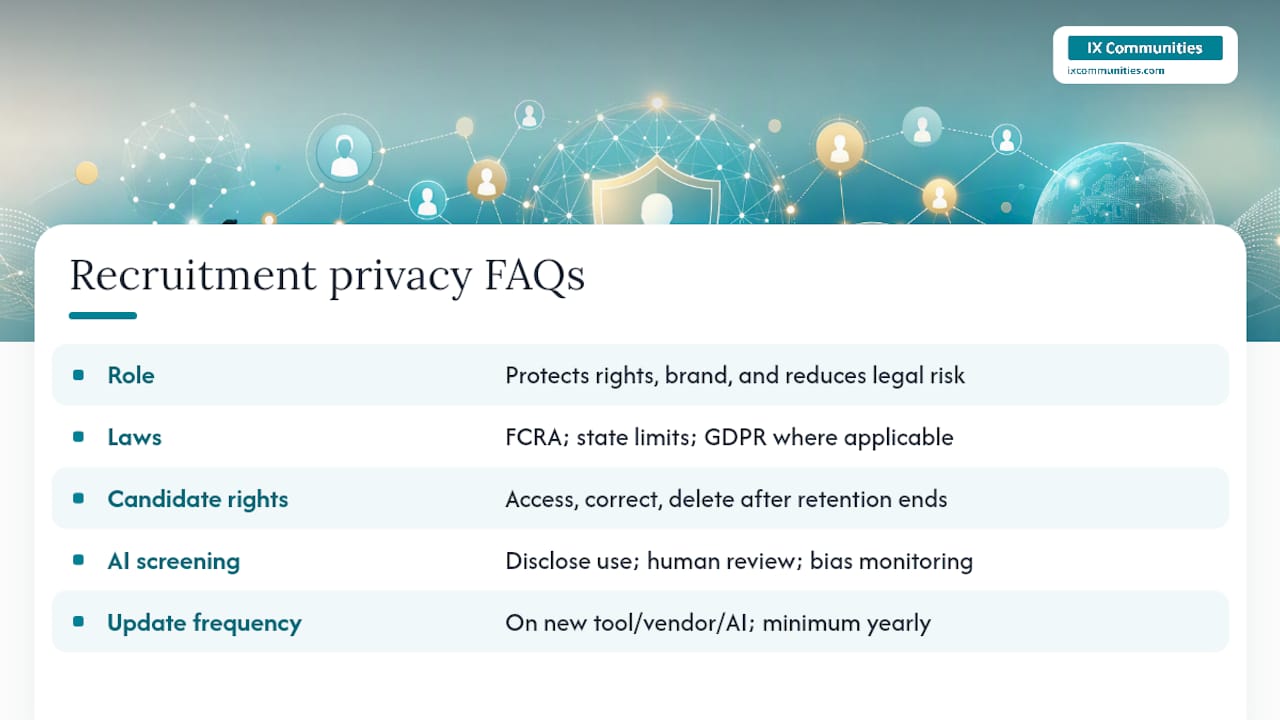
What is the role of privacy in recruitment networks? Privacy protects candidate rights, keeps your talent brand trustworthy, and reduces legal exposure across every stage of hiring, from sourcing through onboarding. It shapes what data you collect, how vendors handle it, and how transparent you are about automated screening.
What data protection laws apply to recruitment in the United States? The FCRA governs background checks and potentially AI-driven scoring treated as consumer reports, while several states impose their own social media and biometric data restrictions. Employers hiring internationally also need to account for GDPR-style requirements where candidates are located abroad.
Do candidates have the right to see or delete their recruitment data? Most modern privacy frameworks give candidates rights to access, correct, and request deletion of their data once your lawful basis for holding it expires. Your applicant privacy notice should explain exactly how to exercise those rights.
Are AI screening tools legal to use in recruitment? Using AI screening tools is generally lawful, but regulators expect disclosure, human review options, and bias monitoring. If a tool's scoring could qualify as a consumer report, additional FCRA-style notice obligations may apply.
How often should HR teams update their applicant privacy notice? Review it any time you add a new sourcing tool, assessment vendor, or AI feature, and at minimum annually, since regulatory frameworks and vendor terms both change frequently.
This article is general information, not a substitute for advice from a qualified lawyer. Consult a qualified legal professional about your own circumstances before acting on anything here.
Sources
- 90 Percent Of Job Platforms Sell User Data, Study Finds — Here Are The Biggest Offenders (Inc.)
- Lawsuit targets AI hiring tools using consumer data (ACA International)