

Leadership talent development is the deliberate process of assessing, nurturing, and advancing leadership capabilities within an organization to improve performance and prepare future leaders. Organizations that implement systematic leadership training can realize up to a 25% increase in productivity and profitability. That figure reflects a direct return on structured investment, not a byproduct of general management activity. This leadership talent development guide covers the core components, implementation methods, measurement frameworks, and cultural conditions that make leadership programs work. It draws on standards from FranklinCovey, McKinsey, and CIPD to give HR professionals and corporate leaders a clear, evidence-based path forward.
What are the essential components of a leadership talent development program?
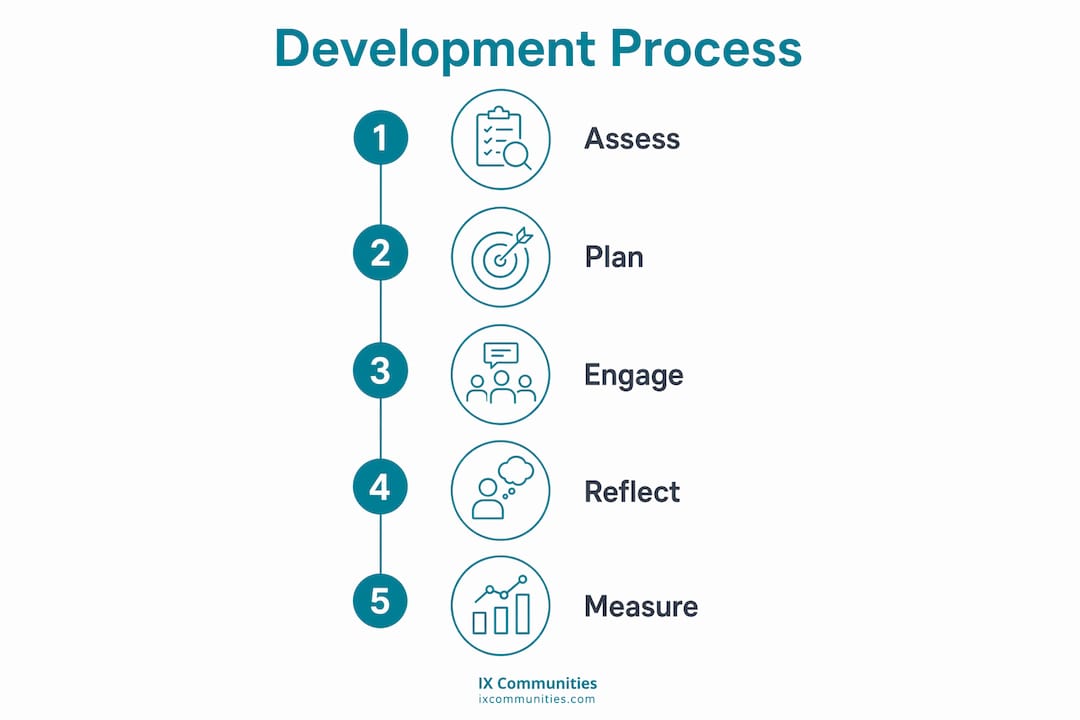
A well-built leadership development program follows a structured sequence. Industry standards define a six-step process focused on behavior change, not course completion. Each step builds on the previous one, and skipping any step weakens the entire program.
The five core components are:
-
Assessment. Start with honest, multi-source evaluation. Many leadership plans fail because leaders overestimate their own effectiveness. 360-degree feedback combined with strengths assessments closes the gap between self-perception and reality. This step gives both the leader and the organization a shared, accurate baseline.
-
Competency identification. Identify 1–3 high-impact leadership skills aligned with organizational strategy. Pursuing too many competencies dilutes focus and prevents deep development. Combining assessment data, manager input, and strategic direction helps prioritize the right skills. Fewer targets produce stronger results.
-
Goal setting. Use SMART goals and WIG® (Wildly Important Goals) frameworks to create measurable, focused outcomes. Vague goals produce vague progress. Specific targets give leaders and their managers a clear standard to track against.
-
Relationship-based learning. Coaching, mentorship, and peer accountability are not optional add-ons. Leadership coaching paired with accountability partners produces a 95% goal achievement rate. Self-directed learning alone cannot match that result.
-
Ongoing tracking and review. Schedule regular check-ins at 30, 90, and 180 days. Continuous review cadences that include mentor conversations and goal alignment updates keep development plans relevant as organizational priorities shift.
Pro Tip: Pair each leader with a peer accountability partner from a different department. Cross-functional pairing reduces groupthink and surfaces blind spots that same-team partners often miss.
How to design activities that drive real behavior change

Formal classroom training alone does not change behavior. The 70-20-10 learning model allocates 70% of development to experiential learning, 20% to social learning, and 10% to formal instruction. That ratio reflects how adults actually build skills, not how most training budgets are spent.
Effective development activities include:
- Stretch assignments. Place leaders in roles or projects that require skills they have not yet mastered. Discomfort is the mechanism. A finance manager leading a cross-functional product launch builds influence and communication skills faster than any workshop.
- Cross-functional projects. Exposure to different business units builds systems thinking. Leaders who understand how sales, operations, and HR interact make better decisions at every level.
- Simulations and scenario exercises. Structured simulations let leaders practice high-stakes decisions without real-world consequences. Debrief sessions after simulations are where the actual learning happens.
- Real-time coaching. Coaching delivered in the moment, tied to a specific situation the leader just experienced, produces faster behavior change than scheduled coaching sessions disconnected from daily work.
- Peer learning circles. Small groups of leaders meeting regularly to share challenges and solutions create accountability without hierarchy. These circles work best with 4–8 participants and a structured agenda.
Treating development as isolated events rather than a continuous process is the most common reason programs fail. Capability builds through daily practice and project-based application, not through annual off-sites. Technology platforms can support this by delivering microlearning, tracking progress, and connecting leaders with coaches between formal sessions. Using internal video for engagement is one practical way to scale social learning across distributed teams.
Pro Tip: Schedule a 15-minute debrief with a coach or manager within 48 hours of any stretch assignment. Reflection within that window locks in learning before the experience fades.
How can organizations measure the impact of leadership development?
Measuring leadership development requires more than tracking course completion rates. Completion tells you what leaders attended. It does not tell you whether their behavior changed or whether the organization benefited.
The most useful measurement framework combines quantitative KPIs with qualitative feedback. McKinsey research identifies four categories that one technology company uses to measure leadership development success: development time, 360-degree feedback shifts, client satisfaction, and employee satisfaction. Each category captures a different dimension of impact.
Key performance indicators worth tracking include:
- Engagement scores. Leaders who develop their skills tend to run more engaged teams. Track engagement at the team level, not just the organizational level.
- Retention rates. High-potential employees stay longer when they see a clear development path. Retention data tied to program participation reveals whether development is working.
- Productivity improvements. Output metrics at the team level, measured before and after a development cycle, show whether leadership behavior is translating into results.
- 360-degree feedback shifts. Comparing pre-program and post-program 360 scores gives a direct read on behavior change from multiple perspectives.
Qualitative data matters equally. A short narrative from a direct report describing a specific behavior change carries more credibility with executives than a percentage point shift in a survey score. Combine both types in quarterly reporting to stakeholders. The 30, 90, and 180-day checkpoint cadence creates natural reporting moments without requiring a separate measurement infrastructure.
What role does executive leadership play in sustaining development programs?
Executive sponsorship is the single most reliable predictor of whether a leadership development program produces lasting results. McKinsey's leadership factory model is explicit: CEOs must be actively involved in managing development interventions, not delegate them entirely to HR. Delegation signals that leadership development is an HR initiative rather than a business priority. That signal travels fast through an organization.
"Successful leadership factories require CEO prioritization and hands-on involvement with high-potential cohorts working in small peer group settings to foster authentic growth. Executive involvement is not ceremonial. It is the mechanism that connects leadership development to real business outcomes and signals to the organization that the work matters."
Aligning development programs with top-level strategic priorities is the practical expression of that involvement. When a CEO names two or three business challenges and asks the leadership development program to build the capabilities needed to address them, the program gains a clear mandate. That mandate makes it easier to select competencies, design activities, and measure outcomes.
CIPD guidance reinforces that there is no single talent management model that works for every organization. HR professionals should adopt evidence-based strategies tailored to their specific organizational context. That means resisting the pull toward off-the-shelf programs that were designed for a different company's problems. It also means connecting talent management and recruiting into a unified strategy rather than running them as separate functions.
Small, high-performing peer groups are a structural tool that supports both executive involvement and authentic development. Groups of 6–12 high-potential leaders, meeting regularly with senior sponsorship, create the psychological safety needed for honest reflection. That safety is what separates peer groups that produce growth from those that produce polished presentations.
Key Takeaways
Effective leadership talent development requires a structured, continuous process that connects individual behavior change to measurable organizational outcomes, with active executive sponsorship at every stage.
| Point | Details |
|---|---|
| Start with honest assessment | Use 360-degree feedback to close the gap between self-perception and actual performance. |
| Limit competency targets | Focus on 1–3 skills aligned to strategy; pursuing more dilutes impact and slows progress. |
| Apply the 70-20-10 model | Allocate 70% of development to experiential learning, not formal classroom instruction. |
| Measure behavior, not completion | Track 360 shifts, retention, and engagement scores at 30, 90, and 180-day intervals. |
| Require executive sponsorship | CEO involvement, not HR delegation alone, determines whether programs produce lasting results. |
What I have learned about leadership development that most guides skip
The most common failure I see in leadership development programs is not a lack of tools or budget. It is the absence of a clear link between the development activity and a real business problem the organization is trying to solve. Programs built around generic competency frameworks produce generic leaders. Programs built around specific strategic challenges produce leaders who can actually move the business forward.
The second pattern worth naming is the overreliance on formal training as the primary vehicle. Organizations spend significant resources on workshops and certifications, then wonder why behavior does not change back on the job. The leadership pipeline research is consistent on this point: capability builds through practice, feedback, and application, not through attendance. The 70-20-10 model is not a new idea, but most organizations still invert it in practice.
Peer learning is the most underused asset in most development programs. When leaders at the same level share real challenges in a structured, confidential setting, the quality of insight they generate exceeds what most external consultants provide. The reason is simple: they have the same organizational context. Ixcommunities is built on exactly this principle, connecting talent and recruiting leaders in peer groups where benchmarking and shared learning happen in a secure environment.
The last point is about continuity. A development plan reviewed once a year is not a development plan. It is a document. The organizations that build strong leadership capability treat development as a management rhythm, not an annual event.
— Simon
How Ixcommunities supports your leadership development programs
HR professionals and corporate leaders who want to move beyond generic training programs have a direct path through Ixcommunities. The platform connects talent leadership professionals in peer networks where real benchmarking, shared learning, and structured mentoring replace one-off workshops.
The Talent Leaders Peer Mentoring Program gives HR leaders access to structured peer cohorts designed specifically for leadership development at scale. Ixcommunities also offers guest speaker programs that bring executive perspectives directly into your development curriculum. For organizations that want data to support their programs, benchmark surveys provide the comparative metrics needed to validate investment and guide competency selection. These resources work together as a connected system, not as isolated events.
FAQ
What is leadership talent development?
Leadership talent development is the structured process of identifying, assessing, and building leadership capabilities within an organization to improve performance and prepare future leaders. It differs from general training by focusing on behavior change tied to specific organizational outcomes.
How many competencies should a leadership development plan target?
A leadership development plan should target 1–3 competencies at a time. Focusing on more than three dilutes effort and prevents the deep practice needed to change behavior.
What does the 70-20-10 model mean for leadership programs?
The 70-20-10 model allocates 70% of development to on-the-job experiential learning, 20% to social and relationship-based learning, and 10% to formal instruction. Most effective programs weight activities accordingly rather than relying primarily on classroom training.
How should organizations measure leadership development ROI?
Organizations should measure both quantitative KPIs, including retention rates, engagement scores, and productivity metrics, and qualitative feedback such as 360-degree shifts and stakeholder narratives. Checkpoints at 30, 90, and 180 days provide a practical cadence for tracking progress.
Why does executive involvement matter in leadership development?
Executive involvement signals that leadership development is a business priority, not an HR administrative function. McKinsey research shows that CEO-led programs with hands-on involvement in high-potential peer groups produce significantly stronger and more sustained results than programs delegated entirely to HR.