

Internal TA optimization is the strategic improvement of in-house talent acquisition workflows, technology, and metrics to deliver faster, higher-quality hires at lower cost. For large corporations, this means moving beyond reactive recruiting and building a repeatable, data-driven hiring system. Tools like applicant tracking systems (ATS), AI sourcing platforms, and structured KPIs such as time-to-fill and screening conversion rates are the operational foundation. Organizations that rely on tactical recruiting rather than strategic multi-year planning pay a 25 to 40% cost premium per hire. That gap is the business case for treating TA as a strategic function, not a transactional one.
What are the pillars of a successful internal TA optimization framework?
Effective internal TA optimization rests on seven interconnected pillars: workforce planning, employer branding, sourcing strategy, candidate experience, assessment and selection, technology stack, and analytics with continuous improvement. Each pillar depends on the others. A strong sourcing strategy fails without a compelling employer brand. A well-designed assessment process loses value without the data infrastructure to measure its outcomes.
The table below maps each pillar to its primary scope and the KPIs that signal performance.
| Pillar | Scope | Key KPIs |
|---|---|---|
| Workforce planning | Forecasting headcount and skill gaps | Forecast accuracy, internal fill rate |
| Employer branding | Candidate perception and attraction | Application rate, offer acceptance rate |
| Sourcing strategy | Channel mix and pipeline volume | Source-of-hire, pipeline conversion |
| Candidate experience | Quality of every touchpoint | Candidate NPS, drop-off rate |
| Assessment and selection | Structured evaluation and consistency | Screening conversion rate, interview-to-offer |
| Technology stack | ATS, CRM, AI tools integration | System adoption rate, data accuracy |
| Analytics and improvement | KPI tracking and cycle reviews | Time-to-fill, cost-per-hire, quality-of-hire |
The most common failure in large enterprises is treating these pillars as separate programs. A technology upgrade without updated assessment rubrics produces faster but less accurate hiring decisions. Workforce planning disconnected from sourcing strategy creates pipeline gaps at peak demand. The talent acquisition trends shaping 2026 consistently point to integration as the differentiator between high-performing and average TA functions.
Pro Tip: Before investing in new technology, audit which pillars are weakest. Deploying AI sourcing tools into a broken candidate experience process accelerates rejection, not hiring.
How do enterprises map and optimize the internal TA workflow end-to-end?
Workflow mapping is the prerequisite to any meaningful TA process improvement. Without a documented view of every step from requisition approval to offer acceptance, you cannot identify where time is lost or where candidate drop-off occurs. The mapping process should involve both recruiters and hiring managers, since bottlenecks often live at the handoff points between them.
A practical end-to-end mapping process follows this sequence:
- Document every stage from job requisition to day-one onboarding, including approval chains, communication touchpoints, and decision gates.
- Assign time benchmarks to each stage. Enterprise hiring teams should target under 48 hours to screen candidates and a 25% screening interview conversion rate as baseline standards.
- Identify bottlenecks by comparing actual stage durations against benchmarks. Common culprits include scheduling delays, slow hiring manager feedback, and redundant interview rounds.
- Redesign the workflow by eliminating steps that add time without adding decision quality. Consolidate interview rounds where possible and set mandatory feedback windows.
- Pilot the redesigned process in one business unit before scaling. One documented case shows that piloting workflow changes reduced time-to-fill from 62 days to 47 days. That 24% reduction demonstrates proof of concept before committing enterprise-wide resources.
- Collect feedback from recruiters, hiring managers, and candidates during the pilot to surface issues the map did not predict.
A critical warning: mapping workflows exposes "Black Box Hiring" traps where inefficient or hidden steps exist that automation will amplify if left unaddressed. Process simplification must precede technology adoption, not follow it.
Pro Tip: Set a rule that no hiring manager feedback window exceeds 24 hours after an interview. This single change eliminates one of the most common time-to-fill delays in enterprise TA.

What role does AI and technology play in modern TA process improvement?
AI in talent acquisition is most effective when it handles repeatable, time-consuming tasks while preserving human judgment for evaluation and relationship decisions. The right frame is augmentation, not replacement. Intelligent AI should support tasks like scheduling and initial screening but not replace the recruiter's role in assessing fit and building candidate trust.
The highest-value AI applications for internal TA functions include:
- Sourcing automation: AI tools scan LinkedIn, job boards, and internal talent pools to surface qualified candidates based on structured criteria, reducing manual search time significantly.
- Conversational screening: Chatbot-based screening tools conduct initial qualification conversations, freeing recruiters to focus on candidates who meet threshold criteria.
- Interview scheduling: Automated scheduling tools eliminate the back-and-forth that typically adds two to five days to the early hiring stages.
- Candidate engagement: Automated status updates and personalized communication sequences reduce candidate drop-off during long hiring cycles.
The ATS remains the source of truth. CRM tools, AI sourcing platforms, and scheduling software must integrate into the ATS rather than create parallel data streams. Fragmented data produces inaccurate metrics and undermines the quality of any analysis you run. Structured criteria and rubrics within the ATS also control for bias by ensuring every candidate is evaluated against the same standards.
On timeline: AI-supported workflow automation can be deployed in two to four weeks when combined with clear process standards and escalation paths. That speed makes experimentation practical within standard enterprise planning cycles. For TA leaders building the business case internally, this timeline removes the "multi-year implementation" objection that often stalls technology investment.
For a deeper look at balancing AI tools with recruiter skill development, the recruiter training and AI tools resource from Ixcommunities covers this intersection in detail.
How can TA leaders measure success and drive continuous improvement?
Data-driven TA optimization requires both the right metrics and the right review cadence. Tracking time-to-fill alone tells you how fast you hired. Combining it with quality-of-hire, hiring manager NPS, and screening conversion rate tells you whether speed came at the cost of quality or candidate experience.
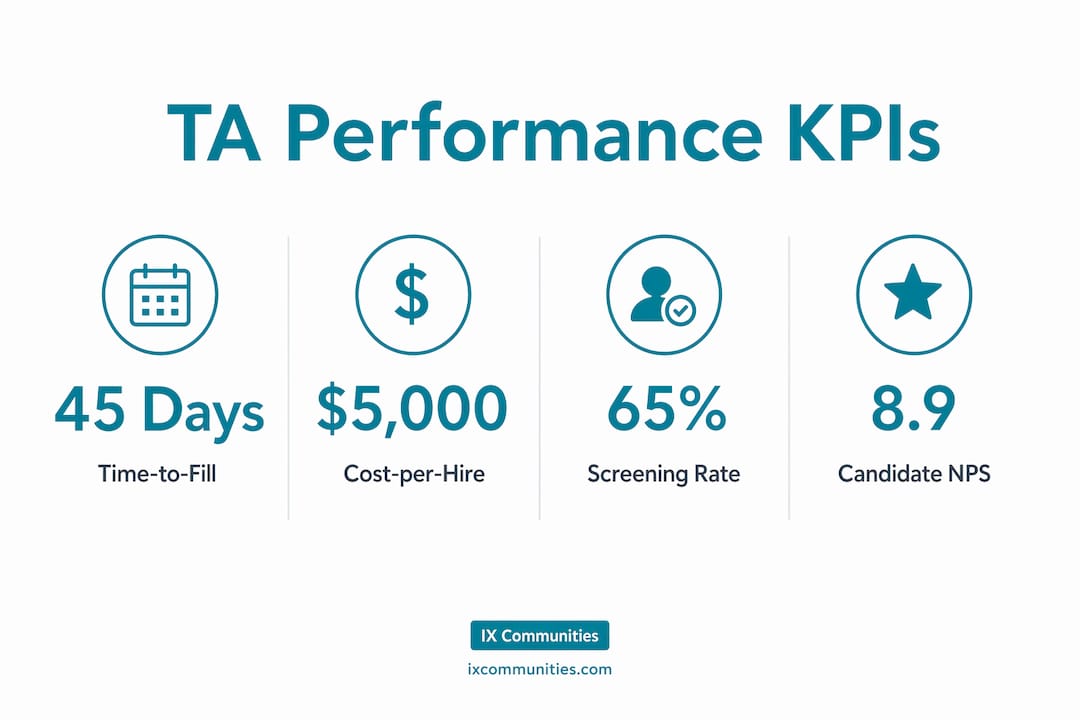
The core KPI set for enterprise TA functions covers six areas: time-to-fill, cost-per-hire, screening conversion rate, candidate NPS, hiring manager NPS, and quality-of-hire. Diversity slate completion is a seventh metric that many large organizations now treat as a non-negotiable reporting requirement. Reviewing executive recruiting metrics at multiple levels of the organization ensures both operational and strategic visibility.
A three-level review cadence structures how these metrics drive decisions:
- Weekly tactical reviews focus on pipeline health, open requisition aging, and scheduling bottlenecks. These are recruiter and coordinator-level conversations.
- Monthly operational reviews assess conversion rates, source-of-hire performance, and candidate experience scores. TA managers and business partners lead these.
- Quarterly strategic reviews evaluate cost-per-hire trends, quality-of-hire outcomes, workforce plan accuracy, and technology adoption rates. These require executive sponsorship to drive cross-functional accountability.
Integrating experiential data from candidate and hiring manager feedback with operational ATS metrics provides a complete view of TA performance. This combination allows leaders to act on emerging satisfaction trends before they become systemic problems. A drop in candidate NPS at the screening stage, for example, signals a specific process failure rather than a general dissatisfaction trend.
What organizational practices maximize internal TA optimization success?
Technology and process redesign account for roughly half of what determines TA optimization outcomes. The other half is organizational. Change management, recruiter capability, and hiring manager engagement determine whether new processes take hold or revert to old habits within six months.
The Enablement Team model addresses the organizational side directly. An Enablement Team within TA functions as an internal consulting unit that strips administrative duplication, simplifies interview layers, and frees recruiters for higher-value work. This is not a support function. It is a structural change that repositions recruiters as strategic advisors rather than process administrators.
Key organizational practices that support sustained improvement include:
- Structured interviewer training: Hiring managers who use calibrated scorecards and behavioral interview frameworks produce more consistent, defensible hiring decisions.
- Clear communication of process changes: Recruiters and hiring managers need to understand why a process changed, not just what changed. Adoption rates are significantly higher when the rationale is explicit.
- Feedback loops during pilots: Scaling a workflow change before collecting structured feedback from participants embeds the wrong behaviors at scale.
- Avoiding over-engineering: Adding complexity to solve a simple problem is a common failure mode. The goal is fewer steps with clearer ownership, not more sophisticated processes.
TA optimization also requires a shift from measuring hiring productivity to building hiring capacity. Capacity includes internal mobility programs, onboarding ownership, and workforce planning participation. This shift moves TA from a reactive cost center to a proactive business function.
Pro Tip: When rolling out a new process, assign one internal champion per business unit. Peer-level advocates drive adoption more effectively than top-down mandates.
Key takeaways
Effective internal TA optimization requires integrating strategic workforce planning, mapped workflows, AI augmentation, and structured KPI reviews within a change-managed organizational framework.
| Point | Details |
|---|---|
| Strategic planning reduces cost | Organizations without multi-year TA plans pay 25 to 40% more per hire than those with structured strategies. |
| Map before automating | Workflow mapping must precede technology adoption to avoid amplifying existing inefficiencies. |
| AI accelerates repeatable tasks | AI-supported automation can be deployed in two to four weeks when process standards and rubrics are in place. |
| Metrics require a review cadence | Weekly, monthly, and quarterly KPI reviews at different organizational levels convert data into decisions. |
| Capacity beats productivity | Shifting focus from hiring output to hiring capacity, including internal mobility, produces sustainable TA performance. |
Where the real leverage in TA optimization actually sits
Most TA leaders I observe focus the majority of their optimization effort on technology selection. They spend months evaluating AI sourcing tools, ATS upgrades, and scheduling platforms. The technology decisions matter, but they are rarely where the leverage is.
The highest-impact changes I have seen in large enterprise TA functions come from two places: workflow simplification and hiring manager accountability. A well-mapped, simplified process with clear ownership at every stage outperforms a sophisticated technology stack built on top of an undocumented, inconsistent workflow. Every time.
The shift from productivity to capacity is the strategic reframe that separates high-performing TA functions from average ones. Productivity thinking asks how many requisitions a recruiter can handle. Capacity thinking asks whether the organization can absorb growth, respond to attrition, and develop internal talent without triggering a reactive hiring crisis. These are fundamentally different questions, and they require different investments.
The data-and-relationships combination is also underrated. Metrics tell you what is happening. Recruiter relationships with hiring managers tell you why. The TA leaders who combine both consistently make better decisions faster than those who rely on dashboards alone. Technology should support that combination, not substitute for it.
— Simon
How Ixcommunities supports your TA optimization work
Ixcommunities operates ESIX, TLIX, and IXCommunities as peer networking and benchmarking groups specifically for talent acquisition and recruiting leaders in large corporations. Members access strategy forums, technology stack discussions, and benchmarking data in a secure environment designed for candid professional exchange.
The ESIX Recruiter Peer Mentorship Programs connect TA leaders with peers who have navigated the same optimization challenges, from workflow redesign to AI adoption and change management. Ongoing events and guest speakers bring current best practices directly to members. For TA leaders building the case for internal investment or looking to benchmark their metrics against peer organizations, Ixcommunities membership provides the reference points and community that accelerate that work.
FAQ
What is internal TA optimization?
Internal TA optimization is the structured improvement of an organization's in-house talent acquisition workflows, technology, and metrics to reduce time-to-fill, lower cost-per-hire, and improve hiring quality. It combines strategic workforce planning, process redesign, AI adoption, and data-driven review cycles.
What KPIs matter most for measuring TA performance?
The core KPIs are time-to-fill, cost-per-hire, screening conversion rate, candidate NPS, hiring manager NPS, and quality-of-hire. Reviewing these at weekly, monthly, and quarterly cadences converts raw data into decisions at the right organizational level.
How long does AI implementation take in a TA function?
AI-supported workflow automation can be deployed in two to four weeks when clear process standards, structured rubrics, and escalation paths are already in place. Attempting AI deployment before process documentation is complete typically extends timelines and reduces adoption.
What is the most common mistake in TA process improvement?
The most common mistake is deploying technology before mapping and simplifying existing workflows. Automation applied to a broken process amplifies inefficiencies rather than eliminating them. Workflow mapping and process simplification must come first.
How does an Enablement Team improve internal recruitment efficiency?
An Enablement Team functions as an internal consulting unit within the TA function, removing administrative duplication and simplifying interview layers. This frees recruiters to focus on candidate relationships and strategic sourcing rather than coordination tasks.