

Sharing best practices in hiring is the process of systematically exchanging proven recruitment methods and workflows to improve hiring quality and consistency across teams. HR professionals who build structured systems for this exchange see measurable gains: companies adopting HR best practice bundles report 20%+ lower turnover and a 4.6% performance increase per additional practice introduced. That is not a marginal improvement. It signals that how you share recruitment knowledge is as important as the knowledge itself. The most effective organizations treat sharing as a formal discipline, not an informal habit.
How to share best practices in hiring: prerequisites and tools
Sharing recruitment techniques at scale requires three foundations before any documentation begins: executive sponsorship, the right technology, and a culture that rewards contribution.
Executive sponsorship sets the tone. When senior talent leaders publicly endorse a shared hiring system, adoption rates rise because the initiative carries organizational weight. Without that signal, individual hiring managers default to their own methods, and knowledge stays siloed.
Technology platforms provide the infrastructure. Centralized repositories built on platforms like Microsoft SharePoint or Notion serve as a single source of truth for hiring playbooks, scorecards, and interview guides. Trapping knowledge in silos inhibits scaling and slows decision-making. A well-organized portal lets any recruiter self-serve answers without waiting for a colleague. For real-time collaboration and peer exchange, tools like Slack and Microsoft Teams create channels where hiring teams can discuss live challenges and share updates quickly.
Learning Management Systems (LMS) add a training layer on top of the repository. An LMS lets you publish structured courses on interviewing technique, bias reduction, and evaluation standards, then track who has completed them. This turns passive documentation into active learning.
- Assign a content owner for each section of the hiring playbook
- Create a dedicated Slack or Teams channel for recruiter questions and updates
- Use an LMS to deliver and track interviewer training completion
- Build a reward system that recognizes contributors who update or improve shared content
Pro Tip: When launching a shared hiring knowledge system, explain the "why" clearly to every stakeholder. Leaders who communicate how shared knowledge removes friction see significantly higher engagement from their teams. Mandate without context creates resistance.
How to document, standardize, and centralize hiring best practices
Documentation is where most organizations stall. The goal is not a comprehensive manual. The goal is a concise, visual, and modular set of resources that recruiters actually use.
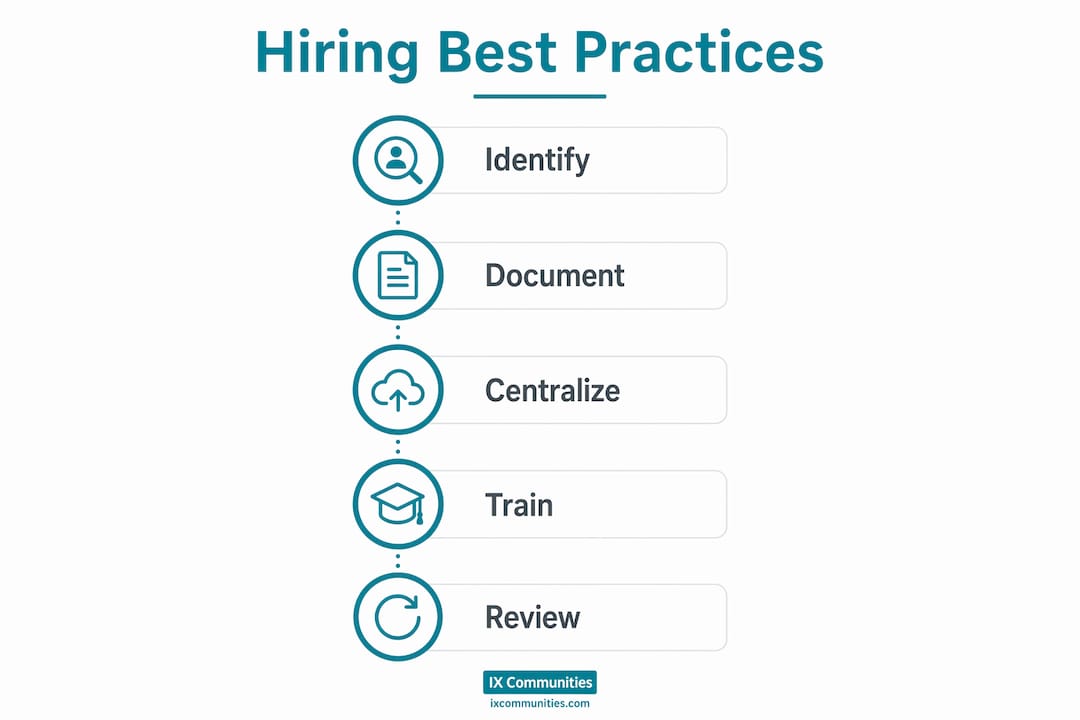
Step 1: Identify what works
Start with data. Pull offer acceptance rates, time-to-fill metrics, and quality-of-hire scores from your applicant tracking system (ATS). Interview hiring managers and recruiters to surface the methods behind your best hires. This stakeholder input reveals which practices are genuinely effective versus which ones simply feel familiar.
Step 2: Document workflows and evaluation tools
Translate successful methods into reusable formats. Standardized scorecards with behavioral anchors and 1–5 rating scales improve evaluation consistency and make calibration sessions more productive. Pair scorecards with structured interview templates that map questions directly to the competencies each role requires. Keep each document to one or two pages. 150-page hiring manuals are rarely read, and over-documenting reduces engagement with the entire repository.

Step 3: Centralize and integrate
Load all documentation into your central repository and link it directly to your ATS. When a recruiter opens a job requisition, the relevant interview guide and scorecard should be one click away. This integration also enables compliance tracking. You can monitor whether interviewers are using the approved scorecards and flag deviations before they affect hiring decisions.
| Documentation element | Format | Review cadence |
|---|---|---|
| Interview guides | Role-specific templates | Bi-annual |
| Evaluation scorecards | Behavioral anchor scales | Bi-annual |
| Hiring playbook | Modular wiki pages | Bi-annual |
| Onboarding checklists | Step-by-step task lists | Annual |
Pro Tip: Treat your hiring playbook as a living document. Bi-annual reviews keep materials fresh and aligned with current role requirements, legal changes, and performance data. Schedule these reviews on the calendar at the start of each year so they do not get skipped.
Early alignment with hiring managers is equally critical. Kickoff meetings that clarify measurable skills reduce "wish-list" bias and produce job requirements that translate directly into evaluation criteria. This is one of the most underused steps in effective hiring strategies, and it pays off in evaluation consistency throughout the process. You can read more about early stakeholder alignment and why the best hiring organizations prioritize it.
What are best practices to communicate and train teams on hiring standards?
Documentation without training produces compliance theater. Recruiters and hiring managers read the playbook once, then revert to instinct. Structured training closes that gap.
Interactive workshops are the most effective format for introducing new hiring standards. A two-hour workshop on structured interviewing, for example, lets participants practice writing behavioral questions and calibrate their scoring in real time. This active format builds muscle memory that a PDF cannot.
Calibration sessions deserve special attention. Interviewer training boosts hiring accuracy by 30–40%, more than documentation alone. Calibration sessions held before final interview rounds align all interviewers on what "strong" looks like for each competency. They reduce unconscious bias and produce more defensible hiring decisions. Schedule them as a standard step in your hiring process, not an optional add-on.
- Run quarterly webinars on updated hiring standards and new tools
- Pair new hiring managers with experienced interviewers for their first three searches
- Use your LMS to publish on-demand modules on bias recognition and structured questioning
- Create a feedback loop: ask interviewers to flag confusing scorecard criteria after each search
Candidate experience is the external measure of how well your internal standards are working. 86% of candidates say a negative experience changes their perception of the employer. Organizations in the top quartile for candidate experience receive twice the referrals and 34% higher offer acceptance rates. Consistent training is what produces consistent candidate experience.
Peer mentoring accelerates adoption faster than formal training alone. When a senior recruiter walks a newer colleague through a live search using the shared playbook, the documentation becomes real and practical. Platforms like knowledge management systems that centralize both content and communication channels make this kind of peer exchange easier to scale. You can also explore talent networking best practices for additional frameworks on building peer learning into your team's routine.
How to maintain and evolve your hiring knowledge system
A sharing system that is not maintained becomes a liability. Outdated scorecards, obsolete interview guides, and stale playbooks erode trust in the entire repository. Maintenance requires a schedule, not good intentions.
-
Set a bi-annual review calendar. Assign a content owner to each section of the playbook. That person is responsible for reviewing their section every six months and flagging content that needs updating based on recruiter feedback, legal changes, or shifts in role requirements.
-
Use ATS analytics to track compliance. Monitor whether interviewers are completing scorecards, whether structured interview guides are being used, and whether time-to-fill is improving. Data gaps reveal where the system is breaking down. Address those gaps with targeted retraining, not more documentation.
-
Build a contribution pipeline. Invite recruiters to submit new techniques, updated templates, or lessons learned after each search. A simple submission form and a monthly review meeting are enough to keep the pipeline active. Recognize contributors publicly to reinforce the behavior.
-
Balance structure with flexibility. Not every role fits a standard template. Executive searches, highly technical roles, and niche markets often require modified approaches. Build a "custom search" section in the playbook that gives recruiters a framework for adapting standard methods without abandoning them entirely.
Centralizing hiring knowledge transforms TA teams from reactive to strategic. When recruiters spend less time reinventing processes, they spend more time on sourcing, relationship building, and candidate experience. That shift is the real return on investment for a well-maintained sharing system. For a deeper look at how this applies to leadership roles, see leadership hiring best practices and the specific methods that work at the executive level.
Key takeaways
The most effective way to share hiring best practices is to combine a centralized, accessible repository with structured training, regular maintenance, and a culture that rewards contribution.
| Point | Details |
|---|---|
| Centralize before you communicate | Build a single repository in SharePoint or Notion before training teams on its contents. |
| Use structured interviews | Structured interviews are 2.5x more predictive and reduce mis-hires by 30–40%. |
| Train, do not just document | Interviewer calibration sessions improve hiring accuracy by 30–40% more than documentation alone. |
| Review content bi-annually | Assign content owners and schedule reviews to keep playbooks current and trusted. |
| Measure system compliance | Use ATS analytics to track scorecard usage and identify where the system breaks down. |
What I have learned from building hiring knowledge systems
The hardest part of sharing recruitment techniques is not the documentation. It is the culture. Every organization I have worked with has had some version of the same problem: a senior recruiter or hiring manager who believes their method is the right method and sees a shared playbook as a threat to their judgment.
The fix is not to mandate compliance. It is to involve those people in building the system. When a skeptical hiring manager co-authors a scorecard, they defend it in interviews. When a senior recruiter contributes a sourcing template, they teach it to junior colleagues. Ownership converts resistance into advocacy.
The second lesson is about usability. I have seen beautifully designed hiring playbooks that nobody reads. Length is the enemy. Every time a team adds a new section "just in case," they reduce the chance that anyone reads the sections that matter. The best playbooks I have seen are under 20 pages, heavily visual, and linked directly from the ATS so recruiters encounter them at the moment of need.
The third lesson is that sharing hiring knowledge is a competitive advantage, not just an operational improvement. Organizations that share and benchmark recruitment practices consistently outperform those that leave knowledge in individual heads. The gap widens over time because shared systems compound. Every search adds data. Every calibration session sharpens judgment. Every updated template reflects a lesson learned.
— Simon
Ixcommunities: a resource for talent acquisition professionals
HR professionals and talent acquisition specialists who want to move beyond internal knowledge sharing can access a broader network through Ixcommunities.
Ixcommunities operates ESIX, TLIX, and IXCommunities as peer networking and benchmarking groups for talent leadership professionals worldwide. Members gain access to recruiter peer mentorship programs that facilitate direct knowledge exchange between practitioners at large corporate talent departments. The Talent Leaders Peer Mentoring Program connects senior TA leaders for structured collaboration on hiring standards and process improvement. Ixcommunities also provides benchmark surveys that let members compare their hiring metrics against peer organizations in a secure environment.
FAQ
What does sharing best practices in hiring mean?
Sharing best practices in hiring is the systematic exchange of proven recruitment methods, interview formats, and evaluation tools across teams. The goal is consistent hiring quality and reduced reliance on individual judgment.
Why should HR teams share hiring best practices?
Companies that adopt structured HR best practice bundles report 20%+ lower turnover and measurable performance gains. Shared systems also reduce mis-hires and improve candidate experience, which directly affects offer acceptance rates.
What tools support hiring best practice sharing?
Platforms like Microsoft SharePoint and Notion work as central repositories. Slack and Microsoft Teams support real-time peer exchange. An LMS handles structured training and completion tracking.
How often should hiring documentation be reviewed?
Bi-annual reviews are the standard recommendation. Assign a content owner to each section and trigger updates based on recruiter feedback, ATS performance data, and any legal or compliance changes.
How do calibration sessions improve hiring consistency?
Calibration sessions align all interviewers on evaluation criteria before final rounds. Interviewer training combined with calibration improves hiring accuracy by 30–40%, more than documentation alone achieves.