

Talent peer reviews work best as a six-step, facilitator-led cycle: define objectives, prepare data and participants, select frameworks and tools, run the review session, convert outcomes into development plans, and track follow-through with manager accountability. A typical mid-to-large organization completes one full cycle over several weeks, with several hours of manager preparation per employee, a multi-hour group session per cohort, and time allocated afterward for documentation.
Before scheduling your first session, confirm these mandatory items are in place:
- Written confidentiality rules distributed to all reviewers
- Calibration norms agreed on by the panel (what "high potential" means, with behavioral anchors)
- One designated HR facilitator per session
- A documented decision framework (9-box, competency model, or readiness scale)
- A follow-up ownership model (who owns each development action after the session closes)
The six-step checklist:
- Define objectives, scope, and success criteria
- Prepare the data set, select participants, and distribute pre-reads
- Choose assessment frameworks and supporting tools
- Run the review meeting with structured facilitation
- Make decisions and create development plans
- Follow up, measure, and hold managers accountable
For a one-hour pilot with a single team, assign one manager to complete a pre-read worksheet, select three to five peer reviewers, and run a 45-minute facilitated session using a 9-box slide and a scribe template. That is enough to test the process before scaling.
Key Takeaways
A structured, facilitator-led talent peer review cycle that ends in documented development actions and manager accountability is the most reliable way to turn assessment conversations into measurable workforce outcomes.
| Point | Details |
|---|---|
| Six-step cycle | Define objectives, prepare data, choose frameworks, run the session, create development plans, and track follow-through. |
| HR facilitator is mandatory | Every session requires a designated facilitator to enforce evidence standards and manage bias. |
| Evidence gates prevent bias | Require at least two behavioral examples from two independent sources before finalizing any placement. |
| 30-day action start rate | Track the percentage of agreed development actions started within 30 days as the primary effectiveness KPI. |
| Ixcommunities accelerates adoption | Membership provides benchmarking data, facilitator training, and practitioner templates to speed the first pilot. |
Table of Contents
- How do you define objectives and scope for a talent peer review?
- What data and participants do you need before the review session?
- Which assessment frameworks and tools should you use?
- When should you use a platform versus lightweight tools?
- How do you run the talent peer review meeting?
- How do you turn review outcomes into development plans?
- How do you track follow-through and measure review effectiveness?
- What governance structure does a repeatable review cycle require?
- Copyable templates: scoring rubric, 9-box guide, and manager worksheet
- Common pitfalls and how to fix them
- How should you communicate review outcomes to employees?
- Why talent peer reviews often fail at scale
- Ixcommunities and ESIX give talent leaders a faster path to review excellence
- Sources
How do you define objectives and scope for a talent peer review?
The most common reason talent peer reviews produce inconclusive results is that the session begins without a clear primary objective. Before any data is gathered or participants are selected, the HR leader and sponsoring executive must agree on what the review is designed to decide.
The four most common primary objectives are: calibration across a population (normalizing performance and potential ratings), succession planning (identifying readiness for specific roles), development identification (surfacing high-potential employees who need targeted investment), and retention risk assessment (flagging employees likely to leave). Each objective shapes the data you collect, the framework you use, and the decisions the session is authorized to make. Trying to accomplish all four in one session usually produces none of them well.
Scope checklist:
- Population: which levels, functions, and geographies are included
- Frequency: annual, biannual, or quarterly cadence
- Exclusions: employees on leave, in active performance improvement plans, or within their first 90 days
- Eligible outcomes: promotions, lateral moves, stretch assignments, succession nominations, development investments, or performance improvement plans
Once scope is set, define success criteria before the session. A useful evidence gate asks: what minimum evidence is required to move an employee to a different quadrant or readiness level? Without that gate, reviewers default to recency bias and advocacy for people they know well.
| Scope Dimension | Decision Required | Example |
|---|---|---|
| Primary objective | Calibration, succession, development, or retention | Succession planning for VP-level roles |
| Population | Levels and functions in scope | Director and above, all business units |
| Frequency | How often the cycle runs | Annual, with a mid-year refresh |
| Eligible outcomes | What actions the session can authorize | Promotions, stretch assignments, PIPs |
| Evidence gate | Minimum evidence to change a rating | Two behavioral examples from two sources |
Confidentiality and ethics belong in this planning phase, not as an afterthought. Reviewers must understand that discussion content is confidential, that conflicts of interest must be declared before the session, and that HR has authority to pause or redirect a discussion that becomes personal rather than evidence-based. ICMJE guidance on reviewer confidentiality and conflict-of-interest declaration provides a useful model for formalizing these rules in an HR context. Succession risks, including concentrated leadership dependency and pipeline gaps, should also shape which roles and populations the review prioritizes, as Gartner's succession risk research makes clear.
What data and participants do you need before the review session?
Evidence quality determines decision quality. A Mesh recommends gathering calibrated data and securing stakeholder buy-in before any session begins. The data set for each employee under review should draw from multiple sources to reduce the influence of any single rater's perspective.
Data inputs and who supplies each:
| Data Input | Supplied By | Notes |
|---|---|---|
| Recent performance ratings | HR system / manager | Last 12 months |
| Goal progress | Manager | Quantified where possible |
| Peer feedback summaries | HR facilitator (aggregated) | Anonymized before distribution |
| multisource feedback themes | HR or OD team | Patterns, not verbatim comments |
| Recognition patterns | HR system | Awards, nominations, peer recognition |
| Assignment history | Manager / HR | Stretch roles, cross-functional projects |
| Turnover risk indicators | HR analytics | Flight risk score or manager flag |
| Aspiration notes | Manager | Employee's stated career goals |
| Learning records | LMS / manager | Courses completed, certifications |
For a fuller picture of talent assessment methods that can feed this data set, HR leaders should review assessment types alongside performance data.
Participant selection rules:
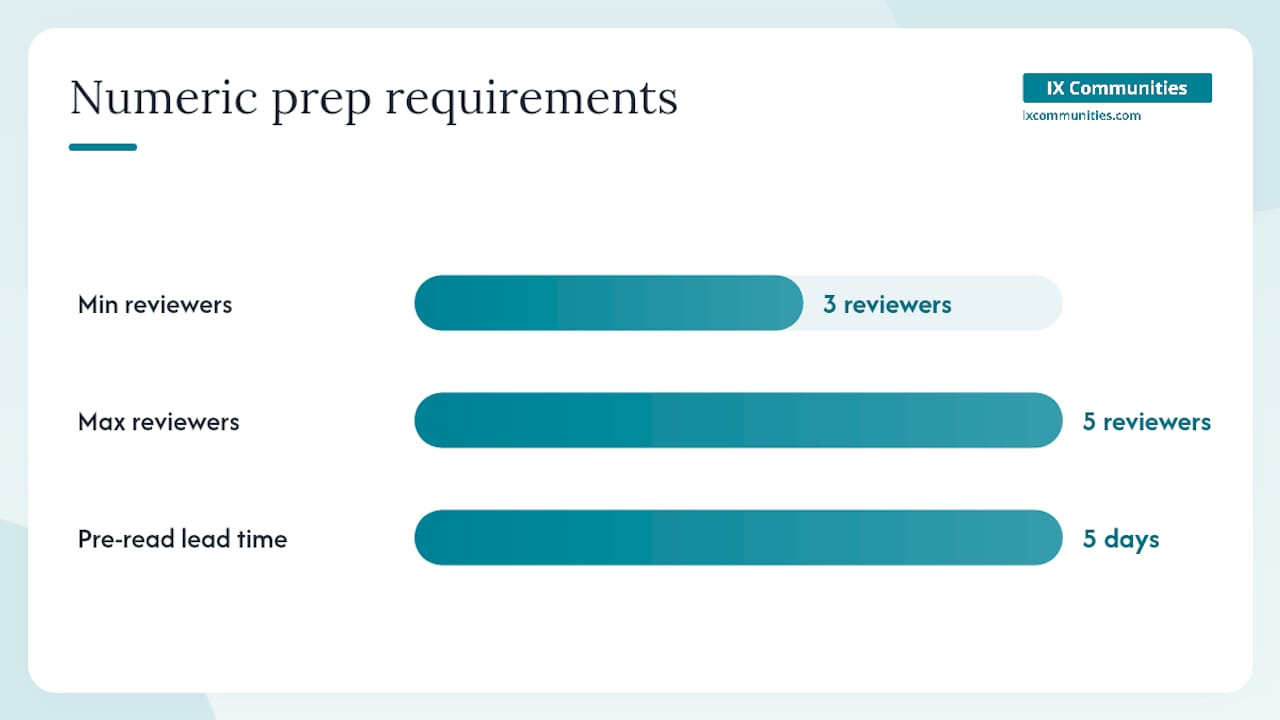
- Three to five reviewers per employee under review
- At least one cross-functional reviewer to provide collaboration visibility
- The presenting manager (who knows the employee's day-to-day work)
- An HR facilitator (mandatory, not optional)
- An executive sponsor for senior-level reviews
Peer review models vary in how much reviewer identity is disclosed. Wiley's overview of peer-review models describes single-anonymous, double-anonymous, and open approaches, each with different trade-offs for bias and transparency. In HR talent reviews, a common practice is to aggregate peer summaries anonymously before the session so that individual comments cannot be traced, while the presenting manager is always identified.
Pre-read checklist (distributed at least five business days before the session):
- Current role impact statement (two to three sentences)
- Two to three behavioral examples with context and outcome
- Development needs and gaps
- Employee's stated career aspirations
- Manager's readiness assessment and recommended next step
- Flight risk flag (yes/no with brief rationale)
Participant roles must be explicit. The presenting manager presents and answers clarifying questions but does not vote. Peer reviewers contribute evidence and debate. The HR facilitator controls process, time, and evidence standards. A scribe captures decisions verbatim. An executive sponsor observes and approves final outcomes for senior cases. Research on structured peer-review processes confirms that clear reviewer roles and pre-distributed materials are among the strongest predictors of review quality.
Which assessment frameworks and tools should you use?
The 9-box grid and competency/readiness frameworks are the two most widely used models in corporate talent reviews. They serve different purposes and work best in combination.
The 9-box grid plots performance (x-axis) against potential (y-axis) on a three-by-three matrix. It is fast, visual, and easy for executive audiences to read. Its limitation is that "potential" is often undefined, which means different reviewers apply different mental models. Lattice's guidance on talent reviews recommends pairing the 9-box with multiple data sources and documented evidence to prevent oversimplification. A competency or readiness framework adds behavioral anchors to each rating level, making the assessment more defensible and consistent across reviewers.
When choosing between frameworks, the deciding question is: what decision does this review need to produce? Calibration across a large population favors the 9-box for speed. Succession decisions for specific roles favor a readiness framework tied to the competencies of the target role. Development planning benefits from both: the 9-box to prioritize investment, and competency anchors to specify what to develop.
Pros and cons of each approach:
The 9-box grid is quick to complete and easy to visualize, but it can oversimplify complex performers and is vulnerable to rater inconsistency when potential is not defined behaviorally. Competency and readiness frameworks produce richer, more defensible assessments and map directly to role requirements, but they require more calibration time and reviewer training to apply consistently.
To operationalize potential, use behavior-based anchors. For example, "high potential" might require evidence of: learning agility demonstrated in a new domain within the past 18 months, influence beyond formal authority in at least one cross-functional project, and a track record of delivering results in ambiguous conditions. Anchors like these give reviewers a shared standard and reduce the risk that "potential" becomes a proxy for likability.
Minimum tool capabilities to support the review process:
- Aggregated peer feedback collection with anonymization options
- Timeline and assignment history display per employee
- Visual calibration interface (9-box or equivalent)
- Exportable development action tracking
Platforms commonly evaluated for this purpose include Lattice, PerformYard, and Quantum Workplace. AIHR publishes practitioner resources on framework design that HR teams use during tool selection. Evaluation should prioritize integration with your existing HRIS and LMS, reviewer anonymity controls, and audit trail functionality. Pricing and contract terms are secondary to fit and data security.
Pro Tip: Before committing to a platform, run a one-session pilot using a shared spreadsheet and a 9-box slide. If the process breaks down at the facilitation level, a tool will not fix it. Confirm the process works first, then automate it.
When should you use a platform versus lightweight tools?
The answer depends on volume, auditability requirements, and integration needs, not on organizational size alone.
Lightweight tools (a shared spreadsheet, a 9-box PowerPoint slide, and a shared document for scribe notes) are sufficient when the review covers fewer than 30 employees, the panel is a single team, and the outputs do not need to feed directly into a compensation or succession system. Many organizations run their first two or three cycles this way before investing in a dedicated platform.
Signals that a dedicated platform is warranted:
- Review population exceeds 50 employees per cycle
- Cross-functional calibration requires a shared, real-time view
- Audit trail is required for compliance or legal defensibility
- Development actions need to integrate with an LMS or HRIS workflow
- Reviewer anonymity must be enforced technically, not just by policy
When evaluating platforms such as Lattice, PerformYard, or Quantum Workplace, prioritize these dimensions in order:
- Reporting and audit trail: can you export a timestamped record of decisions?
- Calibration visualization: does the tool support real-time 9-box placement during the session?
- Reviewer anonymity: is anonymization enforced at the data level or only by convention?
- Workflow automation: can the tool assign and track development actions post-session?
- Security and permissions: can you restrict who sees which employee's data?
Before signing a contract, request a proof-of-concept with your actual data structure. Define pilot success criteria in advance: at minimum, the tool should complete one full review cycle for a cohort of 10 to 15 employees without requiring manual workarounds. Negotiate a 60-to-90-day pilot period before committing to an annual subscription.
How do you run the talent peer review meeting?
A well-facilitated session follows a consistent agenda, enforces evidence standards, and produces documented decisions before participants leave the room. WorkTango's practitioner checklist identifies four essentials: set rules at the start, share tools in advance, encourage calibrated debate, and act immediately after the review. The agenda below operationalizes all four.

Sample agenda (two-hour session, cohort of eight to ten employees):
| Segment | Duration | Owner | Purpose |
|---|---|---|---|
| Ground rules and confidentiality reminder | 5 min | HR facilitator | Set behavioral norms for the session |
| Per-employee presentation | 5 min each | Presenting manager | Summary of performance, potential, and readiness |
| Clarifying questions | 3 min each | Panel | Evidence-based questions only |
| Group debate and calibration | 5 min each | Panel + facilitator | Reach consensus or document disagreement |
| Decision capture | 2 min each | Scribe | Record placement, rationale, and next action |
| Wrap-up and next steps | 10 min | HR facilitator | Confirm owners, timelines, and confidentiality |
For senior-level or contested cases, extend the debate slot to 10 minutes and allow the facilitator to call a structured rebuttal round before forcing a decision.
Facilitator checklist:
- Open with a verbal confidentiality reminder and conflict-of-interest check
- Require all comments to reference a specific behavioral example
- Interrupt advocacy statements ("she's just great") and redirect to evidence ("what did she do, in what context, with what result?")
- Assign a scribe who captures decisions verbatim, not summaries
- Track time per case and flag when a case is running over
- Table heated cases for a follow-up bilateral between HR and the relevant manager
Bias mitigation techniques:
Distribute anonymized peer summaries before the session so reviewers arrive with evidence, not just impressions. Use behavioral anchors on the rating scale so "high potential" means the same thing to every reviewer. Require at least two independent sources of evidence before changing a rating. Rotate who speaks first on each case to prevent anchoring on the first opinion stated. When a senior voice dominates, the facilitator should explicitly invite dissenting views before closing debate.
Pro Tip: When a case becomes heated, redirect with a factual question: "What specific behavior or outcome are we disagreeing about?" That reframe moves the conversation from opinion to evidence within two exchanges.
How do you turn review outcomes into development plans?
Decisions made in the session have no value unless they translate into ownerable, timebound actions. Talent reviews must trigger direct development plans, stretch assignments, or improvement plans; otherwise they become an administrative exercise with no organizational return.
Decision matrix: assessment outcome to action:
- High potential + ready now: Assign to a succession slate for a specific role; initiate a formal development plan with an executive mentor and a target promotion timeline.
- High potential + not yet ready: Assign a stretch project or cross-functional rotation; set a 12-month readiness milestone with quarterly check-ins.
- Strong performer + limited upward potential: Recognize and retain through lateral enrichment, expert track, or compensation adjustment; avoid misrepresenting growth trajectory.
- Developing performer + high potential: Invest in targeted skill development; pair with a coach or peer mentor; reassess in six months.
- Low performer + low potential: Initiate a structured performance improvement plan with clear milestones and a defined decision point.
Every development plan must include five fields: the outcome agreed in the review, the owner (manager, HR, or learning partner), the timeline (specific dates, not "Q3"), success measures (observable behaviors or results), and follow-up checkpoints (dates for manager 1:1 check-ins).
When multiple employees qualify for a limited number of stretch assignments or promotion slots, prioritize by readiness score first, then by business criticality of the target role, then by retention risk. Document the rationale for prioritization decisions so the process is defensible if questioned.
What the employee hears after the review must be carefully scoped. Communicate the agreed development focus, the next steps, and the manager's commitment. Do not share panel discussion details, other employees' placements, or the specific language used in debate. The internal record stays internal; the employee receives a forward-looking development conversation, not a transcript. For guidance on talent analysis methods that complement this step, HR leaders can reference the full talent analysis playbook.
How do you track follow-through and measure review effectiveness?
A talent review that produces no measurable change in development activity within 30 days has effectively failed. WOWledge's practitioner framework emphasizes that documentation and follow-up are as important as the session itself.
Follow-up tracking table (per employee):
Recommended follow-up cadence:
- Manager 1:1 with employee: within two weeks of the review session
- First development check-in: 30 days post-review
- Quarterly progress review: manager reports status to HR
- Next talent review refresh: 12 months (or six months for high-priority succession cases)
KPIs to track review effectiveness:
- Percentage of agreed actions started within 30 days (target: 80% or above)
- Percentage of high-potential employees placed into stretch assignments within one cycle
- Promotion readiness improvement per cohort across successive cycles
- Voluntary turnover rate of the high-potential cohort year over year
At the close of every session, HR should collect a signed manager commitment checklist confirming that the manager has read the agreed actions, accepts ownership, and has scheduled the first employee 1:1. Without that commitment, follow-through rates drop sharply. Aggregate signals from tracking data should be surfaced to senior leadership quarterly to inform workforce planning and succession risk mitigation.
What governance structure does a repeatable review cycle require?
Governance defines who prepares, who facilitates, who decides, and who signs off. Without it, reviews become inconsistent across business units and lose credibility as a decision-making tool. Publication Ethics guidance on transparent peer-review processes recommends that organizations publish their review model, train participants, and establish clear policies for handling conflicts and appeals. The same principle applies in HR.
Roles and responsibilities:
| Role | Responsibilities |
|---|---|
| HR facilitator | Designs the process, trains reviewers, runs the session, enforces evidence standards, documents outcomes |
| Presenting manager | Submits pre-read, presents the employee case, answers questions, owns post-review development actions |
| Reviewer panel | Reviews pre-reads, contributes evidence-based assessments, participates in calibration debate |
| Executive sponsor | Approves senior-level outcomes, provides business context, escalates resource decisions |
| Scribe | Captures decisions, rationale, and action owners verbatim during the session |
Sample timeline for one review cycle:
| Phase | Activity | Duration |
|---|---|---|
| Planning | Define scope, select participants, brief facilitator | Week 1 |
| Pre-read preparation | Managers complete worksheets; HR aggregates peer data | Weeks 2–3 |
| Review sessions | Facilitated panel sessions per cohort | Week 4 |
| Documentation | Scribe notes finalized; development plans drafted | Week 5 |
| Manager 1:1s | Managers deliver development conversations to employees | Week 6 |
| Outcome reporting | HR presents aggregated results to leadership | Week 6 |
Approval points:
- HR approves the process design, participant list, and confidentiality rules before the cycle begins.
- The executive sponsor approves senior-level placement decisions and succession nominations.
- HR signs off on all development plans before they are communicated to employees.
Time estimates: each presenting manager spends two to three hours on pre-read preparation per employee. Each review session block runs two to four hours for a cohort of eight to ten employees. Documentation takes one to two hours per session. Total cycle time for a mid-size organization reviewing 50 employees across five cohorts is approximately six to eight weeks. Creating scalable talent leadership forums requires the same governance discipline applied here.
Copyable templates: scoring rubric, 9-box guide, and manager worksheet
Scoring rubric: performance and potential (behaviorally anchored)
| Rating | Performance Anchor | Potential Anchor |
|---|---|---|
| 3 — Exceeds | Consistently delivers above target; cited by peers as a model; leads without being asked | Demonstrates learning agility in new domains; influences cross-functionally; thrives in ambiguity |
| 2 — Meets | Delivers on commitments; reliable; occasionally exceeds in specific areas | Shows growth in current role; open to feedback; some evidence of broader capability |
| 1 — Below | Misses targets regularly; requires close management; limited peer collaboration | Limited evidence of growth beyond current scope; resistant to feedback or new challenges |
9-box reading guide:
The top-right quadrant (high performance, high potential) represents succession candidates and stretch assignment priorities. The middle band (solid performers with moderate potential) represents the core of the organization and benefits from retention investment and lateral enrichment. The bottom-left quadrant (low performance, low potential) requires a structured improvement plan or a role-fit conversation. Employees in the top-left (high potential, lower current performance) often need a role change or clearer expectations rather than a performance plan.
Manager worksheet template fields:
- Employee name and current role
- Current performance rating (1–3) with two supporting behavioral examples
- Potential rating (1–3) with two supporting behavioral examples
- Key development needs (two to three specific gaps)
- Employee's stated career aspirations
- Readiness for next role: ready now / ready in 12 months / not yet identified
- Flight risk: low / medium / high (with one-sentence rationale)
- Recommended next step: succession nomination / stretch assignment / development investment / PIP / retain and recognize
Copyable meeting agenda (45-minute single-team pilot):
- 0:00–0:05: Ground rules, confidentiality reminder, conflict-of-interest check
- 0:05–0:30: Three employee cases at five minutes each (two-minute presentation, two-minute questions, one-minute decision capture)
- 0:30–0:40: Calibration check (review placements as a group; flag any inconsistencies)
- 0:40–0:45: Action owners confirmed; next steps assigned; session closed
Common pitfalls and how to fix them
Practitioner preparation checklist:
- Pre-reads distributed at least five business days before the session
- Facilitator trained on evidence standards and bias interruption techniques
- Data hygiene confirmed (ratings are current; peer summaries are anonymized)
- Participant selection reviewed for conflicts of interest
- Documentation template prepared and scribe assigned before the session
Common mistakes and remediation actions:
- Treating the review as an administrative checkbox. Fix: require that every session produces at least one documented development action per employee reviewed. If no action is warranted, document why.
- Weak or absent evidence. Fix: enforce evidence fields in the pre-read template. If a manager submits a pre-read without behavioral examples, return it before the session.
- Senior voices dominating the debate. Fix: the facilitator explicitly invites dissenting views before closing each case. Use a round-robin format for initial ratings.
- Overreliance on a single data source. Fix: require a minimum of two independent data sources per employee before the panel can finalize a placement.
- Poor follow-up after the session. Fix: collect signed manager commitment checklists before participants leave the room. Set a 30-day check-in on the calendar before the session closes.
Pro Tip: In matrixed or global organizations, decentralize facilitation by training local HR business partners to run sessions using a standardized rubric and agenda. A small center of excellence at the corporate level maintains the rubric, trains facilitators, and aggregates results. This model scales without requiring a central team to run every session.
For guidance on sharing best practices across talent teams, including templates and lessons learned, HR leaders can reference Ixcommunities' practitioner resources.
How should you communicate review outcomes to employees?
Communication after a talent peer review requires a clear boundary between what is shared with the employee and what remains internal to the panel.
Employees should receive a forward-looking development conversation, not a summary of the panel discussion. The manager delivers this conversation within two weeks of the session. The message covers three things: the agreed development focus, the specific next steps (assignment, program, or coaching), and the manager's commitment to support. It does not reference other employees' placements, the panel's deliberation, or the specific language used in debate.
Framing matters. Employees who learn they are in a development track respond better when the conversation is framed around investment and opportunity rather than a rating or a label. "We've identified a stretch assignment that aligns with your stated goal of leading a cross-functional project" lands differently than "you were placed in the middle band of the 9-box."
Managing expectations requires honesty about timelines. If a promotion is 12 to 18 months away, say so. If a role is not available yet, say that too. Employees who receive vague encouragement without specifics often interpret it as a signal that nothing will change, which increases flight risk in the high-potential cohort.
For employees who receive a performance improvement plan as an outcome, the communication must be direct, specific, and documented. The manager delivers the plan with HR present, outlines the milestones, and confirms the decision point. Ambiguity in PIP communication is a legal and operational risk.
Aggregate outcomes (the distribution of placements, the number of succession nominations, the percentage of employees with active development plans) should be reported to senior leadership as part of the workforce planning cycle. Individual placements are never shared in aggregate communications.
Why talent peer reviews often fail at scale
The gap between a well-designed talent review process and one that actually changes careers is almost always a sponsorship and follow-through problem, not a framework problem.
Most organizations that struggle with talent reviews have the right tools and the right templates. What they lack is a senior leader who treats the review outcomes as binding commitments rather than advisory inputs. When an executive sponsor signs off on a succession nomination or a stretch assignment, that signature needs to carry organizational weight. If managers learn that review decisions can be quietly ignored without consequence, participation quality drops in the next cycle.
Scaling talent reviews across a large or matrixed organization adds a second challenge: facilitator consistency. A rubric that works well when one experienced HR leader runs every session breaks down when 20 local HR business partners apply it independently. The solution is not to centralize every session but to invest in facilitator training and calibration. Running an annual facilitator calibration session, where local facilitators review the same set of cases and compare placements, closes most of the consistency gap.
The third underestimated factor is the link between review outcomes and visible organizational decisions. When employees see peers who were identified as high-potential actually receive stretch assignments and promotions, the review process gains credibility. When those decisions are invisible or delayed, the review is perceived as performative. Connecting review outcomes to compensation cycles, promotion decisions, and succession announcements is the fastest way to build that credibility.
Ixcommunities and ESIX give talent leaders a faster path to review excellence
HR leaders who want to run structured talent peer reviews without building every component from scratch have a direct route through Ixcommunities. Membership in the ESIX and TLIX peer communities gives talent acquisition and talent management leaders access to calibrated benchmarking data, practitioner-tested templates, and a network of peers who have already run the process at scale in mid-to-large organizations.
The ESIX Recruiter Peer Mentorship Programs include facilitator training that shortens the time from planning to a first live session. Members also access benchmark surveys that let HR teams calibrate their potential and retention risk assessments against peer organizations, reducing the guesswork in setting evidence gates and rating anchors. For organizations ready to pilot, the practical starting point is to request a facilitator training session or a template package through Ixcommunities membership, then run a single-cohort pilot using the six-step process described in this guide.
Sources
The sources below support the methodology, governance, and ethics guidance in this guide. Each is listed with its primary use case.
- Research Methods: How to Perform an Effective Peer Review (PubMed)
- Peer review processes
- Why talent reviews are important (and how to run a successful one) (Lattice)
- Mesh
- The peer-review process (Wiley Author Services)
- 5 succession risks that threaten your leadership strategy (Gartner)