

An employer branding workflow is a repeatable, cross-functional process that turns your employee value proposition into a measurable hiring pipeline. Done well, it lowers cost-per-hire, shortens time-to-fill, and improves 12-month retention because the people you attract already understand what the job actually involves.
The workflow runs in seven stages:
- Audit and discovery
- Strategy and EVP development
- Content and channels
- Employee advocacy
- Candidate experience
- Onboarding and internal communications
- Measurement and iteration
The CIPD frames employer brand as a lifecycle asset, not a marketing artifact, and CHRO-level playbooks tie it directly to cost-per-hire and share-of-hires-from-owned-channels.
Key Takeaways
An effective employer branding workflow converts a truth-tested EVP into measurable pipeline value through seven connected stages, clear ownership, and a fixed measurement cadence.
| Point | Details |
|---|---|
| Treat it as a workflow, not a campaign | Integrate employer brand across the full employee lifecycle, from audit through onboarding. |
| Assign one accountable owner | A CHRO or Head of TA prevents the workflow from splintering across departments. |
| Truth-test the EVP first | Ground messaging in 8 to 12 real employee interviews before producing content. |
| Track CFO-visible metrics | Monitor cost per qualified applicant and share of hires from owned channels monthly. |
| Use peer benchmarking to set targets | Ixcommunities benchmark surveys and mentorship programs validate scorecard targets against real peer data. |
Table of Contents
- What Is an Employer Branding Workflow?
- What Are the Core Stages of the Workflow?
- Who Owns Each Part of the Workflow?
- How Do You Build Employee Advocacy Into the Workflow?
- What KPIs Should You Track and How Often?
- What Does a 90-Day Rollout Look Like?
- What Templates Do You Need to Run This Workflow?
- How Ixcommunities Accelerates Your Employer Branding Workflow
- A Talent Leader's Checklist Before You Launch
- Frequently Asked Questions
- Sources
What Is an Employer Branding Workflow?
An employer branding workflow is the operating system connecting your employee value proposition to actual candidate behavior, hires, and retention outcomes. It treats employer brand as infrastructure, not a seasonal campaign.
This distinction matters because talent leaders answer to the P&L. Cost-per-hire, time-to-fill, and quality-of-hire all trace back to whether candidates already trust your organization before a recruiter ever calls. CIPD and CHRO-level guidance both frame employer brand as a lifecycle discipline that touches induction, performance management, and internal comms, not just recruitment marketing.
Pro Tip: The most common failure mode is handing employer branding entirely to marketing. CIPD's lifecycle framing exists because brand promises made in a job ad get broken (or proven true) in onboarding and performance reviews. Keep TA in the room for every stage.
- Cost-per-hire and time-to-fill both respond to brand trust
- Retention ties back to whether the EVP matched reality
- CHRO ownership keeps the workflow accountable to business metrics
What Are the Core Stages of the Workflow?
Each stage needs a defined owner, a concrete output, and criteria for calling it done. Skipping any of these steps is how employer branding degenerates into a one-off recruitment video nobody remembers in six months.
- Audit and discovery. Pull Glassdoor sentiment, run a search audit, and map candidate touchpoints. Candidates spend three to five minutes forming an opinion before they respond to outreach, so this stage determines whether your later content lands or gets ignored.
- Strategy and EVP. Ground your EVP in real employee interviews, not executive assumptions. Guidance from Vouch recommends 8 to 12 interviews across roles and tenure, plus exit data, before you write a single pillar statement.
- Content and channels. Translate EVP pillars into segmented messaging for the channels your priority audiences actually use.
- Employee advocacy. Recruit real employees to share authentic experience rather than scripted copy.
- Candidate experience. Fix operational friction: two-question screens, 24-hour acknowledgments, clear job descriptions.
- Onboarding and internal comms. Deliver on the promise the brand made, reinforcing it through recruitment process design.
- Measurement and iteration. Close the loop with a scorecard reviewed on a fixed cadence.
| Stage | Primary Owner | Output | Typical Duration |
|---|---|---|---|
| Audit/discovery | TA operations lead | Baseline report | 2-3 weeks |
| Strategy/EVP | Head of TA + comms | EVP pillar document | 3-4 weeks |
| Content/channels | Employer brand manager | Channel content calendar | Ongoing |
| Advocacy | Comms + TA | Advocate cohort and toolkit | 4-6 weeks to launch |
| Candidate experience | Recruiting ops | Revised job postings, screening flow | 2-4 weeks |
| Onboarding/internal comms | HRBP + people ops | Onboarding brand touchpoints | Ongoing |
| Measurement | CHRO/Head of TA | Monthly scorecard | Monthly/quarterly |
Who Owns Each Part of the Workflow?
A single accountable owner, usually the CHRO or Head of TA, prevents the workflow from splintering across departments that each optimize for their own metric. Around that owner, build cross-functional pods: TA, corporate comms, internal comms, and people operations.

| Stage | Responsible | Accountable | Consulted | Informed |
|---|---|---|---|---|
| Audit/EVP | TA + comms | Head of TA | Employees (interviews) | Executive team |
| Content/advocacy | Comms/TA | Employer brand manager | Legal, employees | Full org |
| Candidate experience | Recruiting ops | Head of TA | Hiring managers | Candidates |
| Measurement | TA analytics | CHRO | Finance | Board |
Governance runs on a monthly scorecard review, a quarterly EVP check-in, and board-level reporting when metrics move outside target range.
- One accountable owner, not a rotating committee
- Cross-functional pods with named leads per stage
- Fixed governance cadence, not ad hoc reviews
Pro Tip: Governance-by-committee is the second most common failure after marketing capture. If more than three people must sign off on a single piece of content, the workflow will stall.
How Do You Build Employee Advocacy Into the Workflow?
People trust people, not brands. SHRM's employer branding guide treats employee advocacy as essential precisely because passive candidates discount corporate messaging but respond to a peer's honest account.
- Identify naturally engaged employees rather than assigning advocacy as a task.
- Reduce friction with pre-approved content prompts they can adapt in their own voice.
- Build a lightweight approval guardrail so legal and comms sign off without slowing anyone down.
- Create a distribution handoff so advocacy content reaches the right channels at the right time.
- Measure engagement, reach, and referral hires tied directly back to advocate activity.
A working toolkit needs three components: content prompts employees can personalize, a one-step approval guardrail, and a clear handoff to whoever manages distribution. Solution4Guru's guide to employee engagement offers useful groundwork for identifying who is genuinely engaged before you ask them to advocate publicly.
- Engagement rate on advocate-shared content
- Reach compared to owned-channel baseline
- Referral hires attributable to advocacy activity
The credibility payoff compounds. A candidate who reads five employee posts before applying arrives at the interview already sold on culture fit, which shortens the sales job every recruiter has to do afterward.
What KPIs Should You Track and How Often?
The CHRO scorecard should track cost per qualified applicant, share of hires from owned channels, talent community engagement, and 12-month retention by source. These four metrics translate employer brand activity into language your CFO already understands.
Build the dashboard in two layers. A monthly view tracks leading indicators: community growth, content engagement, and applicant volume by source. A quarterly view tracks lagging indicators such as retention by source, cost trends, and conversion rate.
| Metric | Owner | Target Direction |
|---|---|---|
| Cost per qualified applicant | TA analytics | Decreasing |
| Share of hires from owned channels | Head of TA | Increasing |
| Talent community engagement | Employer brand manager | Increasing |
| 12-month retention by source | HRBP | Increasing |
Review the monthly metrics inside the TA team and escalate the quarterly set to CHRO and finance. Benchmark surveys give you a baseline to judge whether your numbers are actually competitive or just moving in the right direction in isolation.
What Does a 90-Day Rollout Look Like?
Sequencing beats speed. A phased rollout, rather than a single big-bang campaign, reduces hiring risk and cost because each phase generates evidence for the next.
- Weeks 1-4: Run the audit and EVP truth-test against real employee interviews.
- Weeks 5-8: Stand up a minimal talent community and segment your priority audiences.
- Weeks 9-12: Activate your first advocacy cohort and launch the scorecard.
Six-month milestones build on that base: scale content production, roll out segmented EVPs by role or region, and set explicit growth targets for owned-channel share of hires.
Budget conversations should cover four line items: a community platform, content production (often the largest recurring cost), any technology benchmarking tools, and internal FTE allocation.
- Start with a low-cost pilot in one business unit before scaling org-wide
- Reuse existing content and interview transcripts before commissioning new creative
- Treat the first 90 days as evidence-gathering, not a finished campaign
What Templates Do You Need to Run This Workflow?
Four templates cover most of what a TA team needs to operationalize this process without building from scratch every quarter.
- Audit checklist: Glassdoor sentiment review, search audit, and a candidate touchpoint walkthrough covering job postings through offer.
- EVP worksheet: pillars, proof points tied to real employee quotes, and segmented messaging by audience.
- Advocacy toolkit: content prompts, a one-step approval guardrail, and a distribution handoff sheet.
- Measurement dashboard: baseline metrics pulled from your recruiting benchmarks before you launch anything new.
Build each template once, then reuse it every cycle. The point isn't originality. It's consistency across every hiring manager and every role.
How Ixcommunities Accelerates Your Employer Branding Workflow
Building this workflow alone means guessing at benchmarks and reinventing templates other TA teams have already tested. Ixcommunities gives you peer-validated numbers instead of best guesses, which is the single biggest difference between a workflow built in isolation and one built on what actually works elsewhere.
Membership connects you to ESIX recruiter peer mentorship programs, where practitioners running the same seven-stage workflow share what worked and what stalled at their own companies. Benchmark surveys let you truth-test your EVP and scorecard targets against real peer data rather than industry averages pulled from a blog post. And IXCommunities membership puts the whole toolkit, benchmarking reports, guidebooks, and secure peer communities, in one place instead of scattered across a dozen vendor relationships.
If you're standing up a scorecard or planning your next 90-day rollout, request a benchmarking conversation through IXCommunities membership before you finalize your targets.
A Talent Leader's Checklist Before You Launch
Before launching, I'd want four boxes checked: EVP truth-tested against real employee interviews, priority audiences defined, one accountable owner named, and a minimal talent community already built, not promised.
The most expensive mistake is commissioning creative before truth-testing the EVP. A close second is launching without cross-functional alignment, so comms and TA end up telling different stories.
Pro Tip: Momentum dies in month three, not week one. Protect the monthly scorecard review even when nothing dramatic happened. Consistency is what turns this into a workflow instead of a campaign that fades.
Frequently Asked Questions
What is the difference between an employer branding workflow and an employer branding strategy?
A strategy sets the direction, your EVP pillars and target audiences. The workflow is the repeatable operating process that executes that strategy across audit, content, advocacy, and measurement stages, with named owners and defined outputs at each step.
Who should own the employer branding workflow inside a company?
A single accountable owner, typically the CHRO or Head of TA, should hold the workflow, supported by cross-functional pods spanning TA, comms, and people operations. Splitting ownership across departments without one accountable leader is a common reason workflows stall.
How long does it take to see results from an employer branding workflow?
Expect the first 90 days to focus on audit, EVP truth-testing, and building a minimal talent community. Measurable shifts in cost-per-hire and share-of-hires-from-owned-channels typically emerge over two to three quarters as the scorecard accumulates enough data to show trends.
Does employer branding workflow apply to small companies, or only large enterprises?
The same seven stages apply regardless of size. Smaller companies can run a lighter version, fewer employee interviews, a smaller advocacy cohort, but should still assign one accountable owner and track the same core metrics rather than skipping measurement entirely.
How does employee advocacy fit into the broader workflow?
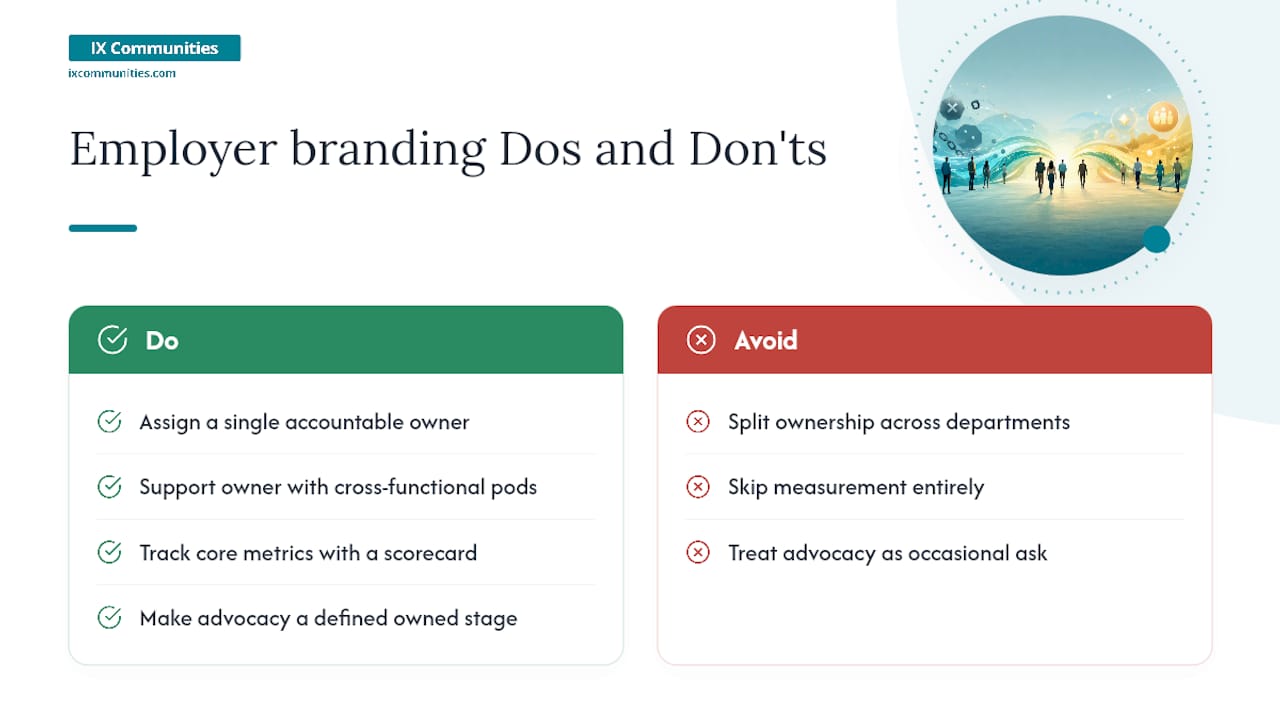
Advocacy sits between content/channels and candidate experience. It works because people trust peer accounts over corporate messaging, so building it into the workflow as a defined stage, with its own owner and metrics, keeps it from becoming an occasional ask rather than a sustained channel.
Sources
- CIPD recruitment brand factsheet
- How to define and communicate your employer brand to attract top talent (SHRM)
- The CHRO's Strategic Employer Branding Playbook