

A practical hiring process checklist follows a repeatable 10-step sequence: define the role, write the job description, choose sourcing channels, screen applicants, interview, assess skills, run a final round, check references, extend an offer, and onboard. Each stage has a target timeframe, a set of documents, and a decision point, and treating hiring as a linear checklist rather than an improvised process is what separates companies with predictable time-to-fill from those scrambling every open requisition.
Here is the 10-step sequence at a glance:
- Define the position, success criteria, and get approvals
- Write a focused job description
- Choose recruitment channels and sourcing strategy
- Screen applications and conduct phone screens
- Run structured first-round interviews
- Administer skills assessments or work samples
- Hold second-round or panel interviews and finalize the scorecard
- Complete background and reference checks
- Extend a verbal offer, then a written offer
- Prepare onboarding documents and launch the new hire's first 90 days
Timing varies by role and company size, but the table below reflects benchmarks many HR teams use to set service-level agreements, informed by time-to-fill research from Toggl.
| Stage | Target Timeframe |
|---|---|
| Approval to job posting live | 2 to 3 business days |
| Application screening | 3 to 5 business days after posting |
| First-round interviews | Within 7 business days of screening |
| Skills assessment turnaround | 3 to 5 business days |
| Offer to acceptance | 2 to 4 business days |
| Total time-to-fill (median target) | between one month and a month and a half |
Each stage below expands into a usable checklist, with sample questions, rubrics, and the documentation you need on hand. Keep a printed or shared digital copy of the bullet points as your working checklist, and adapt the timing table to your own historical time-to-fill data once you have three or four completed hires to measure against.
Table of Contents
- Define the Position: Business Need, Success Criteria, and Approvals
- Develop a Compelling Job Description: What to Include and What to Avoid
- Determine Recruitment Strategy and Sourcing Channels
- How Should You Screen and Triage Applications?
- Conduct Interviews: The Structured Approach, Rubrics, and Scoring
- Skills Assessments and Work Samples: When to Use Them
- Second-Round and Panel Interviews: Reaching a Final Decision
- Background Checks and References: Timing, Scope, and Compliance
- Job Offer and Negotiation: Verbal and Written Offer Checklist
- Onboarding Preparation and New-Hire Documentation Checklist
- Welcome and the New Hire's 30/60/90-Day Plan
- Continuous Improvement: Hiring Metrics to Track and How to Run Retrospectives
- Wrapping Up: Audit the Hire, Document Lessons, and Update the Checklist
- Evidence-Backed Best Practices and Research Highlights
- What Experienced Talent Leaders Prioritize
- Peer Benchmarking and Recruiter Community Options
- Key Takeaways: The Checklist Boiled Down to the Essentials
- Sources
Define the Position: Business Need, Success Criteria, and Approvals
Every hiring process checklist breaks down at the source when the position itself is fuzzy. Before a job description exists, the hiring manager needs a documented business case: why this role, why now, and what does success look like in six months. Skipping this step is the single most common reason recruiters end up screening 200 resumes for a role nobody can clearly describe.
Loop in the right stakeholders before you post anything:
- Budget owner or finance partner, to confirm headcount and compensation band
- Hiring manager, to define the day-to-day scope and reporting line
- HR business partner, to flag internal equity, job architecture, and compliance issues
- Department leadership, if the role is new or represents a structural change
Success criteria should read like a short performance brief, not a wish list. Frame it around outcomes: what will this person have accomplished by day 30, day 60, and day 90? A sales role might target a set number of qualified pipeline meetings by day 60. An operations role might target a completed process audit by day 90. Writing these targets down before sourcing begins keeps the entire hiring team anchored to the same definition of a good hire.
Run a short job scoping session with the hiring manager and HR partner covering:
- The three to five outcomes that define success in year one
- Must-have skills versus skills that can be developed on the job
- Reporting structure, team size, and key internal stakeholders
- Salary range and any approved flexibility
Pro Tip: Cap your must-have list at five items during the scoping session. Every requirement beyond that shrinks your applicant pool without meaningfully improving hire quality, and you can always test for the rest during interviews or assessments.
Develop a Compelling Job Description: What to Include and What to Avoid
A strong job description does one job: it tells qualified people this role is worth their time, without scaring off candidates who could actually do the work. The structure that consistently performs well includes seven parts.
- Job title that matches how candidates search, not internal jargon
- Role summary in two to three sentences describing purpose and impact
- Outcomes the person will own in their first year, tied to the success criteria from your scoping session
- Core responsibilities as five to seven concrete bullet points
- Must-have qualifications, kept short and skills-based
- Nice-to-have qualifications, clearly separated from must-haves
- Compensation range and benefits, plus a brief culture note
The most damaging habit in job description writing is requirement inflation, listing 15 or more qualifications when the role genuinely needs five or six. Research from the Harvard Business Review found that women apply for roles only when they meet most listed qualifications far more often than men do, who tend to apply when they meet a partial match. A bloated requirements list does not filter for quality. It filters out qualified women and career changers who would otherwise be strong candidates. Fast Company has documented the same pattern with inflated job titles and scope creep in postings, both of which narrow rather than widen your applicant pool.
A sample role summary might read: "Our operations team is hiring a Supply Chain Analyst to own vendor performance reporting and reduce fulfillment delays across three regional warehouses. You'll report to the Director of Operations and partner directly with procurement and logistics."
Dos and don'ts for the requirements section:
- Do separate must-haves from nice-to-haves in clearly labeled subsections
- Do use measurable language ("three years managing a $2M+ budget" instead of "strong financial acumen")
- Don't list more than six or seven must-have qualifications
- Don't require a specific degree unless it is a legal or licensing necessity
- Don't copy-paste a previous job description without checking if the scope has actually changed
Determine Recruitment Strategy and Sourcing Channels
Picking the right sourcing channel matters more than posting on every job board available. Each channel has a different cost, speed, and candidate profile, and matching the channel to the role prevents wasted recruiter hours.
| Channel | Best For | Typical Time-to-Source |
|---|---|---|
| Employee referrals | Roles where culture fit and team trust matter most | a short amount of time |
| Internal mobility | Roles that benefit from institutional knowledge | a few weeks |
| Job boards | High-volume or standard roles with broad applicant pools | a few weeks |
| Niche communities and associations | Specialized technical or licensed roles | several weeks |
| Social media outreach | Passive candidates and employer brand building | several weeks |
| Agency or executive search | Senior, confidential, or hard-to-fill roles | several weeks |
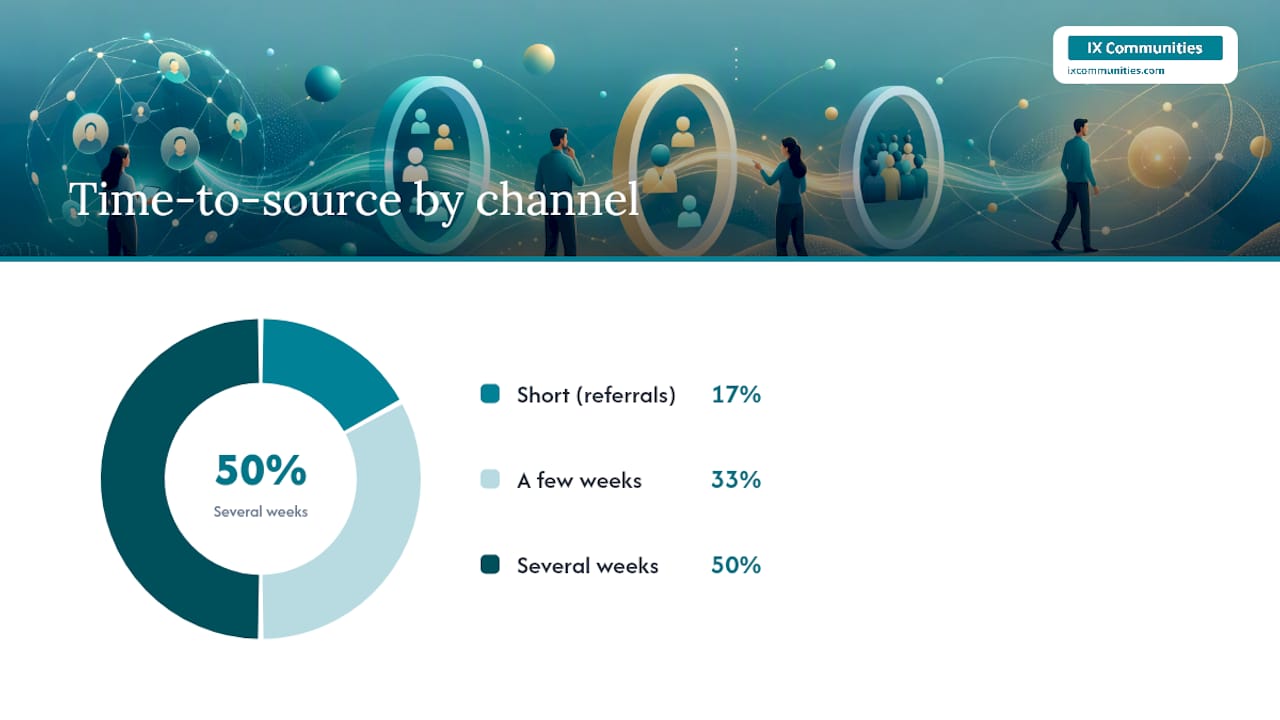
Referrals consistently produce some of the fastest and highest-retention hires, but most referral programs underperform because employees forget the program exists. A few practical steps boost uptake: send a monthly reminder listing open roles, pay out bonuses faster (within a few months of the new hire's start rather than after a full year), and make the referral form a two-minute mobile-friendly process instead of a clunky internal portal.
Agencies and executive search firms earn their fee on roles where confidentiality, seniority, or a thin talent pool make internal sourcing impractical. If a role has been open for more than 60 days with no qualified pipeline, that is usually the signal to bring in outside search support rather than keep re-posting the same listing. For senior or executive-level searches specifically, an executive hiring process guide can help you adapt this checklist to longer timelines and higher-stakes stakeholder management.
How Should You Screen and Triage Applications?
Application volume is where hiring processes either stay consistent or fall apart. An applicant tracking system (ATS) centered workflow keeps triage standardized instead of dependent on whichever recruiter happens to be reviewing resumes that day. The workflow should sort every application into one of three buckets: quick-pass to phone screen, hold for further review, or reject with a templated response.
Your screening checklist should confirm:
- Resume meets the must-have qualifications defined in the job description
- Required documents are attached (portfolio, certification, writing sample, as applicable)
- No obvious red flags: unexplained employment gaps without context, mismatched dates, or a pattern of very short tenures without explanation
- Application answers, if you use screening questions, match minimum thresholds
Set a clear SLA for this stage. SHRM's hiring checklist guidance recommends candidates hear back within a defined window, because slow or silent processes damage your employer brand and cause strong candidates to abandon the pipeline for a competing offer. A reasonable target is an initial response within three to five business days of application, even if that response is simply "we're reviewing applications and will follow up by [date]."
A short candidate communication template keeps this consistent: "Thank you for applying to [role]. Our team is reviewing applications now, and we expect to reach out with next steps by [specific date]. We appreciate your patience." Sending this single line at scale, either through your ATS or a simple email template, measurably reduces candidate frustration even when you have nothing new to report yet.
Conduct Interviews: The Structured Approach, Rubrics, and Scoring
Structured interviewing is the single highest-leverage change most hiring teams can make. Every candidate answers the same core set of vetted, role-relevant questions, every interviewer scores independently against a shared rubric, and interviewers are trained on what a strong versus weak answer actually looks like. Google's structured interviewing guidance documents this approach as one of the most reliable ways to improve hiring accuracy compared with freeform, unstructured conversations where each interviewer asks whatever comes to mind.
A basic structured interview process looks like this:
- Select four to six core questions tied directly to the success outcomes you defined during job scoping
- Build a scoring rubric with defined criteria for each question (1 to 4 scale, with written anchors for what each score looks like)
- Assign each interviewer a specific competency area to avoid redundant questions
- Require independent written scores before any group discussion happens
- Compare scores in a debrief and resolve disagreements with specific examples from the interview, not gut feeling
A simplified scoring matrix might look like this:
| Competency | Question Focus | Score (1 to 4) |
|---|---|---|
| Problem solving | Walk through a time you diagnosed a process failure | ___ |
| Collaboration | Describe a conflict with a peer and how you resolved it | ___ |
| Ownership | Tell me about a project you drove start to finish | ___ |
| Communication | Explain a complex idea to a non-expert audience | ___ |
Behavioral questions built on the STAR format (Situation, Task, Action, Result) give candidates a consistent structure to answer within and give interviewers a consistent structure to evaluate against. A sample question: "Tell me about a time a project you were leading fell behind schedule. What did you do?" A strong STAR answer names the specific situation, the action the candidate personally took, and a measurable result, rather than staying vague or speaking only in terms of "we."
Pro Tip: Require every interviewer to submit their independent score before the debrief conversation starts. The moment one senior interviewer says "I really liked her" out loud first, everyone else's scores shift toward that opinion. Independent scoring first is the single easiest fix for anchoring bias in a hiring process.
Skills Assessments and Work Samples: When to Use Them
Not every role benefits from a formal skills test, but for roles where the day-to-day output can be simulated, a well-designed work sample often predicts performance better than another round of conversation. SHRM's guidance on pre-employment testing treats structured assessments as a legitimate and defensible part of a hiring process when they are scored consistently and tied directly to job requirements.
| Assessment Type | Best For | Evaluation Focus |
|---|---|---|
| Work sample | Roles with a clear deliverable (writing, design, analysis) | Quality, accuracy, adherence to brief |
| Coding test | Technical and engineering roles | Correctness, code readability, problem-solving approach |
| Case study | Strategy, consulting, and analyst roles | Structure of reasoning, use of data, recommendation clarity |
| Timed exercise | High-volume or operational roles | Speed and accuracy under realistic constraints |

A writing sample prompt might ask a marketing candidate to draft a 150-word product announcement based on three bullet points of information, evaluated on clarity, tone match, and whether they asked clarifying questions before starting. A case study prompt for an analyst role might present a simplified dataset and ask the candidate to identify the biggest driver of a metric decline, evaluated on the logic of their approach more than whether they land on the exact "right" answer.
Balance is the real skill here. A four-hour take-home assignment might produce great signal, but it also filters out candidates who cannot spare four unpaid hours, disproportionately affecting people with caregiving responsibilities or multiple jobs. A tighter, paid, or time-boxed exercise (60 to 90 minutes) usually gives you most of the predictive value with far less candidate burden. Reviewing assessment approaches used by other TA teams can help you calibrate what "reasonable" looks like for your industry.
Second-Round and Panel Interviews: Reaching a Final Decision
By the second round, you are narrowing from a shortlist to a decision, and the format you choose changes what you learn. A panel interview, where three or four stakeholders meet the candidate together, is efficient and useful for assessing how a candidate handles group dynamics. Sequential one-on-one interviews take longer to schedule but often surface more candid answers, since candidates tend to open up more in a one-on-one setting than in front of a panel.
A final scorecard should consolidate every interviewer's independent notes into one document, organized by competency rather than by interviewer, so patterns of agreement or disagreement are easy to spot.
Before the final round, confirm:
- All interviewers have reviewed the candidate's resume and prior interview notes
- Interview questions are assigned so competencies are not duplicated
- The hiring manager has final sign-off authority clearly established
- Logistics (location, video link, timing) are confirmed 24 hours in advance
Resolve these open questions before extending an offer:
- Is there flexibility in the compensation range, and how much?
- What does the realistic career path look like in this role over 18 to 24 months?
- Do team-fit signals from the panel align, or is there a real disagreement worth discussing further?
Background Checks and References: Timing, Scope, and Compliance
Background checks should happen after a candidate has verbally accepted a contingent offer, not earlier in the process. Running checks too early wastes time and money on candidates who may decline anyway, and running them too late risks losing the candidate to a competing offer while you wait on results.
Common components include employment verification, education verification, criminal history where legally permitted, and credential or license verification for regulated roles. Reference checks work best with three references who worked directly with the candidate, ideally including at least one former manager, using a consistent question set: "What were this person's biggest strengths on your team? Can you describe a time they faced a setback and how they handled it? Would you rehire them, and why or why not?"
Compliance is not optional here. Written consent is required before running a background check, and the Fair Credit Reporting Act (FCRA) governs disclosure and adverse-action procedures if a check affects a hiring decision. Many states and cities also have "ban-the-box" laws restricting when in the process you can ask about criminal history, so confirm your local requirements before building this step into your workflow. Document every result, consent form, and decision rationale in the candidate's file, since incomplete documentation is one of the most common gaps auditors find during a hiring-process review.
Job Offer and Negotiation: Verbal and Written Offer Checklist
Extend a verbal offer first. A short phone call confirming interest, compensation, and start date gives you a real read on acceptance likelihood before you invest in drafting formal paperwork, and it gives the candidate a chance to raise questions or concerns in a low-pressure conversation.
Follow the verbal offer with a written offer letter that documents:
- Base compensation, bonus structure, and equity if applicable
- Start date and reporting manager
- Any contingencies (background check, reference check, licensing verification)
- At-will employment status, where applicable under state law
- Benefits summary and enrollment timeline
- Signature lines for both parties
Negotiation is normal and expected at this stage. Know in advance what you can flex on, typically start date, signing bonus, or a slightly adjusted base within the approved range, and what is fixed, like the overall salary band or title. Document every concession in writing so there is no ambiguity later about what was promised.
Pro Tip: If a candidate asks for more than your approved range allows, offer a one-time signing bonus instead of raising the base. It solves the candidate's immediate need without permanently shifting your internal pay equity for the role.
Onboarding Preparation and New-Hire Documentation Checklist
Paperwork mistakes at onboarding create real legal exposure, and the timeline matters as much as the content. Federal law requires Form I-9 to be completed with Section 2 verified within three business days of the employee's start date, no exceptions. Form W-4 for federal withholding, along with applicable state tax withholding forms, should be collected before or on day one so payroll can process correctly from the first pay cycle.
| Timing | Documents and Actions | Owner |
|---|---|---|
| Before day 1 | Offer letter, I-9 Section 1 (can be completed remotely), background check clearance | HR |
| Day 1 | I-9 Section 2 verification begins, W-4, state tax forms, handbook acknowledgment | HR / Hiring Manager |
| Within 3 business days | I-9 Section 2 must be fully completed | HR |
| By 30 days | Benefits enrollment finalized, direct deposit confirmed | HR / Payroll |
| By 90 days | Confidentiality or NDA agreements filed, first performance check-in complete | Hiring Manager |
A typical new-hire packet also includes an emergency contact form, direct deposit authorization, and any confidentiality agreements specific to your industry. Structuring this as a day-by-day checklist rather than a single "onboarding folder" dropped on someone's first day reduces the early gaps that cause new hires to feel unprepared or unsupported in their first weeks.
The most common mistake is treating I-9 verification as optional paperwork rather than a hard legal deadline. The three-business-day window is not flexible, and missing it creates compliance risk that falls directly on the employer.
Welcome and the New Hire's 30/60/90-Day Plan
A 30/60/90-day plan turns the vague hope that a new hire will "ramp up" into a concrete, trackable structure. Build it around three categories: learning, performance, and relationships.
- Days 1 to 30: Focus on learning. The new hire should understand core systems, meet key stakeholders, and complete initial training modules.
- Days 31 to 60: Focus on early performance. The new hire should be contributing to real work, even if supervised closely, with one or two small wins to point to.
- Days 61 to 90: Focus on independence. The new hire should be operating with reduced oversight and demonstrating progress toward the success outcomes defined back in the job-scoping stage.
Check-ins should follow a predictable cadence rather than happening only when something goes wrong:
- Manager check-ins weekly for the first 30 days, then biweekly through day 90
- HR check-in at day 30 to catch onboarding friction the manager might not see
- Mentor check-ins informally throughout, especially in the first two weeks
Assigning a mentor, someone outside the direct reporting line, gives new hires a low-stakes person to ask "dumb questions" without worrying about how it reflects on their performance review. Combined with early, achievable wins and a clear culture orientation, this structure is one of the more reliable levers for reducing turnover in the first six months.
Continuous Improvement: Hiring Metrics to Track and How to Run Retrospectives
A hiring process only improves if someone is actually measuring it. Five metrics matter most:
| Metric | What It Measures | Why It Matters |
|---|---|---|
| Time-to-fill | Days from requisition approval to accepted offer | Flags bottlenecks and sets realistic SLAs |
| Time-to-offer | Days from first interview to offer extended | Isolates internal decision speed specifically |
| Quality-of-hire | Performance ratings and retention at 6 months | Confirms the process is selecting the right people, not just fast ones |
| Candidate experience score | Survey feedback from applicants, hired or not | Protects employer brand and referral pipeline |
| Offer acceptance rate | Percentage of offers accepted versus declined | Signals whether compensation and process speed are competitive |
Run a short retrospective after every hire for a critical or senior role, and quarterly for higher-volume roles. Pull time-to-fill and acceptance data, gather feedback from the hiring manager and interview panel, and if possible, ask the new hire directly what felt slow or confusing during their own process. Include HR, the hiring manager, and at least one interviewer in the retrospective conversation.
A simple retrospective checklist:
- What was our actual time-to-fill versus target?
- Where did the process stall, and why?
- Did our sourcing channels deliver the diversity and quality we expected?
- What would we change about the job description or interview questions next time?
- Who owns making that change before the next requisition opens?
Wrapping Up: Audit the Hire, Document Lessons, and Update the Checklist
Every completed hire is a chance to make the next one faster. A quick post-hire audit takes less than 30 minutes and should confirm that paperwork is complete, background-check results are filed correctly, and feedback has been collected from both the hiring team and the new hire.
- Confirm I-9, W-4, and state forms are filed and complete
- File background-check documentation and consent forms in the compliant record location
- Collect brief feedback from the hiring manager on interview quality and candidate fit
- Ask the new hire what part of the process felt unclear or slow
Use that feedback to update your working documents. If a rubric question consistently produced weak signal, replace it. If a sourcing channel produced no qualified candidates after two open roles, deprioritize it. If the job description undersold the role and led to early misalignment, rewrite it before the position opens again. A practical audit framework can help formalize this review if you want a more structured version than an informal debrief.
Assign one owner, usually an HR business partner or TA leader, responsible for updating the master checklist itself, and run a full audit of the entire hiring process at least once a year rather than only reacting hire by hire.
Evidence-Backed Best Practices and Research Highlights
Structured interviewing is not just a best practice in theory. Google's Re:Work guidance documents that vetted, role-relevant questions combined with standardized scoring rubrics and trained interviewers consistently produce better hiring decisions than freeform conversations. The practical steps: build your question bank once, reuse it across candidates for the same role, and train every interviewer on what a strong answer sounds like before they sit in on a live interview.
Requirement inflation carries a real, measurable cost. HBR's research found that women apply to jobs largely when they meet all listed qualifications, while men apply with a partial match, meaning a bloated requirements list quietly filters out qualified women before they even submit an application. Writing job descriptions around five or six true must-haves, with everything else moved to a nice-to-have list, is one of the simplest, lowest-cost changes a hiring team can make.
Time-to-fill benchmarks matter because speed and candidate quality are not opposing forces. Toggl's research on time-to-fill shows that organizations with faster hiring processes tend to see higher offer acceptance rates and better access to top talent, since strong candidates rarely stay on the market long. Slow processes do not produce more careful decisions. They usually just lose the best candidates to someone faster.
Pro Tip: Pull your last four completed hires and calculate your actual time-to-fill for each stage. Compare it against the benchmark table earlier in this article. The gap tells you exactly which stage of your hiring process checklist needs attention first.
What Experienced Talent Leaders Prioritize
Talent leaders who consistently produce strong hiring outcomes tend to make one trade-off that others avoid: they invest disproportionately in the job brief and structured interviewing, and they resist the temptation to chase every new sourcing channel or tool that promises a shortcut. A vague job brief cannot be fixed by better sourcing. It just produces a larger pile of mismatched applicants faster.
Governance matters just as much as the checklist itself. In mid-to-large organizations, the hiring manager should own the job brief and final decision, HR should own compliance, documentation, and process consistency, and the TA function should own sourcing strategy and interview coordination. When these roles blur, usually with a hiring manager trying to also run sourcing, or HR trying to make final hiring calls, the process slows down and accountability disappears. A shared framework for distributing hiring best practices across teams helps keep this division of labor consistent as an organization scales past a handful of hiring managers.
The uncomfortable truth is that most broken hiring processes are not failing because of a bad ATS or a weak sourcing channel. They are failing because nobody defined what success actually looks like before the requisition was ever approved.
Peer Benchmarking and Recruiter Community Options
Building and maintaining a hiring process checklist like this one is easier when you are not doing it in isolation. Ixcommunities is built specifically for corporate talent acquisition and recruiting leaders who want to compare their time-to-fill, offer-acceptance rates, and quality-of-hire benchmarks against peer organizations facing the same hiring pressures, rather than guessing whether their numbers are actually competitive.
Ixcommunities offers a few specific paths depending on what you need. If you want structured, ongoing peer mentorship, the ESIX recruiter peer mentorship programs connect you with other talent leaders working through the same hiring challenges. If you want to see how your metrics stack up against similar organizations, the benchmark surveys give you real comparative data on time-to-fill and offer acceptance instead of industry averages pulled from a generic report. And if you are exploring what ongoing membership looks like day to day, Community Connection walks through the access and resources included.
Start with the benchmark surveys if you already have hiring data from your last few requisitions. That comparison alone often reveals which stage of your checklist needs the most attention next.
Key Takeaways: The Checklist Boiled Down to the Essentials
The hiring process checklist works when success criteria are defined before sourcing begins, interviews follow a structured rubric, and onboarding paperwork is completed within legal deadlines.
| Point | Details |
|---|---|
| Define success first | Set 30/60/90-day outcomes before writing the job description or sourcing candidates. |
| Keep the job description focused | Limit must-have qualifications to five or six items to widen your applicant pool. |
| Use structured interviews | Score candidates independently against a shared rubric before any group debrief. |
| Enforce your SLAs | Respond to applicants within three to five business days to protect candidate experience. |
| Benchmark against peers | Use resources like Ixcommunities' benchmark surveys to confirm your time-to-fill and acceptance rates are competitive. |
Run a quick audit of your last completed hire against this checklist this week. It usually takes less than an hour and reveals exactly where your process needs the most work.
Sources
For teams that want to go deeper on any single stage of this checklist, a few sources are worth bookmarking directly.
- Onboarding checklist and guidelines — PMC article
- Streamline Your Hiring Process with This Essential Checklist
- Dol
- Time-to-fill benchmarks and insights — Toggl Blog
- Why women don't apply for jobs unless they're 100% qualified — HBR