

Community resourcing is the practice of using peer networking and benchmarking communities to source, share, and allocate recruiting resources, candidates, and best practices across corporate talent teams. For most mid-to-large organizations, the fastest path to better hiring outcomes is joining a focused peer community that offers benchmarking reports, secure candidate sharing, and mentorship. That single move gives your team a comparison set, a referral network, and a shortcut past problems other talent leaders have already solved.
Before evaluating any community, confirm it delivers three things:
- Regular benchmark reports with real sample sizes, not anecdotes.
- Secure, confidential forums for peer discussion and candidate referrals.
- Structured peer referral and mentorship channels, not just a message board.
Key Takeaways
Community resourcing succeeds when talent leaders pair rigorous, confidential peer benchmarking with structured referral and mentorship channels rather than informal networking alone.
| Point | Details |
|---|---|
| Start with the checklist | Score any peer community on membership mix, rigor, confidentiality, and cost before joining. |
| Referrals outperform other sources | Referred candidates pass screens at notably higher rates than the overall pipeline average. |
| Pilot in 90 days | Plan, enroll, integrate, and measure using time-to-hire and offer acceptance as early signals. |
| Diversity sourcing sees fastest gains | Pooled peer data exposes sourcing blind spots individual teams can't see alone. |
| Ixcommunities maps to the full checklist | ESIX and TLIX provide secure forums, benchmark surveys, and structured mentorship for talent leaders. |
Table of Contents
- What Is Community Resourcing for Talent Acquisition Leaders?
- Why Community Resourcing Matters Now for Recruiting Leaders
- How Does Community Resourcing Work in Practice?
- Who Should Use Community Resourcing and When?
- How Do You Evaluate a Peer Benchmarking Community?
- What Does a 90-Day Community Resourcing Rollout Look Like?
- How IX Communities Maps to the Evaluation Checklist
- Ready to Put Community Resourcing to Work?
- Frequently Asked Questions
- Sources
What Is Community Resourcing for Talent Acquisition Leaders?
Community resourcing means treating peer networks as a recruiting resource, not just a professional development perk. Instead of building every benchmark, sourcing channel, and best practice internally, talent leaders pool knowledge and candidate signal with peers at other companies through structured, secure groups.
The distinction matters. Traditional "networking" is loose and social. Community resourcing is operational: it produces benchmark data you can act on, candidate referrals you can track, and mentorship relationships that shorten a new leader's learning curve. Groups like ESIX and TLIX exist precisely because talent leaders needed something more rigorous than a LinkedIn group and less expensive than a full consulting engagement.
Why Community Resourcing Matters Now for Recruiting Leaders
Recruiting leaders are judged on a handful of numbers: time-to-fill, cost-per-hire, source-to-hire conversion, and pipeline diversity. Community resourcing moves all four, because it gives you comparison data and warm candidate flow you cannot generate alone.

Referral candidates consistently outperform other sources. In one dataset, referred candidates passed screens at 52% versus 35% for the overall pool, and automated scheduling cut cycle time significantly compared to manual scheduling. A peer community that facilitates cross-company referral swaps effectively extends your referral pipeline beyond your own employee base.
Benchmarking itself has become table stakes. Recruitment benchmarks like time-to-fill, cost-per-hire, and channel conversion only mean something in context, and internal hiring costs can be a substantial portion of total spend when nobody is comparing notes externally. The strategic benefits break down clearly:
- Benchmarking against peer companies, not generic industry averages.
- Shared candidate pools that widen reach without widening budget.
- Faster hiring cycles through referral exchanges and shared vendor intelligence.
- Sharper diversity signal from pooled sourcing data across member companies.
The market itself is consolidating around this idea. Training Industry's acquisition of Chief Learning Officer and Chief Talent Officer shows executive peer communities becoming a mainstream, not niche, channel for talent leadership development.
How Does Community Resourcing Work in Practice?
The mechanics are simpler than they sound, but the operational discipline is what separates a functioning community from a chat group. Most mature peer networks run on five recurring mechanisms:
- Benchmarking surveys. Members submit anonymized metrics on a set cadence, and the community aggregates them into comparable reports.
- Secure candidate-sharing protocols. Groups like ESIX and TLIX use confidential forums so members can discuss active searches without exposing candidate identities to competitors.
- Referral swaps. When one member's finalist isn't a fit, that candidate gets routed to another member with an open, matching role.
- Mentorship programs. Senior leaders get paired with peers navigating similar org structures or growth stages.
- Recurring expert sessions. Live roundtables and guest speakers translate benchmark data into practical action.
The channel mix matters as much as the mechanism. Structured survey data gives you the numbers; member-only forums give you the context behind the numbers; live roundtables let you challenge assumptions in real time. Sourcing itself keeps evolving too. Social and professional networks now drive a significant majority of new hires, with platforms like TikTok emerging as a channel for reaching passive candidates. A peer community that tracks which channels are working for similar companies saves you months of trial and error.
Pro Tip: Set a clear rule before your first benchmarking survey: never share candidate names or offer specifics in open forums. Keep identifying details inside one-on-one mentorship conversations or vetted, invitation-only subgroups. Confidentiality is what makes candid benchmarking possible in the first place.
Who Should Use Community Resourcing and When?
Community resourcing fits mid-to-large organizations where the talent function has enough scale to benefit from comparison data but not enough internal bench strength to solve every hiring problem alone. That usually means heads of TA, chief people officers, diversity recruiting leads, and executive search teams.
The highest-value use cases cluster around three problems:
- Hard-to-fill and executive roles, where referral swaps and mentorship shortcut months of cold sourcing.
- Diversity sourcing, where pooled data reveals which channels and practices actually widen candidate pools.
- Seasonal ramp and capacity planning, where benchmarking against peer companies prevents both under and overstaffing recruiting teams.
Pro Tip: If you're only solving one problem right now, pick diversity sourcing. It's the use case where peer benchmark data exposes gaps fastest, because you can't see your own blind spots without a comparison set.
How Do You Evaluate a Peer Benchmarking Community?
Not every peer group is worth your membership dollars. Before signing on, score any candidate community across seven dimensions using a simple 1 to 5 scale.
- Membership mix. Are members from comparable company sizes and industries, or is the group too broad to produce useful comparisons?
- Benchmarking rigor. Ask for sample sizes and methodology. A repeatable benchmarking process, moving from current-state measurement to gap analysis to targeted action, should be visible in how reports are built.
- Confidentiality and legal guardrails. Does the community have clear terms governing what can and can't be shared, and how candidate data is anonymized?
- Data access and exportability. Can you pull benchmark data into your own systems, or is it locked inside a dashboard?
- Member activity and engagement. A directory of inactive members is worse than no community at all.
- Mentorship structure. Is pairing intentional, or is it a self-serve list nobody uses?
- Cost and measured ROI. What will membership actually save or generate against time-to-fill and cost-per-hire?
Red flags that should disqualify a community outright: no stated sample size behind benchmark claims, no written confidentiality policy, or a member roster dominated by vendors rather than practitioners. Before joining, request the community's report cadence, its anonymization method, and a sample benchmark report so you can judge rigor firsthand.
What Does a 90-Day Community Resourcing Rollout Look Like?
A phased pilot keeps risk low while giving you real data by the 90-day mark. Track time-to-hire, offer acceptance rate, and quality of hire throughout, since those three metrics are the fastest way to diagnose whether the pilot is working.
- Days 1 to 15: Plan. Pick your pilot cohort, usually two to three recruiters plus one senior sponsor, and define the two or three KPIs you'll track.
- Days 16 to 30: Enroll. Join the community, review confidentiality terms, and request initial benchmark data for your industry segment.
- Days 31 to 60: Integrate. Run your first benchmarking survey submission, initiate a candidate-sharing or referral pilot with one or two peer members, and attend at least one live roundtable.
- Days 61 to 90: Measure. Compare pilot-period metrics against your pre-pilot baseline and the community's benchmark averages.
| Phase | Days | Primary Action |
|---|---|---|
| Plan | 1 to 15 | Select pilot cohort and baseline KPIs |
| Enroll | 16 to 30 | Join community and request benchmark data |
| Integrate | 31 to 60 | Run first survey, pilot referral sharing |
| Measure | 61 to 90 | Compare results against baseline and benchmarks |
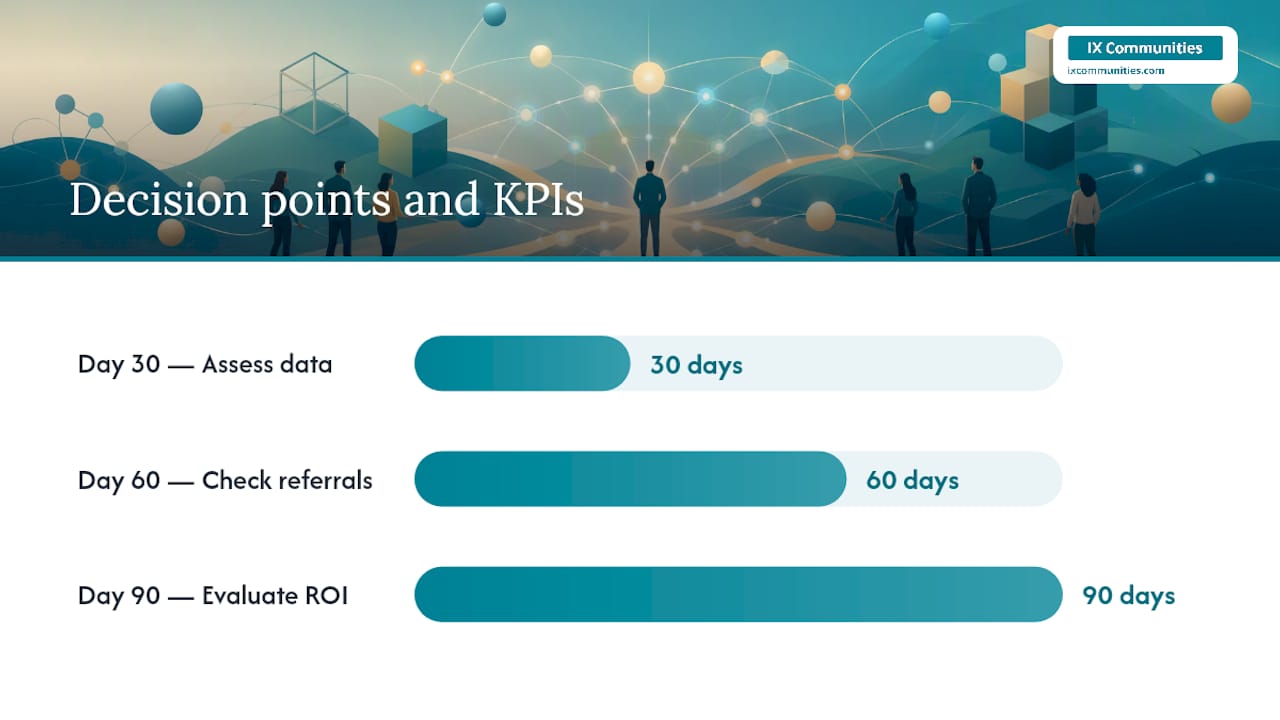
Decision points fall naturally at day 30 (is the data useful?), day 60 (are referrals converting?), and day 90 (does the ROI justify expanding membership beyond the pilot cohort?).
How IX Communities Maps to the Evaluation Checklist
Run IX Communities through the seven-point checklist above and the fit becomes concrete rather than promotional. On membership mix, ESIX and TLIX are structured as focused groups so talent leaders compare against organizations with genuinely similar scale and complexity, not a generic industry-wide average.
On benchmarking rigor, benchmark surveys produce recurring reports built from member submissions rather than one-off vendor studies. On confidentiality, ESIX and TLIX operate as secure, invitation-based groups designed specifically so members can discuss active searches and sensitive hiring data without exposing it to competitors.
Mentorship is not an afterthought bolted onto a forum. IX Communities runs dedicated peer mentorship programs pairing senior talent leaders with counterparts navigating similar org challenges. Member-facing content, including guides on talent communities and diversity recruiting outcomes, gives members practical frameworks between live sessions rather than just data.
The member benefits that matter most to senior leaders:
- Recurring benchmark reports segmented by company size and industry.
- Secure forums for candidate-sharing and confidential search discussion.
- Structured mentorship pairing, not a self-serve directory.
- Expert-led sessions and a proprietary search consultant database.
Member testimonials describe the value of having a confidential peer group to test hiring decisions against before committing budget or headcount, rather than guessing based on internal data alone.
Real member testimonials back this pattern across the membership base, reinforcing that the checklist isn't theoretical. It reflects how the community actually operates day to day.
A talent leader's take on community resourcing
Community resourcing works because it replaces guesswork with comparison data you can actually act on. When our team saw time-to-fill for a director-level role stall past 90 days, a peer benchmark from our group showed we were the outlier on interview panel size, not compensation. Cutting one round closed the gap in three weeks.
Ready to Put Community Resourcing to Work?
The gap between reading about peer benchmarking and actually running it comes down to one decision: joining a group with real rigor behind its data. Ixcommunities is built specifically for that gap, giving mid-to-large talent teams the benchmark reports, secure forums, and mentorship structure this article has walked through, without the trial-and-error of building comparison data internally.
Three ways to start:
- Request a sample benchmark report through Benchmark Surveys to see the data quality before committing.
- Explore joining a focused pilot group like ESIX's mentorship programs if executive-level peer matching is your priority.
- Review full membership details and schedule a conversation about which group, ESIX or TLIX, fits your organization's scale.
Frequently Asked Questions
What is community resourcing in recruiting? Community resourcing is the practice of using peer networking and benchmarking communities to source, share, and allocate recruiting resources, candidates, and best practices across talent teams at different companies.
How is community resourcing different from general networking? General networking is informal and social. Community resourcing is operational: it produces structured benchmark reports, secure candidate-sharing protocols, and tracked referral exchanges you can measure against your own KPIs.
What metrics should we track after joining a peer community? Track time-to-fill, cost-per-hire, source-to-hire conversion, and pipeline diversity before and during your pilot to measure whether the community is moving the numbers that matter.
Is community resourcing only for large enterprises? It works best for mid-to-large organizations with enough hiring volume to benefit from comparison data, though the exact threshold depends on how many roles and how much recruiting complexity your team manages.
How long does it take to see results from community resourcing? Most pilots show early signal within 60 to 90 days, particularly on referral conversion and benchmark-driven process changes, though full ROI typically becomes clear over two or more quarters.
Sources
- Recruiting Operations Benchmarks | 2026 Talent Trends Report — Ashby
- Why smart companies are adding TikTok to their hiring playbook — Inc.
- How to Benchmark Your Hiring - Cadient Talent Guide
- Recruitment Benchmarks Every Recruiter Should Track — Manatal