

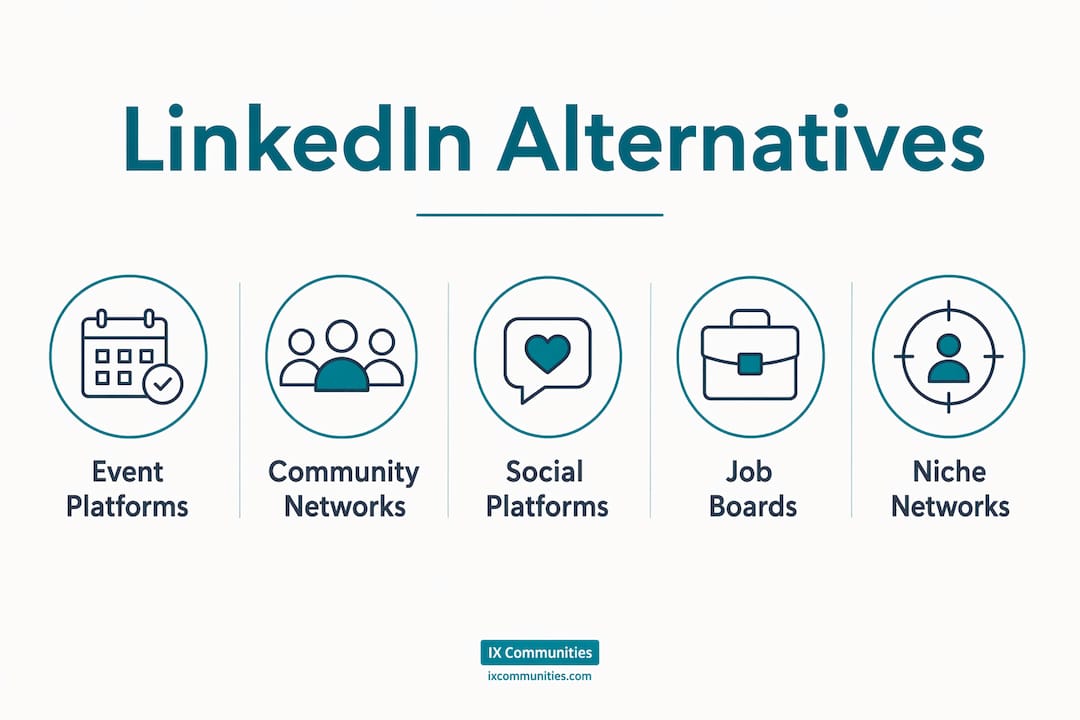
The strongest LinkedIn alternatives for US professionals in 2026 fall into five clear categories, each serving a distinct professional need. Whether you are a recruiter managing high-volume hiring, a creative building a portfolio, or a developer who prefers proof-of-work over a polished profile, a purpose-built platform exists for your goals. LinkedIn alternatives divide into three primary groups: job boards, niche communities, and freelance marketplaces, though event platforms and social networks round out the full picture.
Here is a quick orientation by category:
- Event and in-person networking: MeetUp, Eventbrite — best for local relationship-building and face-to-face professional gatherings
- Community and group-based networking: Slack Communities, Discord, Facebook Groups, The Dots, Goodwall, Epiloge, Letslunch — best for niche interest groups and ongoing professional conversation
- Open and social networking: X (formerly Twitter), Reddit, Xing — best for public idea exchange, thought leadership, and regional networking
- Job boards and recruiting marketplaces: Indeed, Glassdoor, Monster, ZipRecruiter, Jobcase, Wellfound, Dice, Upwork, Twine, Opportunity, Gust, ZipRecruiter — best for high-volume hiring, AI-assisted matching, and freelance project work
- Niche profession-specific networks: GitHub, Behance, AngelList, ResearchGate, Zerply, Twine — best for portfolio visibility, startup ecosystems, and academic collaboration
Pricing across these platforms ranges from fully free (Discord, Reddit, GitHub) to subscription-based tiers (Dice, Upwork, ZipRecruiter). Most offer a functional free tier, which directly addresses one of the most common frustrations with LinkedIn's paid recruiter tools.
Event and in-person networking platforms
Face-to-face professional contact builds trust faster than any digital feed. Two platforms dominate this category for US professionals.
MeetUp centers on local, in-person gatherings organized around shared professional interests. It gives recruiters and professionals a way to find niche or location-specific groups where talent discovery happens naturally. A hiring manager looking for UX designers in Austin or a data scientist seeking a local analytics community can find active groups within minutes. MeetUp's free tier covers basic group membership; organizers pay a subscription to host groups.
- Ideal for: local relationship-building, community-led hiring, industry meetups
- Mobile app: available on iOS and Android
- Pricing: free to join; organizer plans are paid
- Geographic reach: strong US coverage with active groups in most major cities
Eventbrite operates at larger scale. It lists over 4.7 million curated events across 180 countries, making it a practical tool for recruiters who want to attend professional conferences, industry panels, or networking mixers where candidates self-select by showing up. Unlike MeetUp's community-first model, Eventbrite functions primarily as an event discovery and ticketing platform. Recruiters use it to identify relevant events rather than to build ongoing groups.
- Ideal for: large-scale professional events, conference networking, industry panels
- Mobile app: available on iOS and Android
- Pricing: free for free events; paid events carry ticketing fees
- Geographic reach: global, with strong US event volume
Both platforms fill a gap that purely digital networks cannot. When you meet a candidate or peer in person, the professional relationship tends to be more durable.
Community and group-based networking platforms
Niche community-based networking often produces stronger professional relationships than LinkedIn's broadcast-style feed. These platforms work because members share a specific interest or professional identity, which lowers the barrier to genuine conversation.
Slack Communities started as an internal messaging tool but has been widely adopted for professional networking. Communities exist for startup founders, UX designers, data analysts, and dozens of other specializations. For example, data professionals can join Measure or LocallyOptimistic, both active Slack communities focused on analytics practice. Slack and Discord both host vibrant niche professional groups that function as ongoing professional development spaces.
Discord extends this model with voice and video channels, making it useful for communities that want real-time discussion rather than asynchronous threads. Most professional Discord servers are free to join, and the platform's channel structure keeps conversations organized by topic.
- Facebook Groups remain widely used for informal professional networking. Searching by keyword and filtering by location surfaces active groups across nearly every industry. The platform's broad user base means groups exist for almost any professional niche, though the signal-to-noise ratio varies.
- The Dots positions itself as a professional network specifically for creatives and freelancers, with a community focus and project showcasing built in. TechCrunch noted its creative professional focus when it raised funding to build this niche.
- Goodwall targets students and early-career professionals, offering skill showcasing and mentorship connections. It suits recruiters sourcing entry-level talent or recent graduates.
- Letslunch simplifies one-on-one professional meeting scheduling, making it useful for professionals who want structured networking conversations rather than group discussions.
- Epiloge offers a professional profile and community space, though its public profile and feature set are not as extensively documented as the other platforms in this category.
For recruiters, the practical advantage of these platforms is cost. Most are free or low-cost, which directly addresses the high expense of LinkedIn's paid recruiting tiers.
Open and social networking platforms that serve professionals
Large social platforms carry professional networking potential that many recruiters and professionals underuse.

X (formerly Twitter) reaches 586 million estimated monthly active users as of late 2025, making it one of the largest public professional forums available. Tech professionals, digital marketers, and founders use X to share work, build public credibility, and connect with peers outside their immediate networks. The platform is free, fully public, and accessible on mobile. Its real-time nature suits professionals who want to stay current on industry conversations rather than maintain a static profile.
Reddit hosts hundreds of professional communities organized by topic. Subreddits like r/SEO, r/MachineLearning, and r/recruiting function as open forums where professionals ask questions, share resources, and occasionally surface job opportunities. All communities are free to join. Reddit's anonymity also makes it a space where professionals discuss topics they might avoid on LinkedIn, including honest assessments of employers and compensation.
Xing serves a different geographic segment. It is the dominant professional network in German-speaking markets (Germany, Austria, Switzerland), with job listings and professional tools built for that region. For US professionals with DACH market responsibilities or international recruiting needs, Xing offers access to a professional audience that is largely absent from LinkedIn's US-centric feed.
Key characteristics across this category:
- Pricing: free on all three platforms
- Mobile: all three have fully functional mobile apps
- Privacy: X and Reddit are largely public; Xing offers more profile control
- Primary audience: tech professionals and marketers (X), topic-driven communities (Reddit), DACH-region professionals (Xing)
Job boards and recruiting marketplaces
For volume hiring and candidate sourcing, dedicated job boards and freelance marketplaces outperform LinkedIn on both cost and reach. LinkedIn Recruiter's high costs and paywalls reduce ROI for many recruiting teams, and the platforms below offer concrete alternatives.
The table below maps each platform to its primary use case, audience, and pricing model.
| Platform | Best for | Type of networking | Primary audience | Pricing model |
|---|---|---|---|---|
| Indeed | High-volume inbound recruiting | Job board | Broad job seekers and employers | Free to post; paid promotion |
| Glassdoor | Employer branding and job search | Job board + reviews | Job seekers and HR teams | Free tier; paid employer tools |
| Monster | General job search and recruiting | Job board | Broad job seekers and employers | Paid plans |
| ZipRecruiter | AI-assisted broad job distribution | Job board | Employers and job seekers | Paid subscription |
| Jobcase | Community-supported job search | Community job board | Hourly and blue-collar workers | Free |
| Wellfound | Startup and tech hiring | Startup job board | Tech professionals and founders | Free tier available |
| Dice | Tech and IT recruiting | Niche job board | Technology professionals | Paid plans |
| Upwork | Freelance and contract hiring | Freelance marketplace | Freelancers and employers | Service fee model |
| Twine | Creative and tech freelance projects | Freelance marketplace | Creative and tech freelancers | Free post + service fee; managed subscription |
| Opportunity | Business development networking | Networking platform | Sales and BD professionals | Freemium |
| Gust | Startup funding and talent | Startup network | Founders and investors | Freemium |
| ZipRecruiter | Multi-site job distribution | Job board | Employers | Paid subscription |
Indeed stands out on scale. With over 600 million job seeker profiles, it holds a candidate pool that rivals LinkedIn's. Recruiters can post jobs for free and pay to promote listings for greater visibility. The trade-off is that high volume means more screening work on the recruiter's side.
ZipRecruiter takes a different approach by distributing job postings across partner sites automatically, using AI matching to surface strong candidates. Recruiters who want broad reach without manually posting to multiple boards find this model efficient, though the candidate quality varies by role and market.
Glassdoor serves a dual function. Job seekers use it to research employers through anonymous reviews, and HR teams use it to manage employer branding and post listings. For recruiters, maintaining an active Glassdoor presence can improve candidate conversion on job postings.
Wellfound (formerly AngelList Talent) focuses on the startup and tech market. It offers a free tier for startups, which makes it accessible for early-stage companies that cannot afford LinkedIn Recruiter seats.
Dice targets technology and IT professionals specifically. Its candidate pool is narrower than Indeed's but more relevant for technical roles, which reduces screening time.
Upwork provides access to a large global freelancer pool for contract and project-based work. The platform includes project management tools, though its service fees and variable candidate quality require a clear vetting process before committing to a hire.
Twine offers more flexibility on pricing: employers can post a job for free and pay a service fee on freelancer payments, or opt for a managed per-project subscription. It suits creative and tech project hiring where scope is well-defined.
Jobcase combines job listings with peer support and career advice, making it particularly useful for recruiting hourly and blue-collar workers who benefit from community context alongside job search tools.
Pro Tip: Before posting on a broad job board like Indeed or ZipRecruiter, define your screening criteria precisely. High-volume platforms surface many applicants quickly, and without a clear filter, the time saved on sourcing gets spent on manual review instead.
Niche profession-specific networks
Proof-of-work platforms give recruiters a direct view of what candidates have actually built, written, or shipped. Recruiters use these platforms to find quality candidates while avoiding LinkedIn's crowded pools and costly recruiter tiers.
GitHub is the standard portfolio platform for software developers. Recruiters can search by programming language, location, and contribution history, evaluating candidates on real code rather than self-reported skills. It is free to use and hosts millions of active developers worldwide.

Behance serves the same function for creative professionals. Designers, illustrators, photographers, and editors maintain visual portfolios that show finished work rather than job titles. Recruiters can filter by skill and location, and the platform's integration with Adobe tools keeps it current with professional creative workflows.
AngelList (now operating as Wellfound for talent, with AngelList focused on startup investing) connects founders, investors, and early-stage professionals. With over 13,000 active startups on the platform, it functions as a hub for tech, marketing, and entrepreneurial professionals who want exposure to the startup ecosystem specifically.
ResearchGate serves academics and researchers. Members share publications, follow citation networks, and connect with peers working on related topics. For recruiters in biotech, pharmaceuticals, or research-intensive industries, ResearchGate surfaces candidates whose work is publicly documented and peer-reviewed.
Zerply focuses on media and creative portfolio representation, with an emphasis on entertainment and production industry professionals. It suits recruiters hiring for film, animation, and related creative fields.
Additional platforms worth noting in this category:
- Twine (also listed under job boards) functions as a niche marketplace for creative and tech freelance projects, with portfolio elements built into freelancer profiles
- Goodwall targets students and early-career professionals seeking mentorship and skill recognition, useful for campus recruiting and early-career pipeline building
- Epiloge offers professional profiles with a community component, though its feature set is less publicly detailed than the others in this group
The common thread across all these platforms is that they surface professional identity through demonstrated work rather than self-description. For talent acquisition teams evaluating technical or creative candidates, that distinction reduces the gap between a candidate's profile and their actual capabilities.
How to choose the right LinkedIn alternative for your goals
The right platform depends on what you are trying to accomplish, not on which platform has the most users. A recruiter filling a senior software engineering role has different needs than a freelance designer building a client base or a startup founder seeking co-investors.
Start with platform purpose. Each category covered above serves a distinct function. Event platforms build local relationships. Community platforms sustain ongoing professional conversation. Job boards generate candidate volume. Niche platforms surface proof-of-work. Matching the platform to your specific goal is the first filter.
Align with your audience. A platform with millions of users is only useful if your target professionals are active there. Dice's smaller pool is more relevant for a tech recruiter than Indeed's larger but broader one. ResearchGate reaches academics who rarely appear on general job boards. Selecting targeted platforms aligns better with authentic networking goals than spreading activity across every available option.
Evaluate the cost model honestly. LinkedIn Recruiter's pricing creates real budget pressure for many recruiting teams, and several alternatives offer comparable reach at lower cost. Indeed's free posting tier, GitHub's open access, and Wellfound's free startup tier all provide meaningful recruiting capability without a subscription commitment.
Consider privacy and data practices. Platforms vary significantly in how they handle member data. Discord and Reddit offer more anonymity than LinkedIn or Xing. GitHub profiles are public by default. Behance portfolios are publicly viewable. For candidates who are not actively job-seeking, platforms with lower public visibility may produce less engagement.
Check mobile experience. Most professionals access networking platforms on mobile. MeetUp, Eventbrite, Indeed, ZipRecruiter, and Glassdoor all have well-regarded mobile apps. Discord and Slack Communities are mobile-first by design. Platforms with poor mobile experiences tend to see lower engagement from candidates who are passively browsing.
Go deep rather than wide. Professionals gain more value by focusing on one or two platforms tailored to their career than by maintaining a thin presence across many. A developer active on GitHub with a well-maintained repository history will attract more relevant recruiter attention than one with profiles on six platforms and nothing distinctive on any of them.
Practical selection criteria at a glance:
- Platform purpose: event, community, job board, or portfolio
- Audience fit: does your target professional use this platform actively?
- Cost model: free, freemium, or subscription, and what does the paid tier actually unlock?
- Privacy controls: public, semi-public, or member-only visibility
- Mobile access: is the mobile experience functional for your use case?
- Integration: does the platform connect with your ATS, CRM, or other recruiting tools?
Pro Tip: For recruiters evaluating proof-of-work platforms like GitHub or Behance, search by specific skills or project types rather than job titles. Candidates who have not updated their job title in months may still have recent, relevant work visible in their portfolio or repository activity.
Key Takeaways
The most effective approach to replacing or supplementing LinkedIn is to match the platform category to your specific professional goal rather than defaulting to the largest available network.
| Point | Details |
|---|---|
| Category match matters most | Choose by platform purpose: event, community, job board, or portfolio, not by user count alone. |
| Cost alternatives exist | Indeed, GitHub, Wellfound, and Discord offer free or low-cost access compared to LinkedIn Recruiter's paid tiers. |
| Proof-of-work platforms reduce screening time | GitHub and Behance let recruiters evaluate real contributions, cutting the gap between profile and actual skill. |
| Focus beats breadth | Professionals active on one or two targeted platforms build stronger professional identities than those spread thin across many. |
| Ixcommunities serves a different need | For corporate talent leaders seeking peer benchmarking and secure knowledge-sharing, Ixcommunities offers a structured alternative to public networking platforms. |
Ixcommunities: a peer network built for corporate talent leaders
The platforms covered in this article serve individual professionals and general recruiting teams well. Ixcommunities addresses a different need: large corporate talent acquisition and HR leadership teams that require a secure, structured environment for peer benchmarking, knowledge exchange, and professional development.
Through ESIX, TLIX, and IXCommunities, Ixcommunities brings together talent leadership professionals from major organizations to share recruiting data, compare practices, and learn from peers facing the same challenges. This is not a job board or a public social network. It is a closed, vetted community where senior TA leaders can discuss hiring challenges candidly, access benchmark surveys, and connect with guest speakers from across the industry.
For recruiting professionals who have found value in the platforms listed above but need a more structured peer learning environment, Ixcommunities membership offers a complementary layer. The ESIX Recruiter Peer Mentorship Programs are particularly relevant for senior recruiters and TA directors who want structured peer support alongside their broader professional networking activity.