

The five DEI priorities to start this week: set representation targets by level, run a pay-equity audit, pilot skills-first hiring in at least one role, formally resource your ERGs, and complete a basic accessibility review of your digital tools and physical spaces. Each of these can be assigned to an owner and tracked within 30 days.
One-line implementation checklist: HR assigns an owner to each priority by end of week one, sets a 30-day milestone for each, and reports initial findings at the next leadership meeting.
- Representation targets: HR lead sets baseline data and target bands by level. Metric: qualitative representation by demographic group at each job grade.
- Pay-equity audit: Total rewards or compensation team runs a regression analysis by role, level, and tenure. Metric: assessment of pay equity without specifying a numerical gap.
- Skills-first hiring pilot: TA lead selects one open role and removes degree requirements; adds structured, scored interview criteria. Metric: increased diversity in shortlists without specifying a numeric rate.
- ERG resourcing: HR or Chief People Officer allocates a defined budget and an executive sponsor to each active ERG. Metric: ERG participation and program outputs assessed qualitatively without specific counts.
- Accessibility review: Facilities and IT jointly audit physical spaces and digital tools against WCAG 2.1 standards. Metric: identified and remediated accessibility barriers assessed within a short-term period.
SHRM's I&D playbook frames these five areas as the foundation of a legally defensible and measurable inclusion program. The EEOC's ADA guidance makes accessibility non-optional: reasonable accommodations are a baseline legal obligation, not a discretionary benefit.
Key Takeaways
Effective DEI work requires assigning clear owners, fixing hiring and pay processes first, and measuring system-level outcomes rather than training completion rates.
| Point | Details |
|---|---|
| Start with process fixes | Skills-first hiring, standardized interview scoring, and pay-equity audits deliver the most durable early results. |
| Assign named owners | Every DEI priority needs a specific individual accountable, not just a department label. |
| Replace one-off training | Multi-session programs with trained facilitators produce more lasting behavior change than annual workshops. |
| Measure outcomes, not inputs | Track representation by level, pay gaps, and retention by group, not training completion rates. |
| Ixcommunities benchmarking | Peer benchmark surveys and mentorship programs help talent leaders prioritize and calibrate their DEI roadmap against comparable organizations. |
Table of Contents
- What DEI means at work and why it matters for your organization
- How to read and prioritize these tips
- Practical diversity and inclusion tips, organized by theme and owner
- How to implement these tips: a 30/90/365 roadmap
- How to measure DEI progress
- Common pitfalls that derail DEI work
- What the evidence says about effective DEI practices
- A practical checklist you can use this week
- What peer communities reveal about DEI momentum
- Peer benchmarking and templates for DEI leaders
- Sources
What DEI means at work and why it matters for your organization
Diversity, Equity, and Inclusion (DEI) in the workplace refers to three distinct but connected commitments. Diversity is the presence of differences across race, gender, age, disability status, sexual orientation, national origin, and other dimensions. Equity is the practice of adjusting systems and processes so that access and opportunity are fair, not just formally equal. Inclusion is the daily cultural work that makes diverse employees feel respected, heard, and able to contribute fully.
The business case for DEI is grounded in three evidence-backed outcomes.
Talent access. Organizations with credible inclusion practices draw from a wider candidate pool. A systematic review of strategic HR management found that skills-first hiring and standardized objective interview processes directly expand the qualified candidate pipeline, particularly for historically underrepresented groups.
Retention and engagement. Employees who experience inclusion stay longer and perform at higher levels. SHRM's guidance on inclusion frames inclusion as a daily cultural commitment, not a one-time HR program, and recommends integrating it into everyday collaboration to sustain engagement.
Innovation and financial performance. HBR's research on diversity and financial performance shows a positive relationship between diverse teams and financial outcomes when organizations pair diversity with inclusive management practices. The effect is contingent on inclusion: diversity without it tends to produce friction rather than performance gains.
The cost of inaction is concrete. High turnover among underrepresented employees, legal exposure from unaddressed accommodation requests, and reputational damage in competitive talent markets all carry direct financial consequences. CDC data on disability shows that disability affects a large share of the working-age population, which means accessibility gaps alone can exclude a significant portion of potential talent.
How to read and prioritize these tips
This article uses owner tags throughout. Each tip identifies who should take the lead: Leader (C-suite or senior VP), HR (HR business partners, total rewards, or TA), Manager (people managers), Employee (individual contributors), ERG (employee resource group leads), or Vendor (external partners or suppliers).
Prioritization framework: impact vs. effort. Before assigning work, map each tip on a simple two-axis grid. High-impact, low-effort actions (fixing a job posting template, adding structured scoring to interviews) go first. High-impact, high-effort actions (pay-equity remediation, ERG infrastructure) go into the 90-day plan. Low-impact actions go last or get dropped.
Sequencing by organization size:
- Under 500 employees: Focus on hiring process fixes, manager training, and one or two ERGs. Measurement can be lightweight (monthly headcount snapshots).
- 500–5,000 employees: Add pay-equity audits, formal ERG budgets, and quarterly reporting to an executive dashboard.
- Over 5,000 employees: Full representation tracking by level and function, supplier diversity targets, and board-level DEI reporting are realistic and expected.
30/90/365 rule: In the first 30 days, set baselines and assign owners. By 90 days, run the first audits and launch pilots. By 365 days, report on measurable outcomes and adjust the plan based on data.
Practical diversity and inclusion tips, organized by theme and owner
Hiring and talent pipelines
1. Adopt skills-first job postings. (Owner: HR/TA) Remove degree requirements that are not genuinely necessary for the role. Replace them with specific competencies and skills. A diversity hiring checklist from Testask recommends auditing every active job posting for credential inflation before the next hiring cycle opens. Expected metric: increase in applicant pool diversity over subsequent hiring cycles.
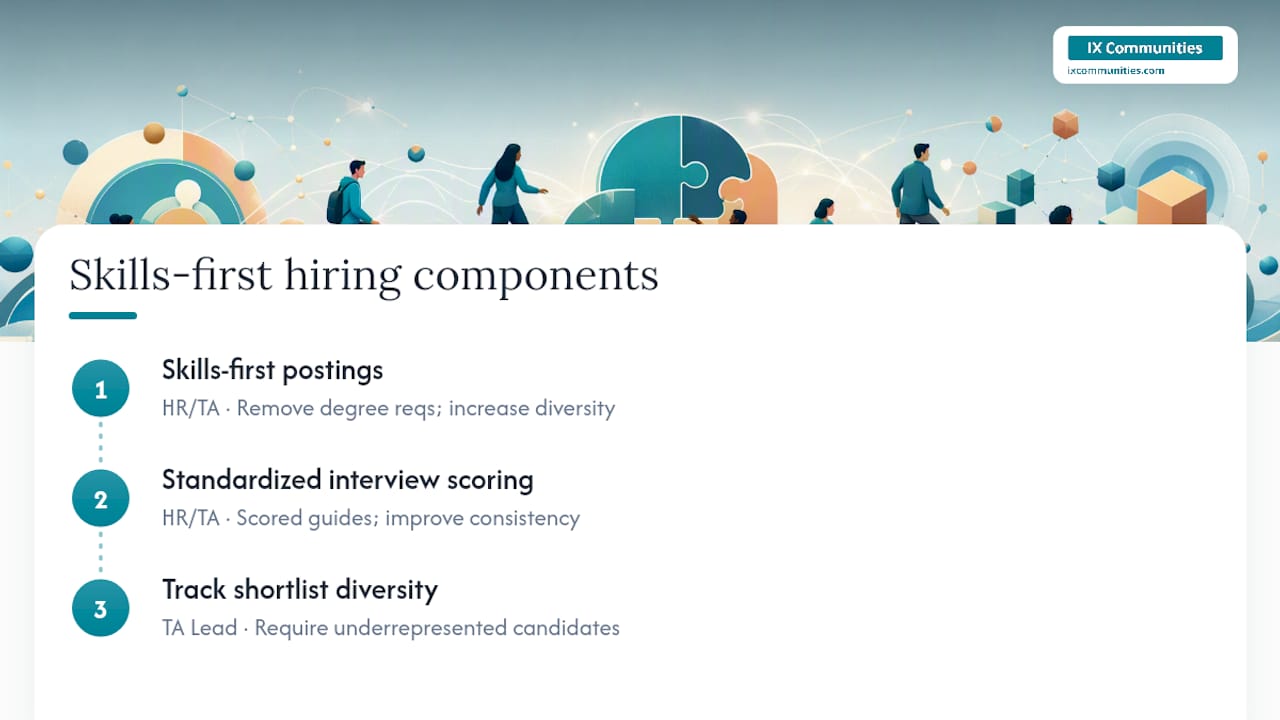
2. Standardize interview scoring. (Owner: HR/TA) Use structured, scored interview guides with pre-defined criteria for every candidate. The systematic review on inclusive talent management identifies standardized objective interviews as one of the most consistent predictors of equitable hiring outcomes. Assign a numerical score to each competency before the debrief conversation begins. Metric: improved consistency in interview scoring across hiring panels.
3. Track shortlist diversity by role. (Owner: TA Lead) Require that every shortlist presented to a hiring manager includes candidates from underrepresented groups. Document shortlist composition and review it monthly. See diversity recruiting examples for documented outcomes from organizations that have formalized this practice.
Onboarding and early experience
4. Build inclusion into onboarding explicitly. (Owner: HR/Manager) Add a structured segment to onboarding that covers ERG access, accommodation request processes, and the organization's DEI commitments. Do not assume new hires will find these resources on their own. Metric: new hires' ERG enrollment monitored early in their tenure.
5. Assign onboarding buddies with inclusion in mind. (Owner: Manager) Pair new hires with a buddy from a different background or function. This practice reduces early attrition among underrepresented employees and accelerates belonging. Track 90-day retention by demographic group to measure impact.
Manager behaviors and inclusive culture
6. Hold managers accountable through scorecards. (Owner: Leader/HR) Include DEI metrics in manager performance reviews: team retention by demographic group, ERG participation rates, and completion of required training. The SHRM I&D playbook recommends linking inclusion to measurable business outcomes and making those outcomes visible in leadership scorecards.

7. Address micro-inequities directly. (Owner: Manager) Micro-inequities are small, often unintentional behaviors that signal exclusion: interrupting one person consistently, attributing an idea to the wrong person, or excluding someone from an informal meeting. Train managers to name these behaviors when they observe them. A useful script: "I want to make sure we heard [Name]'s point fully before we move on." Metric: inclusion survey feedback gathered from teams.
8. Normalize flexible work and accommodation requests. (Owner: Leader/HR) Publicize the accommodation request process at all-hands meetings and in the employee handbook. Under the ADA, employers are required to provide reasonable accommodations unless doing so creates undue hardship. Making the process visible reduces the stigma of requesting support.
Inclusive meetings and communications
9. Set meeting norms that distribute participation. (Owner: Manager) Rotate facilitation, use round-robin check-ins for key agenda items, and circulate materials 24 hours in advance so participants who need more processing time can contribute. Metric: participation equity assessed through team surveys.
10. Include DEI updates in routine communications. (Owner: Leader/HR) Add a standing DEI update to town halls, leadership newsletters, and all-hands agendas. Routine visibility normalizes accountability and reduces the perception that DEI is a separate, performative initiative. The SHRM I&D playbook supports this approach as a way to sustain cultural momentum.
Pay equity
11. Run an annual pay-equity regression analysis. (Owner: Total Rewards/HR) Control for role, level, tenure, and performance rating. Report unexplained gaps to the executive team. Routine equity audits are a recommended practice for detecting and correcting systemic compensation gaps. Metric: pay equity assessed and tracked over time.
Employee resource groups
12. Resource ERGs as strategic partners, not social clubs. (Owner: Leader) Assign each ERG an executive sponsor, a defined annual budget, and a formal channel to surface policy recommendations. Forbes research on fostering inclusive workplaces supports treating ERGs as strategic partners with autonomy to generate authentic insights for product and policy decisions. Metric: count of ERG policy recommendations considered by leadership.
Training design
13. Replace one-off training with multi-session programs. (Owner: HR/L&D) The Devine Lab's annual review of diversity training finds that single-session programs have limited long-term effects. Multi-session designs with reflective exercises, scenario practice, and trained facilitators produce more durable behavior change. Metric: pre/post behavior change scores and 90-day follow-up survey.
Training that incorporates psychological flexibility techniques, such as those drawn from Acceptance and Commitment Therapy (ACT) and Compassion-Focused Therapy (CFT), can reduce stigmatizing reactions and build empathy-driven behavior. Research published in 2024 confirms that these effects depend on participant motivation and repeated exposure, not a single workshop.
Pro Tip: Facilitators should be explicitly trained to manage difficult conversations. Untrained facilitation of sensitive topics can produce backlash that undermines the program's goals.
Accessibility
14. Audit digital tools and physical spaces against WCAG 2.1. (Owner: IT/Facilities) WCAG 2.1 is the standard technical framework for digital accessibility. Apply it to your intranet, job application portal, and any employee-facing software. Physical audits should cover entrances, meeting rooms, and restrooms. Metric: number of barriers identified and closed within 90 days.
Supplier diversity
15. Set a supplier diversity spend target. (Owner: Procurement/Leader) Identify the percentage of addressable spend currently going to certified minority-owned, women-owned, veteran-owned, or disability-owned businesses. Set a target for the next fiscal year and track quarterly. This extends inclusion commitments beyond the organization's own workforce.
How to implement these tips: a 30/90/365 roadmap
The six steps below translate the tips above into a sequenced rollout. Cost buckets are approximate and assume a mid-size U.S. organization (500–5,000 employees).
| Step | Activity | Owner | Time Window | Cost Bucket |
|---|---|---|---|---|
| 1 | Baseline audit: representation, pay, accessibility | HR, Total Rewards, IT | Days 1–30 | Low |
| 2 | Assign owners and set 90-day milestones | Leader, HR | Days 1–30 | Low |
| 3 | Launch skills-first hiring pilot; update job posting templates | TA Lead | Days 15–30 | Low |
| 4 | Resource ERGs; assign executive sponsors and budgets | Leader | Days 30–30 | Medium |
| 5 | Deploy multi-session training program; train facilitators | HR/L&D | Days 60–90 | Medium–High |
| 6 | Report first-cycle metrics to executive team; adjust plan | HR, Leader | Day 90 and Day 365 | Low |
Where to start if resources are limited: Steps 1, 2, and 3 require minimal budget. A baseline audit uses existing HRIS data. Job posting updates cost staff time, not vendor spend. ERG resourcing (Step 4) can begin with a modest budget allocation and an internal executive sponsor rather than an external consultant.
For organizations managing talent acquisition and executive search as separate functions, align both teams on the skills-first pilot before launch. Misalignment between internal TA and external search partners is a common source of inconsistency in shortlist diversity.
Role responsibilities at a glance:
- C-suite/Senior Leader: Sets accountability structures, approves budgets, champions DEI in external communications.
- HR/TA: Owns data collection, process design, training deployment, and reporting.
- People Managers: Implements inclusive meeting norms, addresses micro-inequities, completes training.
- ERG Leads: Surfaces employee insights, runs programs, provides policy input.
- IT/Facilities: Executes accessibility audits and remediations.
- Procurement: Tracks and reports supplier diversity spend.
How to measure DEI progress
Measurement is where many DEI programs stall. The metrics below are practical, defensible, and reportable to an executive audience.
Core metrics to track:
- Representation by level and function (broken down by race/ethnicity, gender, disability status where self-ID data permits)
- Hiring funnel conversion rates by demographic group (application to screen, screen to interview, interview to offer, offer to accept)
- Unexplained pay gap percentage (post regression, controlling for role, level, and tenure)
- Voluntary attrition by demographic group
- Employee Net Promoter Score (eNPS) or inclusion index score, segmented by group
- Accommodation requests received, resolved, and average resolution time
- ERG participation rate and program output count
- Accessibility barriers identified vs. closed
Reporting cadence:
- Monthly: Manager-level snapshots covering team retention and ERG participation.
- Quarterly: Executive dashboard covering representation, pay equity, hiring funnel, and eNPS by group.
- Annually: Board-level report covering year-over-year trends, pay-equity audit results, and supplier diversity spend.
A note on self-ID data: Voluntary self-identification rates vary. Report confidence levels alongside the data. Encourage self-ID through transparent communication about how the data is used and protected.
The SHRM I&D playbook recommends linking every metric to a business outcome so that DEI reporting reads as performance data, not compliance reporting.
Common pitfalls that derail DEI work
Treating training as a checkbox. A single annual unconscious bias workshop does not produce lasting behavior change. The Devine Lab review is clear: one-off sessions have limited long-term effects. Replace the annual workshop with a multi-session curriculum tied to manager performance expectations.
No leader accountability. DEI programs without executive ownership stall at the HR level. Stop treating DEI as an HR initiative and start treating it as a business performance metric. Add DEI outcomes to the CEO and CHRO's quarterly business review.
Poor data hygiene. Reporting on representation without controlling for role, level, or tenure produces misleading numbers. Invest in clean HRIS data before publishing metrics. Inaccurate data undermines credibility with skeptical stakeholders.
Tokenism in hiring. Requiring a diverse shortlist without fixing the evaluation process downstream produces diverse candidates who do not advance. Pair shortlist requirements with standardized scoring and structured debriefs.
Over-reliance on ERGs without resourcing them. Asking ERG members to drive cultural change without budget, executive access, or protected time is extractive. Resource ERGs formally or do not expect strategic output from them.
Ignoring accessibility. Digital and physical accessibility gaps exclude employees with disabilities before inclusion work even begins. The EEOC's ADA guidance makes this a legal baseline, not an optional enhancement.
Pro Tip: During budget pressure or leadership transitions, anchor DEI commitments to specific metrics already in the business review cycle. Programs tied to measurable outcomes survive leadership changes better than programs tied to a single champion.
What the evidence says about effective DEI practices
Three research themes stand out from the current literature.
Skills-first hiring and objective processes have the strongest evidence base. The systematic review on strategic HR management consistently identifies standardized interviews, skills-based criteria, and tracked representation targets as the most reliable levers for equitable talent outcomes. These are also among the lowest-cost interventions available.
Diversity training evidence is mixed, but design matters. The Devine Lab's synthesis of the training literature finds that many programs rely on surrogate measures and short formats that do not translate to sustained behavior change. Programs that use theory-grounded methods, multiple sessions, and system-level outcome measures perform better. Intergroup contact theory and perspective-taking exercises show consistent, if modest, effects.
ERGs as strategic partners produce measurable policy impact. When ERGs have formal access to leadership and a defined channel for policy input, they generate insights that HR alone cannot. The key condition is autonomy: ERGs that function as event planners rather than strategic advisors produce limited organizational change.
Three research-backed recommendations for leaders:
- Prioritize process fixes (hiring criteria, interview scoring, pay audits) before cultural programs. Process changes are more durable and less dependent on individual behavior change.
- Design training as a multi-session curriculum with trained facilitators, not a one-time event. Budget for follow-up measurement at 90 days.
- Measure system-level outcomes (representation by level, pay gaps, retention by group) rather than training completion rates or satisfaction scores. Completion is an input; representation change is an outcome.
A practical checklist you can use this week
30/90/365 DEI action checklist
This week (Days 1–7):
- Assign an owner to each of the five priority areas (representation targets, pay equity, skills-first hiring, ERG resourcing, accessibility)
- Pull current representation data from your HRIS by level and function
- Identify one open role for the skills-first hiring pilot
- Schedule a pay-equity regression analysis with Total Rewards
- Book an accessibility walkthrough of your primary office and main digital tools
This quarter (Days 8–90):
- Complete pay-equity audit and present findings to the executive team
- Update all active job postings to remove unnecessary degree requirements
- Assign executive sponsors and budgets to each active ERG
- Launch the first session of a multi-session inclusion training program
- Complete WCAG 2.1 audit of the employee intranet and job application portal
- Set up a quarterly DEI dashboard for the executive team
This year (Days 91–365):
- Report first-year representation trends to the board
- Complete a full pay-equity remediation cycle
- Publish supplier diversity spend data and set targets for the next fiscal year
- Conduct an annual inclusion survey and segment results by demographic group
- Review and update the DEI roadmap based on year-one data
Owner guide: HR owns the checklist and tracks completion. Each line item should have a named individual, not a department, as the responsible party.
Copy-paste templates
Inclusive job posting language: "We welcome applications from candidates of all backgrounds. This role requires [specific competency 1] and [specific competency 2]. A degree is not required. We provide reasonable accommodations throughout the hiring process — contact [email] to request support."
Manager meeting inclusion prompt: "Before we close this agenda item, I want to make sure we've heard from everyone. [Name], did you have anything to add?"
ERG launch email: "We are launching [ERG Name] as a formal employee resource group with an executive sponsor, an annual budget, and a direct channel to share recommendations with HR and leadership. All employees are welcome. Our first meeting is [date] at [time]. Contact [Name] to join or learn more."
What peer communities reveal about DEI momentum
The most consistent pattern observed across talent leadership peer groups is this: organizations that sustain DEI progress over multiple years share one structural feature. They tie inclusion metrics to the same business review cycle as revenue, retention, and hiring velocity. DEI does not compete for attention in those organizations because it is already on the agenda.
A recurring example from peer discussions involves mid-size companies that improved shortlist diversity within 12 months by making two changes: removing degree requirements from a defined set of roles and adding a structured scoring rubric to every interview panel. Neither change required significant budget. Both required clear ownership and consistent follow-through from TA leadership.
The lesson that surfaces repeatedly is about leadership scorecards. When managers know that their team's inclusion index score appears in their annual review, behavior changes. When it does not appear, training alone rarely moves the needle. Peer groups that benchmark talent retention practices consistently report that manager accountability is the single variable most correlated with sustained inclusion improvement.
Peer benchmarking and templates for DEI leaders
Knowing which DEI practices your peers are using, and which metrics they are tracking, is a different kind of resource than a checklist. Ixcommunities provides talent and recruiting leaders with access to benchmark surveys that show how peer organizations are measuring representation, structuring ERGs, and designing training programs. That comparative data helps leaders prioritize the interventions most likely to move the needle in their specific context.
Membership in Ixcommunities also includes access to peer mentorship programs where diversity recruiting and talent acquisition leaders share templates, review each other's processes, and discuss what is actually working. For leaders who want to move faster than a checklist allows, a peer conversation with someone who has already run a skills-first pilot or a pay-equity remediation cycle is a direct shortcut. Review what Ixcommunities membership includes and request access to a sample benchmarking report to see whether the data fits your planning cycle.
Sources
- Annual review: diversity training literature synthesis (Devine Lab)
- EEOC — ADA: Your responsibilities as an employer